


About this worksheet
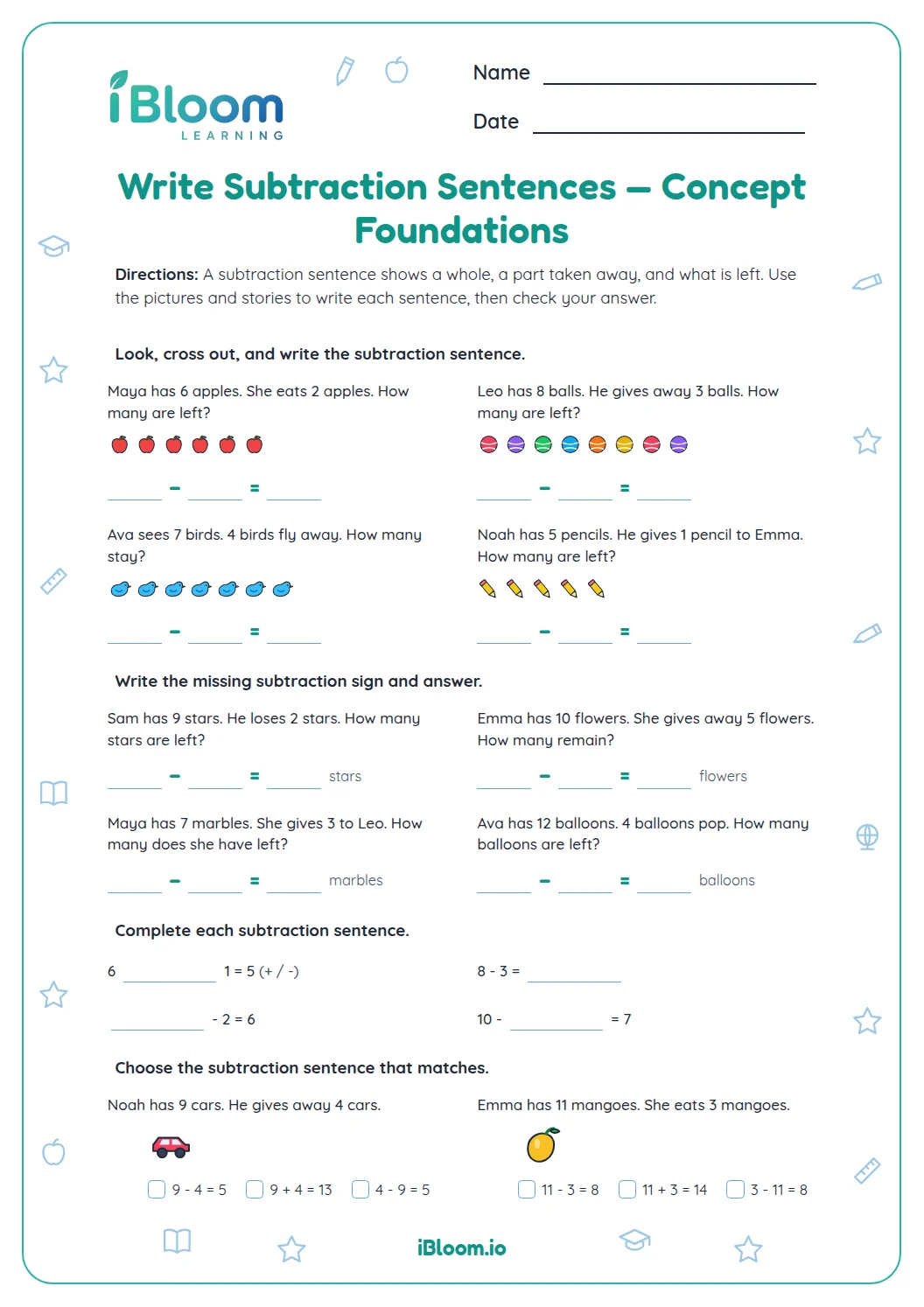
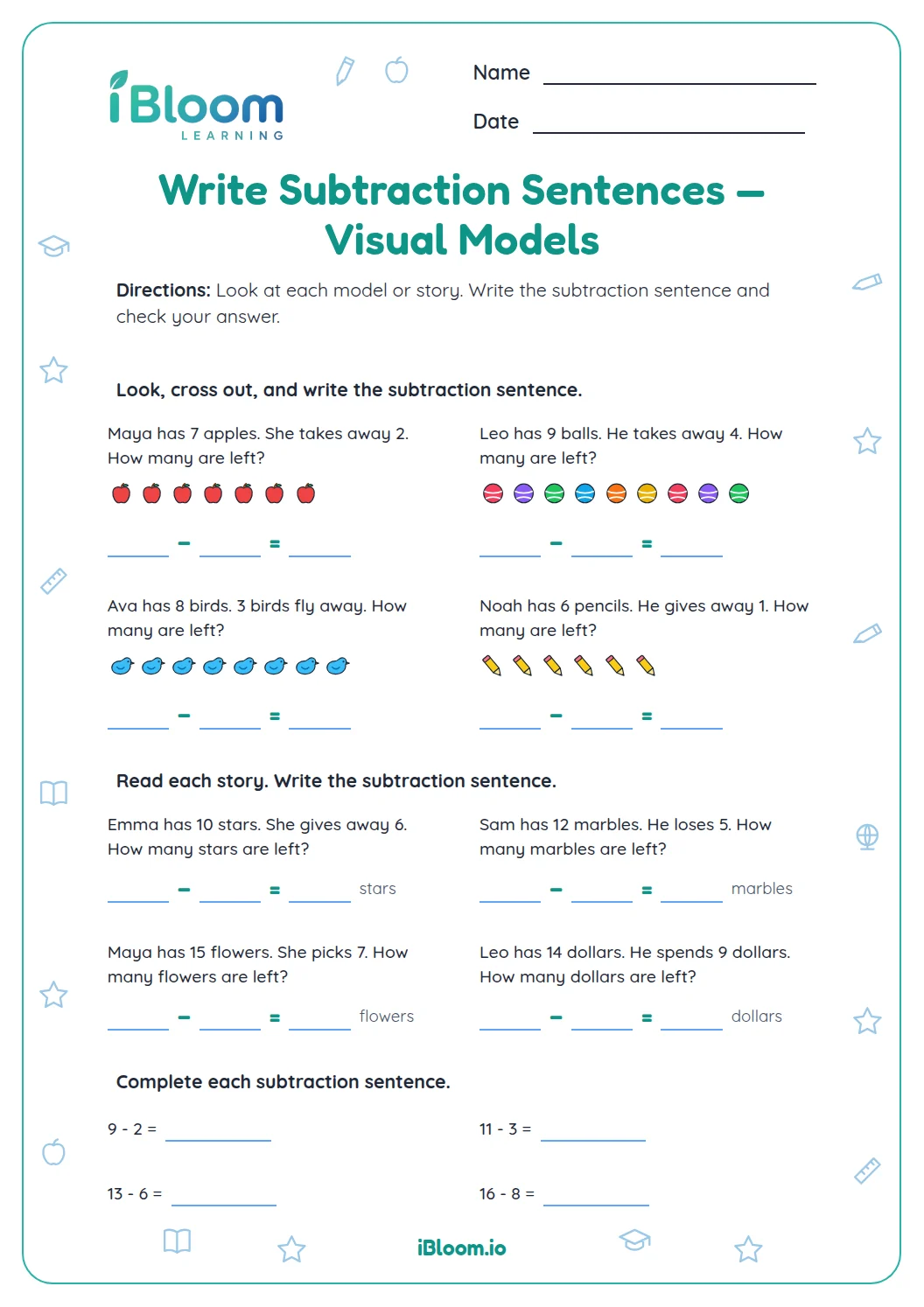
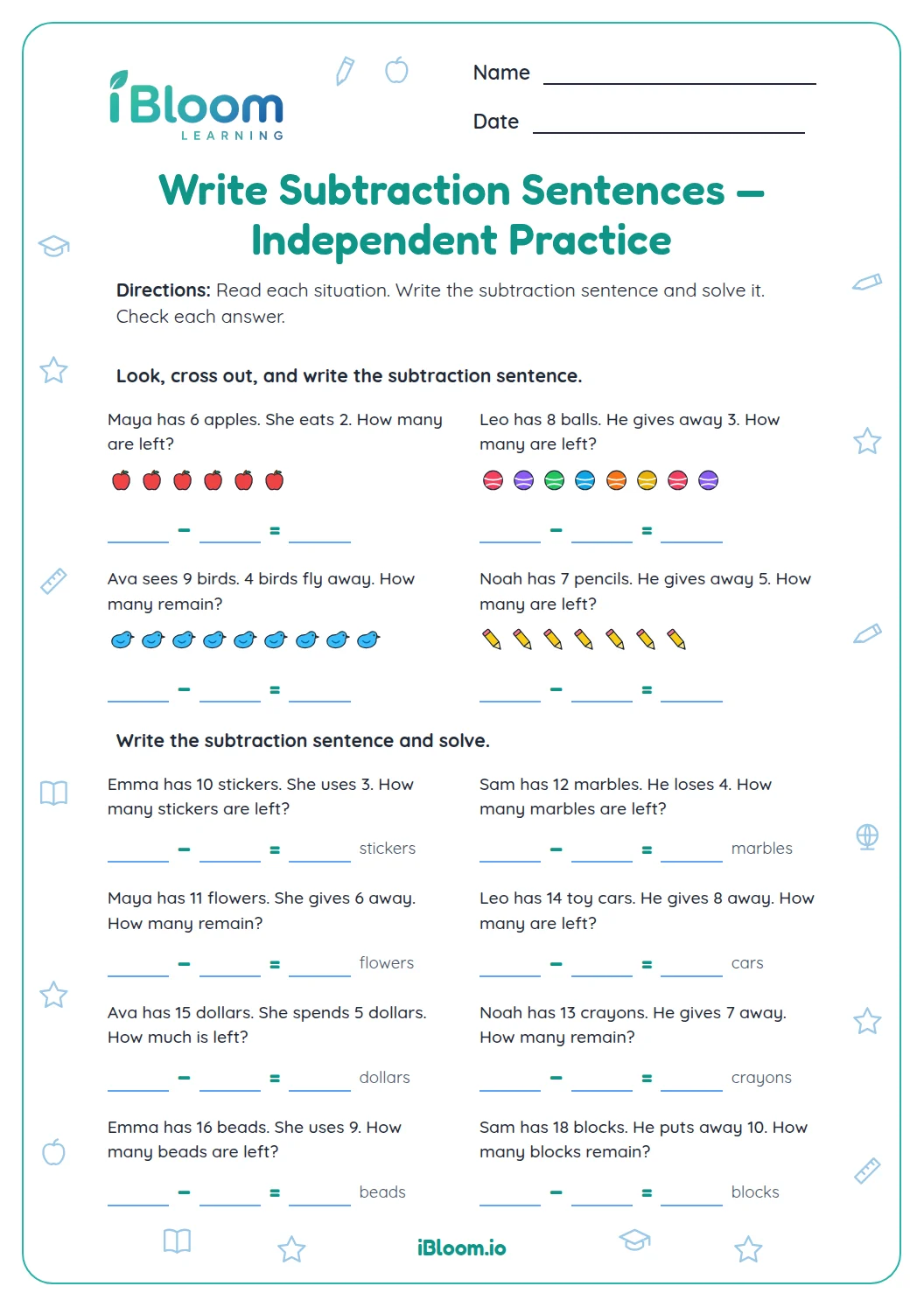
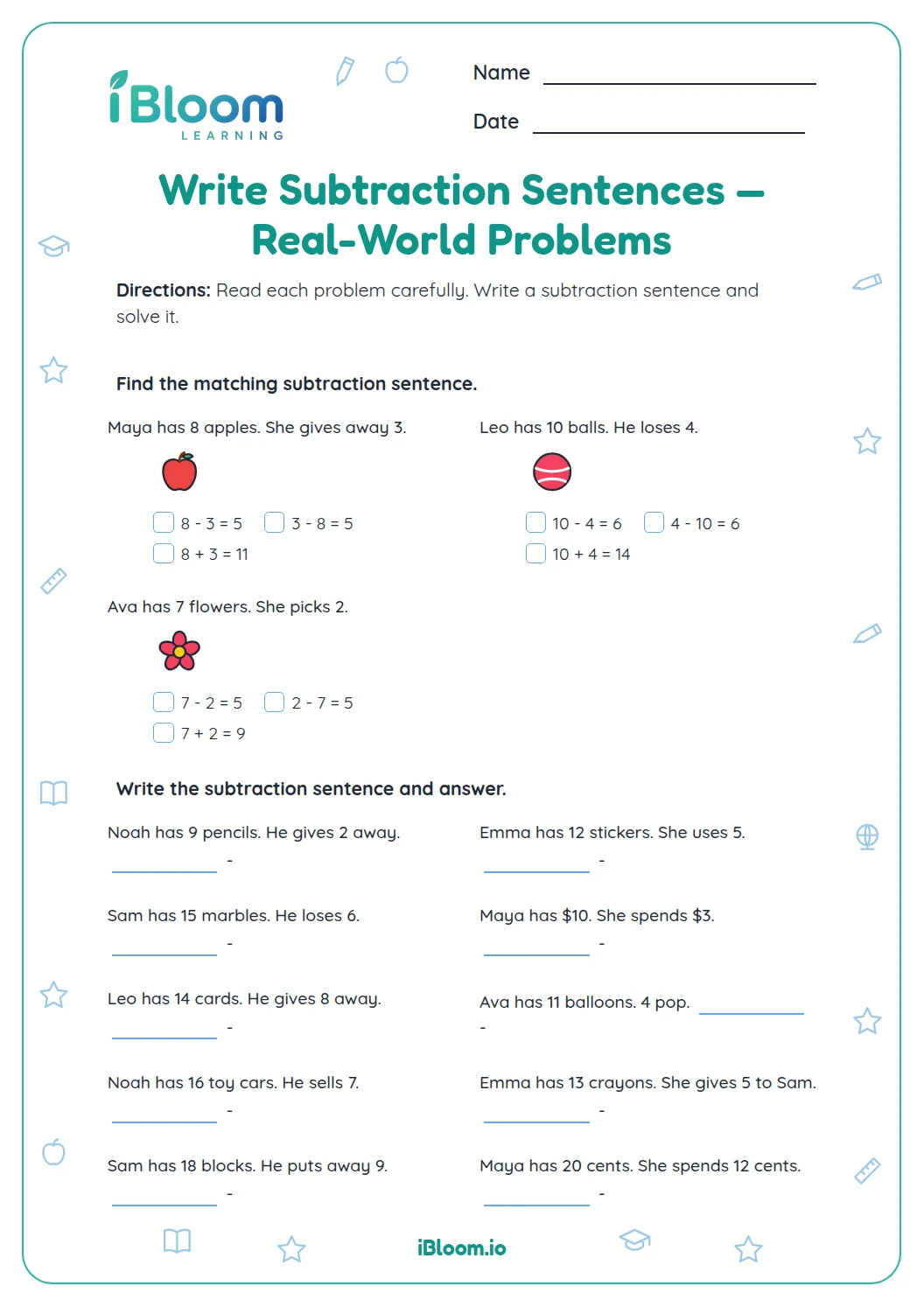
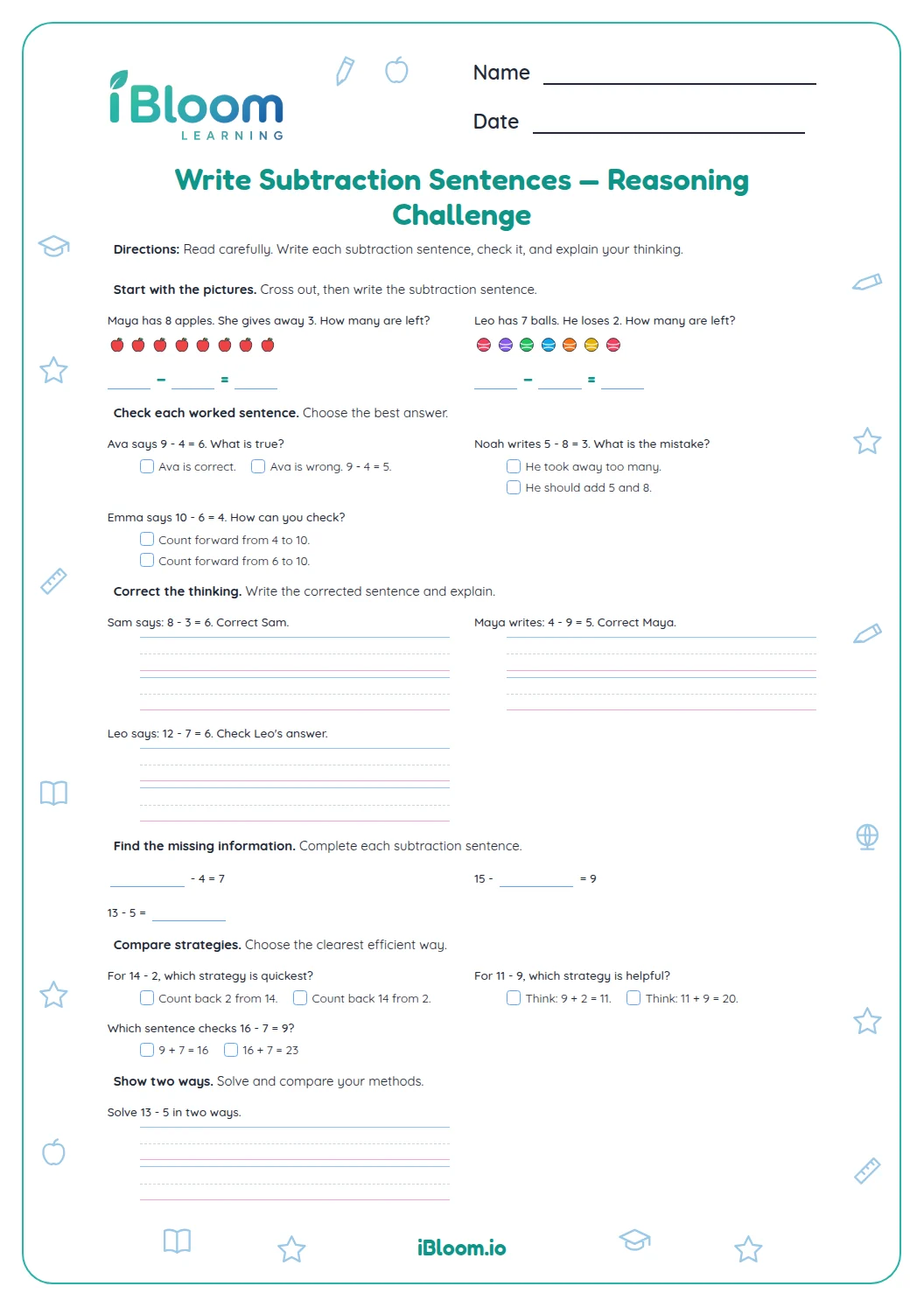
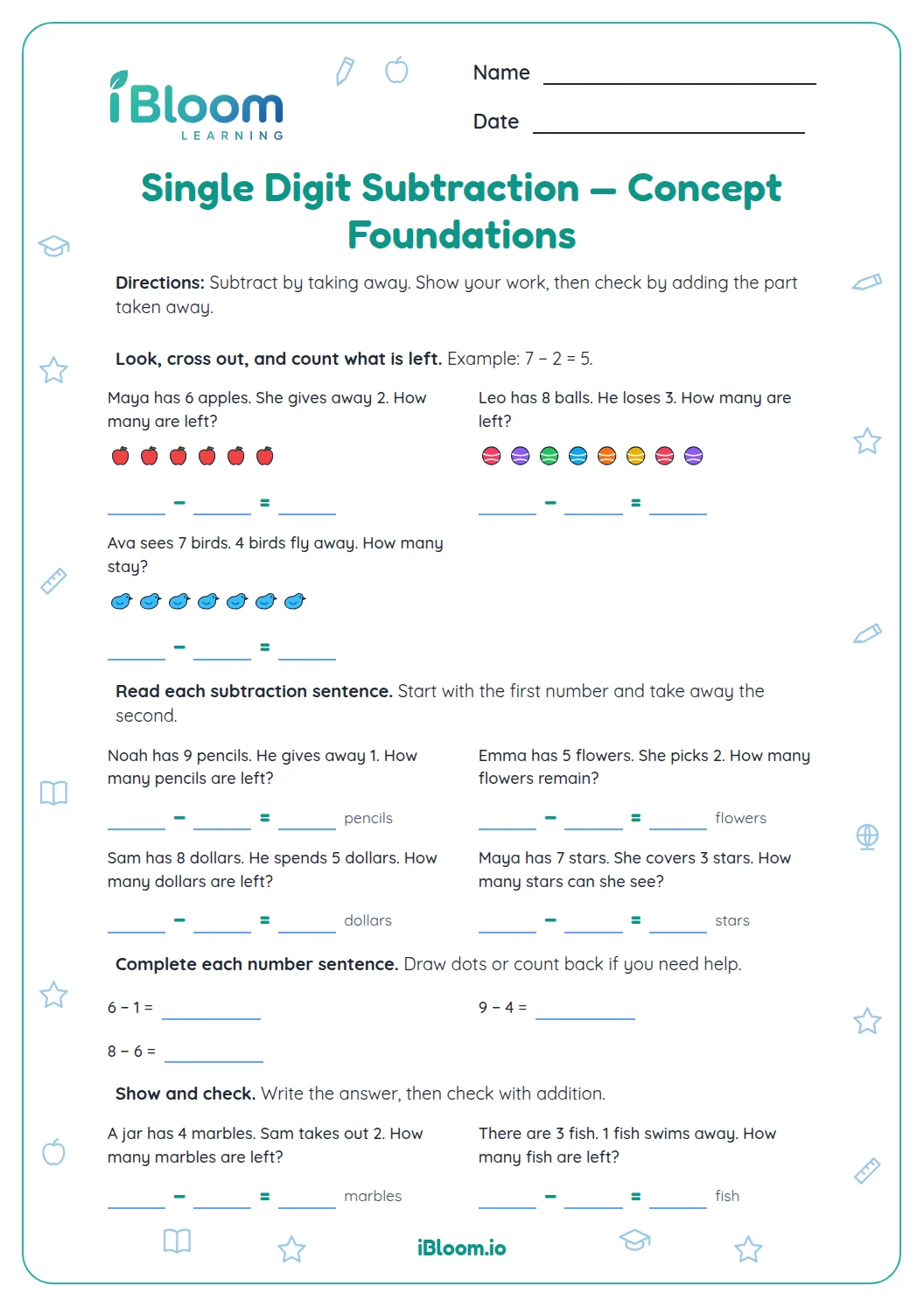
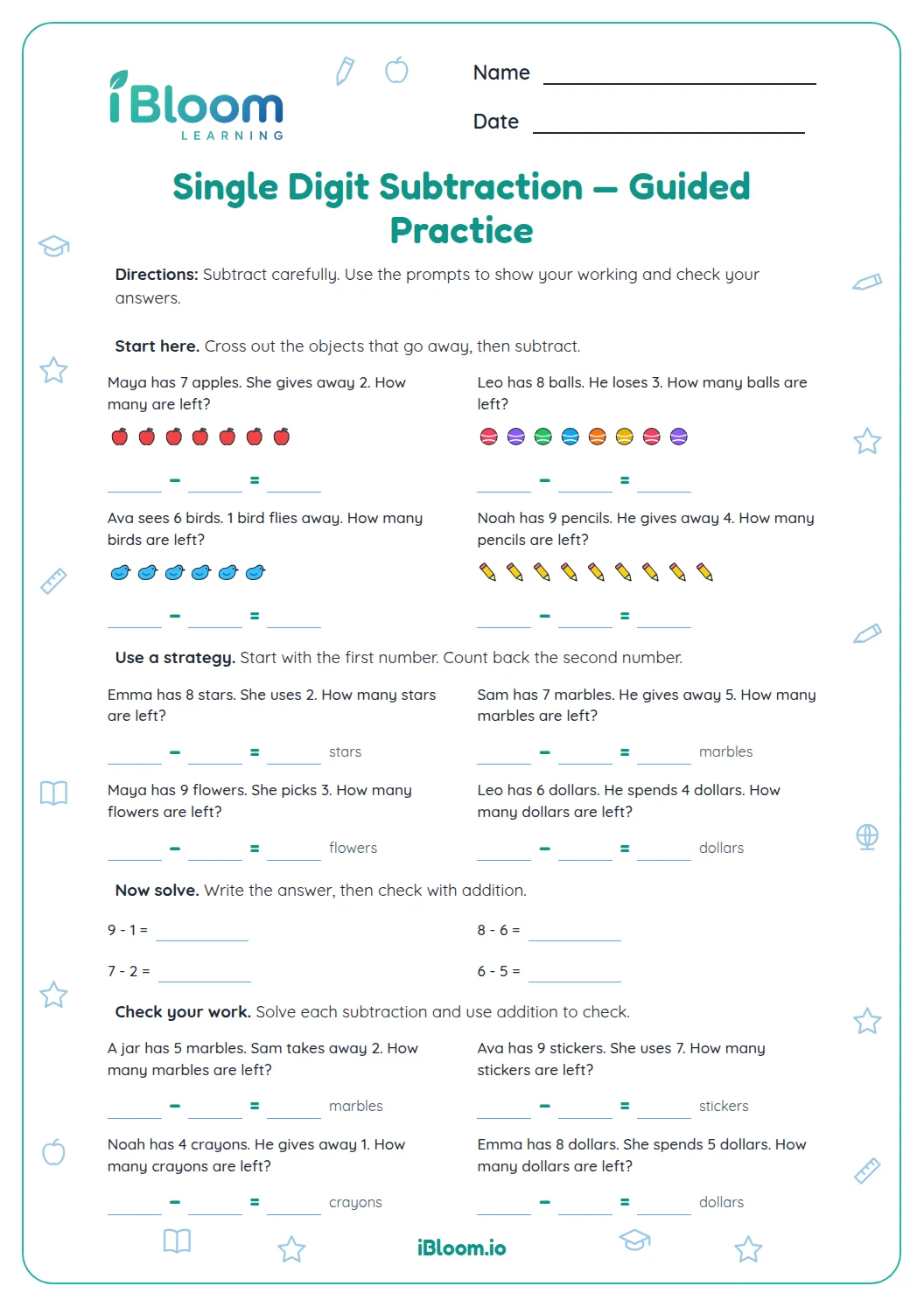
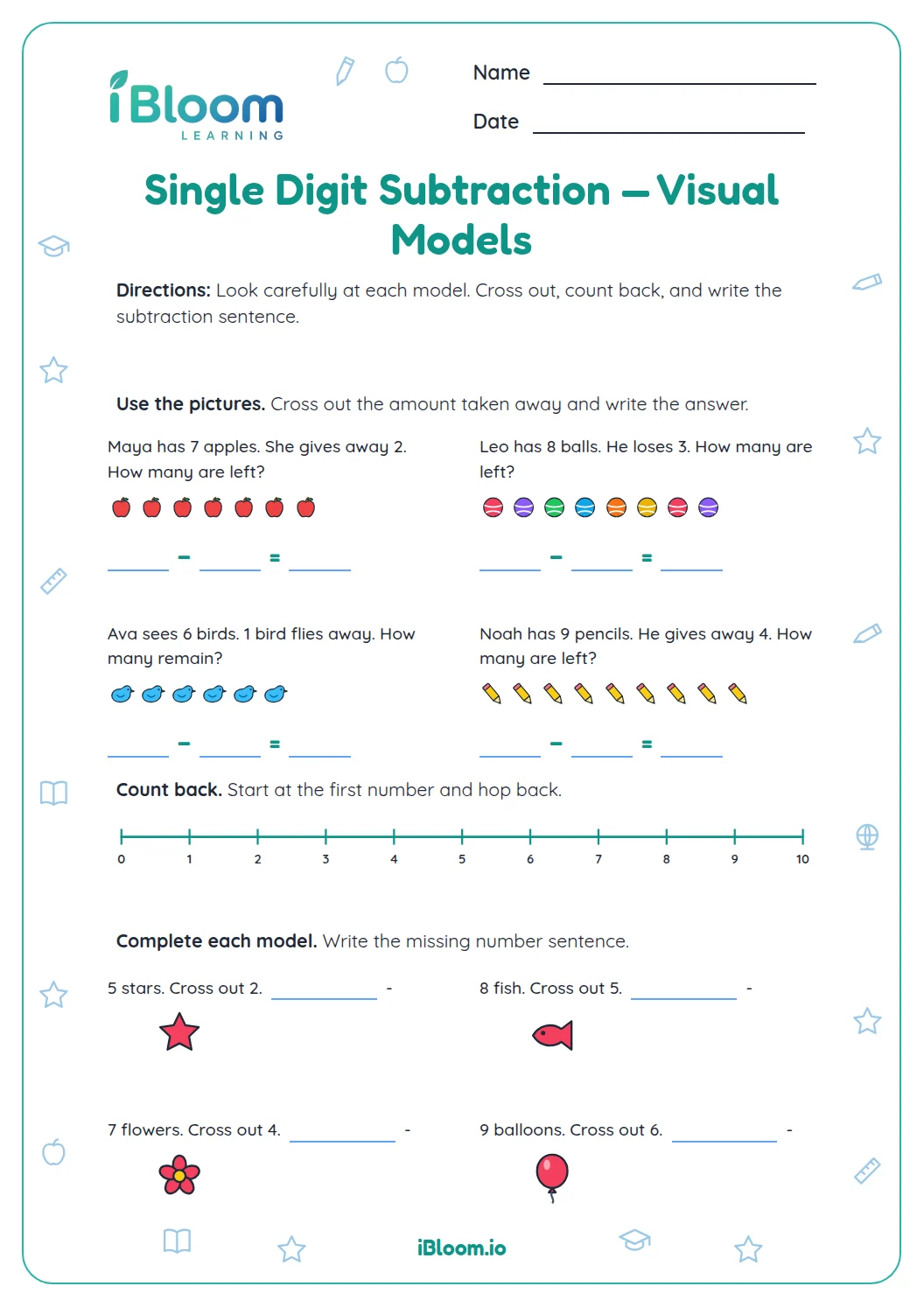
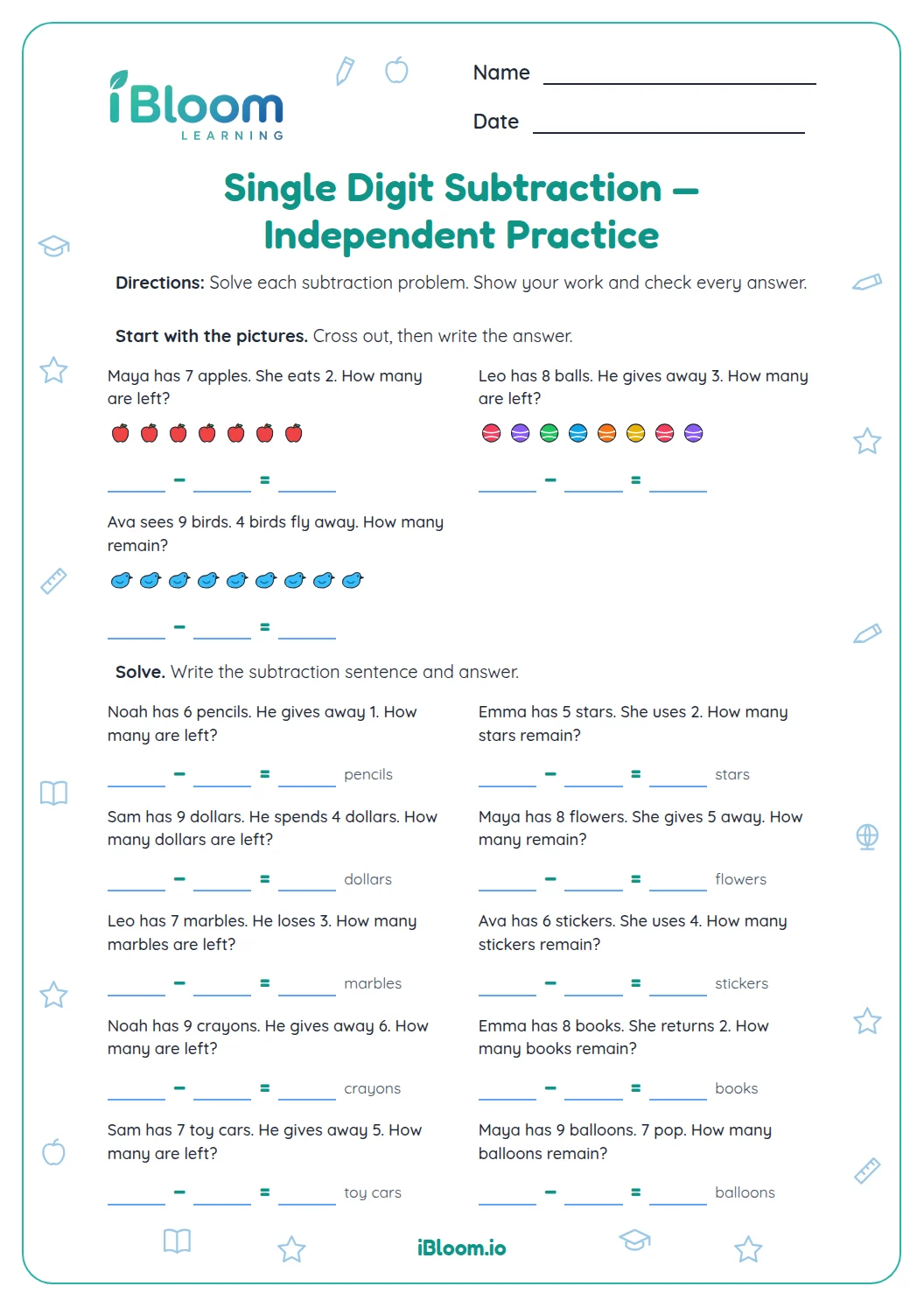
This free Grade 1 worksheet helps children put a taking-away story into a subtraction sentence. Its 12 questions move through three kinds of support: cross out objects and write an equation, fill a missing number, then write an equation from words alone. Stories use familiar objects such as apples, crayons and books, with starting amounts from 4 to 16. The practice supports Common Core 1.OA.A.1 by connecting word problems, pictures and equations. A separate answer key gives each missing number or complete number sentence so adults can check both the computation and the order of the numbers.
Aligned to 1.OA.A.1
Which number comes first in the sentence?
Write the starting amount first. Next write the minus sign and the amount taken away. The equals sign connects that calculation to the amount left. Read the completed sentence back against the story, one number at a time.
- 1Mia has 6 apples and gives away 2.
- 2Start: 6. Taken away: 2. Left: 4.
- 36 − 2 = 4
How does the worksheet reduce the help?
Part A supplies pictures of the starting group. Children cross out the amount taken away and write the equation. Part B supplies an equation with one missing number; the blank moves from the result to the amount taken away and then to the starting amount. Part C asks children to write all three numbers and both signs from words alone.
The changing blank matters. In question 7, 9 − ___ = 5, the story says that 4 leaves blew away. The blank holds 4, even though the result of the subtraction is 5.
How can we check a complete equation?
Ask whether each number has a job in the story. Then add the amount left to the amount taken away to recover the starting amount. For 8 − 3 = 5, the check is 5 + 3 = 8.
Part C includes a story in which all 5 cookies are eaten. Writing 5 − 5 = 0 makes the zero visible and shows that a complete subtraction sentence can describe nothing remaining.
How to use this worksheet
- 1Read the story and identify how many objects there were at the start.
- 2In Part A, cross out the amount taken away and count the pictures still showing.
- 3Write the starting amount, minus the amount taken away, equals the amount left.
- 4Complete Part B by matching each blank to its job in the story.
- 5Write the full equations in Part C. Use counters if a story needs more support.
- 6Check each equation by adding the amount left to the amount taken away.
Mistakes to watch for
The mistake
Writing 2 − 6 = 4 for the apple story.
The fix
Start with the 6 apples Mia had before she gave any away.
The mistake
Putting 5 in the blank in 9 − ___ = 5.
The fix
The blank is the number taken away: 4 leaves blew away, so write 4.
The mistake
Writing only 5 for the story about 8 books and 3 put away.
The fix
Write the complete sentence 8 − 3 = 5, including both signs.
Curriculum alignment
Represent taking-away stories with pictures and subtraction equations.
On this sheet: Children cross out pictured objects, complete missing equation parts, and write subtraction sentences.
Show the official wordingHide the official wording
Use addition and subtraction within 20 to solve word problems involving situations of adding to, taking from, putting together, taking apart, and comparing, with unknowns in all positions, e.g., by using objects, drawings, and equations with a symbol for the unknown number to represent the problem.
What to practice next
Make more practice
Further reading
Questions parents and teachers ask
What makes this guided practice?
The worksheet changes the support as children move along. Part A gives pictures to cross out before writing an equation. Part B leaves one number blank, and Part C asks for the whole sentence from words alone. Each stage uses taking-away stories, with starting amounts from 4 to 16.
Should my child write words or numbers in Part C?
Write a complete number sentence in Part C, using numbers, a minus sign and an equals sign. For the book story, the answer is 8 − 3 = 5. Ask your child to explain what each number means aloud after writing the sentence on the answer line.
Why is the blank sometimes in the middle or at the start?
The moving blank helps children connect each number to its job in the story. A middle blank names how many were taken away, while a starting blank names how many there were at first. Read the whole story again before deciding which number belongs in that space.
Can we use counters with this sheet?
Yes, counters can help your child act out each taking-away story before writing. Set out the starting number, move the stated amount aside, and count what remains. Keep the two groups visible while reading the finished equation so each number connects to a part of the action.
How should I use the answer key?
Check the role of each number as well as the arithmetic. The key gives complete equations in Parts A and C and the missing numbers in Part B. In Part A, also count the crossed-out pictures and those left; these should match the second and third numbers in the equation.