







About this worksheet
This Grade 1 printable practices telling time to quarter hours with analog clocks. Learners read eight displayed clocks, then solve six short real-world questions that move forward or back by 15 minutes. The 16 items fill three worksheet pages, followed by a separate answer key. The practice supports CCSS 1.MD.B.3 by reading and writing times to the hour and half hour, while extending familiar clock reading to quarter-hour marks.
Aligned to 1.MD.B.3
How do learners read a quarter-hour clock?
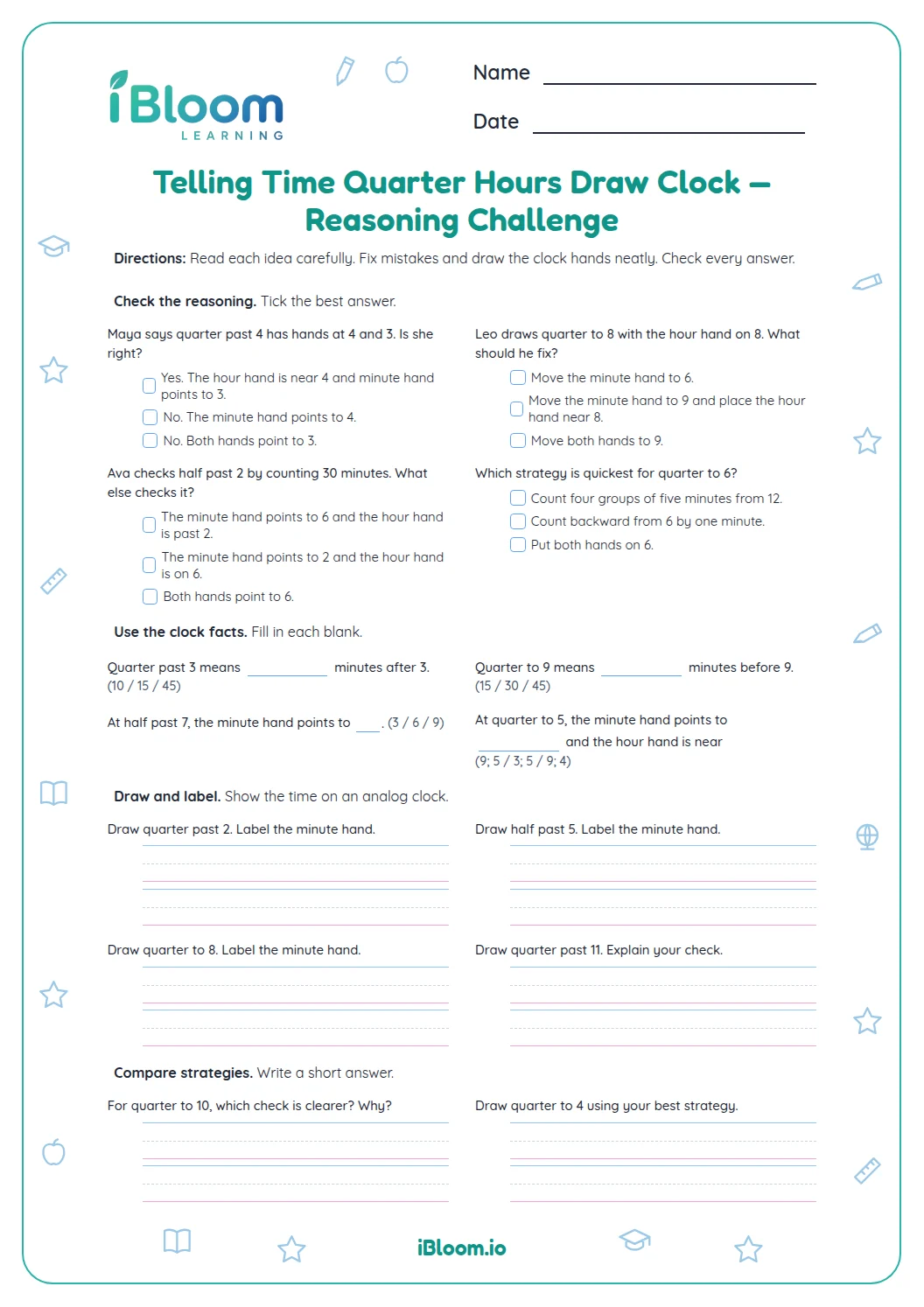
Read the minute hand first. The 3 means :15, the 6 means :30, and the 9 means :45. Then read the hour hand; a clock with the minute hand at 3 and hour hand just past 3 shows 3:15.
How do 15-minute steps change the time?
Move one quarter around the clock face for 15 minutes. For 11:45 plus 15 minutes, the hand reaches 12 and the hour changes, so the new time is 12:00.
What should be checked in each answer?
Check both hands and whether the prompt moves forward or backward. The clocks show the starting time, while the story states the number of minutes to add or subtract.
How to use this worksheet
- 1Read the minute hand and identify its quarter-hour mark.
- 2Read the hour hand to name the hour.
- 3For a story, mark the starting time on the clock.
- 4Move one quarter turn for each 15-minute step.
- 5Check whether the prompt asks for a later or earlier time.
Common mistakes and quick fixes
The mistake
Reading the hour hand as the minutes.
The fix
Use the minute hand’s number to identify :00, :15, :30, or :45.
The mistake
Keeping the old hour after passing :45.
The fix
At :45, one more 15-minute step starts the next hour.
The mistake
Adding minutes when the prompt says earlier.
The fix
Mark the direction first, then move one quarter turn forward or backward.
Common Core alignment
This worksheet practices 1.MD.B.3 through the questions on the printable.
The questions apply 1.MD.B.3 to telling time to quarter hours practice.
On this sheet: The worksheet items directly practice telling time to quarter hours.
Show the official wordingHide the official wording
Tell and write time in hours and half-hours using analog and digital clocks.
What to practice next
Make more practice
Further reading
Questions parents and teachers ask
What quarter-hour times appear?
The clocks display :00, :15, :30, and :45. Learners read each face and write the matching time, practicing the quarter-hour minute-hand positions. The ten clock items include several examples of each mark. The ten clock items include several examples of each quarter-hour mark, so learners can compare :15 with :45 and notice how the hour hand shifts.
Does the worksheet include clocks to read?
Yes. Ten questions show analog clocks and ask learners to write the time. Six short stories then ask learners to move 15 minutes forward or back, applying the same quarter-hour steps. Six short stories then ask learners to move 15 minutes forward or back, applying quarter-hour steps to familiar situations. The clocks provide the reading practice first.
How can a learner read quarter past?
When the minute hand points to 3, it marks :15. Read the hour hand’s position and write :15 after that hour, as with 3:15. Check both hands before answering. The minute hand identifies the quarter hour; the hour hand names the current hour.
How many questions and pages are there?
There are 16 questions: ten clock readings and six time-change stories. A separate answer key follows the worksheet. Learners first read the clocks, then apply quarter-hour steps to familiar situations. Learners first read the clocks, then apply quarter-hour steps to familiar situations. The separate key lists the expected time for every response.
What should learners do when the time crosses noon or an hour?
Check whether the prompt asks for a later or earlier time before moving one 15-minute step. Crossing :45 changes the hour, as 11:45 plus 15 minutes becomes 12:00. Keep the direction in mind when working through each story.