








About this worksheet
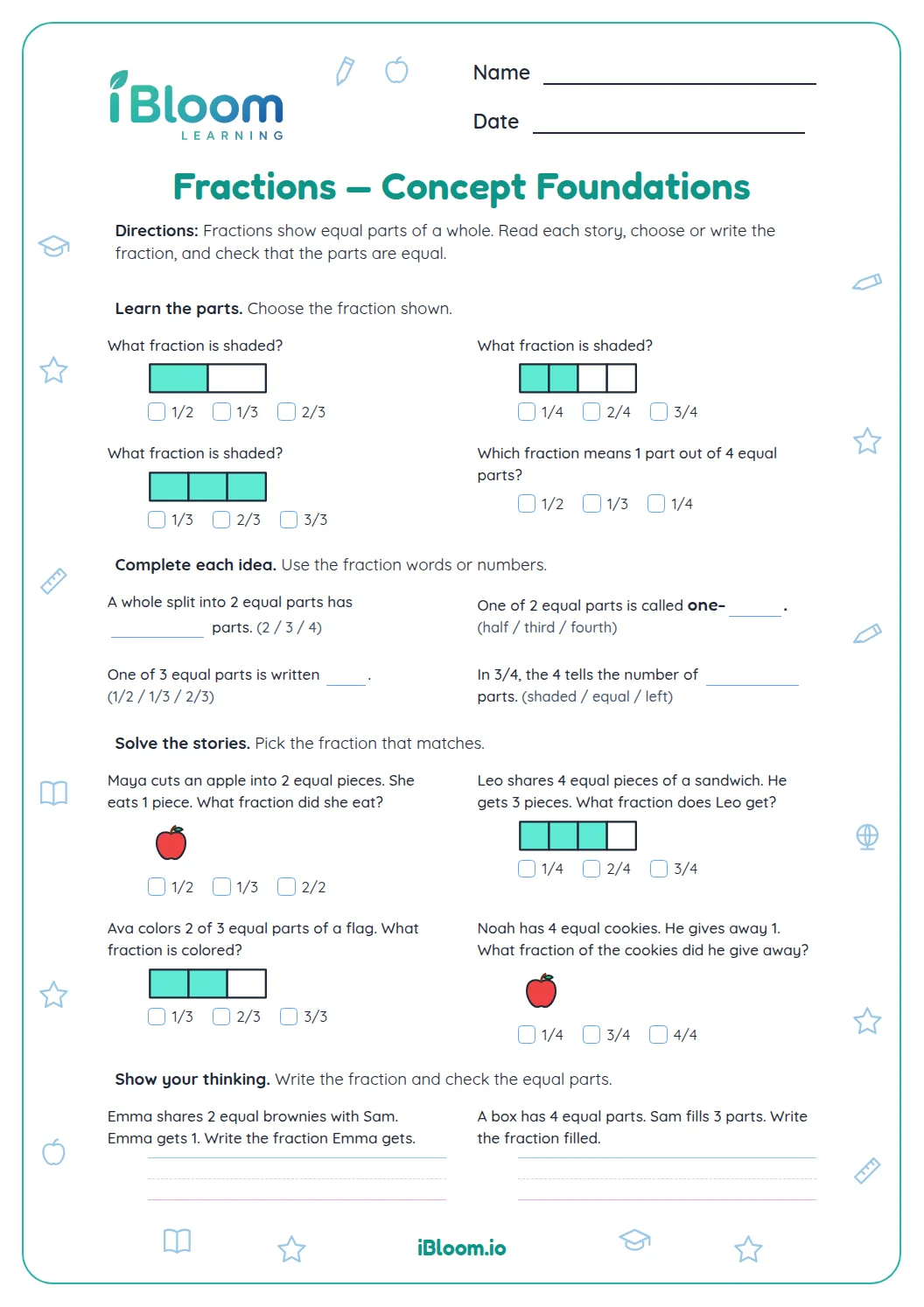
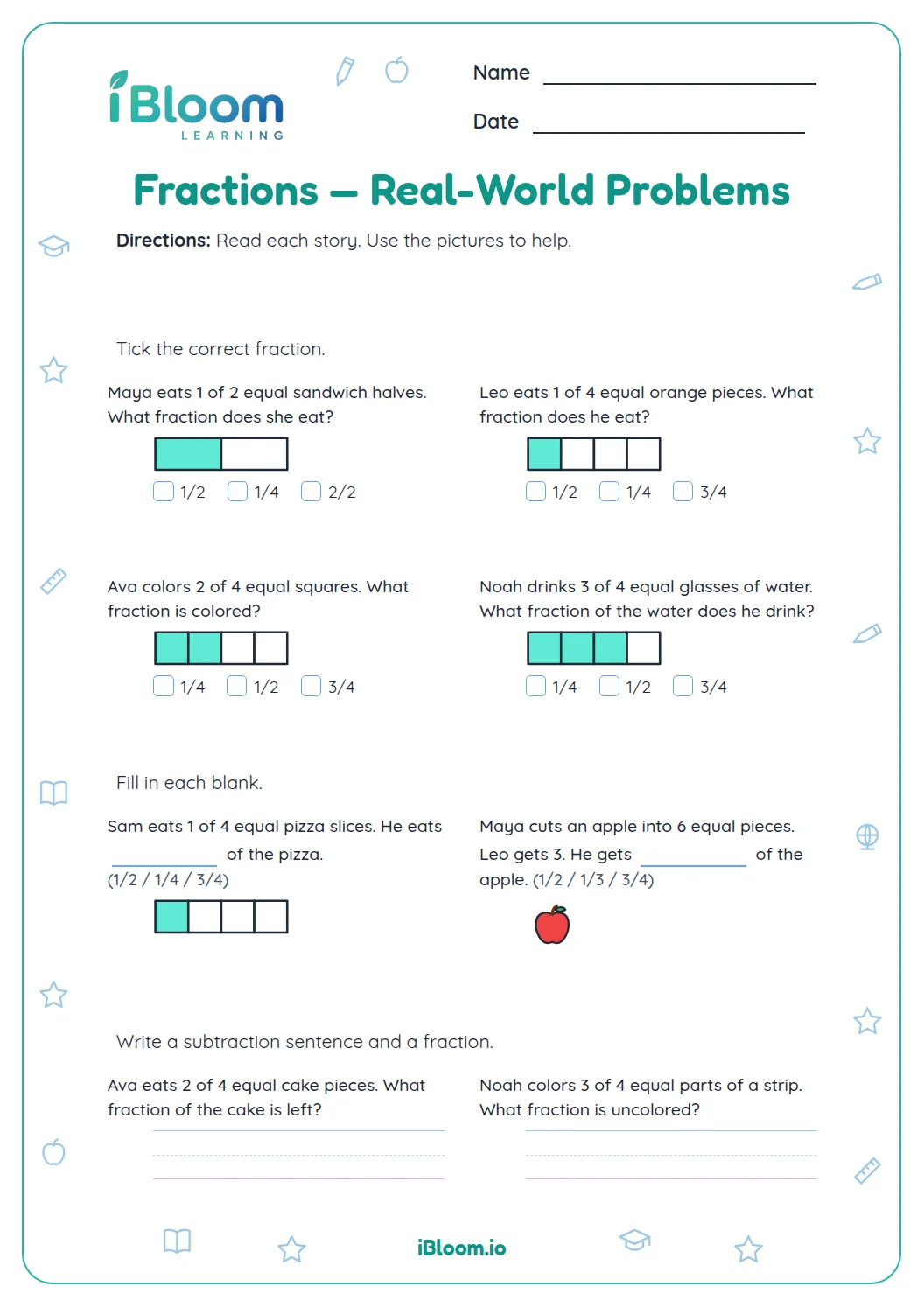
Children read simple sharing situations, identify equal parts, and connect each part to halves, fourths, or quarters. Its bars and short stories keep the whole visible while learners decide how many equal shares there are. The answer key lists all 15 responses, including sample explanations.
Aligned to 1.G.A.3
How do the models show equal shares?
Children read simple sharing situations, identify equal parts, and connect each part to halves, fourths, or quarters. Its bars and short stories keep the whole visible while learners decide how many equal shares there are. The answer key lists all 15 responses, including sample explanations.
- 1A sandwich is cut into 2 equal parts. What fraction is one part?
- 2Answer: 1/2
How do the three parts build fraction understanding?
Part A connects short stories with shaded bars, Part B checks fraction words and equal shares, and Part C asks learners to explain how equal parts name a fraction.
How can an adult help without giving the answer?
Ask the learner to point out the whole and count its equal parts before naming the fraction.
How to use this worksheet
- 1Name the whole in each story or model.
- 2Count how many equal parts make that whole.
- 3Identify the part or parts named in the question.
- 4Write the fraction with the total equal parts as the denominator.
- 5Use the key to check the number of parts and explain one answer.
Common mistakes and quick fixes
The mistake
Counting the shaded pieces but not the total equal pieces.
The fix
Say the total parts first, then name how many of those parts are shaded or eaten.
The mistake
Calling one of four equal parts one half.
The fix
Four equal shares are fourths; one share is one fourth.
The mistake
Treating unequal pieces as equal shares.
The fix
Check that every piece is the same size before naming a fraction.
Common Core alignment
Partition circles and rectangles into two and four equal shares, describe the shares using the words
On this sheet: Stories about halves and fourths use equal parts of a whole.
Show the official wordingHide the official wording
Partition circles and rectangles into two and four equal shares, describe the shares using the words halves, fourths, and quarters, and use the phrases half of, fourth of, and quarter of.
What to practice next
Make more practice
Further reading
Questions parents and teachers ask
Is an answer key included?
Yes. The separate answer key follows all 15 questions in order and includes sample explanations for the final written responses. Check it after the learner has named the whole and counted the equal parts. Ask the learner to point to the whole, count its equal shares, and explain how that count matches the fraction named in the response.
How should the learner check an answer?
Start by identifying the whole and how many equal shares it has. For example, one of two equal sandwich parts is 1/2; the denominator names the total shares. Ask the learner to point to the whole, count its equal shares, and explain how that count matches the fraction named in the response.
Can this be used for independent practice?
Yes. The prompts use short situations and clear fraction language, and the models support reading each whole as equal parts. An adult can read a prompt aloud and let the learner choose the fraction. Ask the learner to point to the whole, count its equal shares, and explain how that count matches the fraction named in the response.
What materials are needed?
A pencil and the printed worksheet are enough. The equal-part bars are already on the sheet, so learners do not need to cut food or bring separate fraction pieces. Ask the learner to point to the whole, count its equal shares, and explain how that count matches the fraction named in the response.
How long does it take?
Plan for about 20 minutes. Learners can pause to name the whole and explain why the parts are equal before checking the answer key. Ask the learner to point to the whole, count its equal shares, and explain how that count matches the fraction named in the response.