






About this worksheet
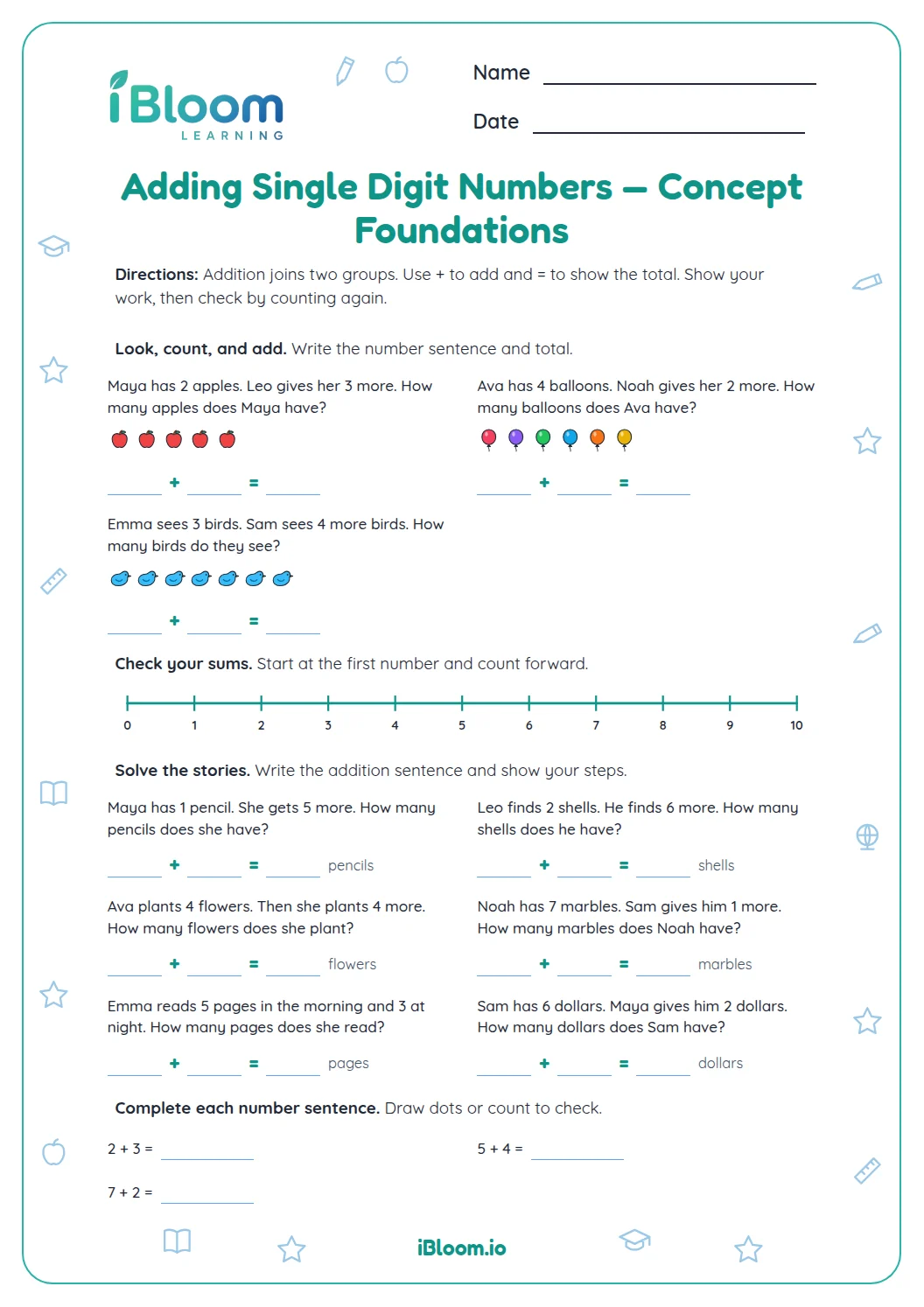
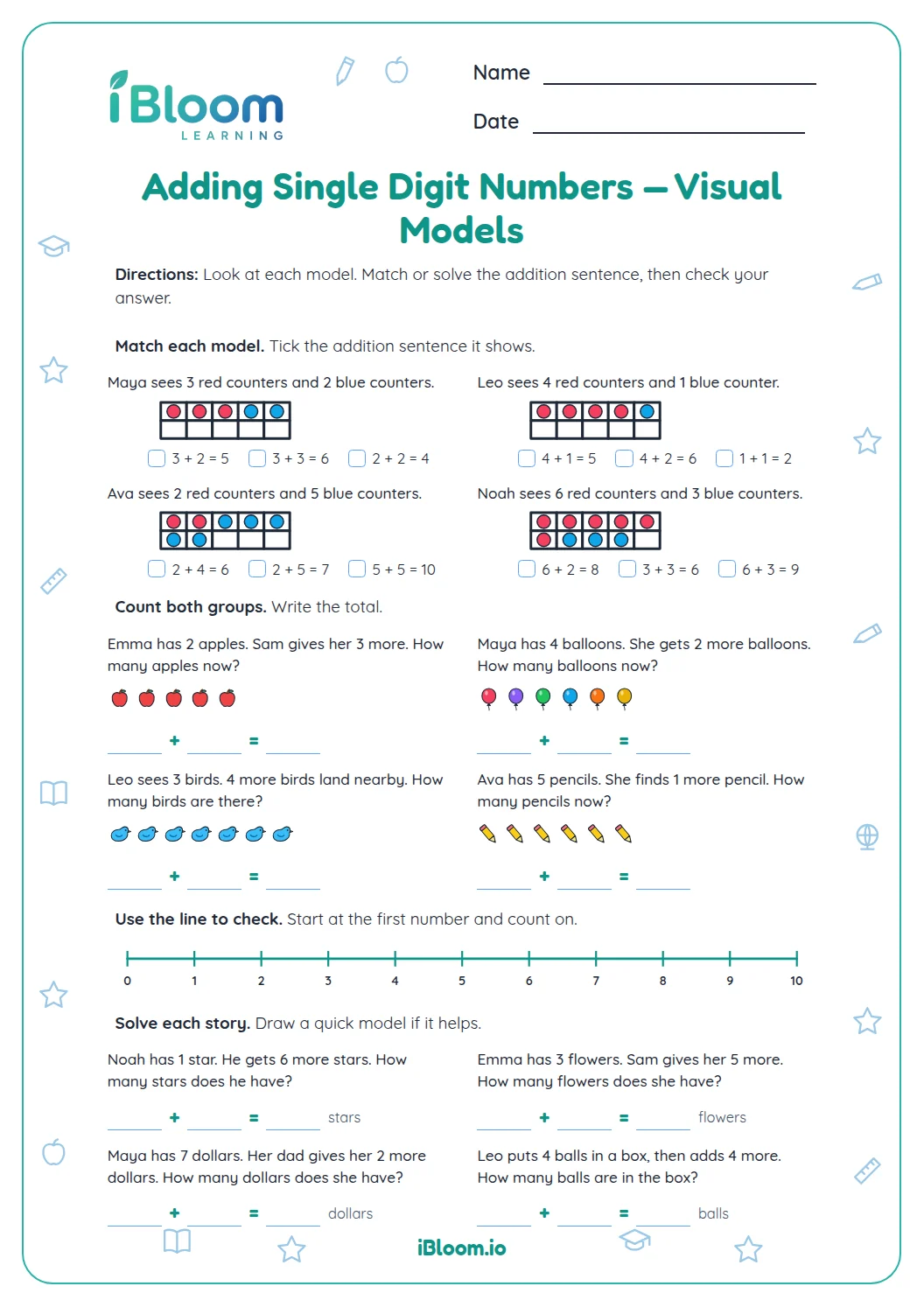
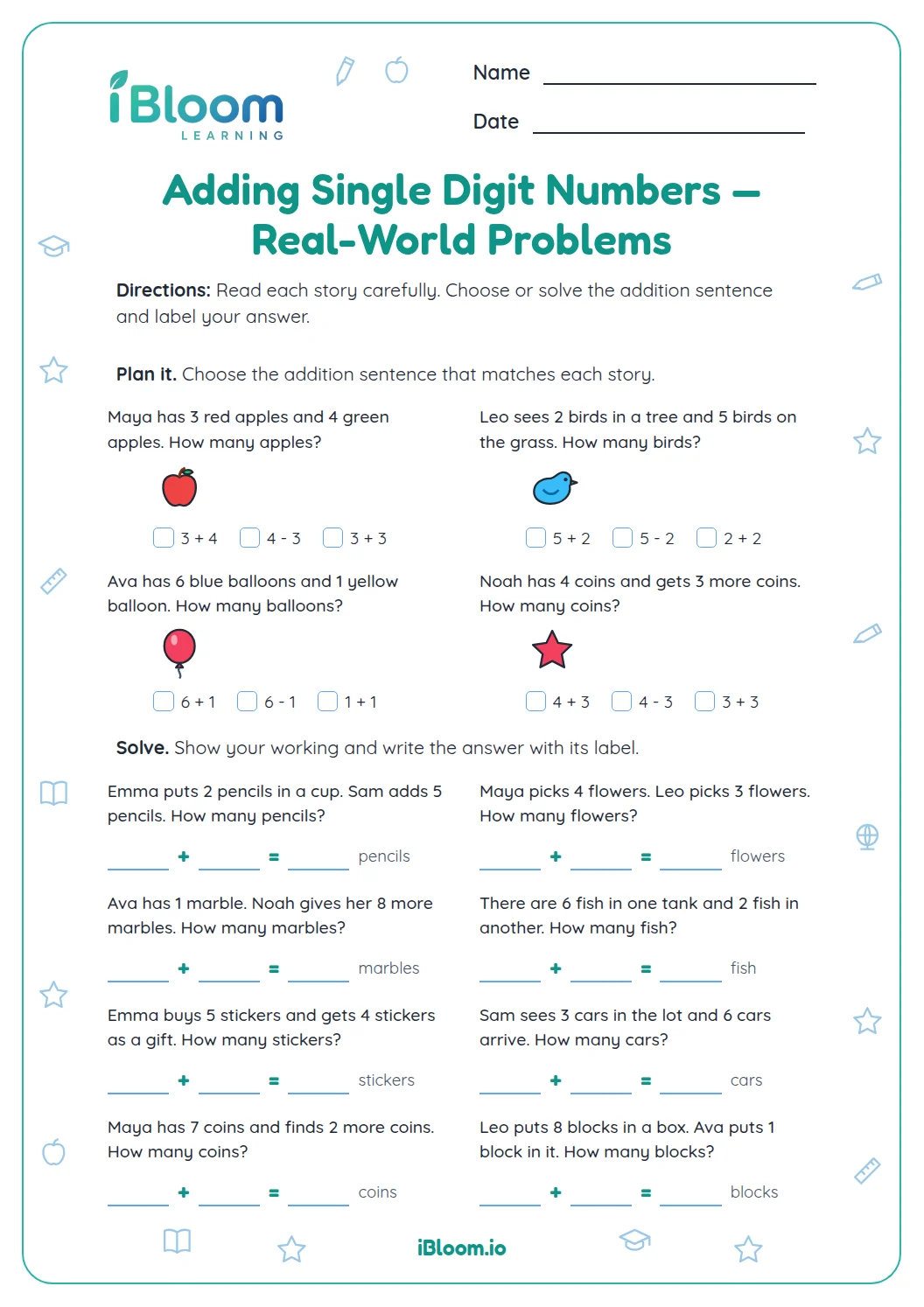
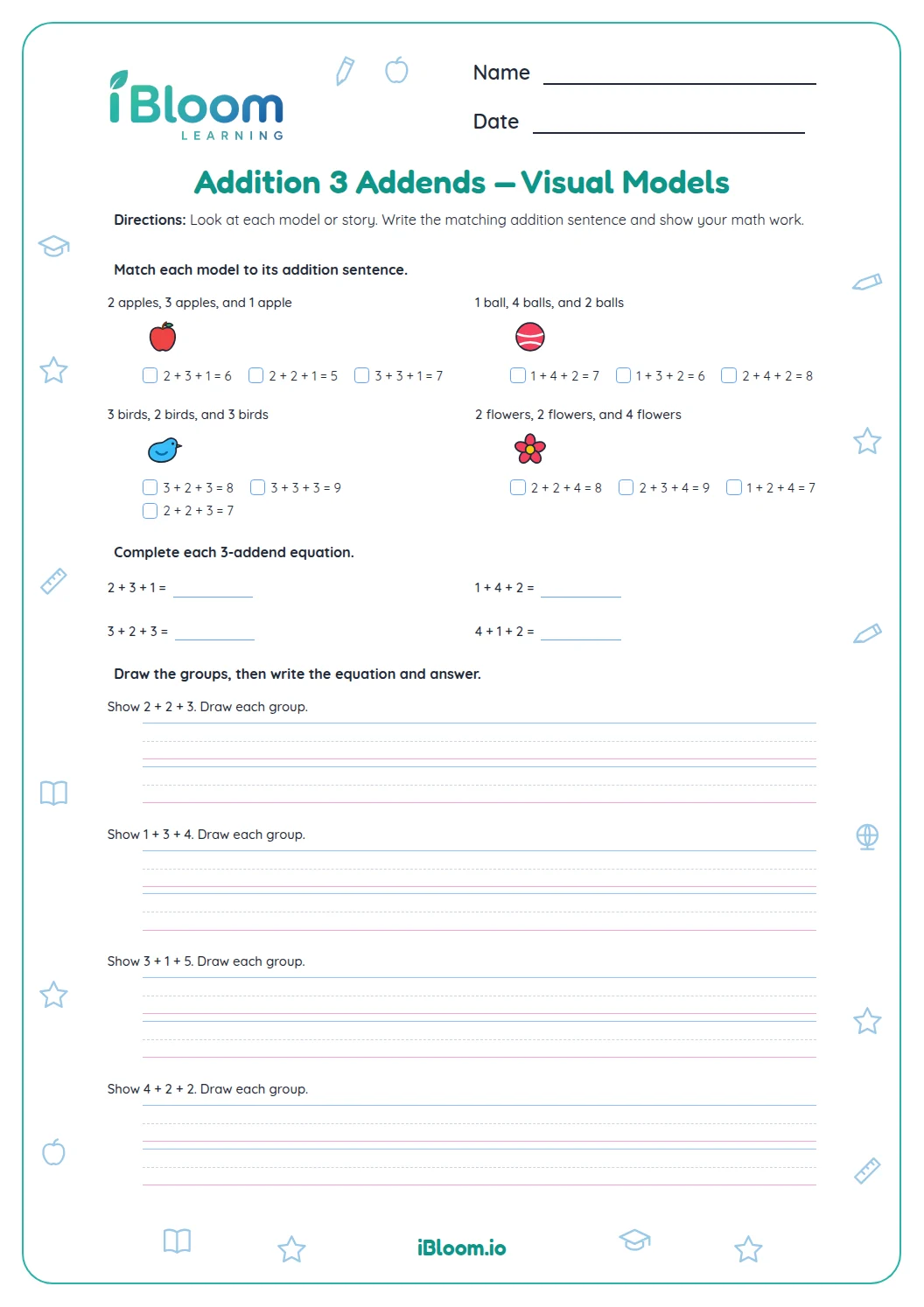
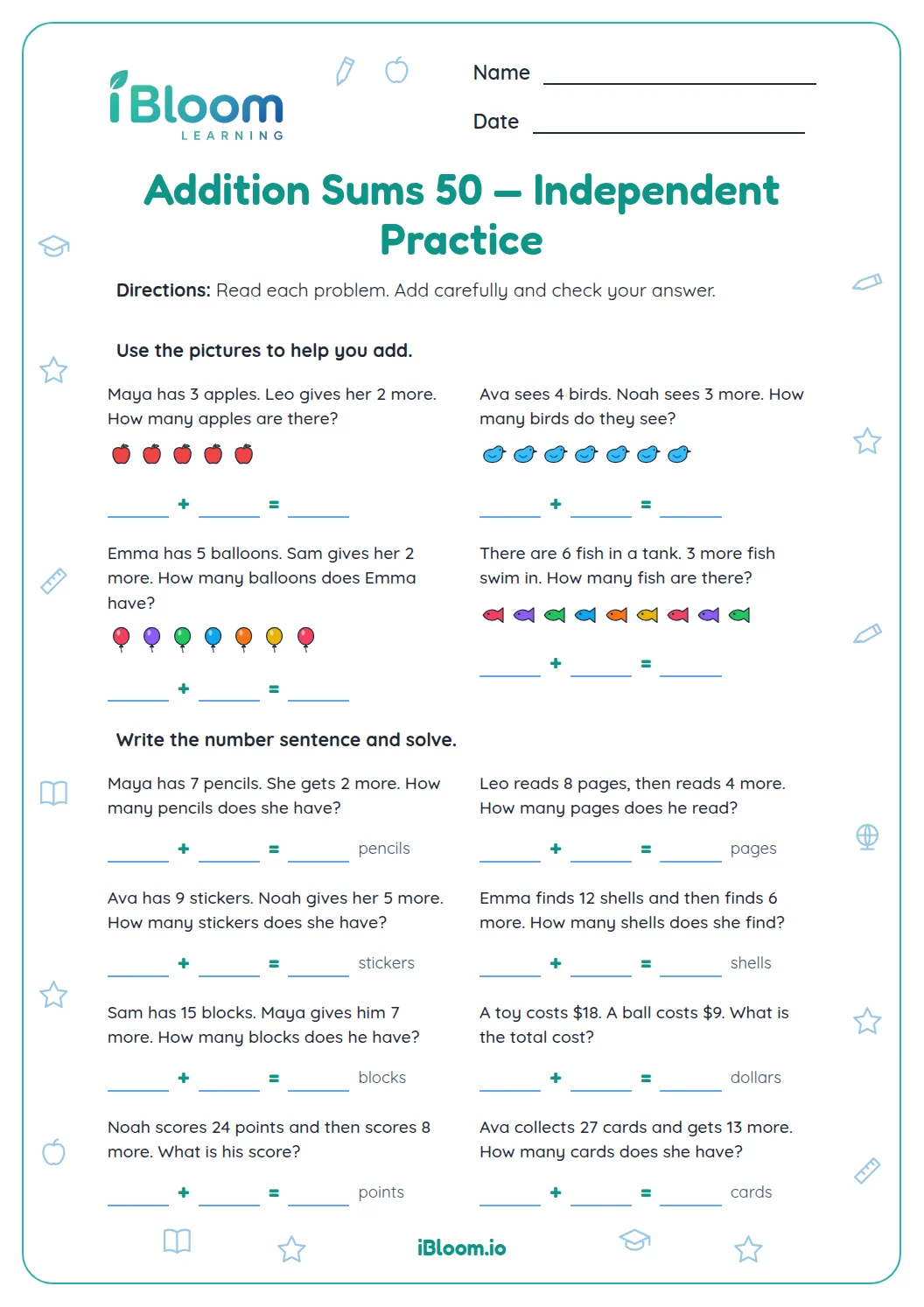
This Grade 1 worksheet gives children 14 short addition word problems with single-digit amounts and totals within 20. Children solve joining stories and find a missing starting amount or added amount. Several questions include a small picture cue. A separate answer key is included, and the stories practice Common Core 1.OA.A.1.
Aligned to 1.OA.A.1
How do I turn a story into an addition equation?
Find the first group and the group being added. Join them with a plus sign. Maya’s 3 apples and Leo’s 2 more make 3 + 2 = 5 apples.
- 1Maya has 3 apples and Leo gives her 2 more: 3 + 2 = 5 apples.
Which words can signal that groups are joining?
“More arrive,” “gets more,” “in all,” and “altogether” can describe joining. Read the whole story to decide what it asks.
What if the starting amount is missing?
Use the total and known added amount. If some stickers plus 6 make 14, solve ___ + 6 = 14; the starting amount is 8.
How can I check a story answer?
Check that the equation uses the story numbers and the answer has the right unit. For flowers, 5 + 8 = 13 flowers.
How to use this worksheet
- 1Read the story and identify what it asks.
- 2Find each amount and decide if groups are joining.
- 3Use the picture model or count on to find the total.
- 4Choose the answer that matches the story.
- 5Add the right unit and reread the story.
Common mistakes and quick fixes
The mistake
Adding numbers without checking what the story asks.
The fix
Name the group or total the question asks you to find.
The mistake
Adding only one of the amounts in the story.
The fix
Point to each group and include both numbers in the equation.
The mistake
Subtracting when a new group joins the first group.
The fix
Draw both groups or model them with counters.
Common Core alignment
Children represent addition stories with equations and solve within 20.
Represent addition stories with equations and solve within 20.
On this sheet: Stories use addition within 20 and include unknown addends.
Show the official wordingHide the official wording
Use addition and subtraction within 20 to solve word problems involving situations of adding to, taking from, putting together, taking apart, and comparing, with unknowns in all positions, e.g., by using objects, drawings, and equations with a symbol for the unknown number to represent the problem.
What to practice next
Make more practice
Further reading
Questions parents and teachers ask
What skills does this worksheet practice?
It practices solving short addition stories with single-digit numbers. Children identify amounts, write an addition equation, and answer with the object or group named. A few questions ask for an unknown starting amount or amount added. Children can count on from one group or draw the other group before writing the total.
Are all answers 10 or less?
No. The groups use single-digit amounts, but totals can be greater than 10 and stay within 20. Children can count on, use objects, or draw groups to find totals such as 13 or 15. The totals stay within 20, so children can use objects, fingers, or counting on.
How should my child show the equation?
Write the amounts from the story with a plus sign and an equal sign, then solve. For 3 red blocks and 4 blue blocks, write 3 + 4 = 7. Include the item named in the question, such as 7 blocks.
What if the starting amount is missing?
Use the total and the amount added to work backward. If some stickers and 6 more make 14, write ___ + 6 = 14. The missing amount is 8 because 8 + 6 = 14. Saying the object name after the number connects the equation back to the story.
Can my child use drawings or counters?
Yes. Draw a group for each amount or use counters, then count all objects once. For a larger total, counting on from the first number can also be efficient. Use one counter per item and move all counters together to check the sum.