




About this worksheet
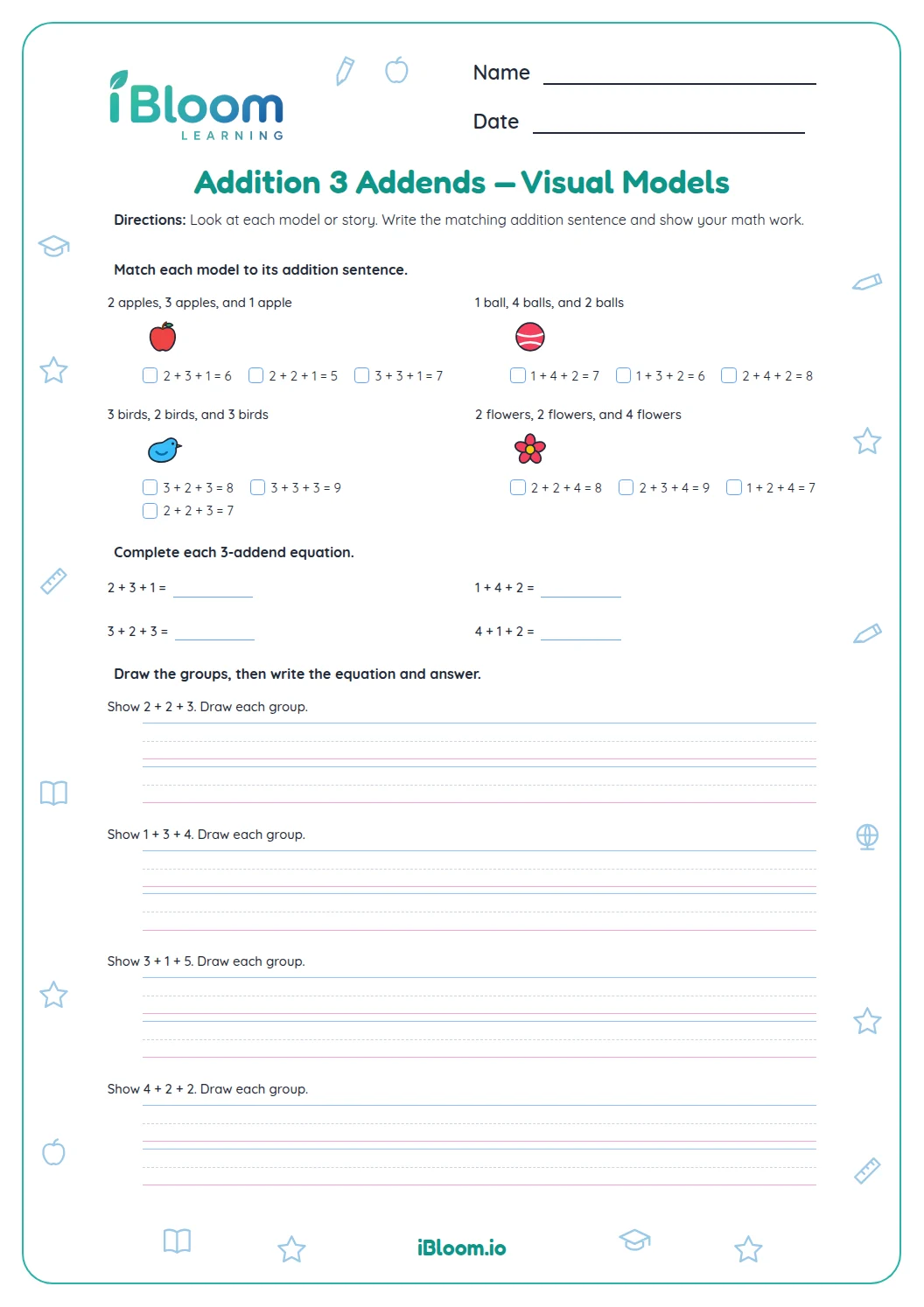
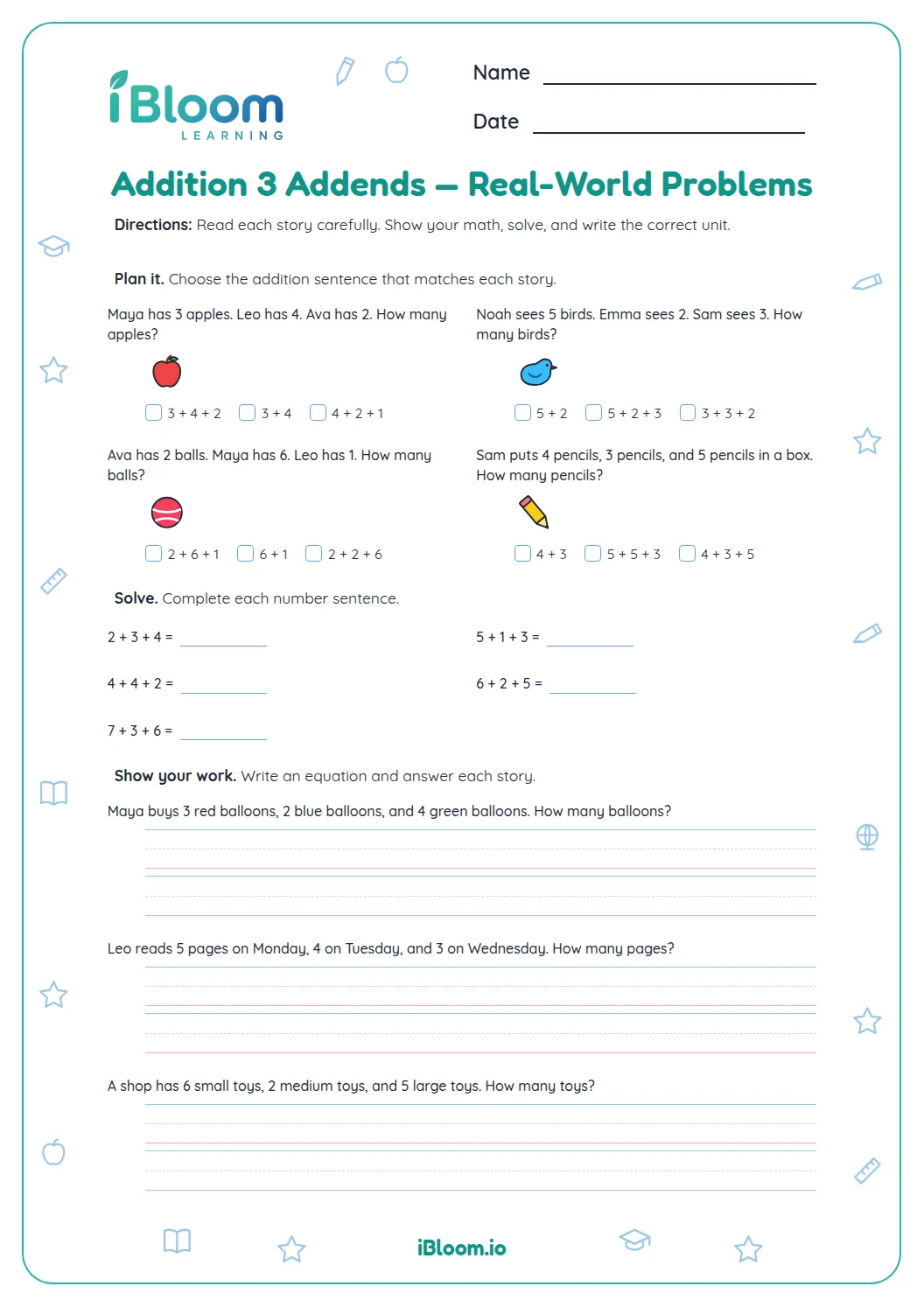
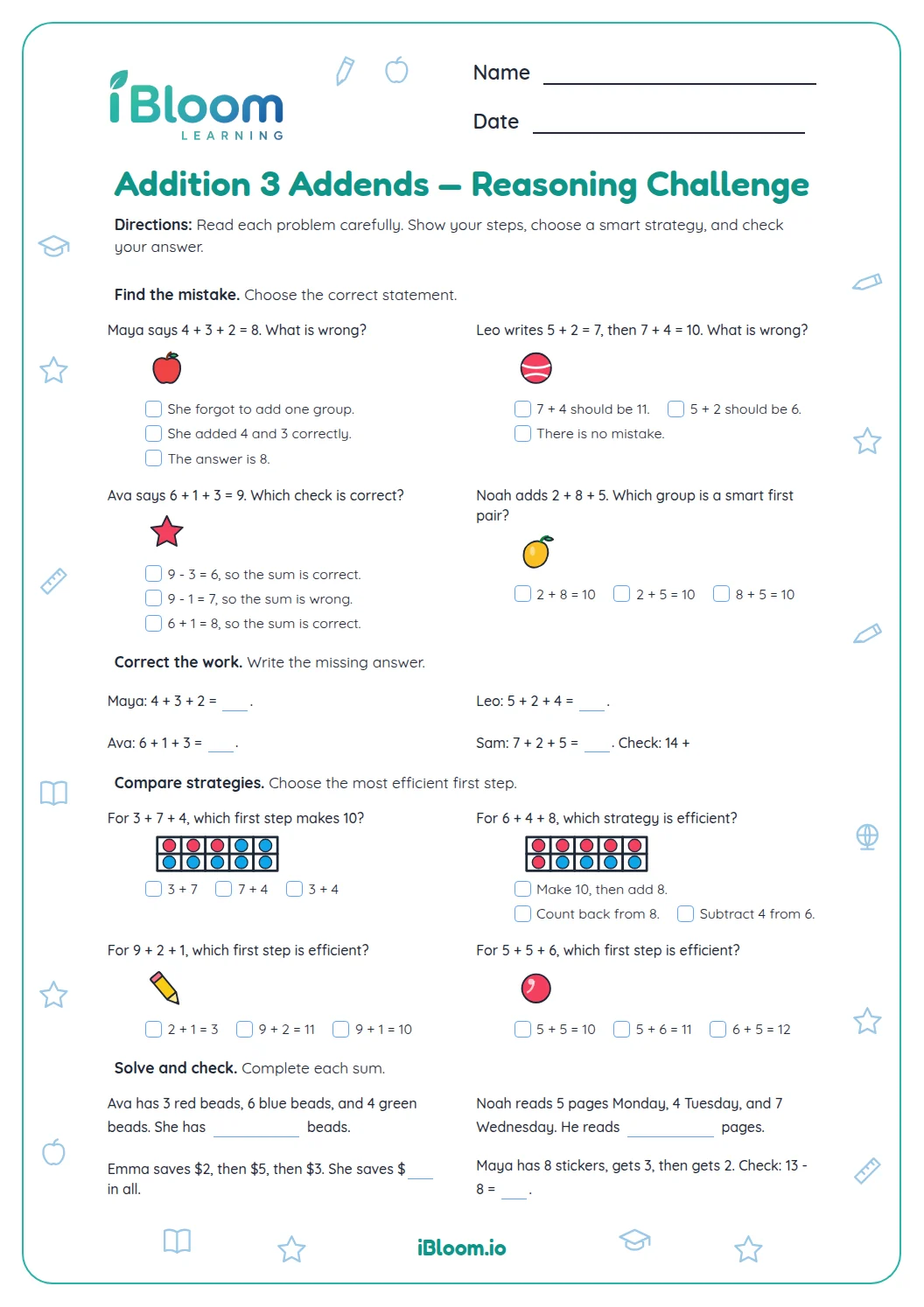
This Grade 1 printable has 14 short stories about combining three groups. Learners add the three amounts and choose the matching total; every sum is within 20. The separate answer key marks each correct choice. The questions practice CCSS 1.OA.A.2.
Aligned to 1.OA.A.2
How do you add three groups?
Find the three amounts in the story and combine them. For example, 3 red blocks, 4 blue blocks, and 5 green blocks make 3 + 4 + 5 = 12 blocks. Add two groups first, then add the third amount and select 12.
- 1Ava has 3 red, 4 blue, and 5 green blocks.
- 23 + 4 + 5 = 12 blocks. Choose 12.
How can you check the total?
Point to each group amount in the story and make sure it appears once in your addition. Check the sum by counting on or using objects, then select the total that answers the question.
How does the practice progress?
Part A starts with totals from 11 to 14. Part B includes larger groups and totals up to 18. Part C finishes with totals from 17 to 19. Each story requires all three amounts to find the answer.
How to solve a three-addend story
- 1Read the story and find all three group amounts.
- 2Add two amounts to find a partial sum.
- 3Add the third amount to the partial sum.
- 4Choose the answer that matches the total.
- 5Check that the total counts all three groups.
Common addition slips
The mistake
Leaving out one group.
The fix
Match each of the three story amounts to one addend.
The mistake
Stopping at the partial sum.
The fix
Bring down the last addend and add it to the partial sum.
The mistake
Counting an amount twice.
The fix
Point to each group once as you write the equation.
Common Core alignment
The stories ask children to add three whole-number groups with totals of 20 or less.
Add three whole numbers in a story problem when the total is 20 or less.
On this sheet: Each story has three addends and a total no greater than 20.
Show the official wordingHide the official wording
Solve word problems that call for addition of three whole numbers whose sum is less than or equal to 20, e.g., by using objects, drawings, and equations with a symbol for the unknown number to represent the problem.
What to practice next
Make more practice
Further reading
Questions parents and teachers ask
How many questions are on this worksheet?
There are 14 story problems. Each one describes three groups, and children combine the three amounts before choosing the total. The separate answer key marks the correct choice for every story. It can also help an adult review the child’s addition strategy and answer.
Are all the sums within 20?
Yes. The largest total is 19, and every other total is also below 20. Children can add two groups first and then combine that partial sum with the third group. Counters, fingers, or counting on can help children check a sum as they work.
What does “three addends” mean?
An addend is a number being added. In 3 + 4 + 5, the three addends are 3, 4, and 5. The worksheet stories each describe three groups that belong in one addition sentence. Children can change the order of the addends and still combine the same groups.
Should children show an addition sentence?
Children may write an addition sentence on separate paper to record their thinking. The worksheet itself asks them to select the total from three choices. Recording each of the three amounts can help a child check that every group was included once before choosing an answer.
What is the answer to the blocks example?
The story has 3 red blocks, 4 blue blocks, and 5 green blocks. Write 3 + 4 + 5 and add the first two numbers to get 7; then add 5 to find 12 blocks altogether. The answer is 12 because 3 + 4 makes 7, and 7 + 5 makes 12 blocks.