









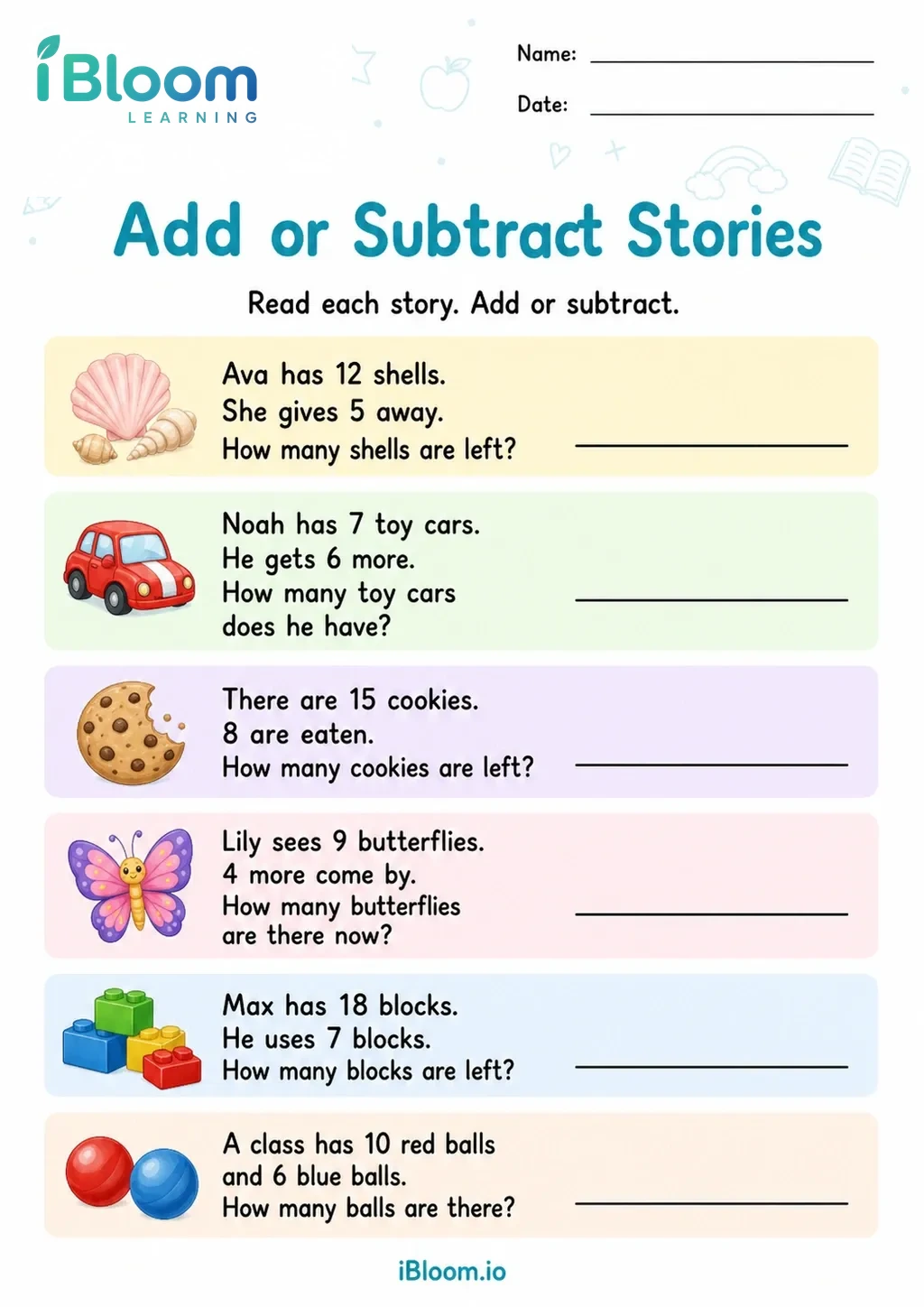
About this worksheet
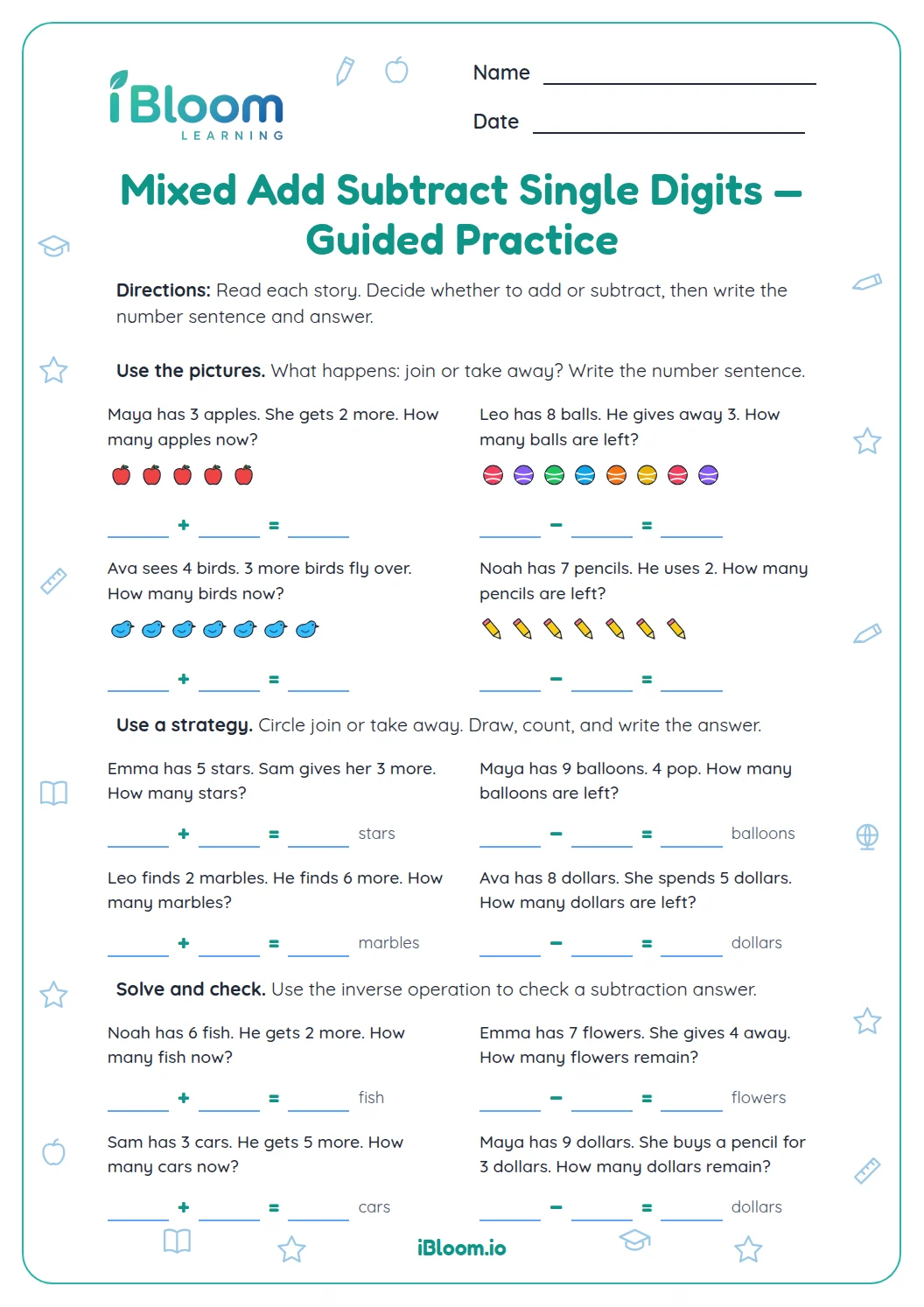
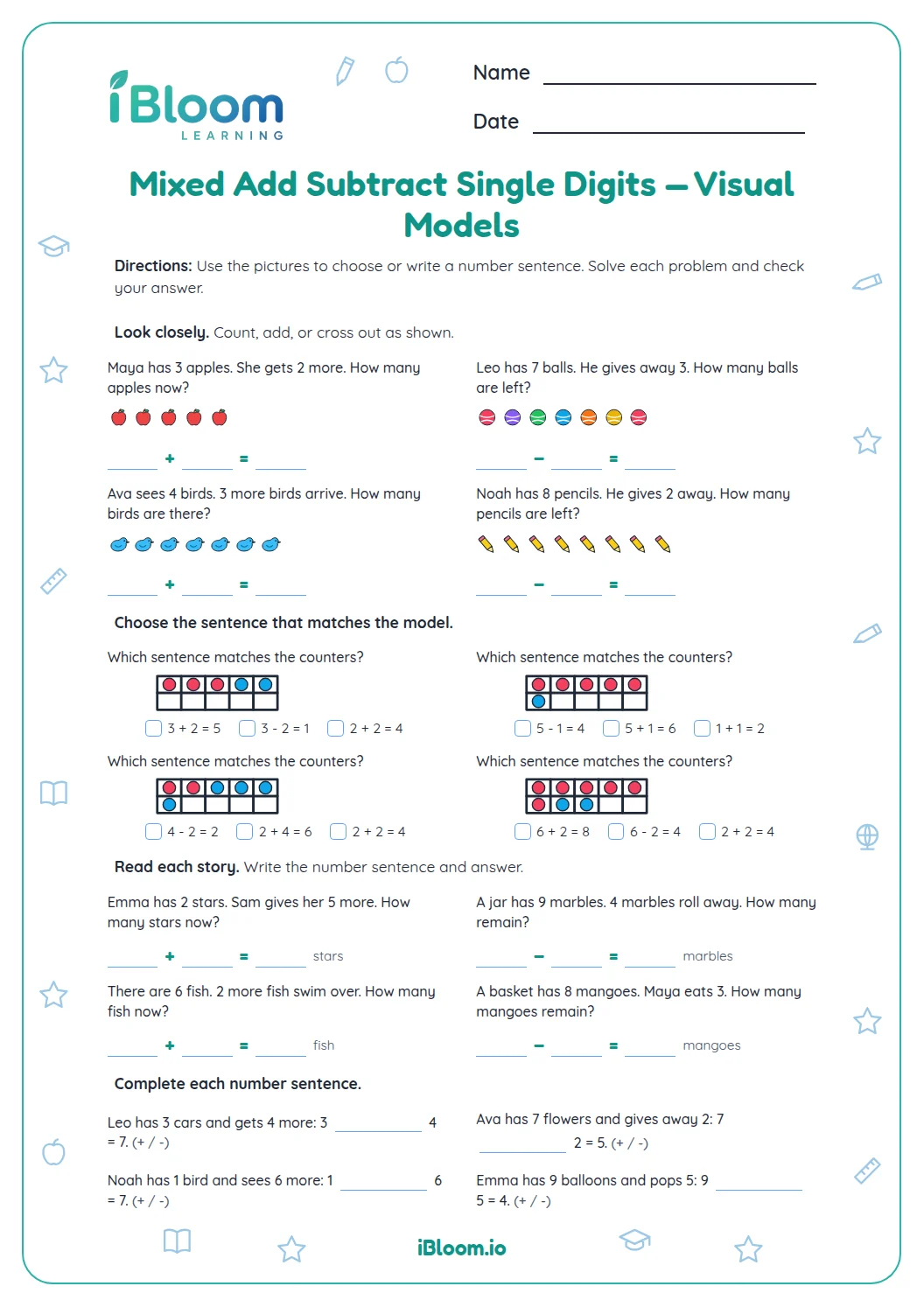
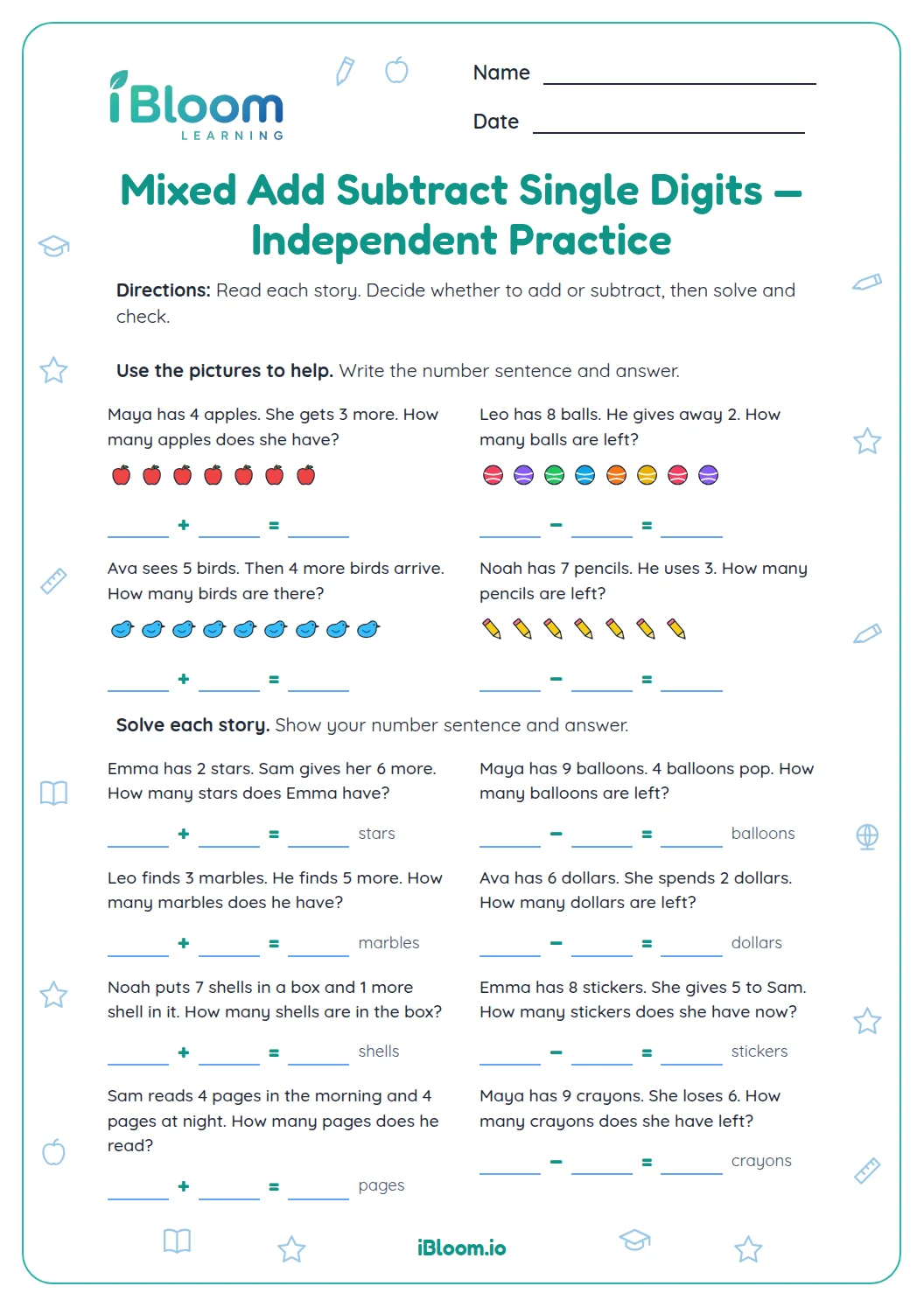
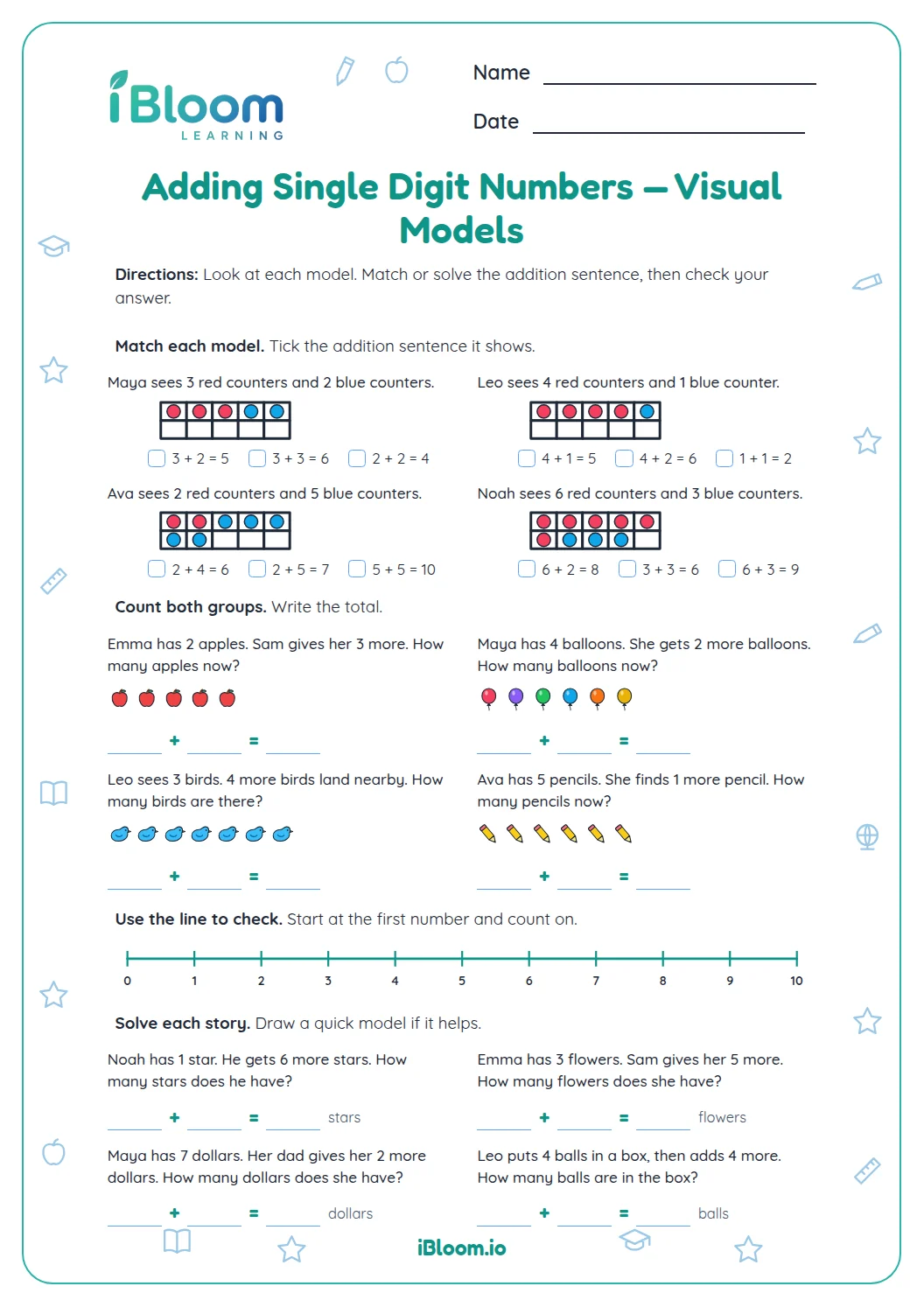
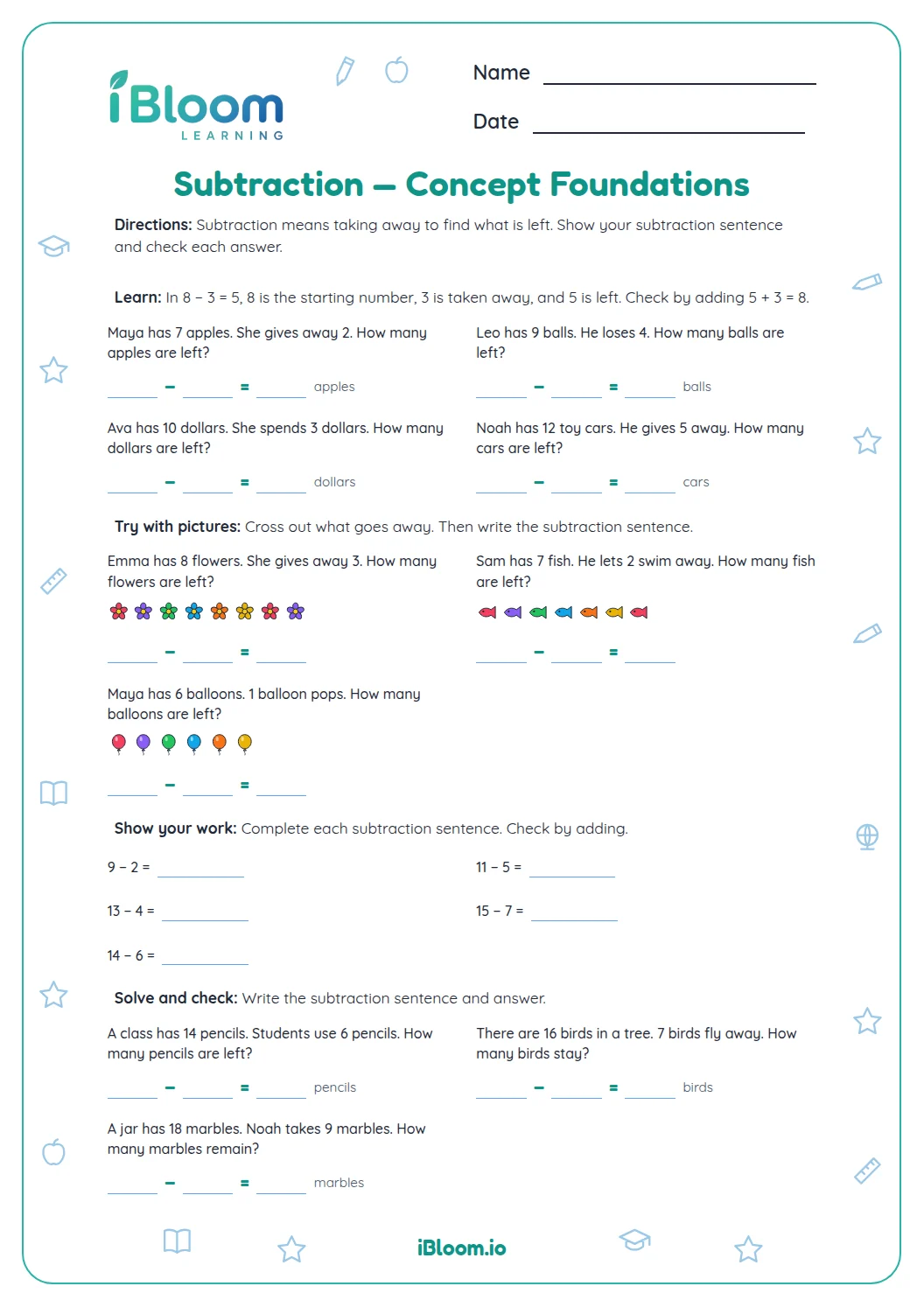
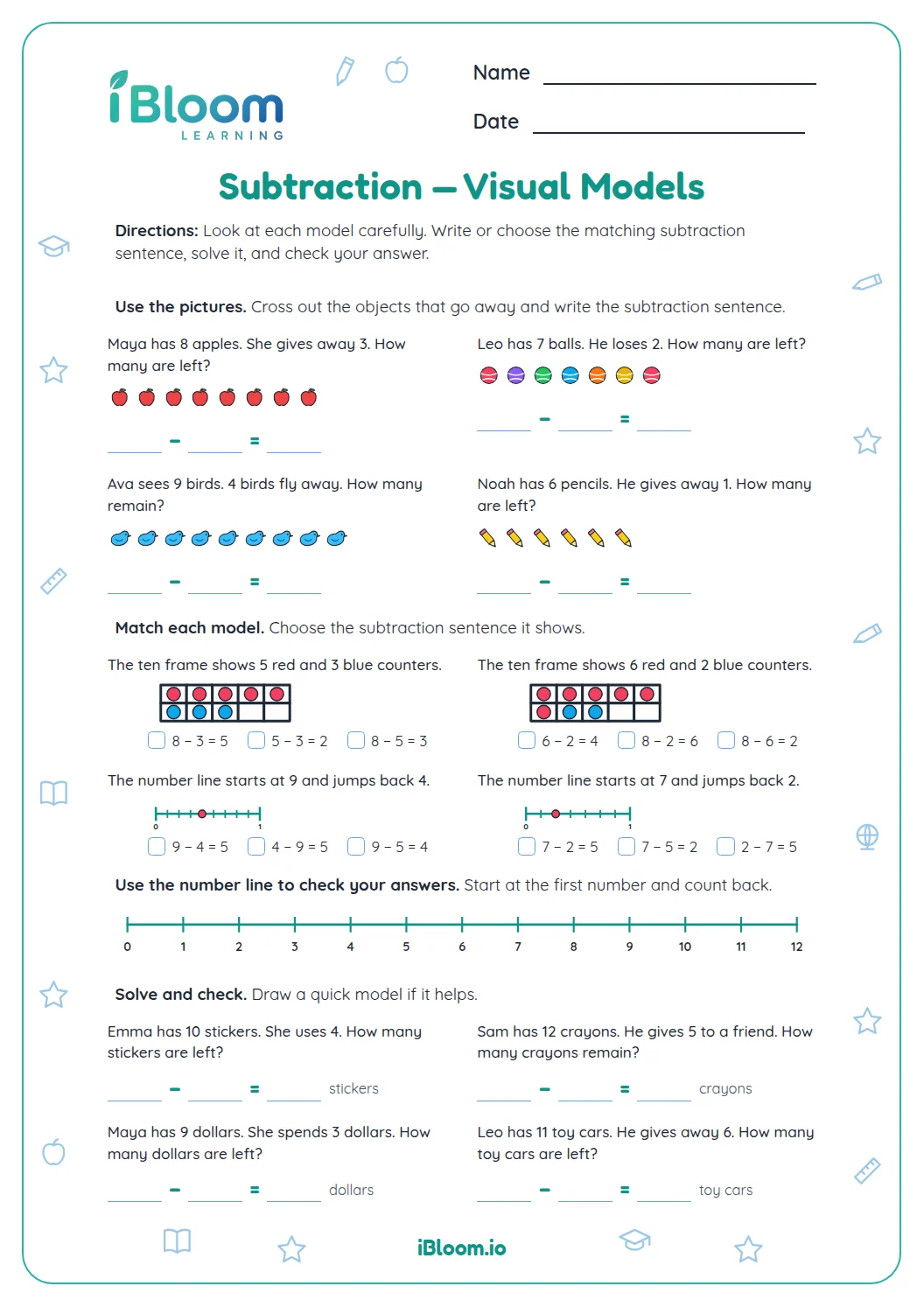
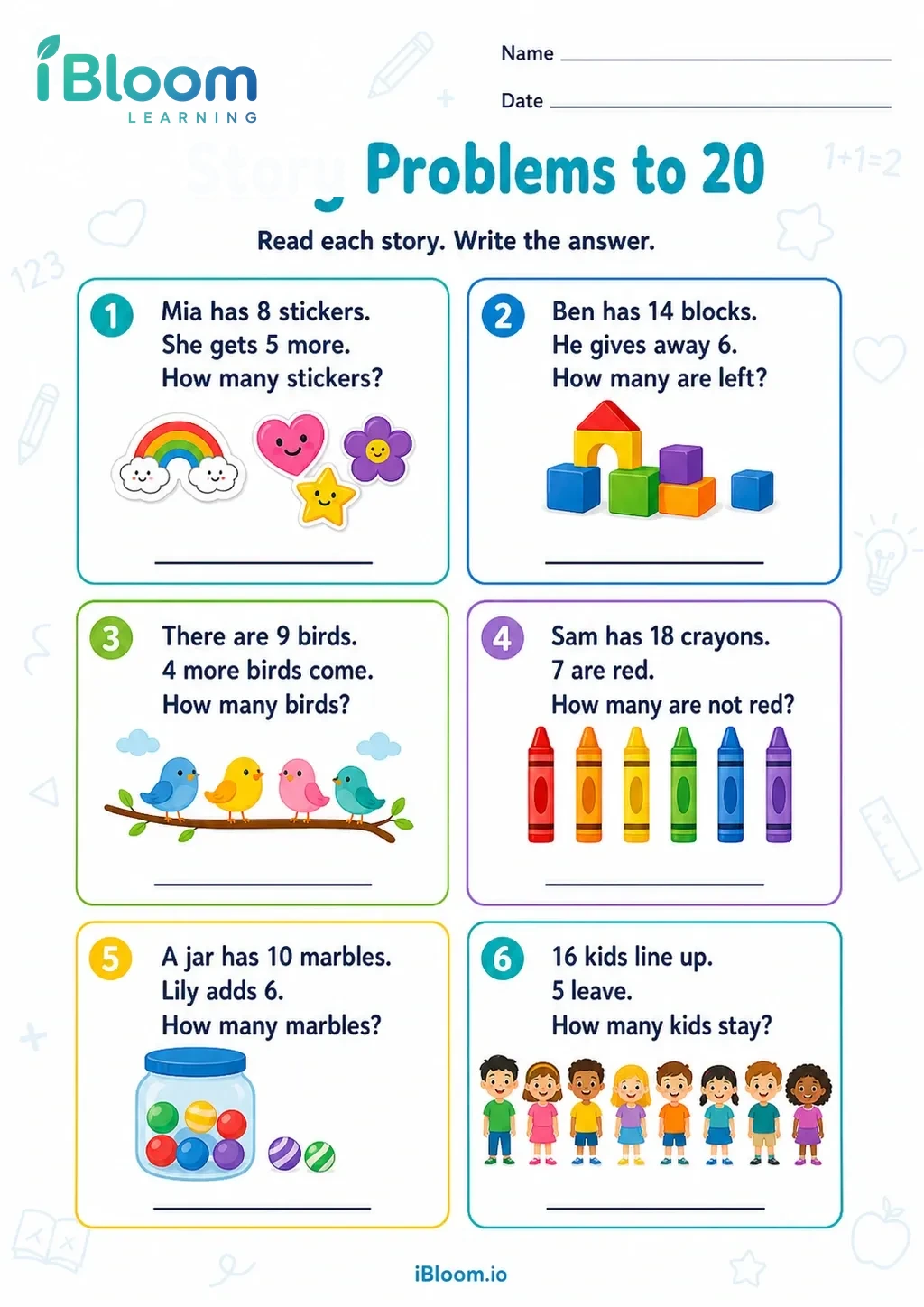
This free Grade 1 worksheet introduces the decision at the heart of mixed word problems: does the story join amounts or take some away? Sixteen short stories use single-digit numbers and results within 9. Part A offers two equation choices, Part B pairs each story with an unfinished equation, and Part C provides working space for children to choose an operation and solve. The sheet supports Common Core 1.OA.A.1 through objects, story situations and equations. Its separate answer key gives the matching equations, missing results and final amounts.
Aligned to 1.OA.A.1
How do the story events tell us which operation to use?
If two groups join, add their amounts. If some objects leave a starting group, subtract the amount that leaves. Ask the child to retell the event before looking at the signs in an equation.
The eight addition stories and eight subtraction stories are mixed throughout the sheet. Children need to read each situation; choosing the same sign as the question before it will not work.
How can we model the block story?
Question 1 describes 3 red blocks and 2 blue blocks. Make two small groups with counters, point to each group, then bring them together. Count the combined group to connect the action with the sum.
- 13 red blocks and 2 blue blocks join together.
- 23 + 2 = 5
- 3Choose the addition equation.
- 4The 5 counts all the blocks.
What changes from Part A to Part C?
Part A asks children to choose an equation that already includes its result. Part B gives the equation and leaves its result blank. Part C asks for the final amount and provides squared working space for dots or an equation.
In question 16, 9 crayons are on a desk and 4 go into a box. The question asks how many stay on the desk. Children can cross out 4 of 9 drawn dots, write 9 − 4 = 5, and put 5 in the answer box.
How to use this worksheet
- 1Read the story aloud and identify what is being counted.
- 2Retell whether objects join the group or leave it.
- 3Choose the matching equation in Part A and explain its sign.
- 4Complete Part B, checking the supplied equation against the story.
- 5In Part C, use the working grid for dots or an equation and write the final amount.
- 6Check with the key and reread any story whose answer needs correcting.
Mistakes to watch for
The mistake
Adding 7 and 2 when 2 of 7 ducks swim away.
The fix
Act out the departure: remove 2 counters from 7 and count the 5 that stay.
The mistake
Using subtraction for 3 red blocks and 2 blue blocks because the colors differ.
The fix
The question asks for the combined amount, so join both color groups.
The mistake
Giving 4 as the answer when 4 of 9 crayons go into a box.
The fix
The question asks how many stay on the desk: subtract 4 from 9 to find 5.
Curriculum alignment
Represent short joining and taking-away stories with equations.
On this sheet: Children translate familiar situations into equations and solve for the number requested.
Show the official wordingHide the official wording
Use addition and subtraction within 20 to solve word problems involving situations of adding to, taking from, putting together, taking apart, and comparing, with unknowns in all positions, e.g., by using objects, drawings, and equations with a symbol for the unknown number to represent the problem.
What to practice next
Make more practice
Further reading
Questions parents and teachers ask
Are all the numbers single digits?
Yes, every number in the stories is a single digit, and all results are within 9. Children can act out the amounts with a small set of counters. This keeps the calculation manageable while they practice deciding whether the events call for addition or subtraction.
How many addition and subtraction stories are included?
There are eight addition stories and eight subtraction stories. Parts A and C each contain two of each, while Part B contains four of each. Children choose matching equations first, fill missing results next, then solve with working space, so both operations appear at every level of support.
Can an adult read the word problems aloud?
Yes, an adult can read each story and its question aloud. Pause before reading the equation choices so the child can retell what happens. Ask whether objects join or leave the group, then let the child choose the sign and work out the amount without a hint.
What belongs in the squared working space?
Children can use the working space for dots, crossed-out dots or an equation that represents the story. In the crayon problem, 9 dots with 4 crossed out show why 5 stay on the desk. Write only the final number in the answer box beside the prompt.
How does the answer key help us review?
The key identifies each correct equation choice, each missing result and each final amount. Ask your child to explain the operation before checking the number. If the operation is correct but the result differs, recount the model; if the sign differs, act out the story again.