
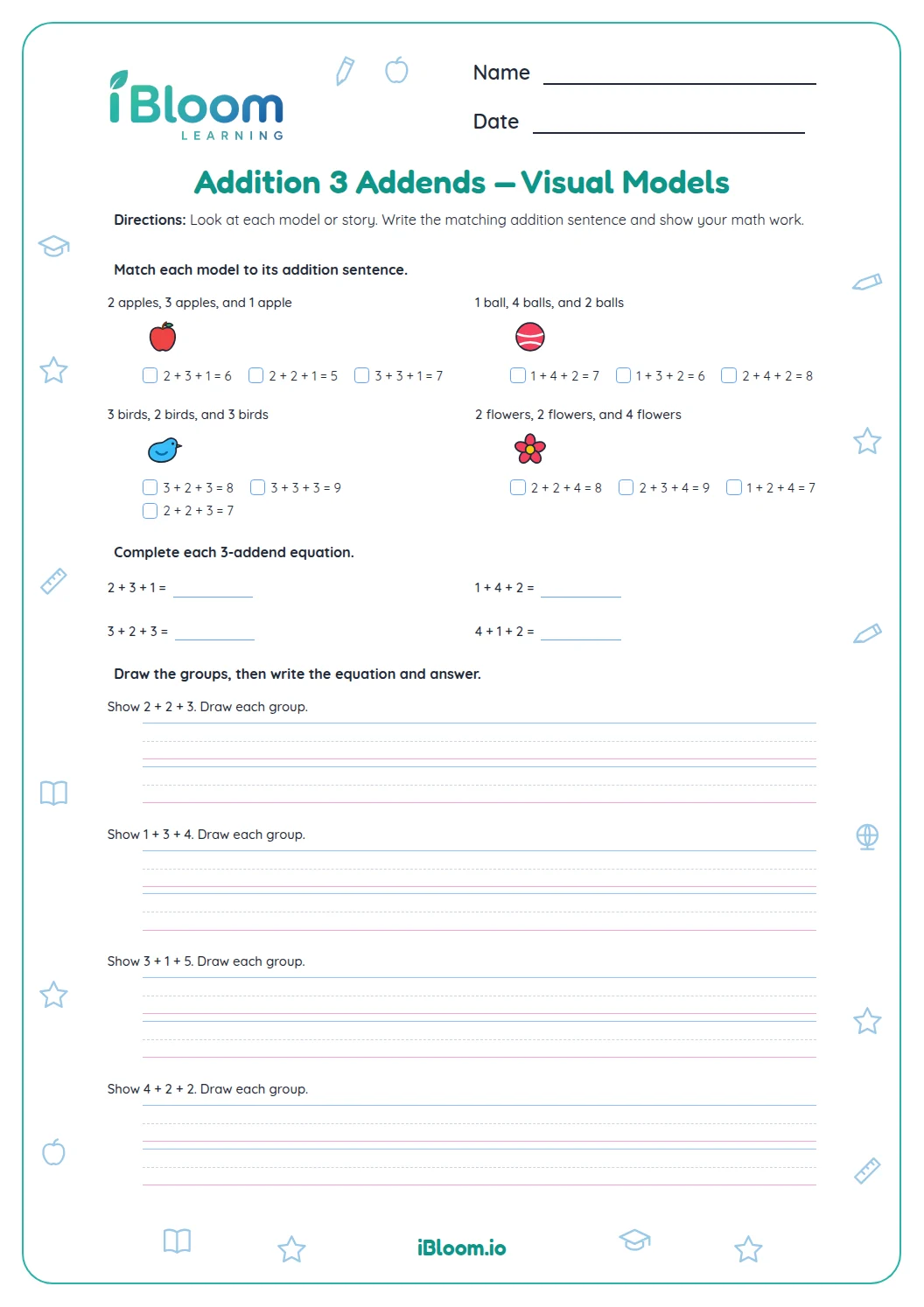
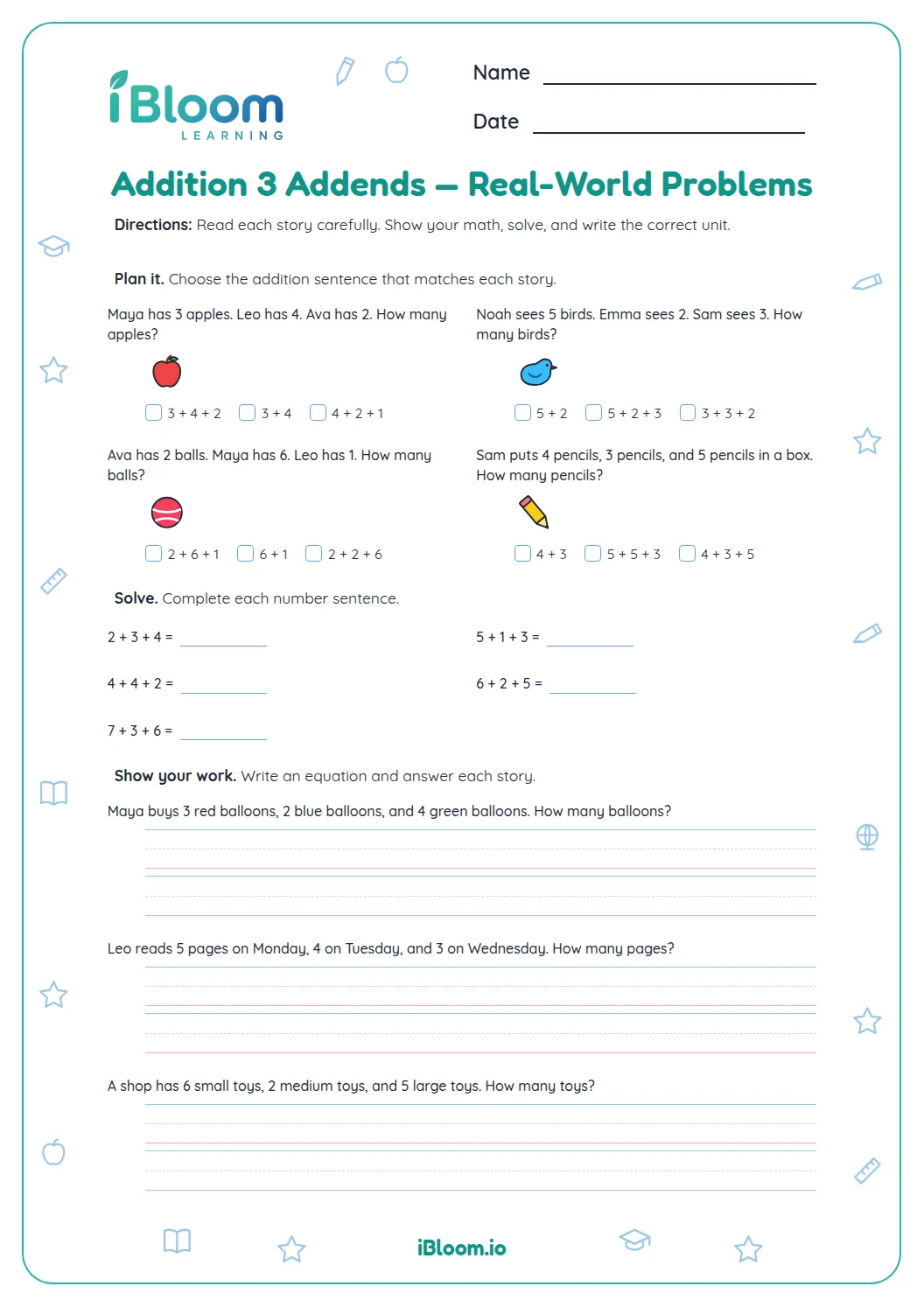
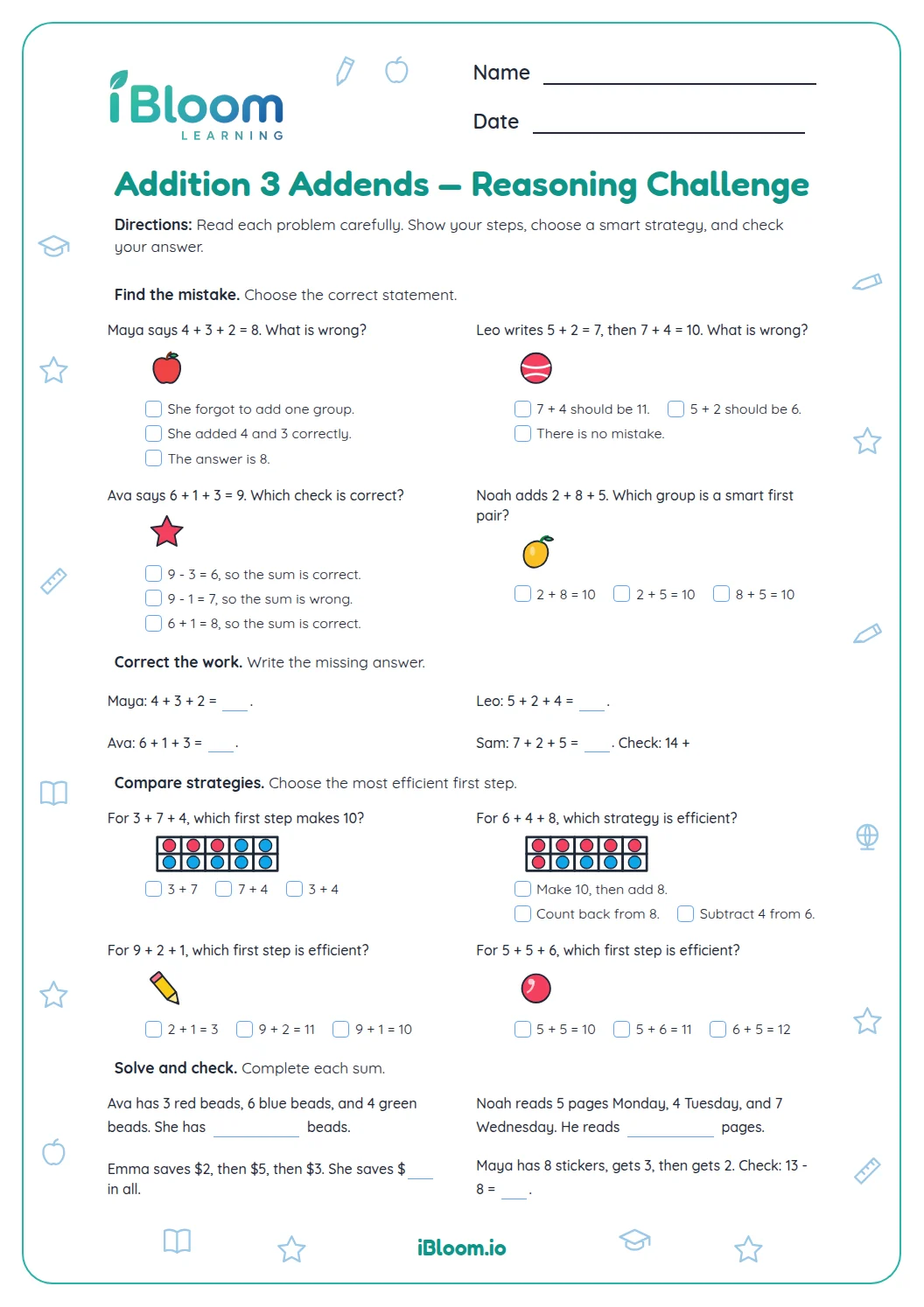
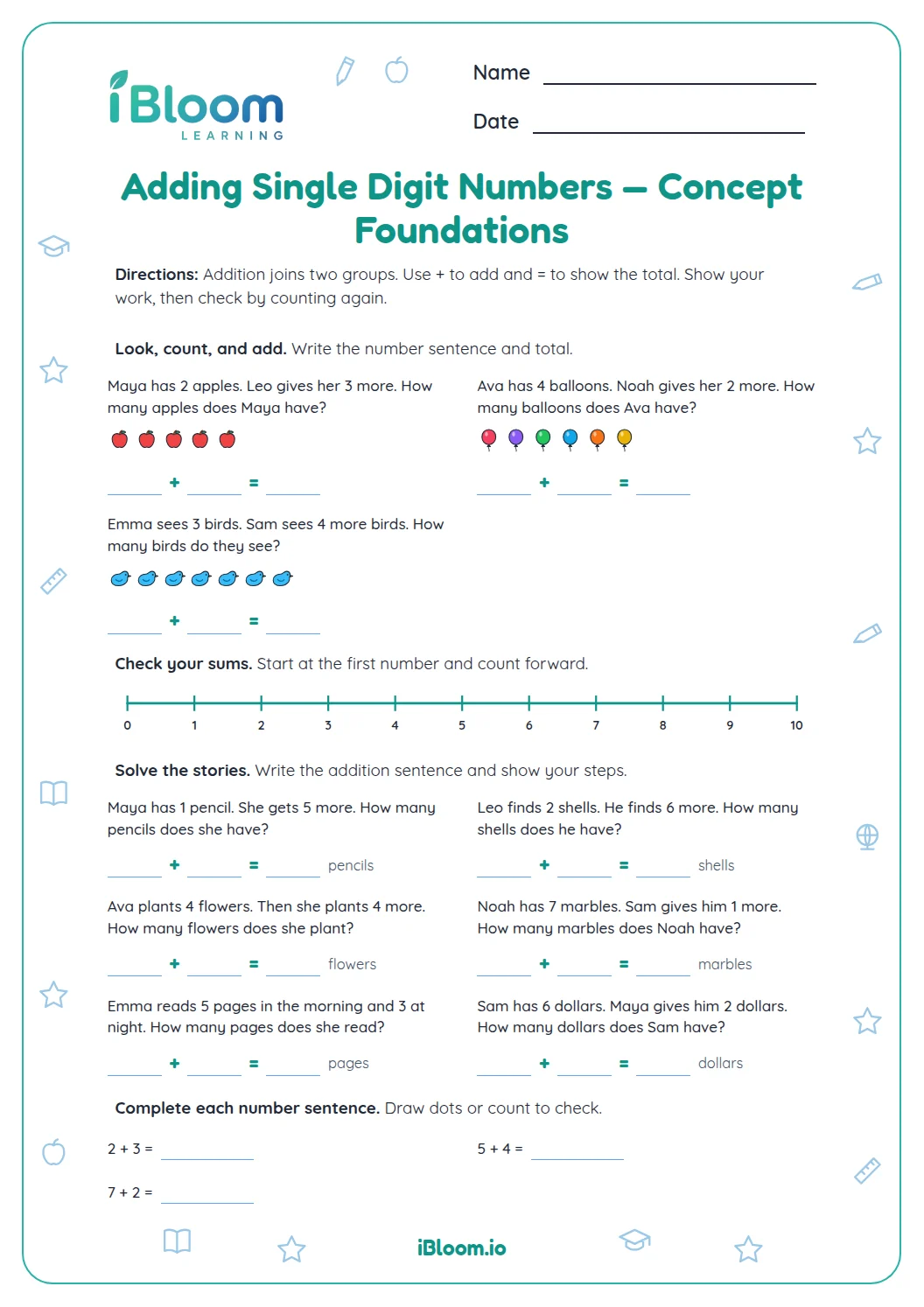




About this worksheet
This free printable Grade 1 worksheet uses 14 short problems to practice adding three groups. Children solve simple stories, look for pairs that make ten, and explain a grouping strategy. All totals are within 20, and a separate answer key lists the sums and sample pairings.
How do three addends match a story?
Each group in a story becomes one addend. Add all three groups to find how many there are altogether.
- 13 red + 2 blue + 4 green
- 23 + 2 + 4
- 35 + 4 = 9
Why look for a pair that makes ten?
Question 7 groups 2 + 8, then adds 4.
What does the final part ask?
Question 11 has 8 + 2 = 10, then 5, for 15.
How to use this worksheet
- 1Find the three groups in the story.
- 2Write one number for each group.
- 3Look for two addends that make ten when helpful.
- 4Add the third group to that total.
- 5Check that your answer includes all three groups.
Common mistakes and fixes
The mistake
Leaving out one of the three groups.
The fix
Point to each group and match it to one addend.
The mistake
Changing an addend while making a ten.
The fix
Regroup the same numbers; do not change their values.
The mistake
Stopping after adding two groups.
The fix
Check that the third addend was included in the total.
What to practice next
Make more practice
Further reading
Questions parents and teachers ask
How do three addends match a story?
Each group in the story becomes one addend. A story with 3 red kites, 2 blue kites and 4 green kites can be written 3 + 2 + 4. The sum tells how many kites there are altogether.
What does make ten mean?
It means finding two addends that combine to 10, such as 8 and 2 or 4 and 6. Add the remaining group afterward. Regrouping keeps the same three quantities. A short equation makes the three groups visible and supports checking.
Should children write equations?
The first two parts provide room to show an equation or calculation. The last part asks children to state the total and name a useful pair, so their strategy is visible. Learners can use counters or draw objects to see the groups.
Is the answer key included?
Yes. The separate key shows each total and sample make-ten pairings for the last items. A different pair works when it totals ten and the overall sum is correct. The answer key page follows the worksheet. Print the answer-key page separately for convenient checking.
How much time should I allow?
About 15 minutes is a helpful estimate. Children may take longer when drawing groups or writing equations for each story. The answer key can support a quick review after all questions are complete. Allow time to talk through a chosen strategy.