





About this worksheet
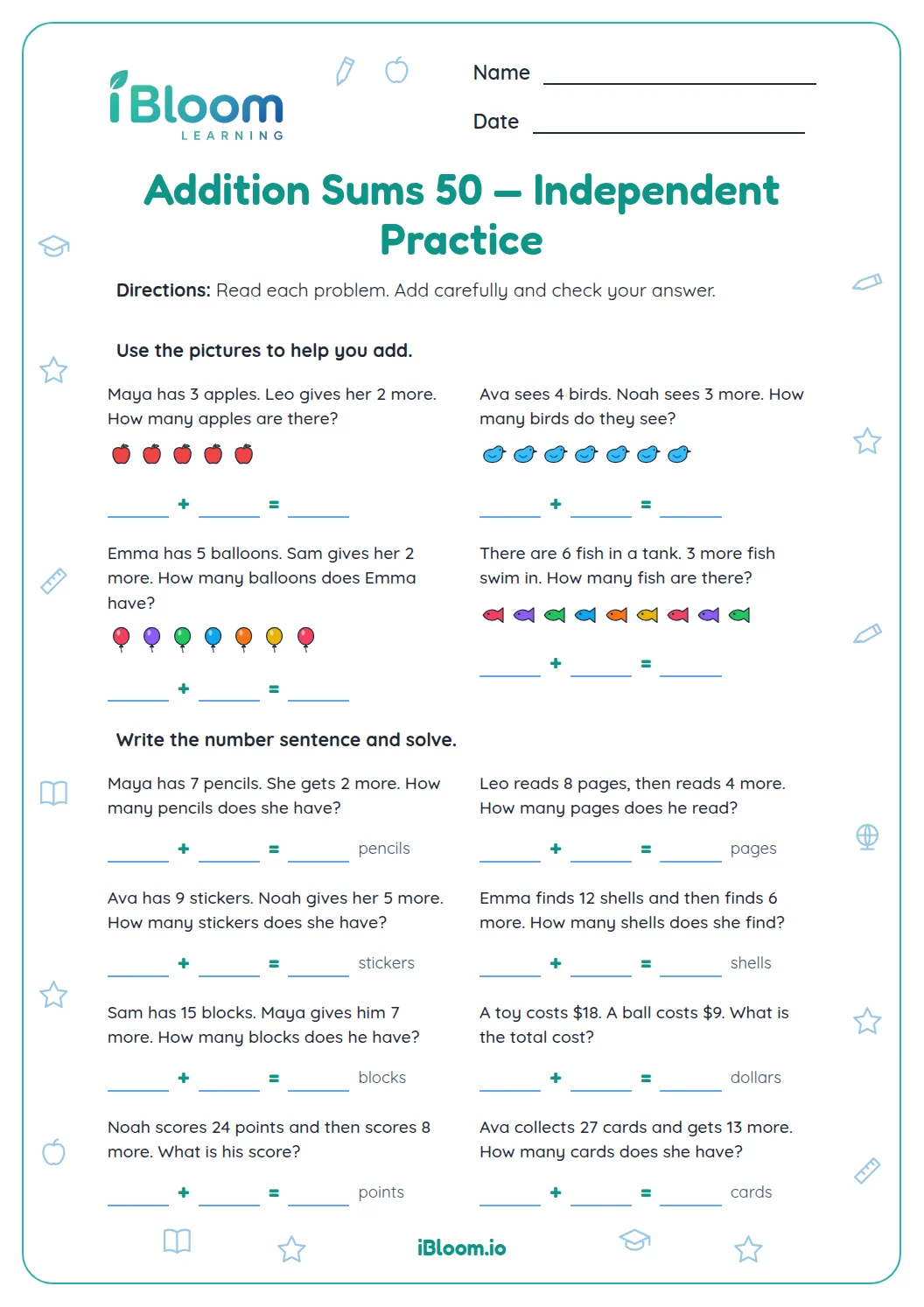
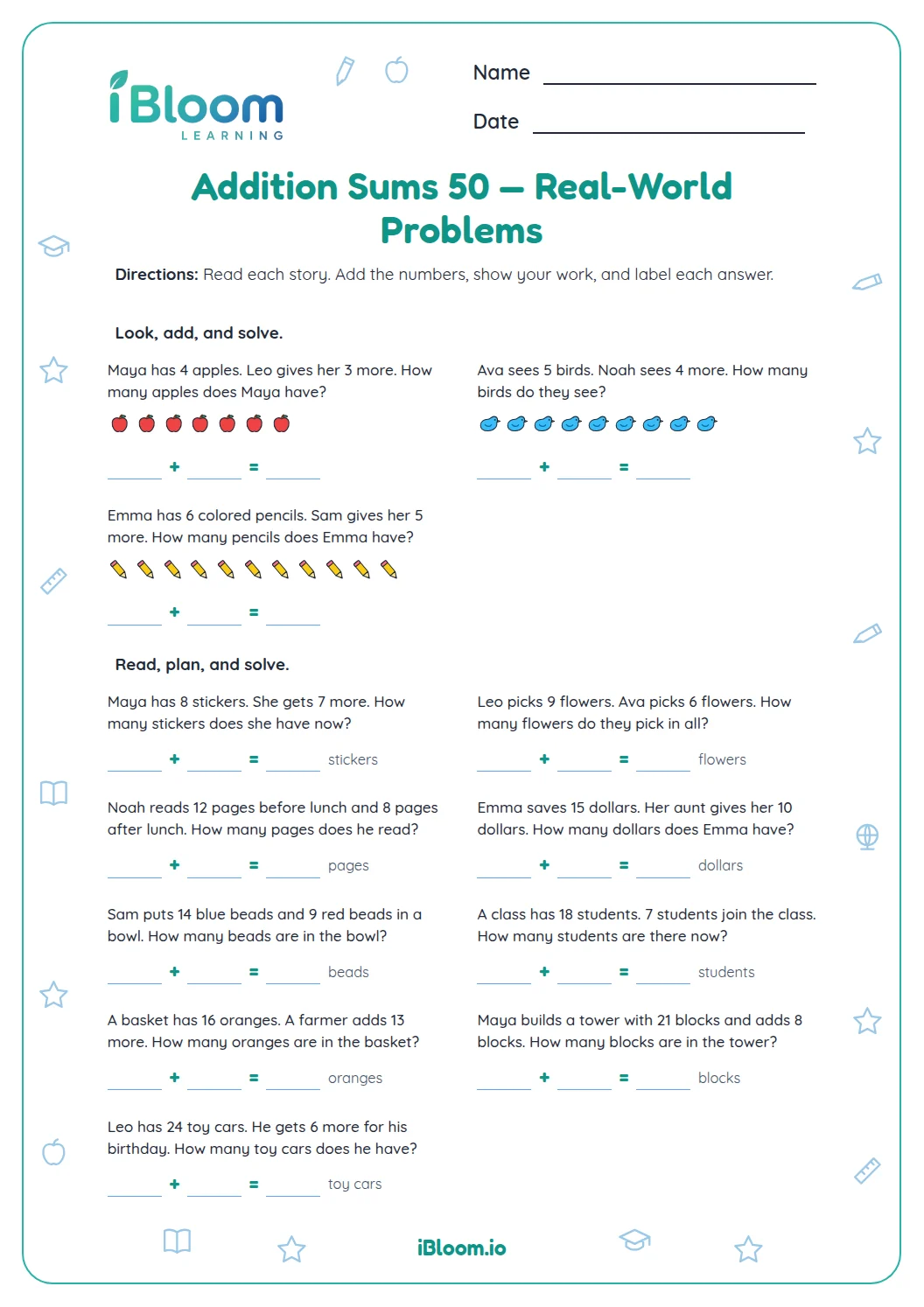
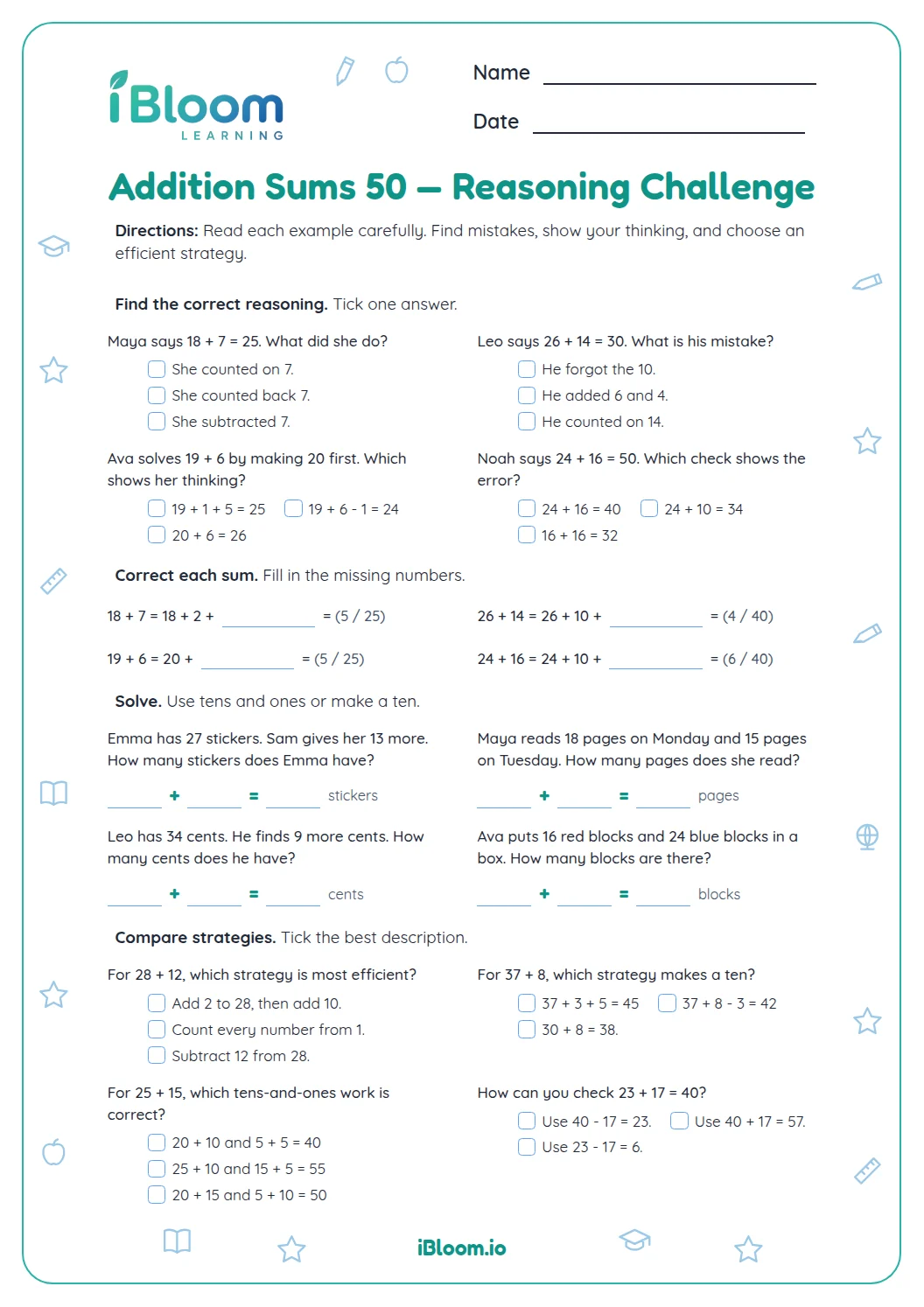
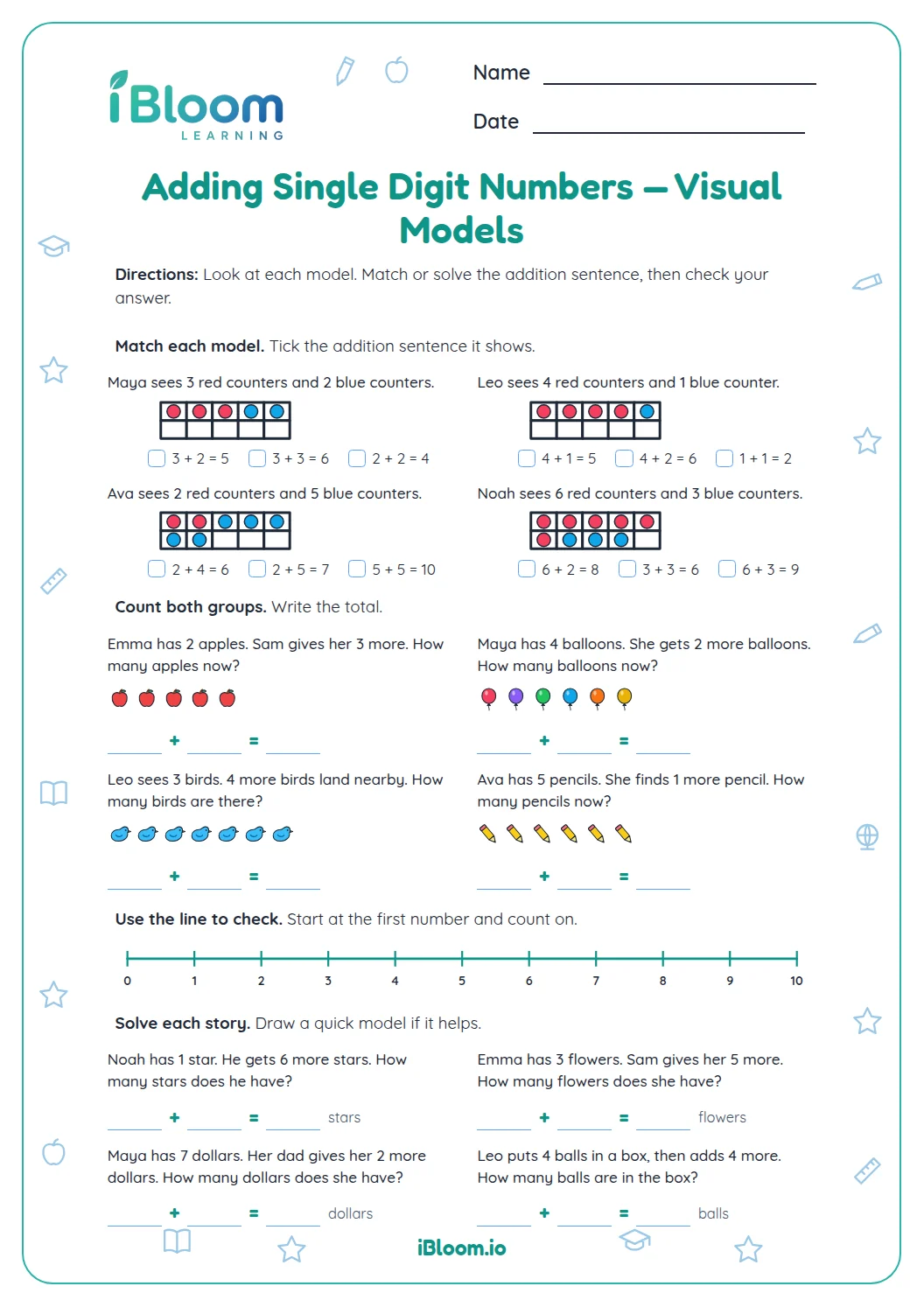
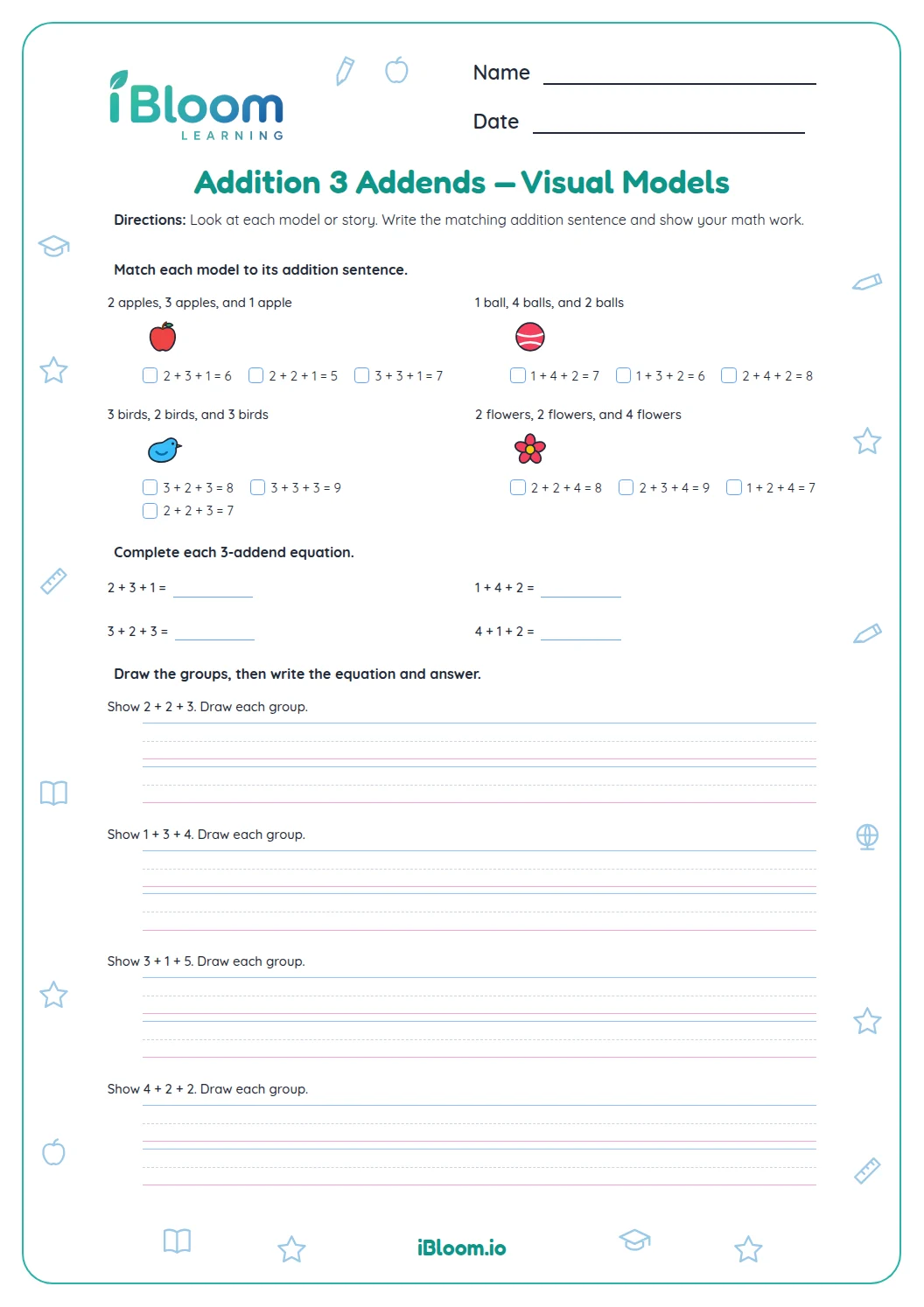
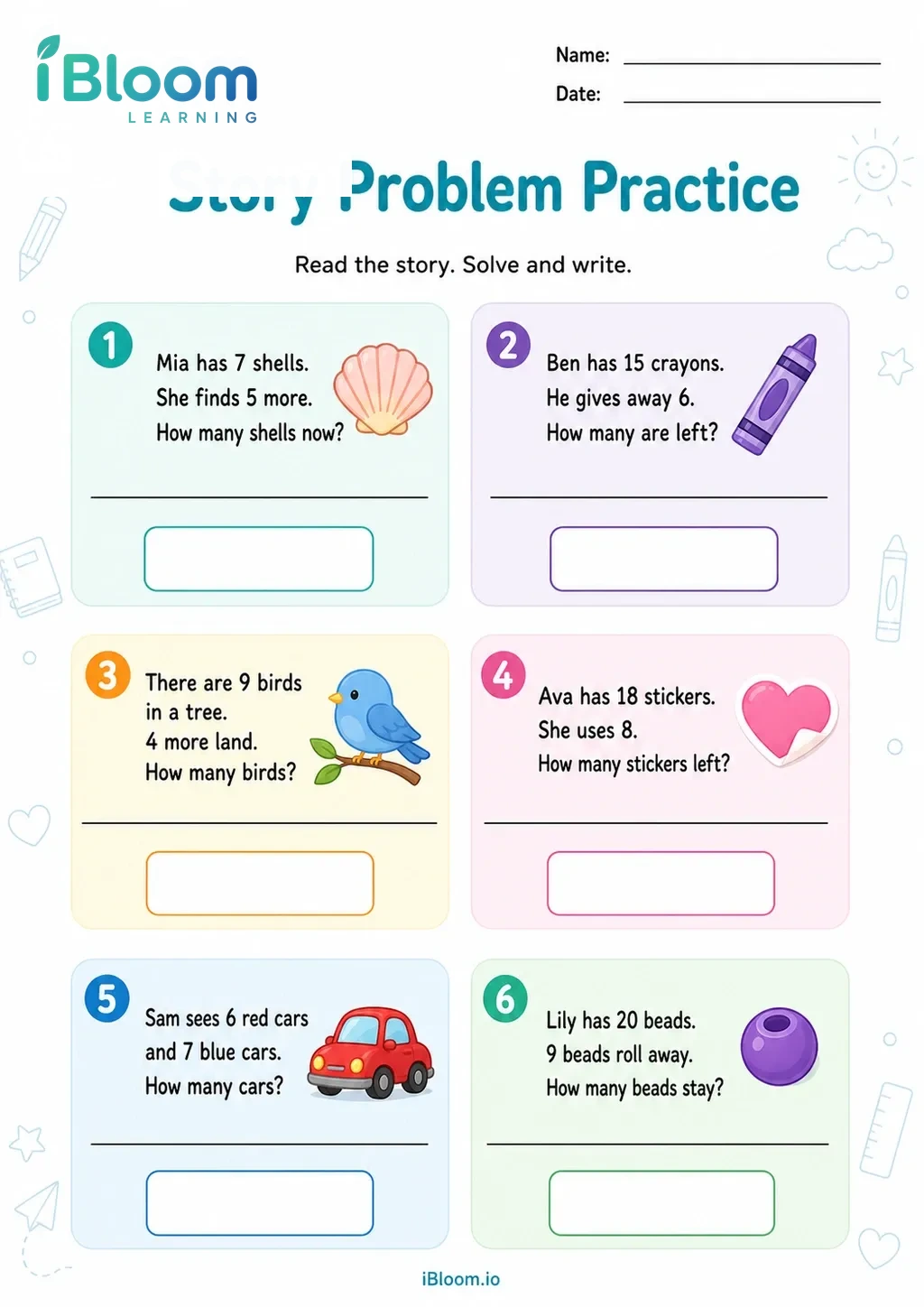
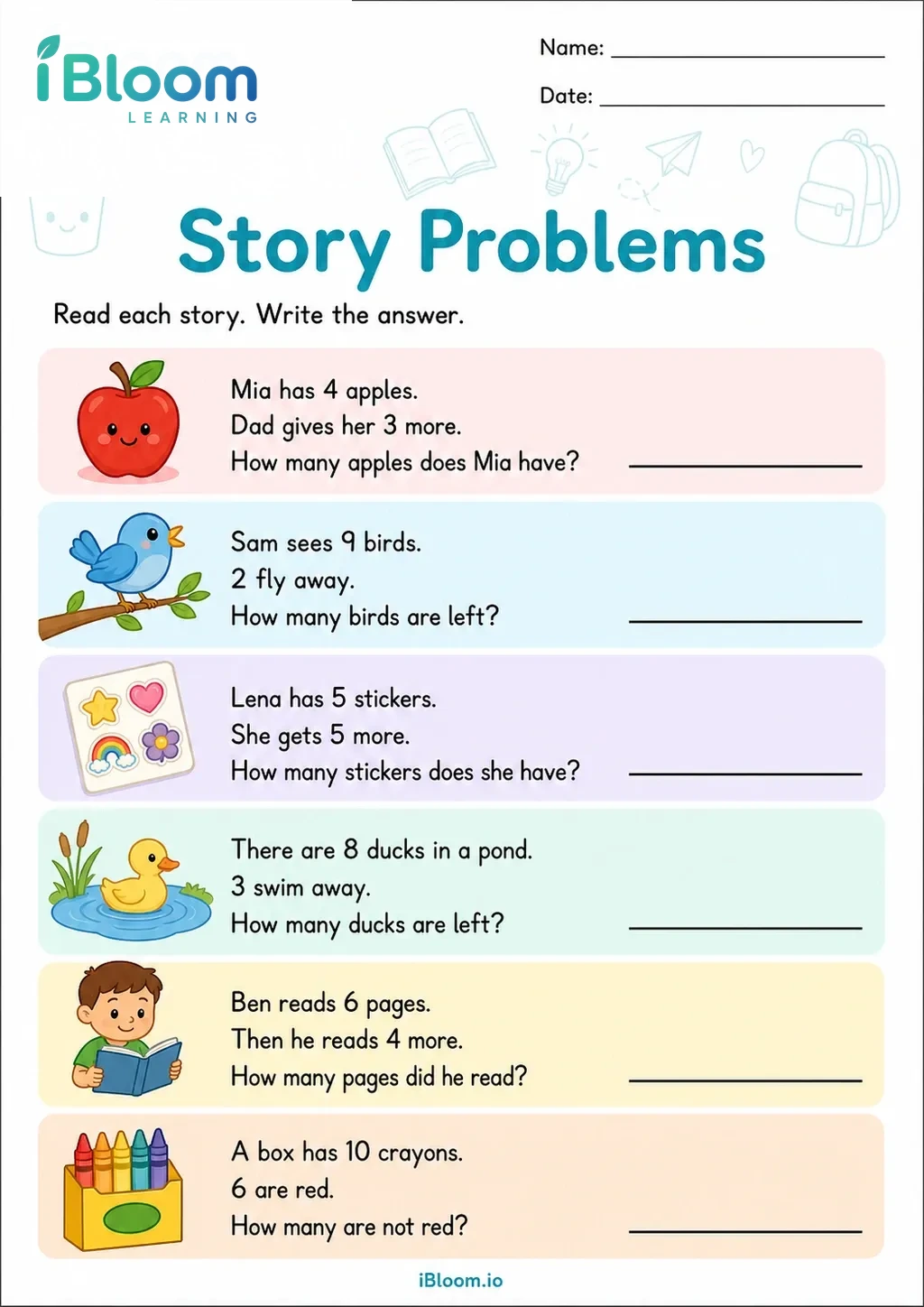
This two-page Grade 1 worksheet practices addition through short word problems with totals no greater than 50. Children begin by joining small groups, move to two-digit quantities, and finish with stories that ask for a total or a missing amount. The multiple-choice format keeps the focus on reading the situation, choosing an addition equation, and finding the sum. A separate two-page answer key lists each result. The problems practice representing addition stories under Common Core 2.OA.A.1.
Aligned to 2.OA.A.1
How do you join two groups?
Part A starts with smaller amounts. Identify the two groups in the story, add them, and choose the total. For question 1, 12 beads and 5 beads make 17 beads.
- 112 beads + 5 beads
- 212 + 5 = 17
- 3Choose 17.
How can you add tens and ones?
Part B uses larger amounts, including 23 books plus 12 books. Add tens to tens and ones to ones, then combine the partial sums to find the total.
What if the story gives a target?
Part C includes a missing-amount question: 28 stickers are already collected and 40 are needed. Find the difference between the goal and the amount already collected.
A simple plan for each story
- 1Read the question to find what is being counted.
- 2Underline the two amounts that are joined or compared.
- 3Write an addition equation, or a related missing-part equation.
- 4Find the total or missing amount.
- 5Check that the answer fits the story and is 50 or less.
Addition story checks
The mistake
Using only one amount from the story
The fix
Point to both groups and include each in the equation.
The mistake
Adding tens but forgetting the ones
The fix
For 23 + 12, combine 20 + 10 and 3 + 2.
The mistake
Adding the target and the amount already collected
The fix
For a missing part, ask what number joins 28 to make 40.
Common Core alignment
This sheet practices the following Common Core standard.
Represent addition story problems with equations and solve sums within 100.
On this sheet: Story situations ask children to join quantities and represent the total with an equation.
Show the official wordingHide the official wording
Use addition and subtraction within 100 to solve one- and two-step word problems involving situations of adding to, taking from, putting together, taking apart, and comparing, with unknowns in all positions, e.g., by using drawings and equations with a symbol for the unknown number to represent the problem.
What to practice next
Further reading
Questions parents and teachers ask
What is the answer to the first story?
Question 1 joins 12 beads and 5 beads. Add 12 + 5 to get 17 beads, then select 17 from the choices. It is a joining problem: the two amounts combine to make one total. Ask the child to identify both amounts before selecting a choice.
Are all the sums within 50?
Yes. The totals in the story problems are 50 or less, including 39 in the largest joining examples. The missing-part question gives a goal of 40 and asks how many more are needed. Read each story once for the objects and again for the question being asked.
Does the worksheet include two-digit addition?
Yes. Part B includes problems such as 23 books plus 12 books and 18 yellow flowers plus 21 white flowers. Children can add tens and ones to find the total before choosing an answer. These examples include totals above 20 while staying within the stated limit of 50.
How many questions and pages are included?
There are 14 multiple-choice story problems arranged in three parts. The practice sheet uses two pages, with a separate two-page answer key for checking the selected totals and missing amount. An adult can read the stories aloud and ask the learner to explain the chosen sum.
How should a child solve the sticker question?
The story says 28 stickers are collected and 40 are needed. Find the missing part by asking 28 + ___ = 40; the answer is 12 stickers. The missing amount is the difference between the goal and the stickers already collected.
Why does the page cite 2.OA.A.1?
This standard includes word problems about joining and taking apart quantities, with unknowns in different positions. The worksheet uses addition stories and a missing-part situation, represented by an equation such as 28 + ___ = 40. The equation shows the missing amount as an unknown addend rather than a new total.