




About this worksheet
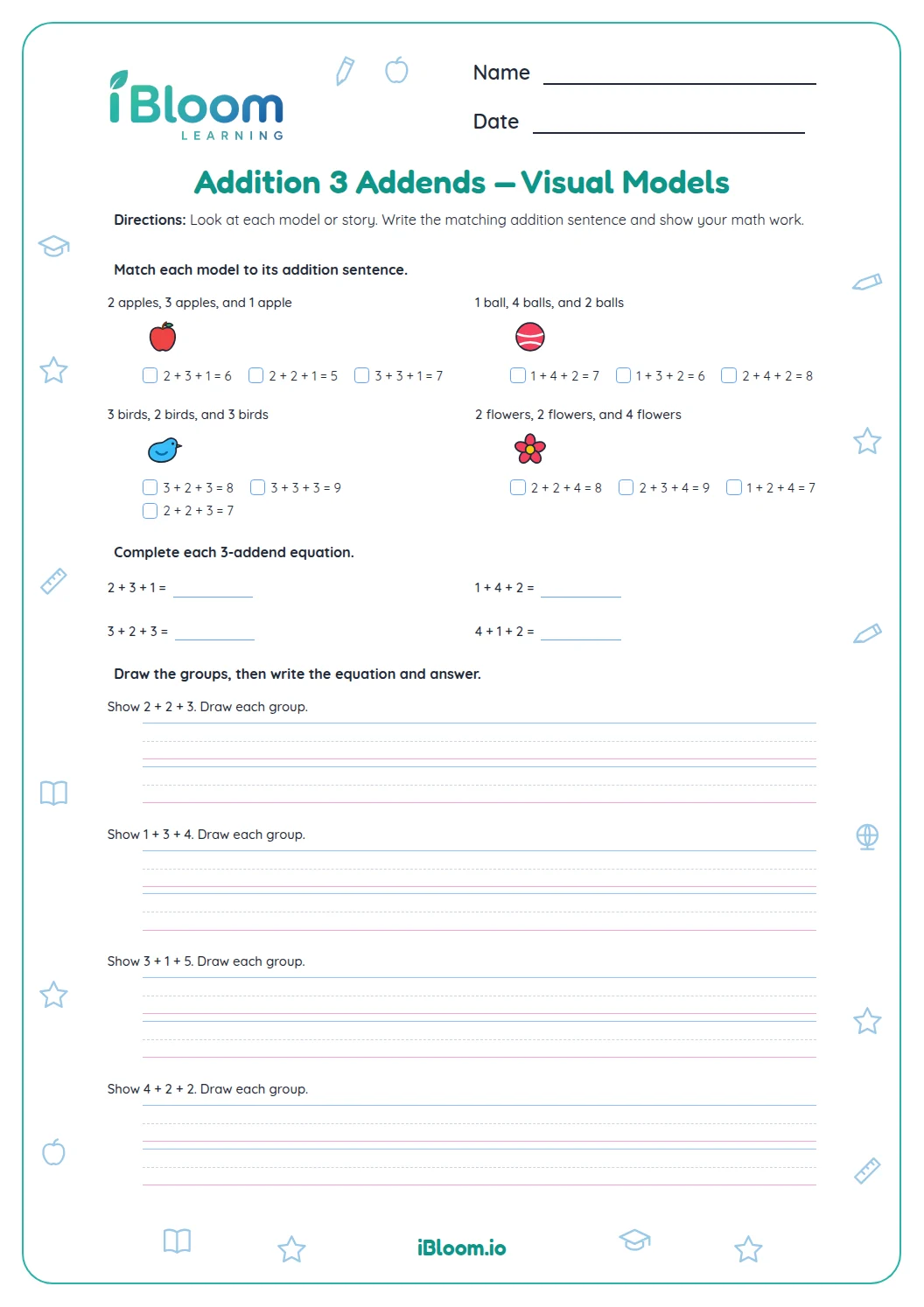
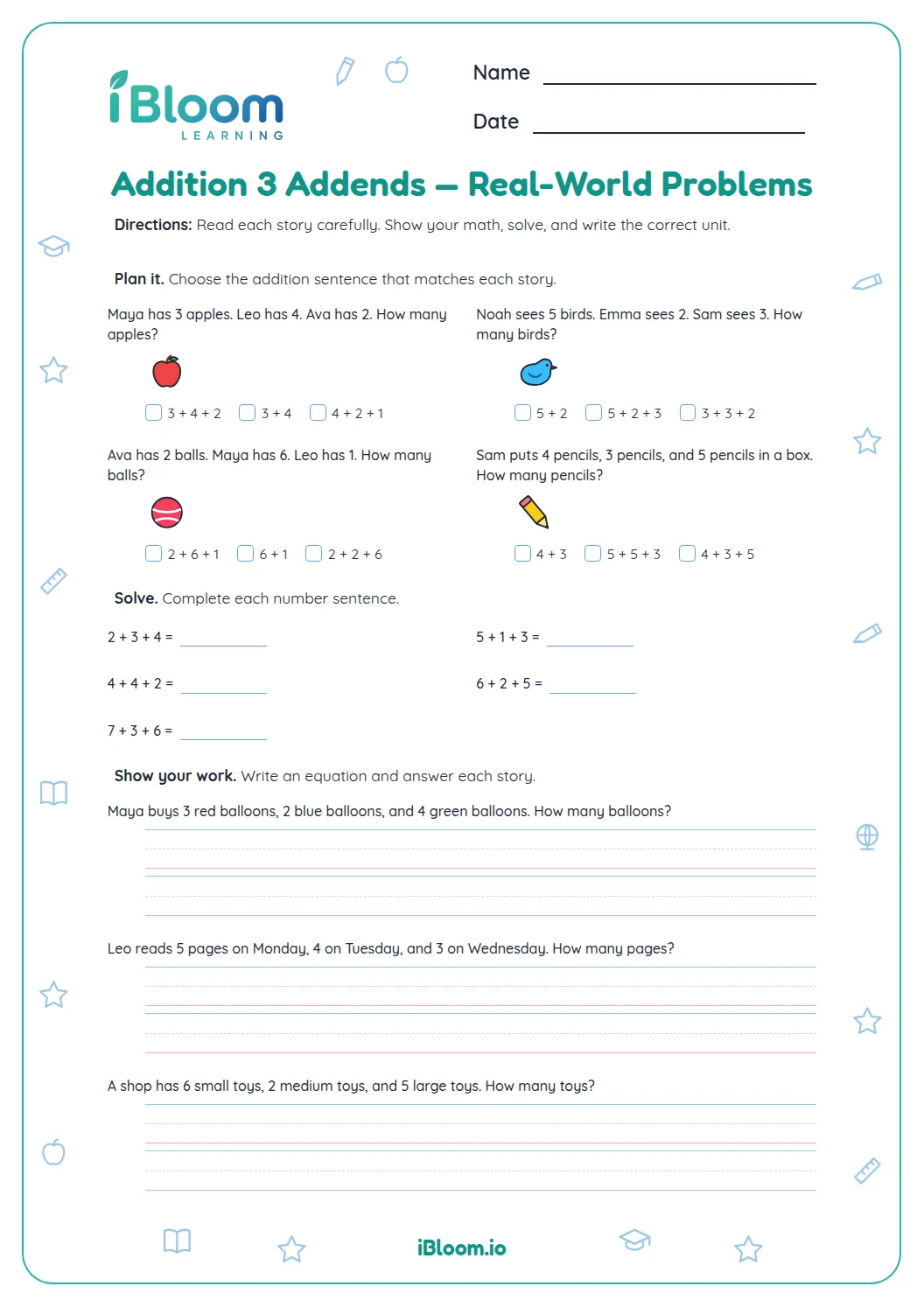
This Grade 1 printable practices addition word problems with three addends. Each story names three groups and asks for their combined total; children write an equation and solve it in the provided work space. For example, 3 red blocks, 4 blue blocks, and 2 green blocks can be recorded as 3 + 4 + 2 = 9. The 16 totals stay within 20 and use familiar contexts such as books, beads, flowers, and games. A separate answer key gives each total.
Aligned to 1.OA.A.1
What does each story ask the child to do?
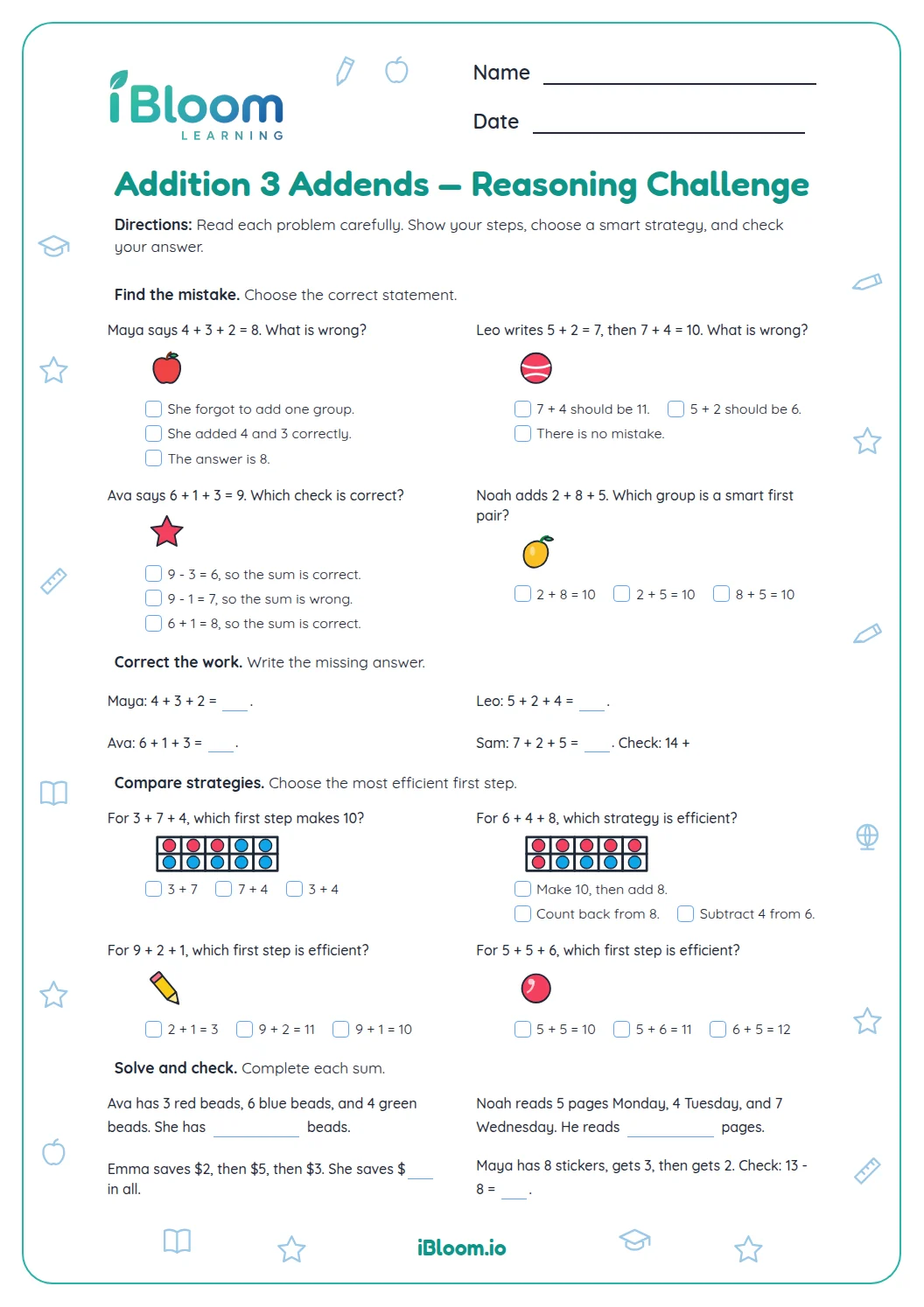
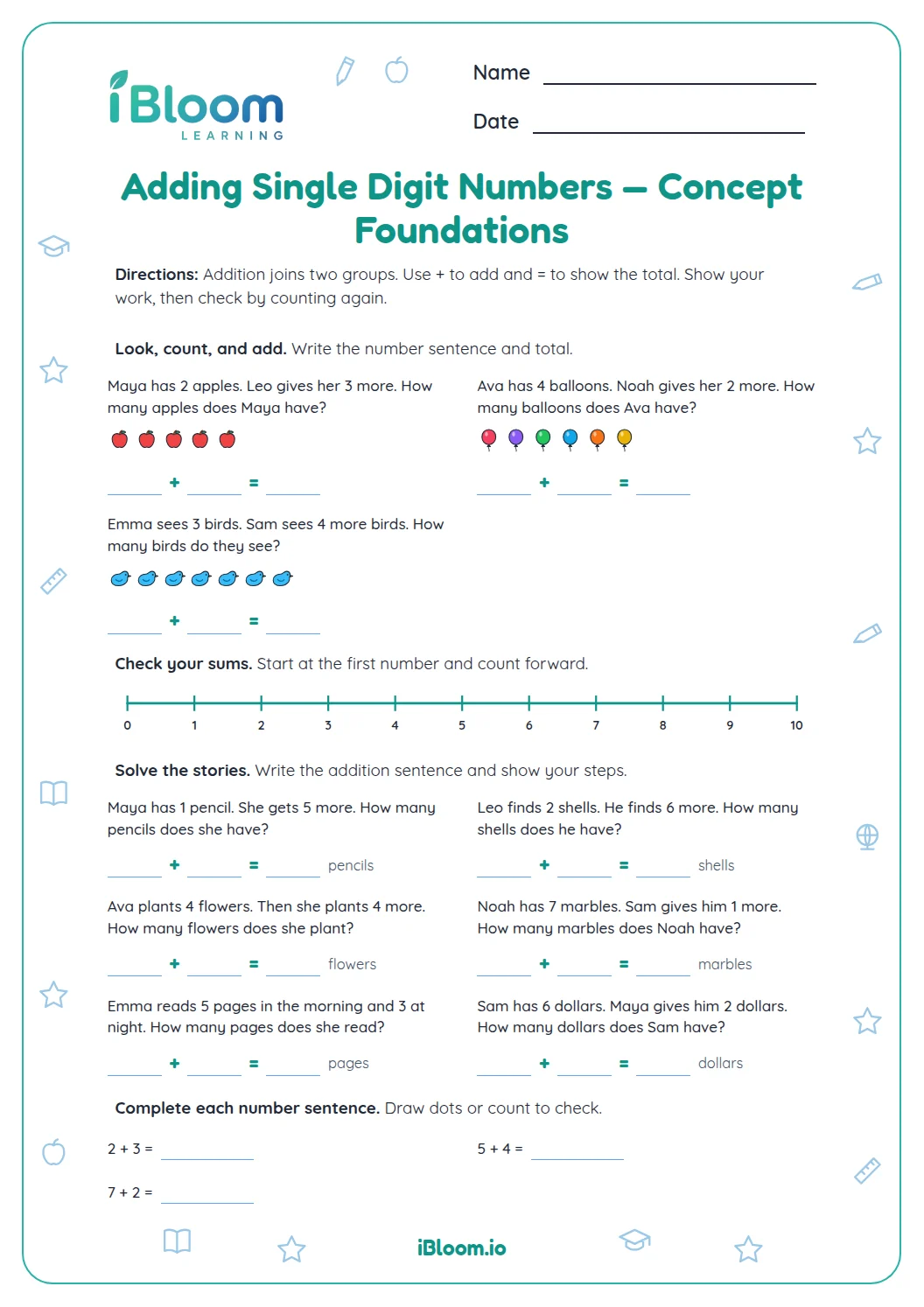
Each of the 16 problems describes three groups and asks for the total. Part A models the routine, Part B continues combining three groups, and Part C gives independent practice. Every prompt has space for an equation and its answer.
How do I turn a story into an equation?
Underline or say each amount as you read. Then write the three addends in the same order and find the total.
- 13 red blocks + 4 blue blocks + 2 green blocks = 9 blocks
- 23 + 4 + 2 = 9
How can a child check the total?
Add two groups first, then include the third. Check that all three amounts from the story appear once in the equation and that the answer names the total requested.
How to solve a three-group story
- 1Read the question to find what total it asks for.
- 2Identify the three amounts in the story.
- 3Write an addition equation with all three addends.
- 4Add two numbers, then add the third.
- 5Write the total with the requested unit or object.
- 6Reread the story and check that each group is included.
Common mistakes and quick fixes
The mistake
Leaving one of the three groups out.
The fix
Point to each amount in the story as it is written into the equation.
The mistake
Adding only the first two numbers.
The fix
After the first sum, bring down the third addend and add it too.
The mistake
Giving a total for just one kind of item when the story asks for all items.
The fix
Check the final question and include every group it names.
Common Core alignment
Solve addition word problems with three whole-number addends within 20.
On this sheet: Every story problem combines three groups and asks for their total within 20.
Show the official wordingHide the official wording
Use addition and subtraction within 20 to solve word problems involving situations of adding to, taking from, putting together, taking apart, and comparing, with unknowns in all positions, e.g., by using objects, drawings, and equations with a symbol for the unknown number to represent the problem.
What to practice next
Make more practice
Further reading
Questions parents and teachers ask
What does “three addends” mean?
An addend is a number being added. A three-addend equation has three numbers to combine, such as 3 + 4 + 2 = 9. Each story on these pages gives three groups and asks children to find their total together.
Do children need to write an equation for each story?
Yes. The directions ask children to write an addition equation and find each total. Writing all three addends helps show that every group in the story was included before the child records the answer. Work space is provided for writing the equation and solving it.
Are the totals appropriate for Grade 1?
The 16 stories use sums from 9 to 16, within 20. The contexts use small whole-number groups, so children can focus on representing a story with addition and combining three addends. The separate key gives the total for each story.
How can I help without solving the problem?
Ask the child to point out the three groups and say how many are in each one. Then invite them to write those amounts as an equation and solve it. The key can be used afterward to check the total.
How long does the worksheet take?
Plan for about 20 minutes for 16 story problems, equation writing, and answer checking. Children can complete one part at a time; reading a story aloud can help them focus on identifying all three groups and choosing the operation the story describes.