
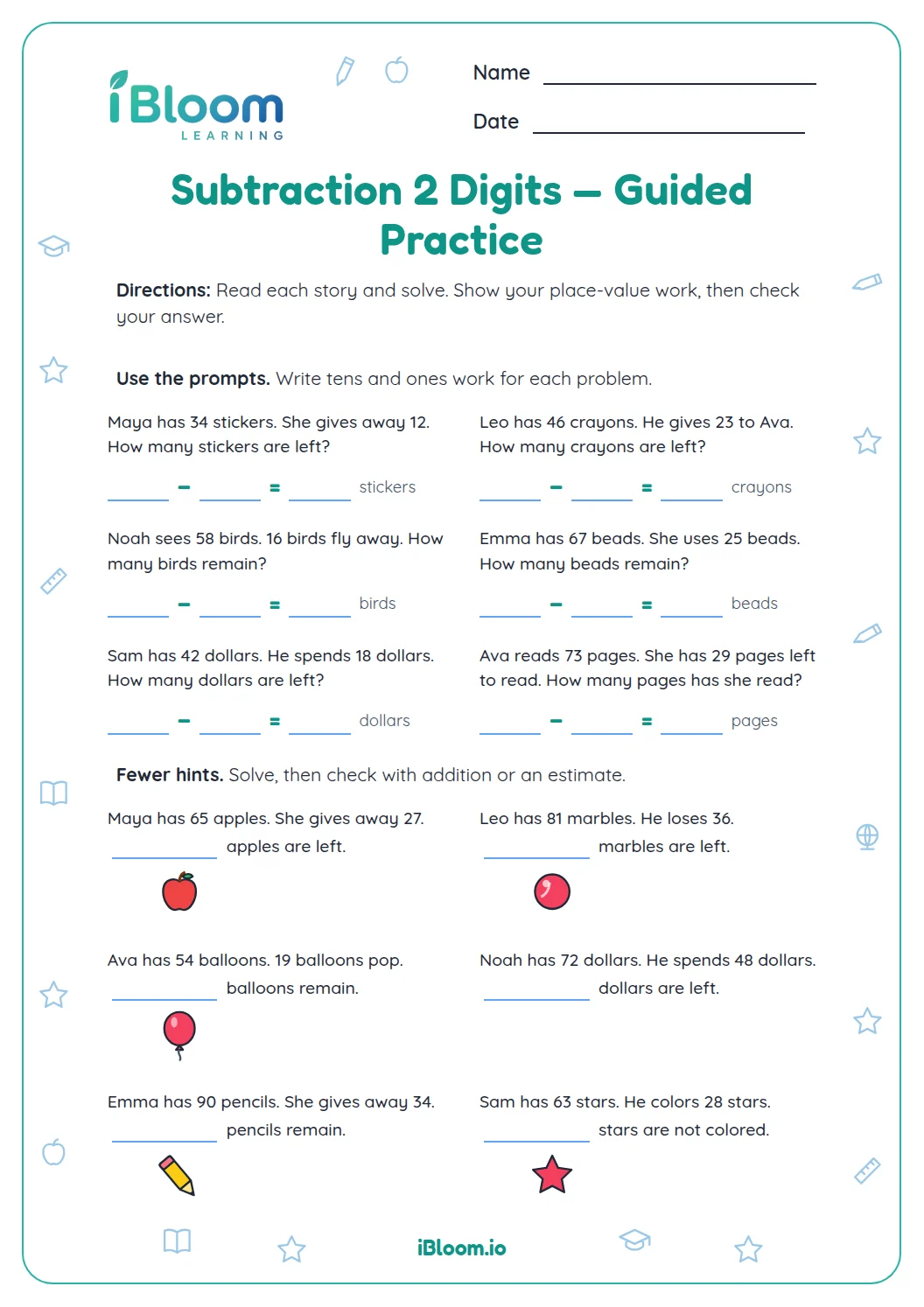
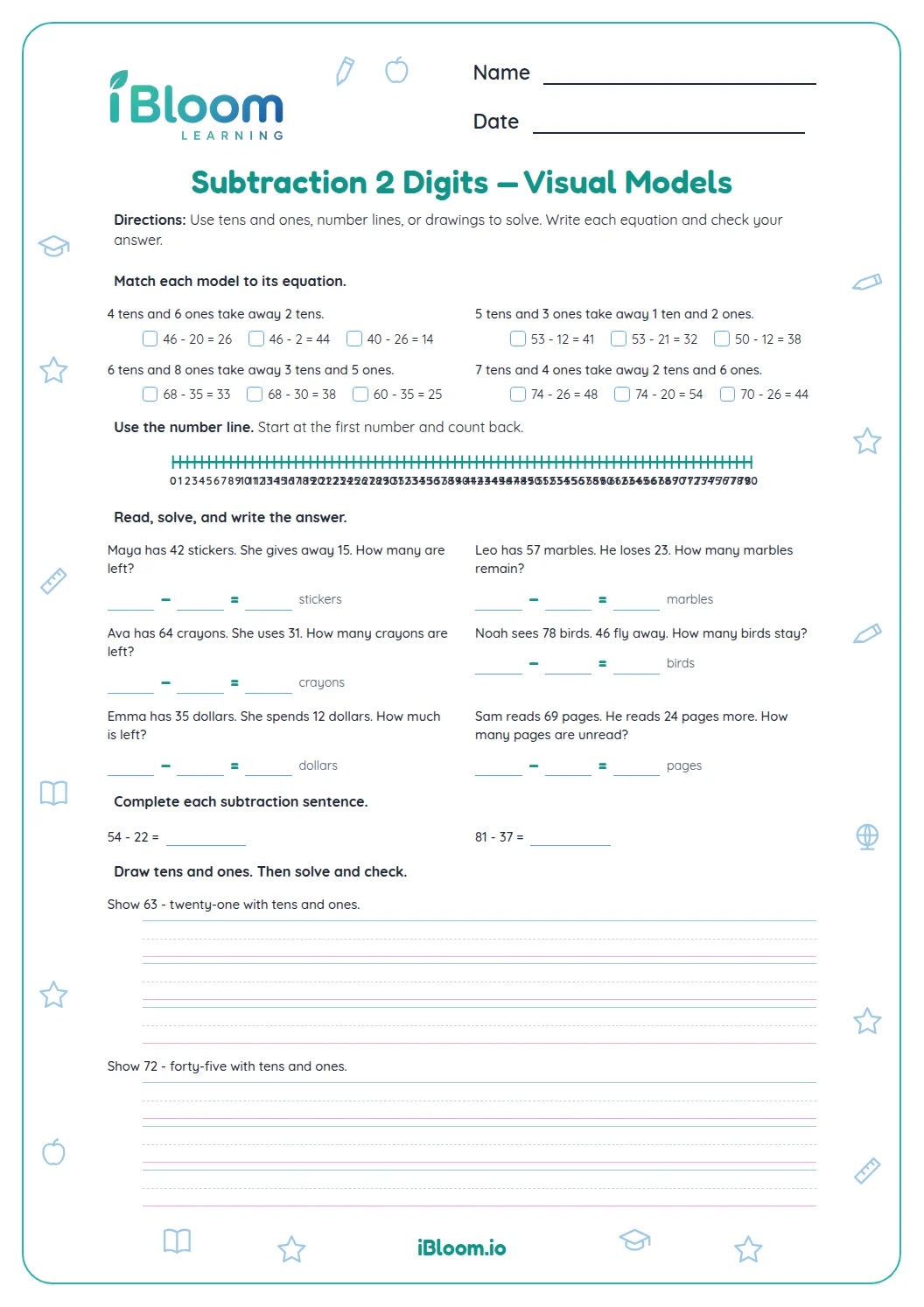
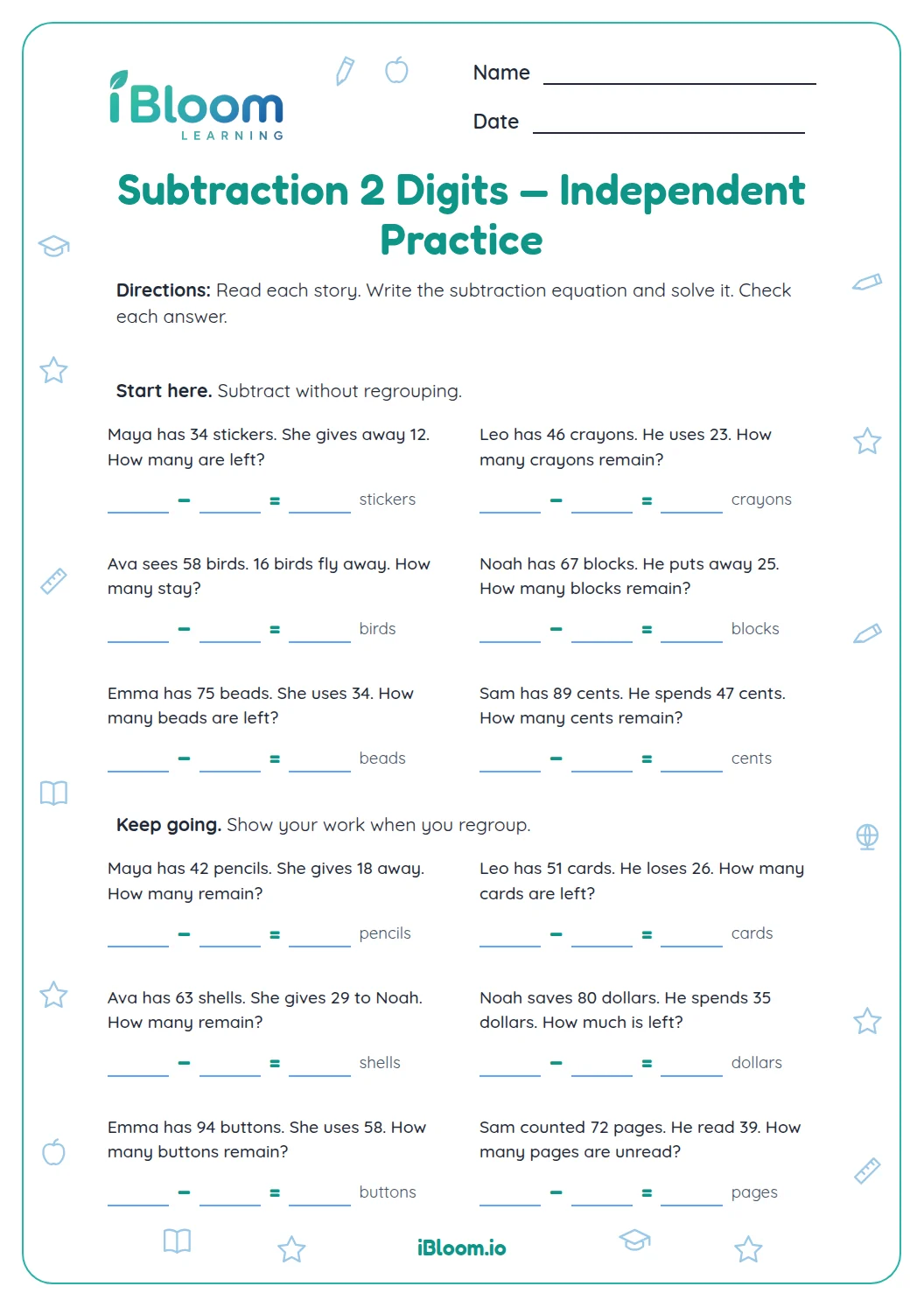
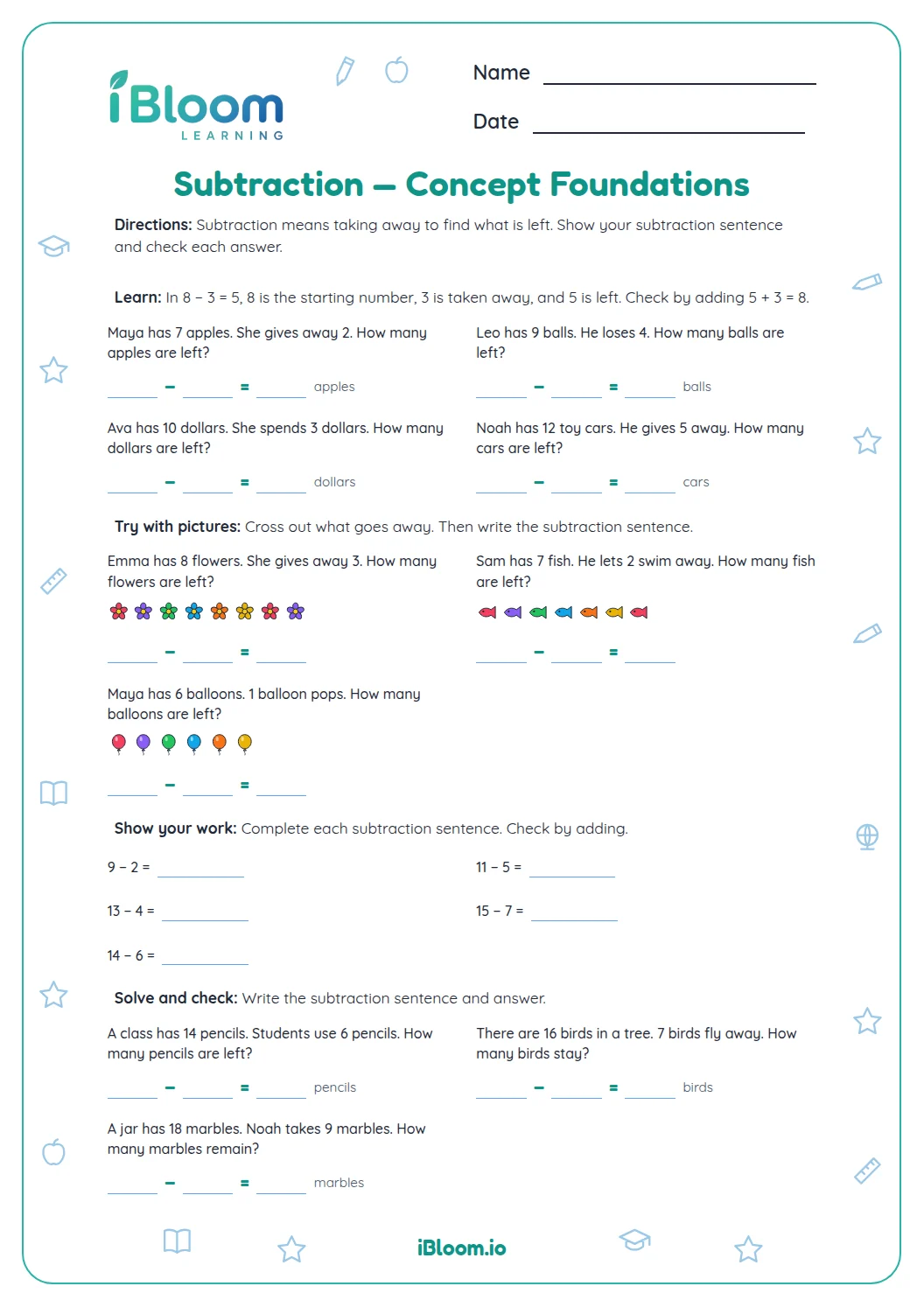



About this worksheet
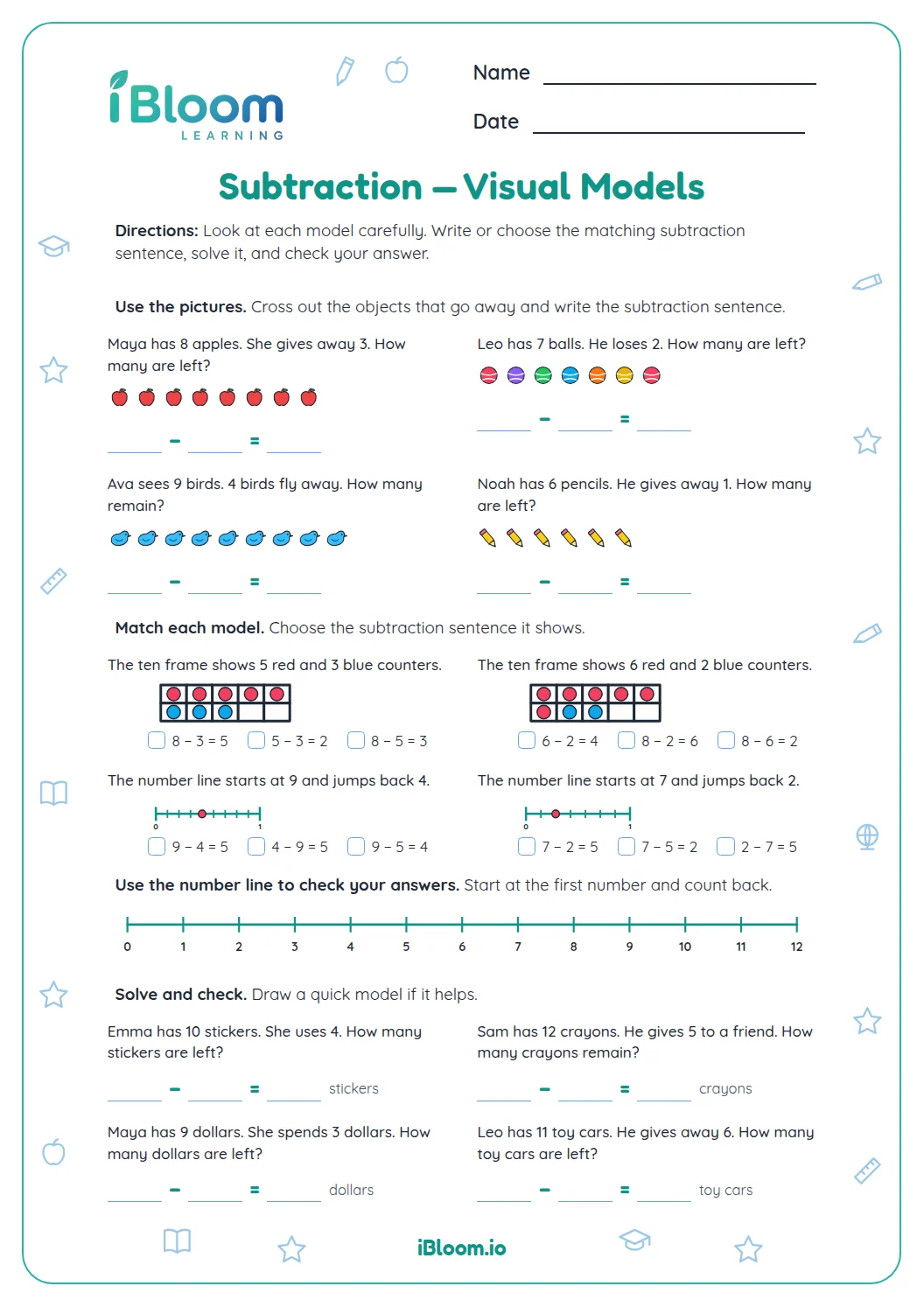
Each story uses multiples of ten so children can focus on what the action removes and what remains. Learners write a subtraction equation, solve it, and check by adding the difference back.
Aligned to 1.NBT.C.6
What is on this subtraction worksheet?
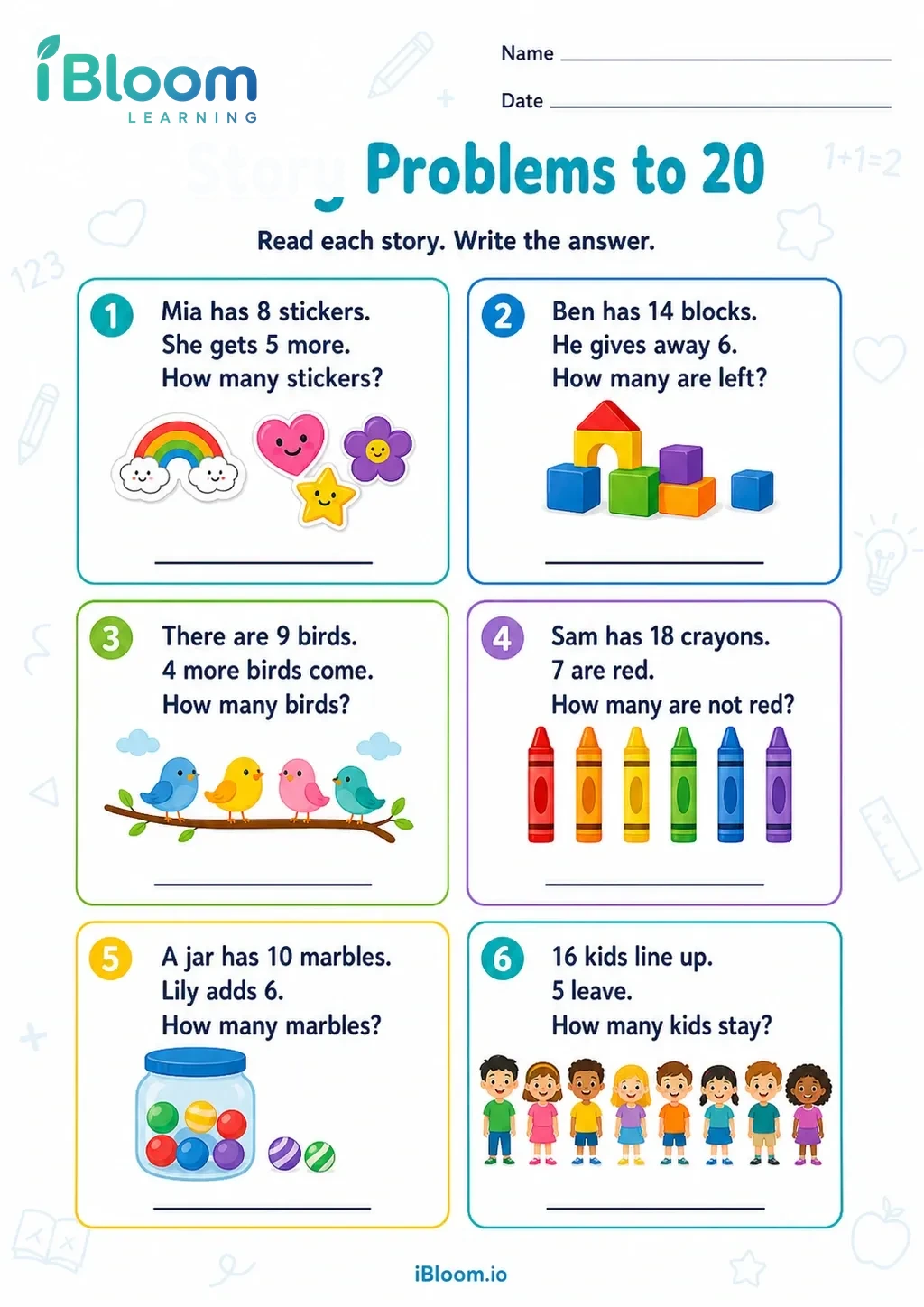
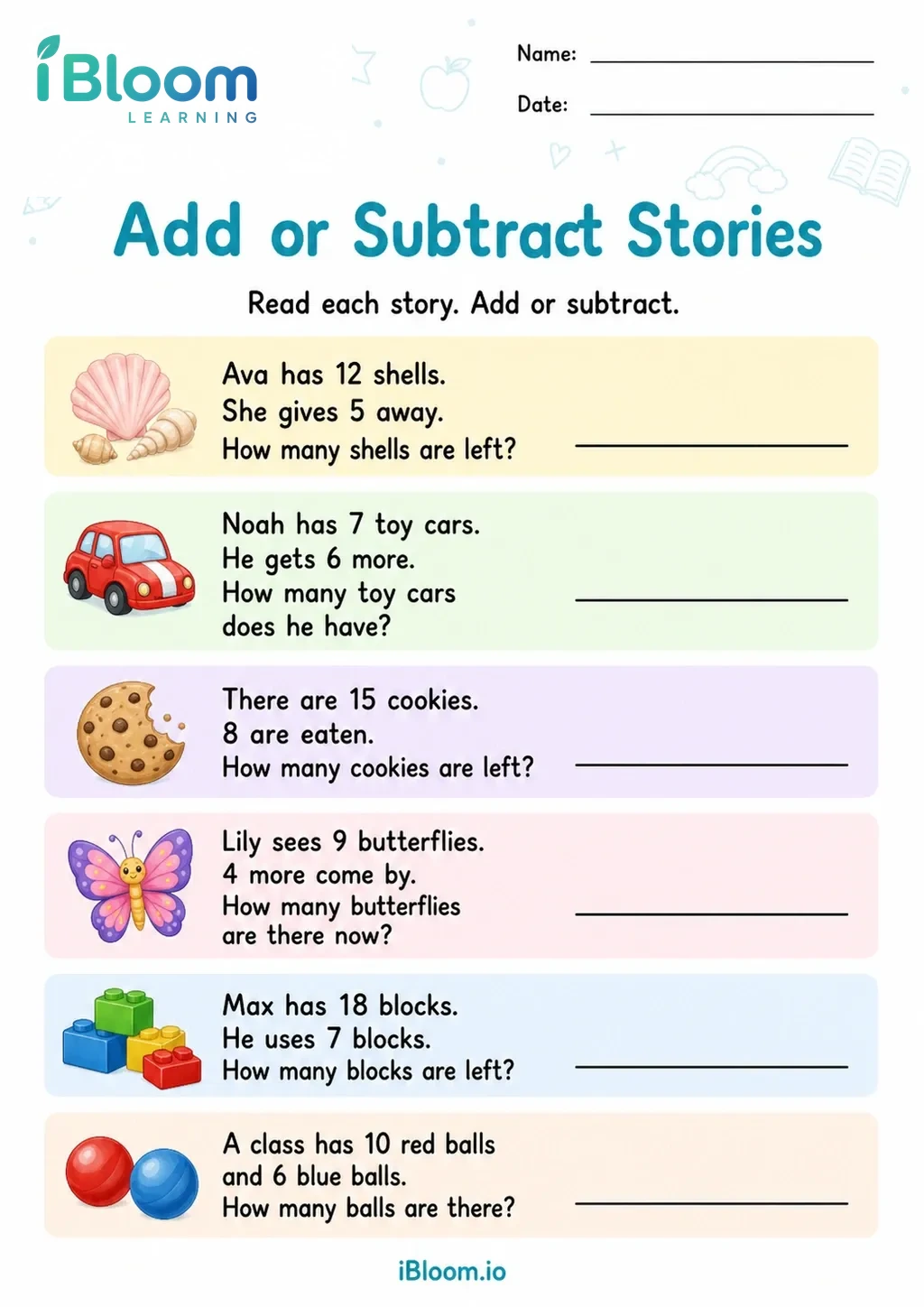
Fourteen short stories give a starting amount and an amount used, borrowed, sold, or moved. Every number is a multiple of ten, so learners can subtract tens and write an equation in the work space.
- Two-digit multiples of ten only
- Stories ask what remains, stays, or is still unused
- The second part encourages checking by addition
A helpful way to think it through
For q1, 80 crayons − 30 used = 50 crayons left. Check by adding back: 50 + 30 = 80.
How can learners check a subtraction answer?
After finding what remains, add the amount taken away back to the answer. For example, if 80 crayons start and 30 are used, 50 remain; 50 + 30 returns to 80. The stories on this sheet use multiples of ten and provide work space for an equation.
Help a learner make sense of the story
- 1Ask what the story starts with and what changes.
- 2Write the starting amount first, then subtract the amount used, borrowed, or moved.
- 3For Part A, think in groups of ten: 80 take away 30 leaves 5 tens.
- 4Check by adding the amount taken away to the answer.
Common mix-ups
The mistake
Subtracting the starting amount from the amount used.
The fix
The starting amount is the whole collection, so write it first in the subtraction equation.
The mistake
Reading 80 − 30 as 8 − 3 and writing 5.
The fix
Keep the tens unit in mind: 8 tens minus 3 tens is 5 tens, or 50.
The mistake
Giving the amount taken away instead of the amount left.
The fix
Reread the question at the end and answer what remains.
Common Core alignment
The stories keep the arithmetic within the Grade 1 focus on subtracting tens with concrete or visual thinking.
Subtract multiples of 10 within 100.
On this sheet: Each problem subtracts one multiple of ten from another and invites an equation and a check with addition.
Show the official wordingHide the official wording
Subtract multiples of 10 in the range 10-90 from multiples of 10 in the range 10-90 (positive or zero differences), using concrete models or drawings and strategies based on place value, properties of operations, and/or the relationship between addition and subtraction; relate the strategy to a written method and explain the reasoning used.
What to practice next
Make more practice
Further reading
Questions parents and teachers ask
Why are all the numbers multiples of ten?
Groups of ten help Grade 1 learners connect subtraction to place value. For example, 80 minus 30 means eight tens minus three tens, which leaves five tens, or 50. This keeps the arithmetic focused on the tens strategy and makes the story easier to model.
Should the learner write an equation for each story?
Yes. The work space is for a subtraction equation and the answer. Encourage the learner to name the starting amount first, then the amount that is taken away, before finding what remains. Adding those two amounts back together is a helpful check.
What grade is this subtraction worksheet for?
This page is intended for Grade 1 practice with two-digit subtraction stories. Each subtraction uses multiples of ten, so children can focus on interpreting the situation and using tens. It is also useful as an early place-value review.
Is an answer key included with the worksheet?
Yes. The separate answer key lists the remaining amount for all fourteen stories. Learners can also check by adding the amount used or removed back to the amount left. This gives families a quick way to review the math together.
How many problems are included?
The worksheet has 14 subtraction stories across three worksheet pages. Each asks for the amount that remains or is still available, and its work space supports an equation. The separate answer key spans three pages and gives the result for each story.
Why are the problems about groups of ten?
The numbers are multiples of ten, such as 80 and 30. This lets a Grade 1 learner think of eight tens take away three tens, which leaves five tens. The stories keep that place-value relationship visible while practicing subtraction in context.