





About this worksheet
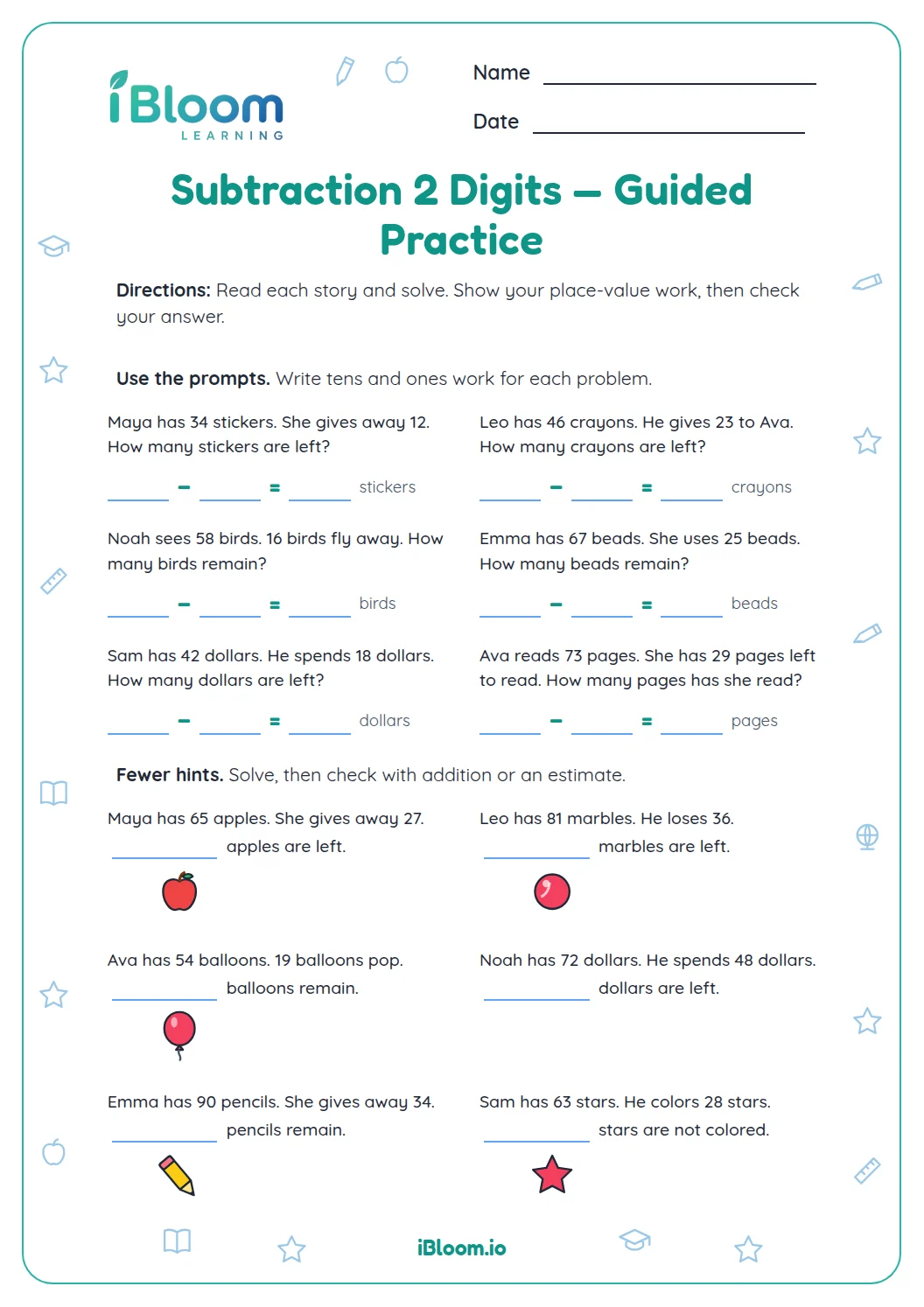
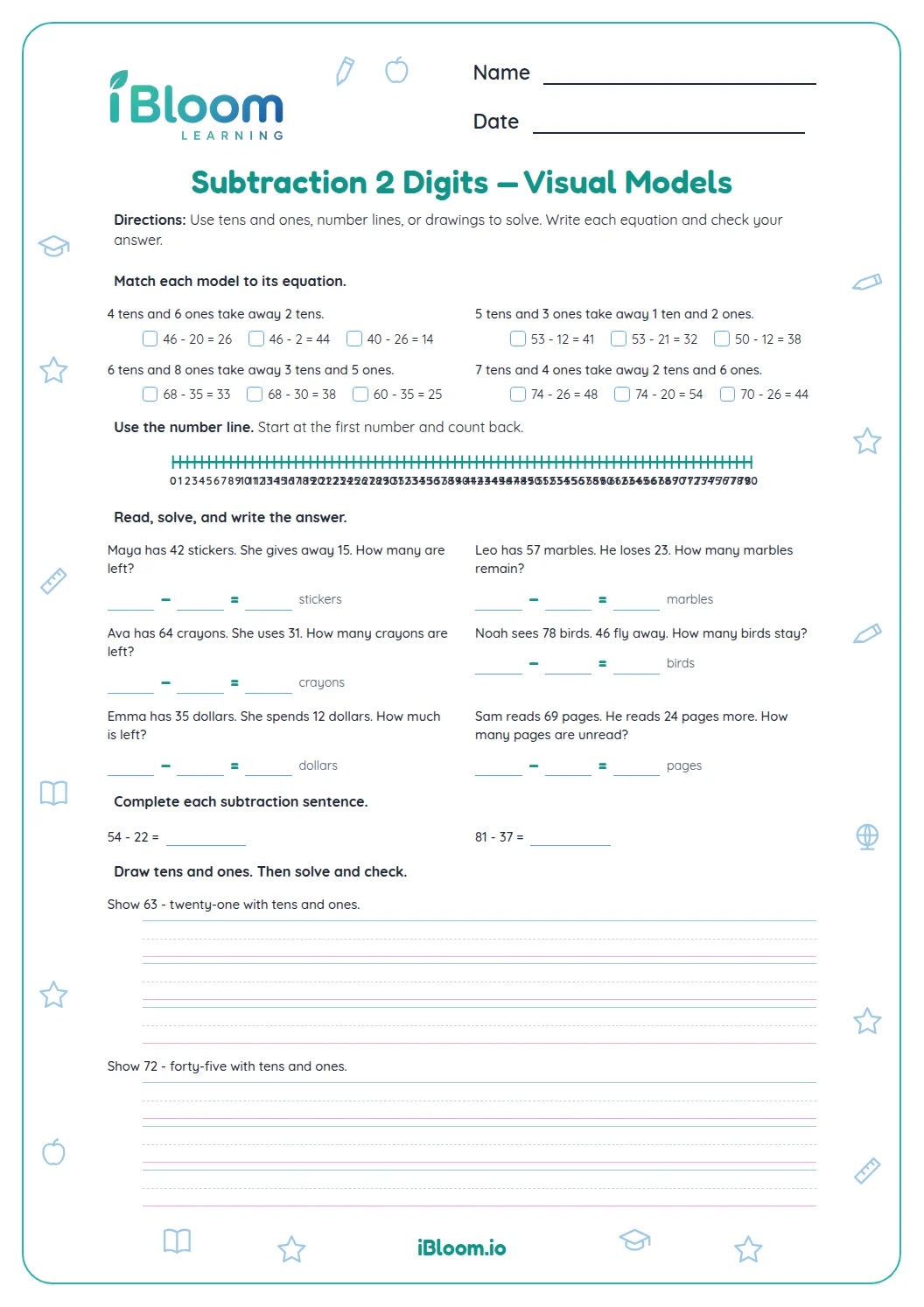
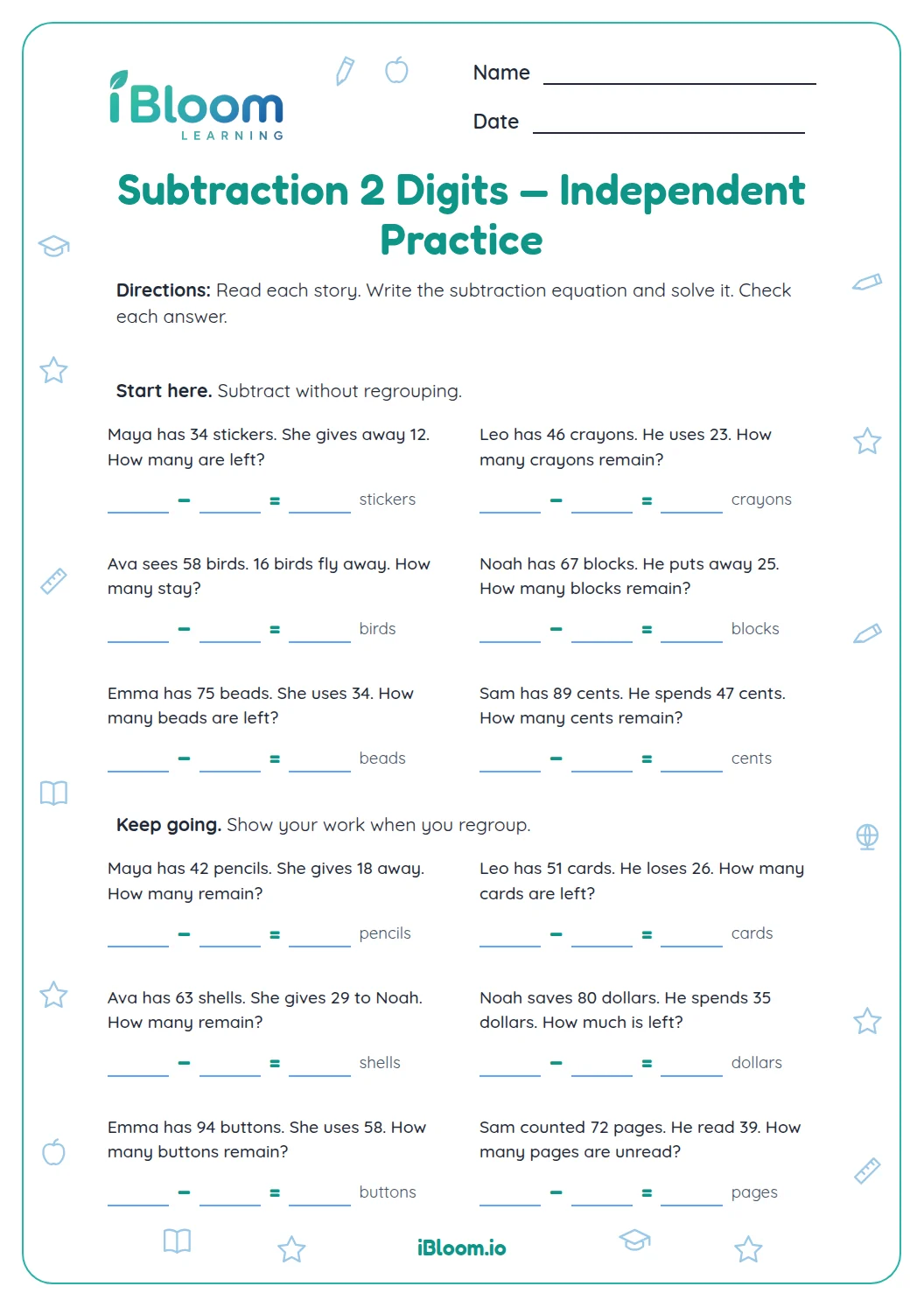
This two-page challenge gives Grade 1 students 14 short word problems using two-digit subtraction within 100. Each story describes an amount and some of it being used, borrowed, lost, or taken away; students find what remains and label the answer with its unit. The problems include cases that require regrouping as well as subtraction without regrouping. A separate two-page key lists the differences. Students may use place-value drawings or equations, then check by adding the difference to the amount removed.
Aligned to 2.NBT.B.5
How can a story show that subtraction is needed?
Find the starting amount, then identify the part that is used, borrowed, sold, or otherwise removed. The question asks what is left, so subtract the removed amount from the start. Question 1 begins with 54 crayons and removes 21.
Break 21 into 20 and 1: 54 − 20 = 34, then 34 − 1 = 33. So 33 crayons remain. This place-value method keeps the tens and ones visible.
- 154 − 21 = 33 crayons
- 2Check: 33 + 21 = 54
How can addition check the difference?
Add the amount left to the amount removed. The total should match the starting amount. For question 1, 33 crayons plus the 21 used crayons rebuild the original 54.
Some problems require regrouping when the ones in the starting amount are smaller than the ones removed. Rename one ten as ten ones, subtract, and keep the unit named in the story.
How to use this worksheet
- 1Read the directions at the start of each part.
- 2Try the first question together and explain the clue or strategy.
- 3Complete the remaining questions, showing work where it helps.
- 4Use the answer key to check each response.
- 5Review any missed item by naming the step that changes the answer.
Common mistakes and quick fixes
The mistake
Subtracting the smaller digit from the larger digit in each column without regrouping.
The fix
Rename one ten as 10 ones when the ones in the top number are too few.
The mistake
Reporting how many were taken away instead of how many remain.
The fix
Reread the final question and label the difference with the story unit.
The mistake
Checking with subtraction again.
The fix
Add the answer and the amount removed; the sum should equal the starting amount.
Common Core alignment
Students subtract within 100 using place-value strategies and the relationship between addition and subtraction.
Subtract within 100 using place value and operation relationships.
On this sheet: Each story asks for a two-digit difference within 100; students can use place-value strategies.
Show the official wordingHide the official wording
Fluently add and subtract within 100 using strategies based on place value, properties of operations, and/or the relationship between addition and subtraction.
What to practice next
Make more practice
Further reading
Questions parents and teachers ask
How many word problems are included?
There are 14 two-digit subtraction stories across two worksheet pages, followed by a two-page answer key. The contexts include school supplies, books, a trail, a garden, and other familiar amounts. Each problem asks how many remain or stay after part of a total is removed.
How can students tell which operation to use?
Look for the starting amount and the quantity being used, borrowed, or taken away. When the question asks what remains, subtract the removed part from the starting amount. In question 1, 21 crayons are used from 54, so 54 − 21 gives 33 crayons.
Why check subtraction with addition?
The difference and the amount removed should add back to the starting amount. For question 1, 33 + 21 = 54. If the total does not return to 54, check the subtraction steps, especially whether a ten needed to be regrouped as ten ones.
Should students include units in their answers?
Yes. A number alone does not say what remains. Write “33 crayons,” “54 feet,” or another unit named in the story. The answer key includes units so students can compare both the numerical result and what the result counts.
Does the worksheet include regrouping?
Yes. Several problems have fewer ones in the starting amount than in the amount removed, such as 92 − 47 and 61 − 29. Students can regroup one ten as ten ones before subtracting. Other questions provide practice where regrouping is not needed.
How many pages are there?
The worksheet has two pages with 14 word problems, and the separate answer key also has two pages. Each story asks for one difference. Students can show a place-value strategy or an equation and use addition to check that the answer and removed amount make the original total.