Free printable practice
Add 2 Digit Plus 1 Digit Missing Addend Practice Activities
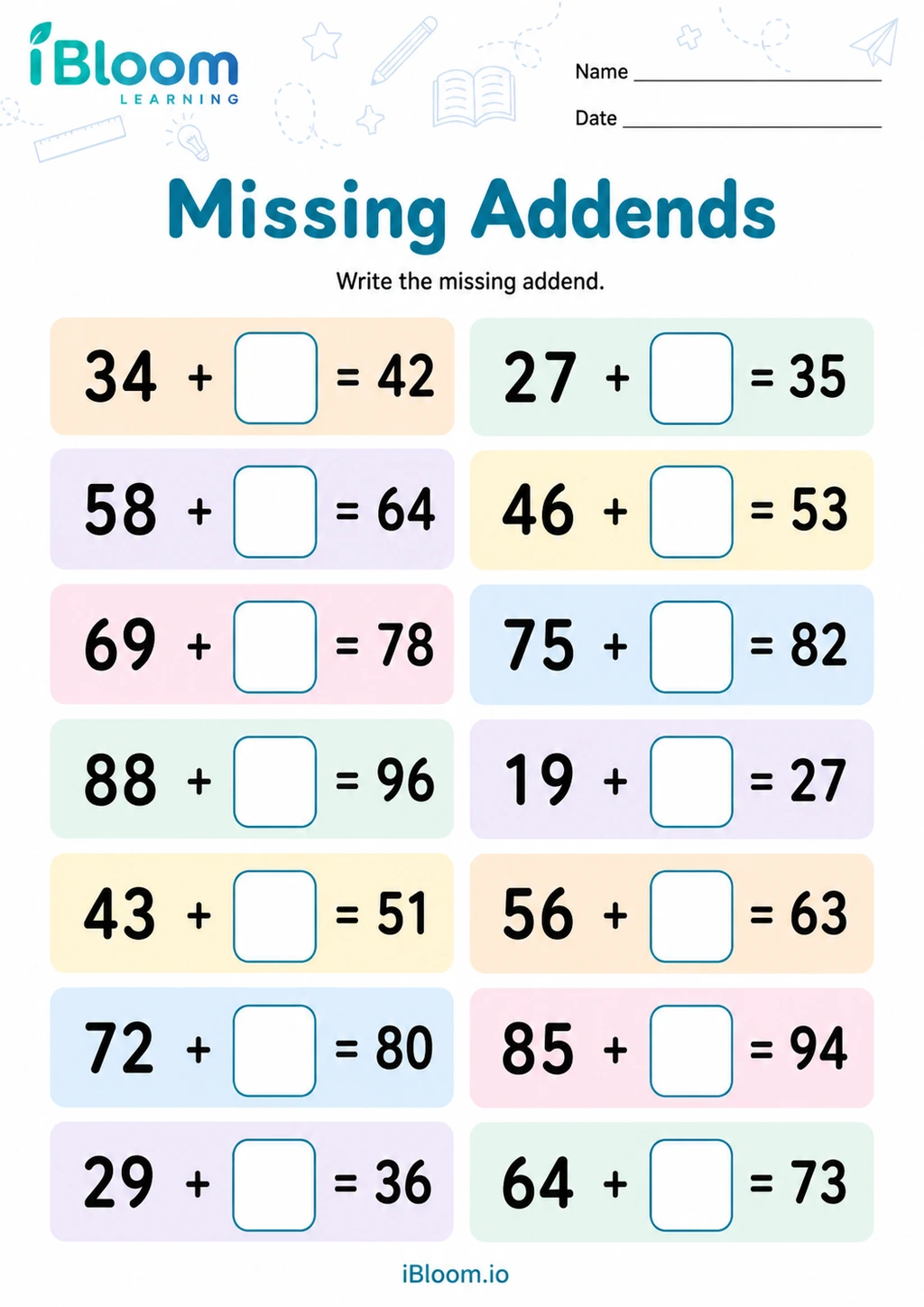
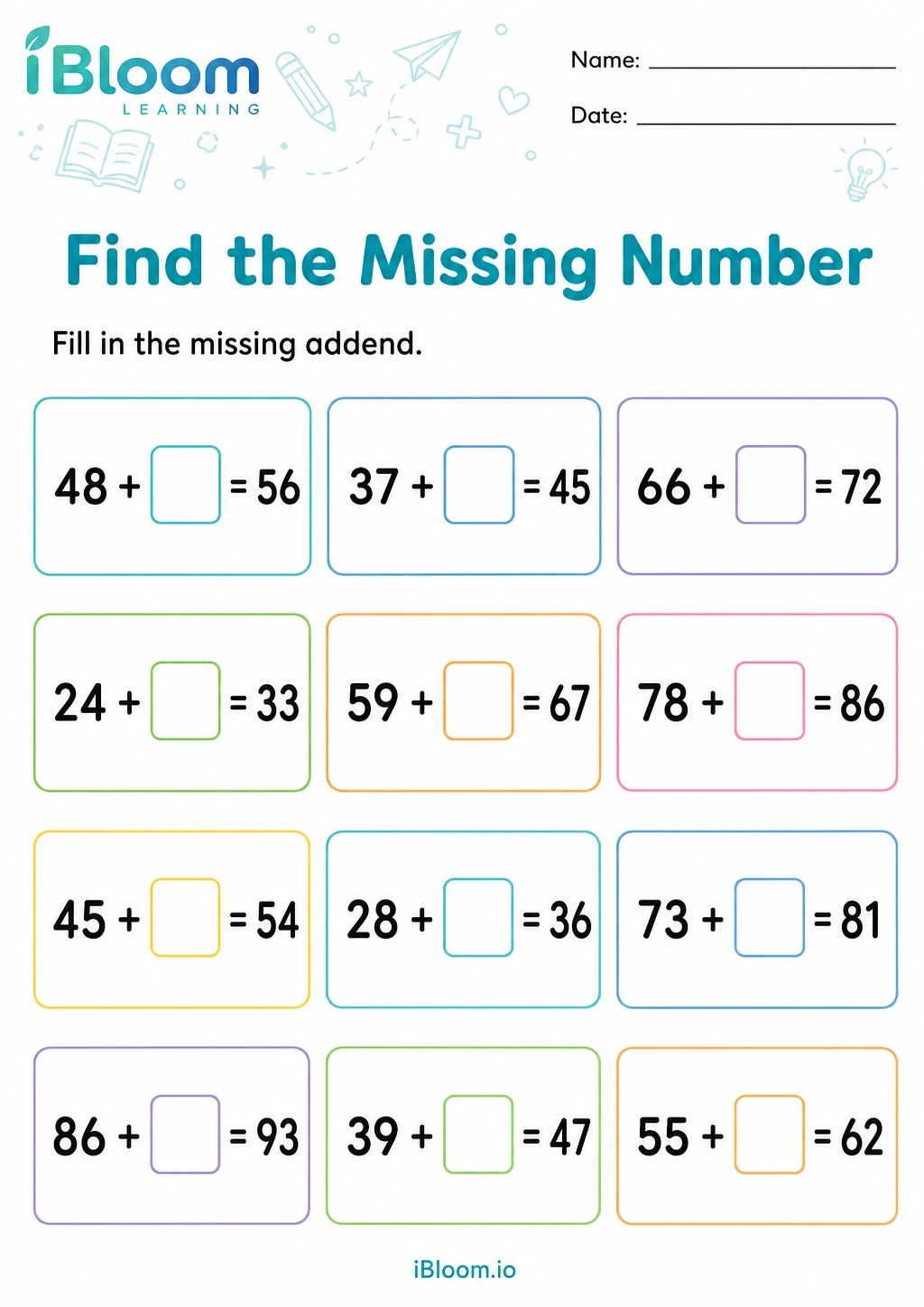
Grade 2 worksheets help children find the missing one-digit addend in 2-digit addition equations using counting on, number bonds, and related subtraction.
Free printable worksheet PDFs
Preview every available page, then download the free worksheet PDF for home, homeschool, tutoring, or classroom practice.
Preview the exact activity before downloading it.
Practice that builds confidence
Understanding the missing addend
These Grade 2 addition worksheets focus on missing addends in equations such as 34 + __ = 39 or __ + 6 = 42. Children practise figuring out the unknown one-digit number while keeping the two-digit number and total in mind.
The printable activities include clear addition sentences with blanks in different positions, helping students move beyond rote sums. They build confidence with counting on, bridging to the next ten, and checking answers with related subtraction.
A missing addend problem asks, “What number was added?” Instead of simply solving 27 + 5, children may see 27 + __ = 32. This supports flexible thinking because they must connect the starting number, the added amount, and the total. In this collection, the known addend is a two-digit number and the missing amount is a one-digit number.

Skill progression in the worksheets
Early items encourage straightforward counting on, such as 41 + __ = 44. As children become more secure, they meet examples that cross a ten, such as 58 + __ = 63. That step is important in Grade 2 because students learn to notice how many are needed to reach the next ten, then how many more are needed after that.
A simple routine for parents
Choose five problems and ask your child to read each equation aloud. Have them start at the two-digit number and count up on fingers or a small number line until they reach the total. Then ask, “How many counts did you make?” For 36 + __ = 42, a child might say 37, 38, 39, 40, 41, 42 and record 6. Finish by checking with 36 + 6 = 42.

Classroom uses for teachers
Teachers can use these pages for independent practice, small-group reteaching, math centers, or quick exit tickets after a lesson on addition relationships. They also work well for partner checks: one student explains the count-on strategy while the other verifies the equation. The format gives teachers a fast way to see who is still counting from 1 and who can count on from the larger number.

Common errors to watch for
Some students write the total in the blank because they focus on the empty space rather than the equation. Others count the starting number as the first count, turning 24 + __ = 28 into 5 instead of 4. When crossing a ten, children may skip a number or lose track. Encourage them to touch each count, use a number line, or make small jumps.
Free printable PDF download
Use this grade 2 missing addend worksheets 2 digit plus 1 digit page to preview the activity, print it, or download it as a PDF for quick practice. It works well for homework, homeschool lessons, tutoring, morning work, revision, and classroom centers.
Answers and answer key support
After the child completes the worksheet independently, parents and teachers can use the answer support or answer key information to check the work, review mistakes, and choose the next practice step.
Why iBloom worksheets help
The worksheets keep the focus narrow: two-digit plus one-digit addition with a missing addend. That targeted practice helps children see patterns without being overloaded. A child-friendly strategy is: start at the two-digit number, count up to the total, and the number of hops is the missing addend.
Helpful answers
Frequently asked questions
What does a missing addend mean in these worksheets?
A missing addend is the number that has been left blank in an addition equation. For example, in 46 + __ = 52, children must find the one-digit number that makes the equation true.
Are the missing numbers always one digit?
Yes. This page focuses on adding a one-digit amount to a two-digit number, so the missing addend is practised as a one-digit number.
What strategy should my child use first?
Counting on is a good starting strategy. The child starts at the two-digit number and counts up to the total; the number of counts is the missing addend.
How can I help if my child counts the first number by mistake?
Remind your child that the starting number is not counted as a hop. In 24 + __ = 28, they should count 25, 26, 27, 28, which gives 4 hops.
Do these worksheets include problems that cross a ten?
They can include equations where the total moves past the next ten, such as 58 + __ = 63. These help children practise bridging through ten while finding the missing addend.
Is this grade 2 missing addend worksheets 2 digit plus 1 digit free?
Yes. You can preview it for free and use the printable worksheet for home or classroom practice.
Can I download this grade 2 missing addend worksheets 2 digit plus 1 digit as a PDF?
Yes. Use the worksheet download option to save a printable PDF, or print the worksheet directly from the page.
Does this grade 2 missing addend worksheets 2 digit plus 1 digit include answers or an answer key?
When the activity has fixed answers, iBloom includes answer support so parents and teachers can check the completed worksheet.