Free printable practice
Add 2 Digit Numbers In Columns No Regrouping Practice Activities
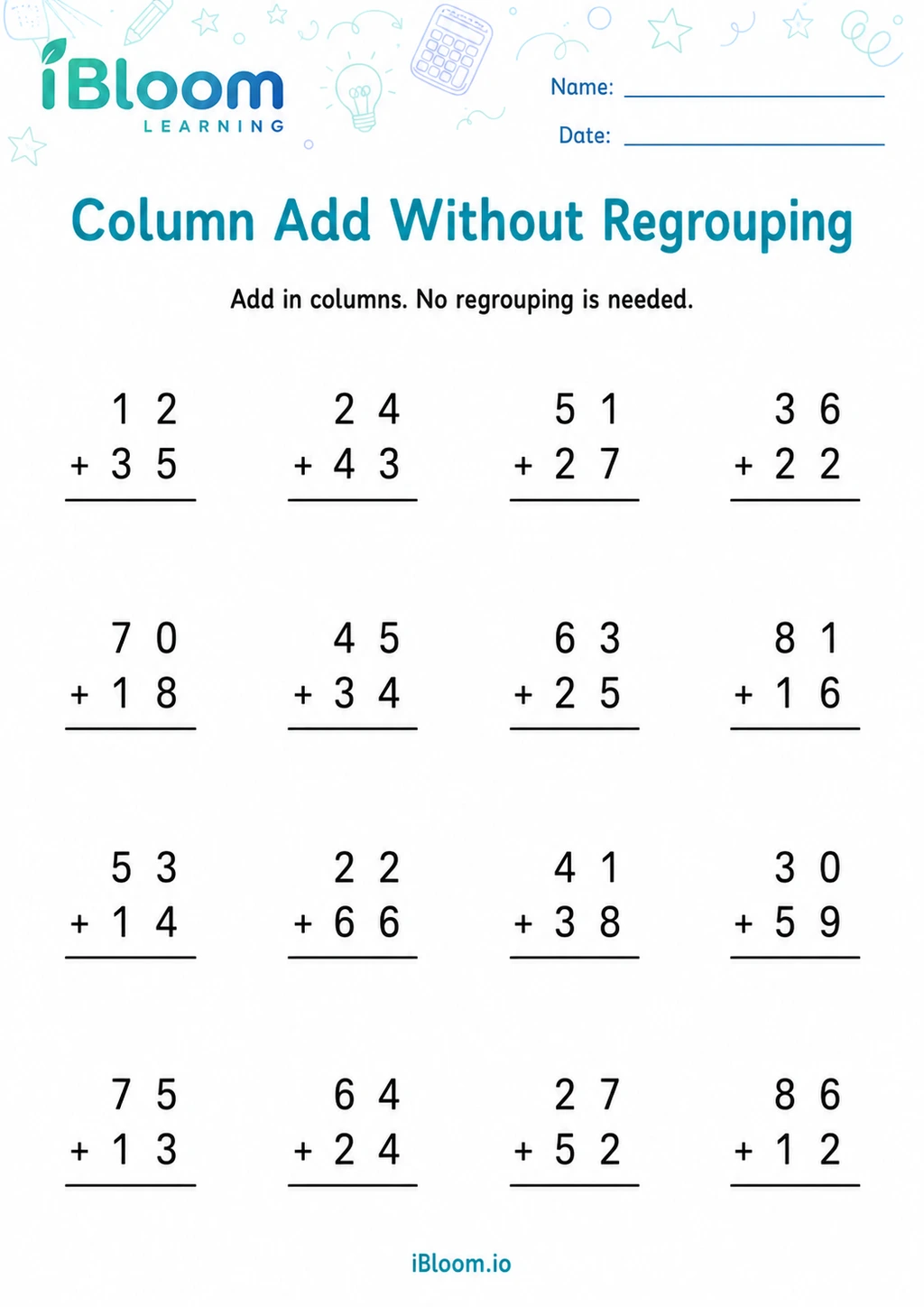
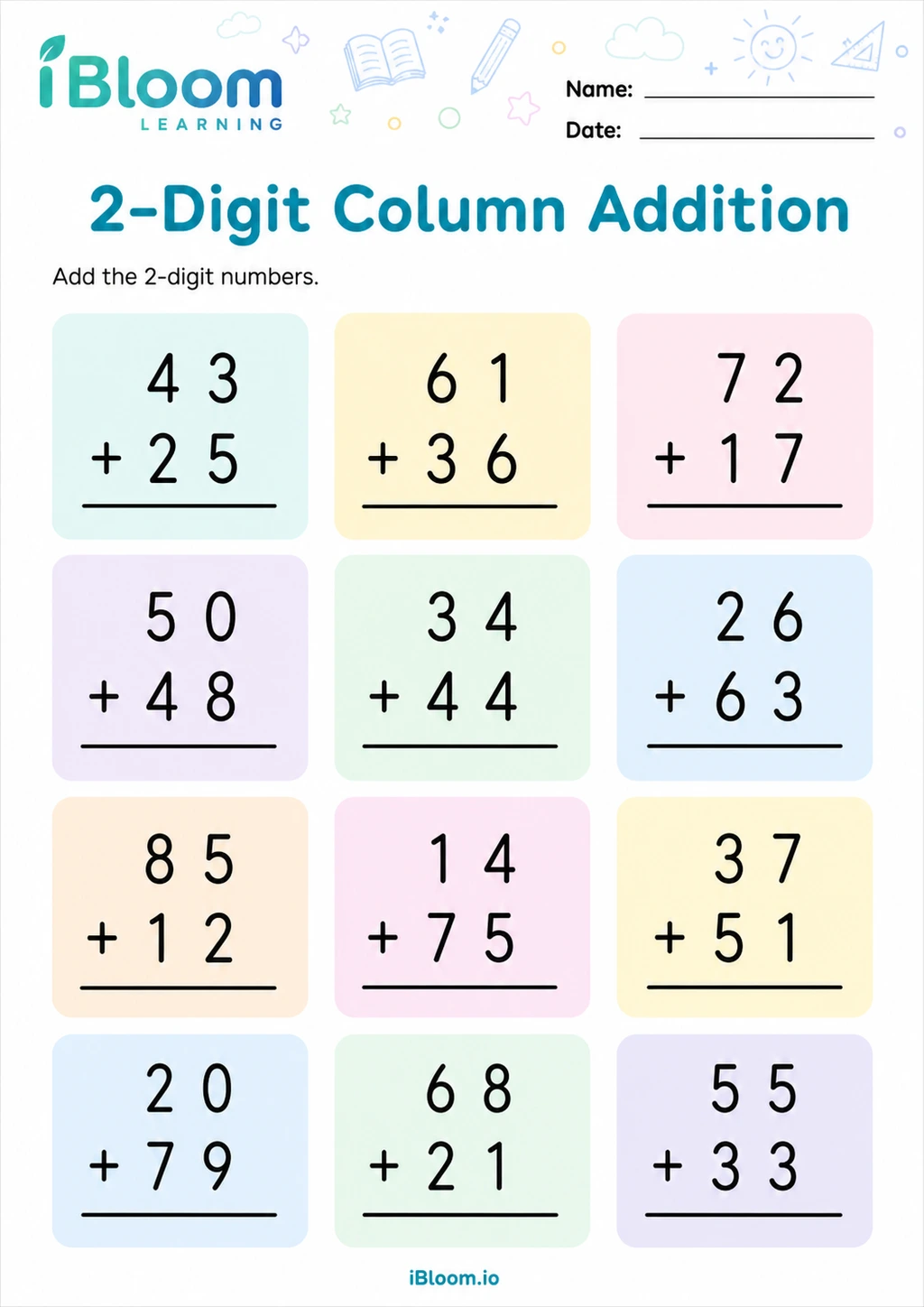
Grade 2 printable activities help children add 2-digit numbers in columns without regrouping, using place value and careful digit alignment.
Free printable worksheet PDFs
Preview every available page, then download the free worksheet PDF for home, homeschool, tutoring, or classroom practice.
Preview the exact activity before downloading it.
Practice that builds confidence
What children practise
These Grade 2 addition worksheets focus on adding 2-digit numbers in columns with no regrouping. Children practise lining up tens and ones, adding each place, and recording sums accurately without carrying.
The printable activities include clear vertical addition problems designed for early confidence with column addition. They are useful for independent practice, math centers, homework, review, or extra support after place value lessons.
Children work with 2-digit addends arranged vertically, such as 24 + 35 or 61 + 18, where the ones add to 9 or less and the tens also stay within a 2-digit sum. Because there is no regrouping, the focus stays on understanding place value: ones are added to ones, and tens are added to tens.

Building from place value to column addition
This skill connects base-ten understanding to written calculation. Students learn that the right column shows ones and the left column shows tens. They add the ones first, write the ones digit in the ones place, then add the tens and write the result in the tens place. The worksheets help children see why neat alignment matters before they move on to addition with regrouping.
A simple parent routine
At home, ask your child to read each problem as “tens and ones.” For 42 + 26, they can say, “2 ones plus 6 ones is 8 ones; 4 tens plus 2 tens is 6 tens, so the sum is 68.” Have them point to each column as they work. After a row of problems, invite them to check one answer by drawing quick tens sticks and ones dots or by breaking the numbers apart mentally.

Classroom uses for teachers
Teachers can use these pages for morning work, small-group review, math centers, or a quick check after introducing vertical addition. They also work well before mixed addition practice because every problem reinforces the same routine: align, add ones, add tens, write the sum. Pairing the worksheet with place-value blocks or a place-value chart can support students who still need a visual model.

Common errors to watch for
Some children add across the row even when the numbers are in columns, or they start in the tens place and lose track of the ones. Others write digits in the wrong column, especially when their handwriting drifts. Encourage students to use the plus sign and line as cues, keep each digit in its own place, and check that the answer has tens under tens and ones under ones.
Free printable PDF download
Use this add 2 digit numbers in columns no regrouping worksheet page to preview the activity, print it, or download it as a PDF for quick practice. It works well for homework, homeschool lessons, tutoring, morning work, revision, and classroom centers.
Answers and answer key support
After the child completes the worksheet independently, parents and teachers can use the answer support or answer key information to check the work, review mistakes, and choose the next practice step.
Why iBloom worksheets help
The practice is focused and uncluttered, so Grade 2 learners can build accuracy without being distracted by new problem types. A child-friendly strategy is: “Line up, ones first, tens next, check the places.” Repeating this pattern helps children gain fluency with 2-digit addition before the added challenge of regrouping.
Helpful answers
Frequently asked questions
What does no regrouping mean in 2-digit column addition?
No regrouping means the ones digits add to 9 or less, so children do not need to carry a ten into the tens column. They simply add ones to ones and tens to tens.
Why should Grade 2 students practise vertical addition before regrouping?
Vertical addition helps students learn digit alignment and place value. Practising without regrouping first lets them master the routine before adding the extra step of carrying.
How can I help my child if they add the wrong columns?
Have your child point to the ones column first, then the tens column. You can also draw a simple place-value chart labeled tens and ones to keep each digit in the correct place.
Are these worksheets suitable for math centers?
Yes. The focused format makes them useful for Grade 2 math centers, independent practice, small-group review, or a quick follow-up after a lesson on tens and ones.
What should children be able to do before using these worksheets?
Children should recognize tens and ones in 2-digit numbers and understand basic one-digit addition facts. Place-value blocks or drawings can help if they are still developing that understanding.
Is this add 2 digit numbers in columns no regrouping worksheet free?
Yes. You can preview it for free and use the printable worksheet for home or classroom practice.
Can I download this add 2 digit numbers in columns no regrouping worksheet as a PDF?
Yes. Use the worksheet download option to save a printable PDF, or print the worksheet directly from the page.
Does this add 2 digit numbers in columns no regrouping worksheet include answers or an answer key?
When the activity has fixed answers, iBloom includes answer support so parents and teachers can check the completed worksheet.