







About this worksheet
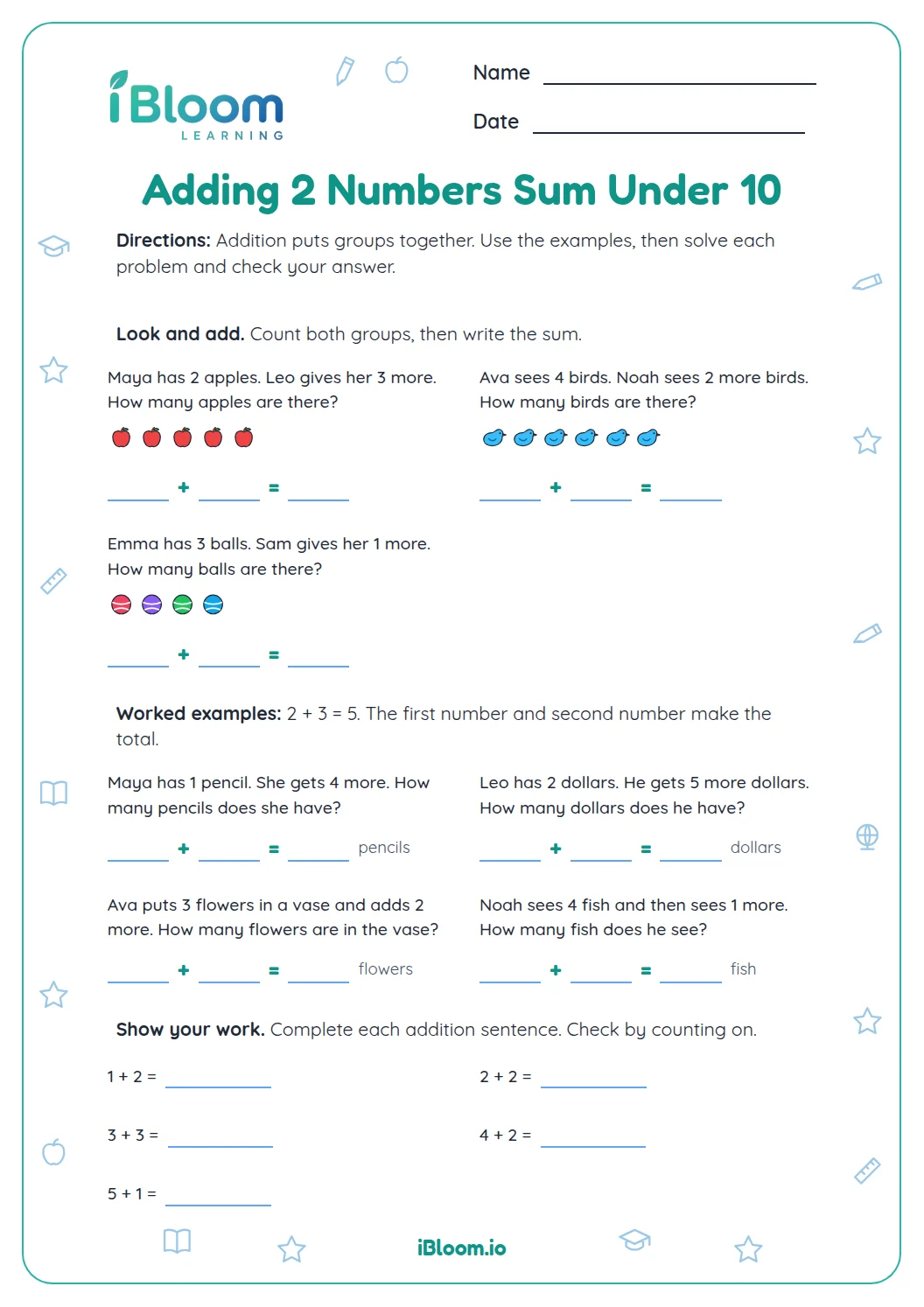
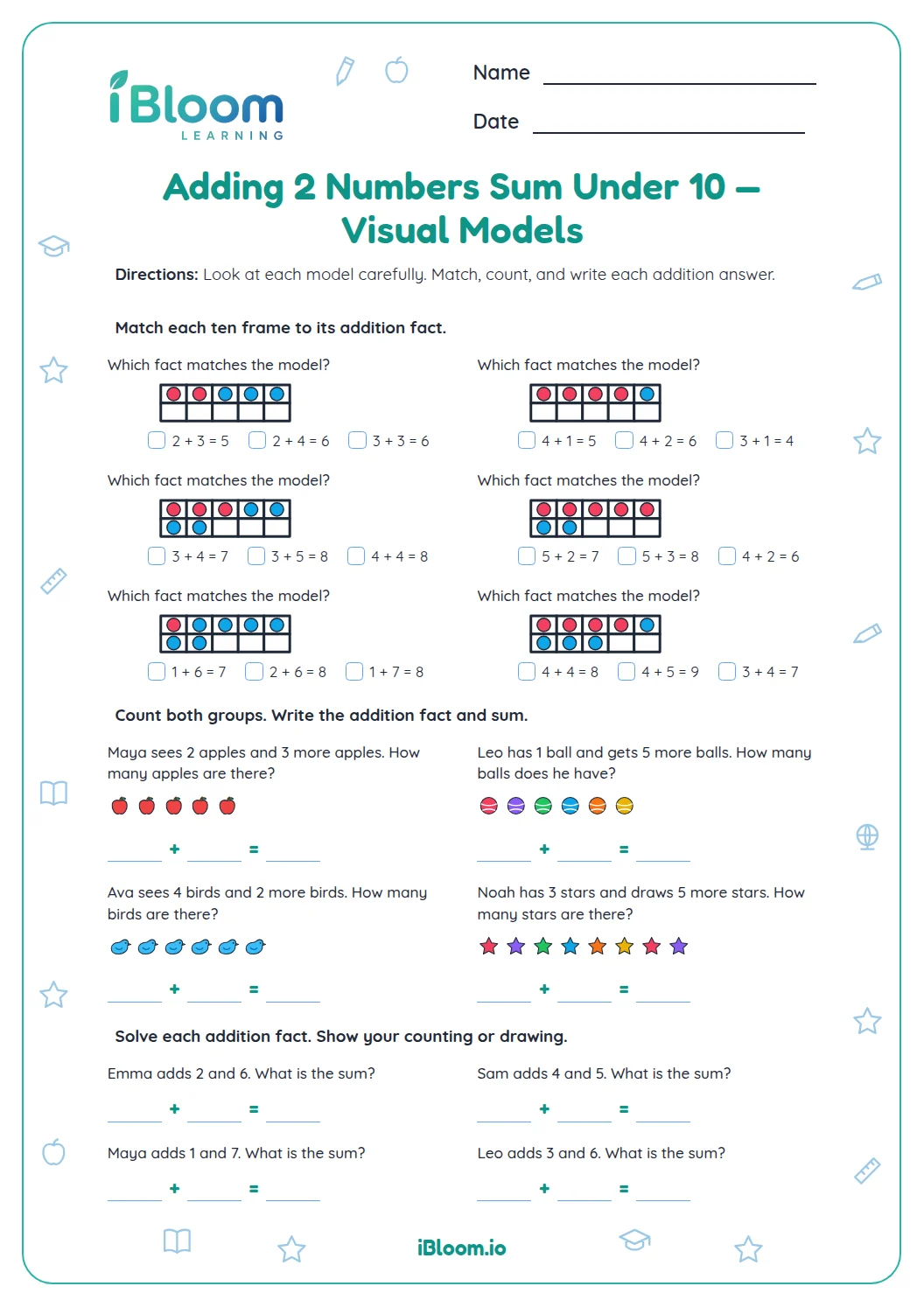
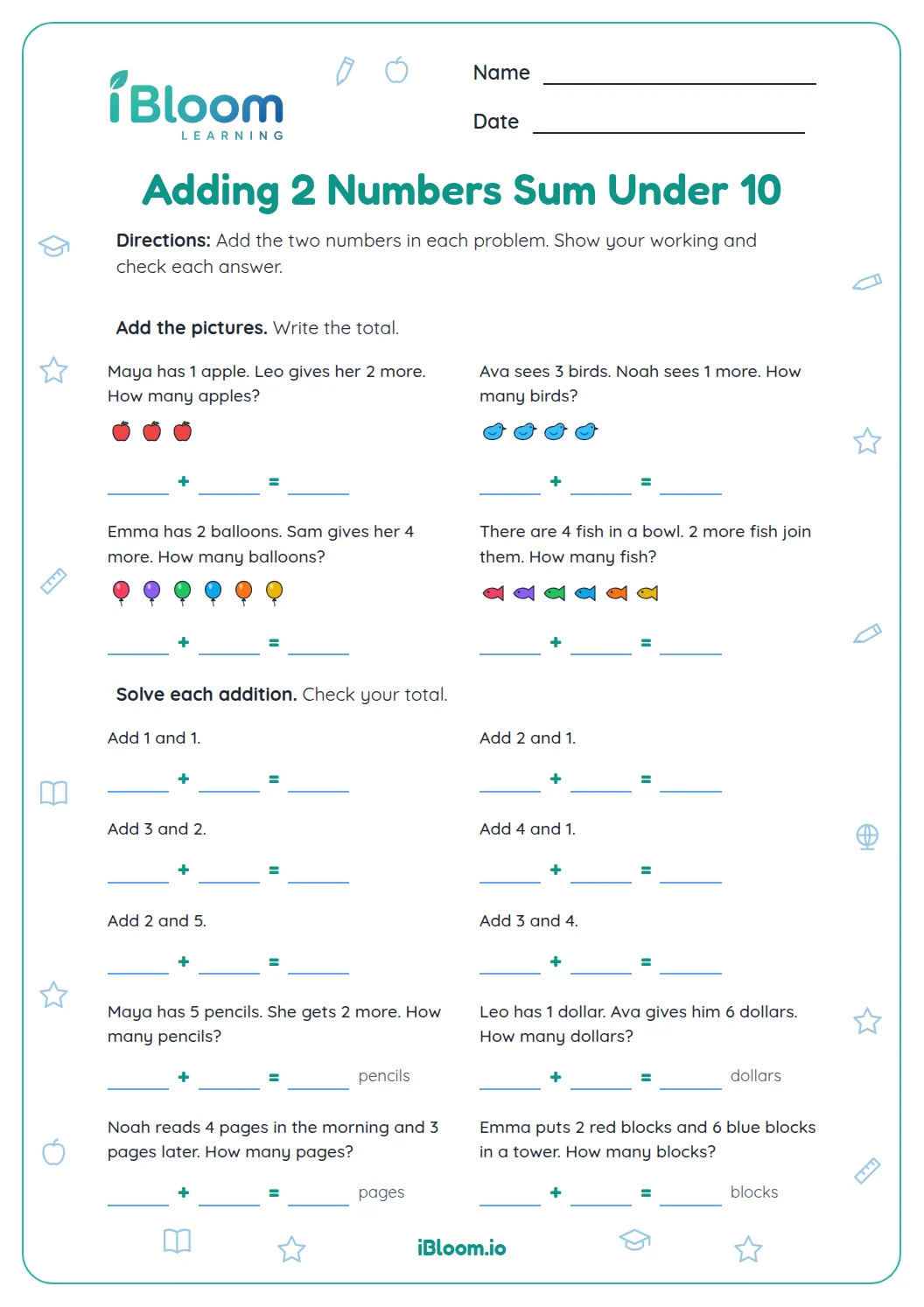
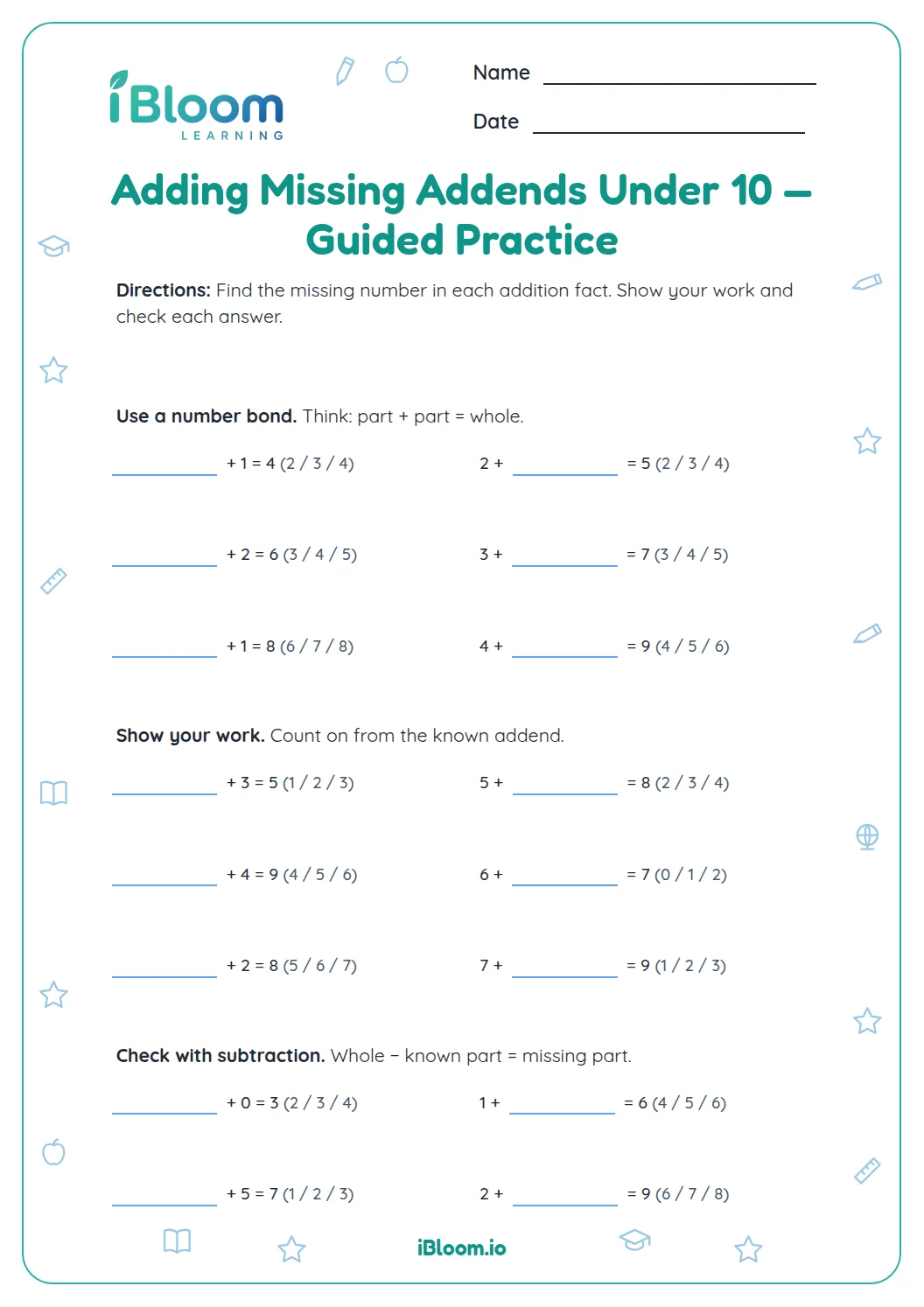
This Grade 2 addition worksheet focuses on pairs of one-digit numbers with totals under 10. Children solve equations, read a ten-frame, compare pairs of sums, and use addition facts in short situations. One final prompt asks children to write a new pair of addends, with sample answers in the separate key.
Aligned to 2.OA.B.2
What does this addition challenge include?
Part A has five small-sum equations and a missing addend. Part B reads a ten-frame. Part C compares sums and applies addition facts to short situations. Part D asks children to write one more pair that makes 8.
- Part A: 5 sums and 1 missing addend
- Part B: 1 ten-frame question
- Part C: 8 reasoning questions
- Part D: 1 open response
How can a model help with a sum?
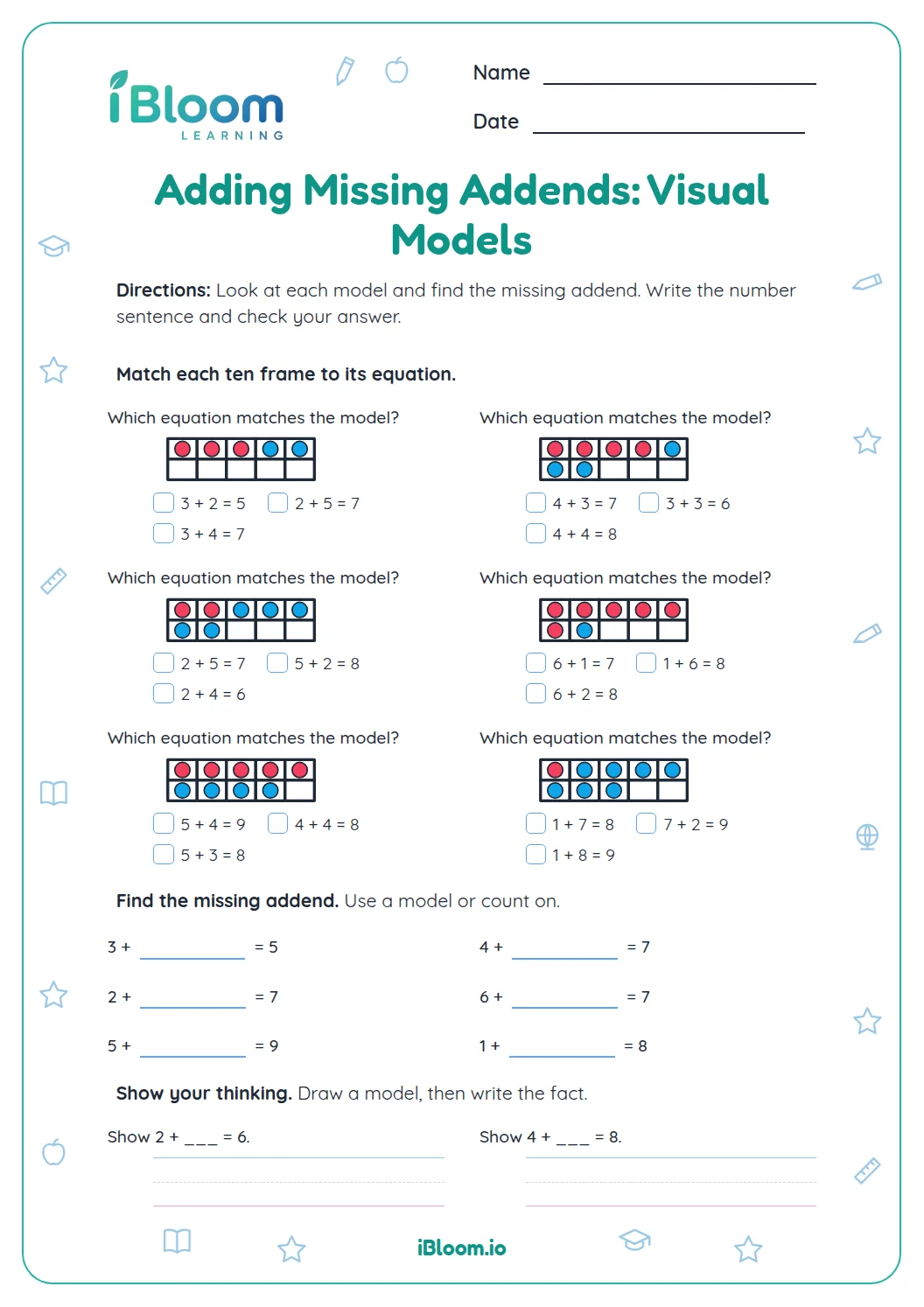
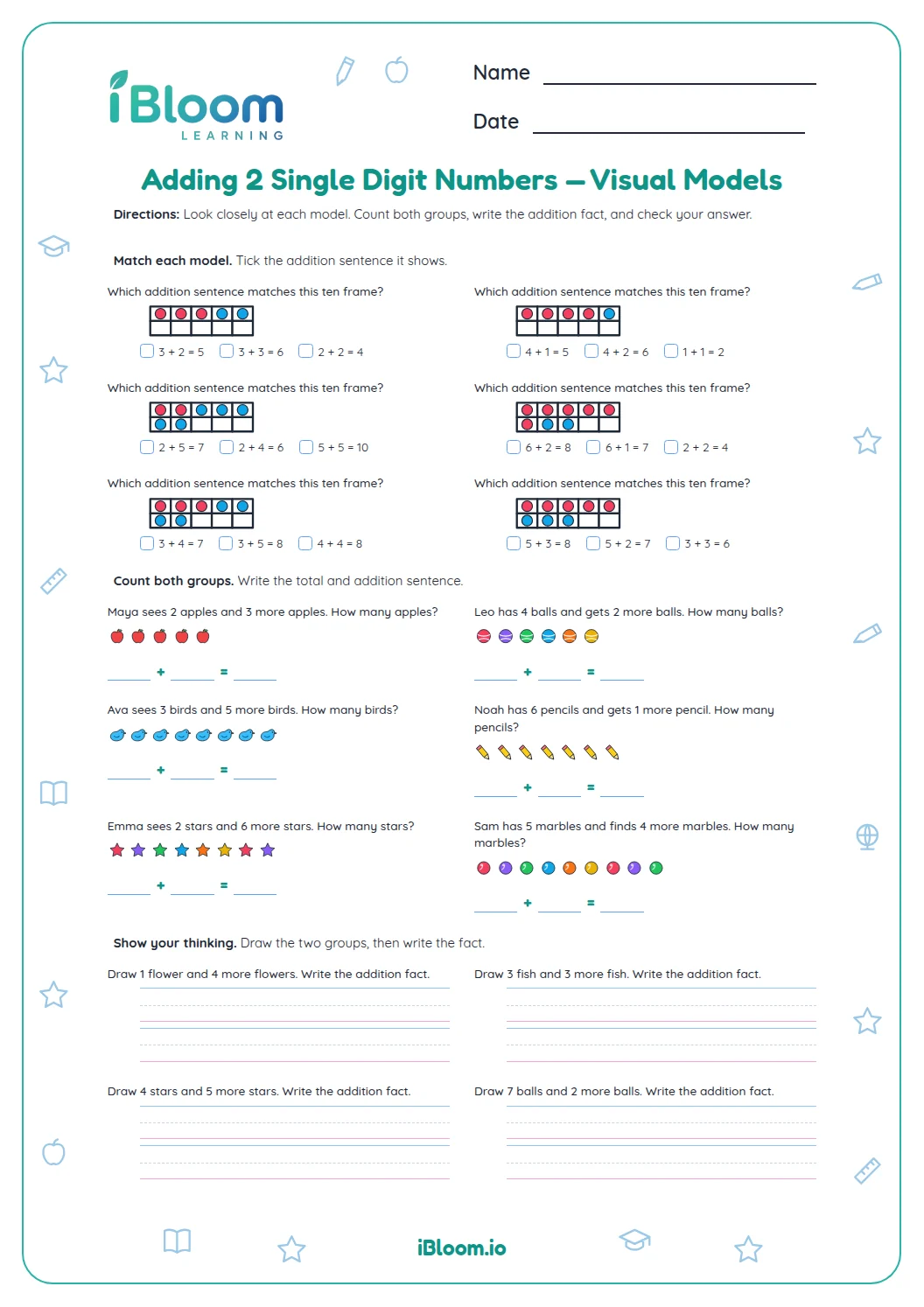
A ten-frame makes each counter easy to track. The frame on this page shows six counters, so count each one to find the total: 6. Children can also make pairs such as 5 + 4 to build a total of 9.
Can different addends make the same sum?
Yes. The addends can be switched without changing the total, and different pairs can also make the same total. Compare 3 + 5 and 4 + 4: both equal 8.
- 13 + 5 = 8
- 24 + 4 = 8
- 3The pairs differ, but the total stays 8.
What counts as a complete written answer?
For an equation prompt, give a true equation. For a story prompt, include both addends and the total in a short situation. The key shows a sample, while another correct pair or story can also earn credit.
How to use this worksheet
- 1For each equation, count on from the larger addend if that helps.
- 2Check a model by counting every counter or adding the shown parts.
- 3Compare totals before deciding whether one sum is greater.
- 4Use a true equation when asked to show a different pair.
- 5For a story, include the starting amount, amount added, and total.
Common mistakes and quick fixes
The mistake
Counting both groups again and skipping a counter
The fix
Point to each counter once, or start at the larger addend and count on.
The mistake
Thinking switched addends change the total
The fix
Check both orders: 2 + 6 and 6 + 2 each make 8.
The mistake
Writing a story that omits the total
The fix
Include the two groups and say how many there are altogether.
Common Core alignment
This page practices one-digit addition facts and mental reasoning.
Add two one-digit numbers and use mental strategies to check sums.
On this sheet: Parts A and B practice sums of two one-digit addends and properties of addition.
Show the official wordingHide the official wording
Fluently add and subtract within 20 using mental strategies. By end of Grade 2, know from memory all sums of two one-digit numbers.
What to practice next
Make more practice
Further reading
Questions parents and teachers ask
Are all the sums under 10?
Yes. Each addition fact and model has a total from 6 through 9. The questions stay with the title skill while asking children to compare pairs and explain how different addends can make one total. Some tasks invite more than one valid example.
How can a ten-frame help find a sum?
A ten-frame arranges counters in spaces that are easy to count. The model on this page shows six counters, so the total is 6. Children can then use addition facts to compare ways to make totals such as 8 or 9.
What does “same sum” mean?
The sum is the total after adding. Different pairs can make the same total, such as 3 + 5 and 4 + 4, which both make 8. Children also see that switching addends does not change the total, as in 2 + 6 and 6 + 2.
Can a child give a different answer to the writing prompts?
Yes. Part D asks for a different pair of addends that makes 8, and the key provides a sample. Any true addition sentence with two addends totaling 8 can be accepted. The child’s exact pair may differ from the key.
Is an answer key included?
Yes. A separate answer key page lists each numeric answer and a sample response for the open question. It helps adults check sums while leaving room for children to choose a different pair of addends that makes 8.
How long does this worksheet take?
Plan about 15 minutes. The 16 questions include quick facts, a ten-frame, reasoning choices, and one written response. A child may take longer when explaining a strategy aloud. Pause between parts if needed, then check answers together with the key.