


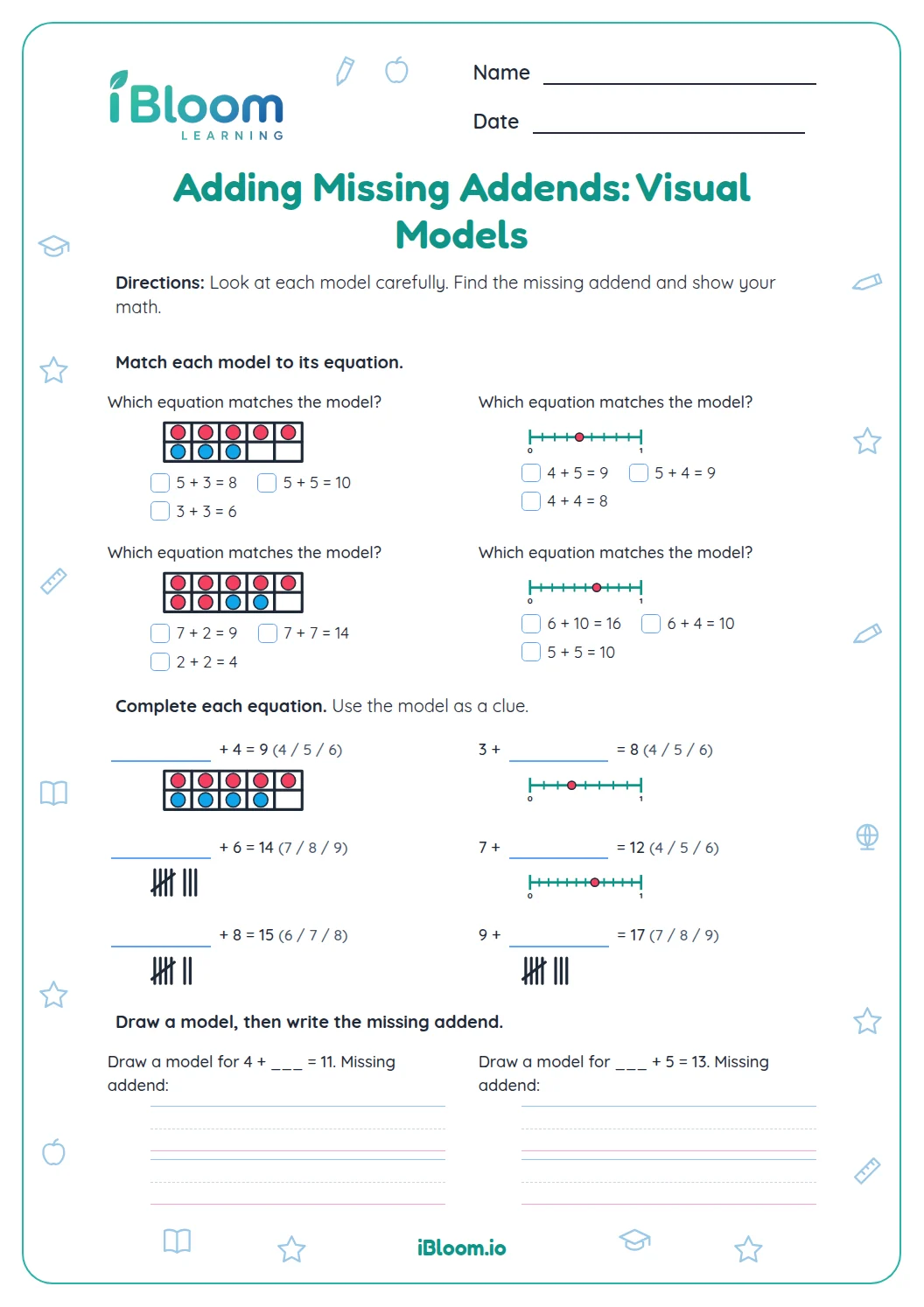
About this worksheet
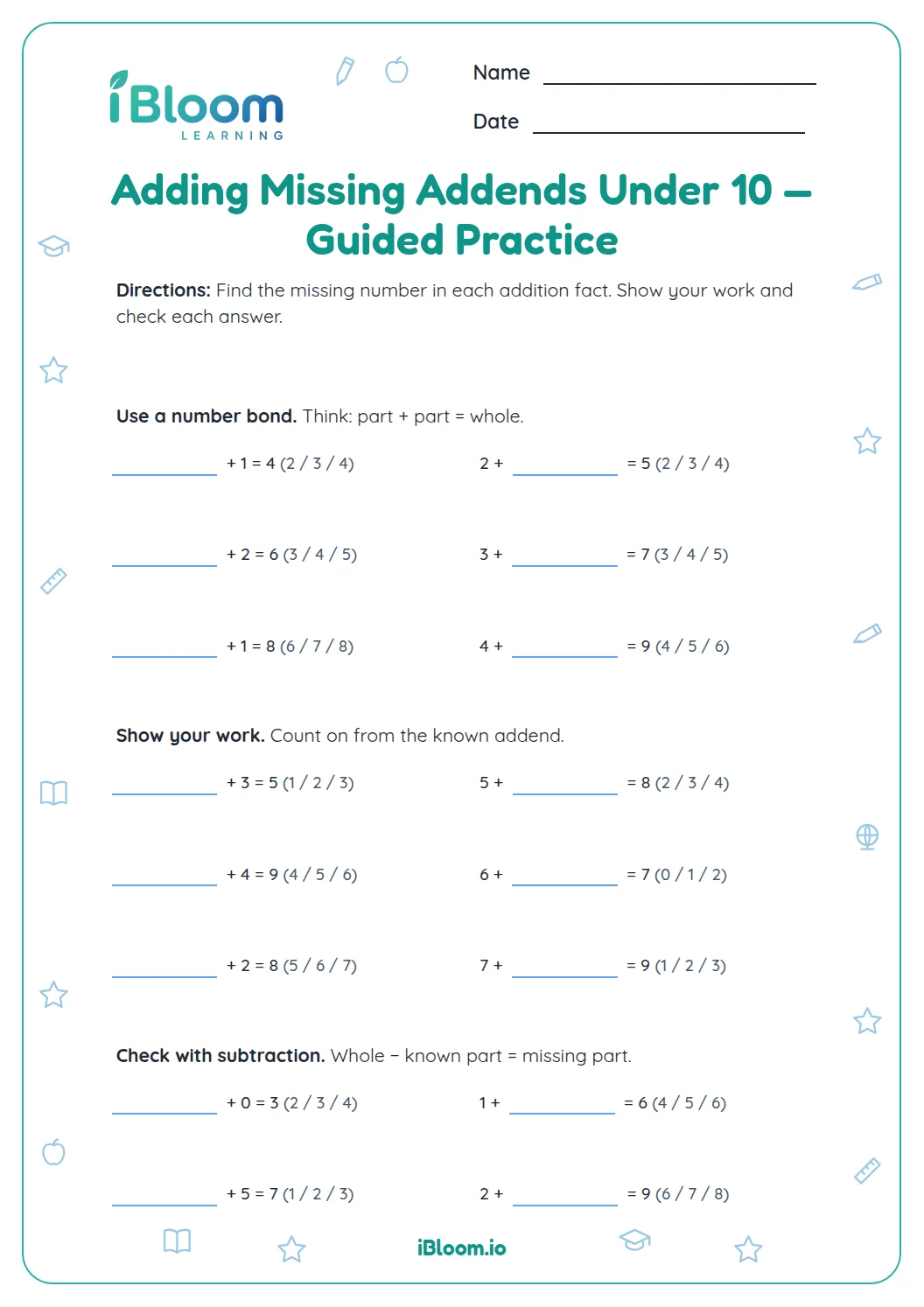
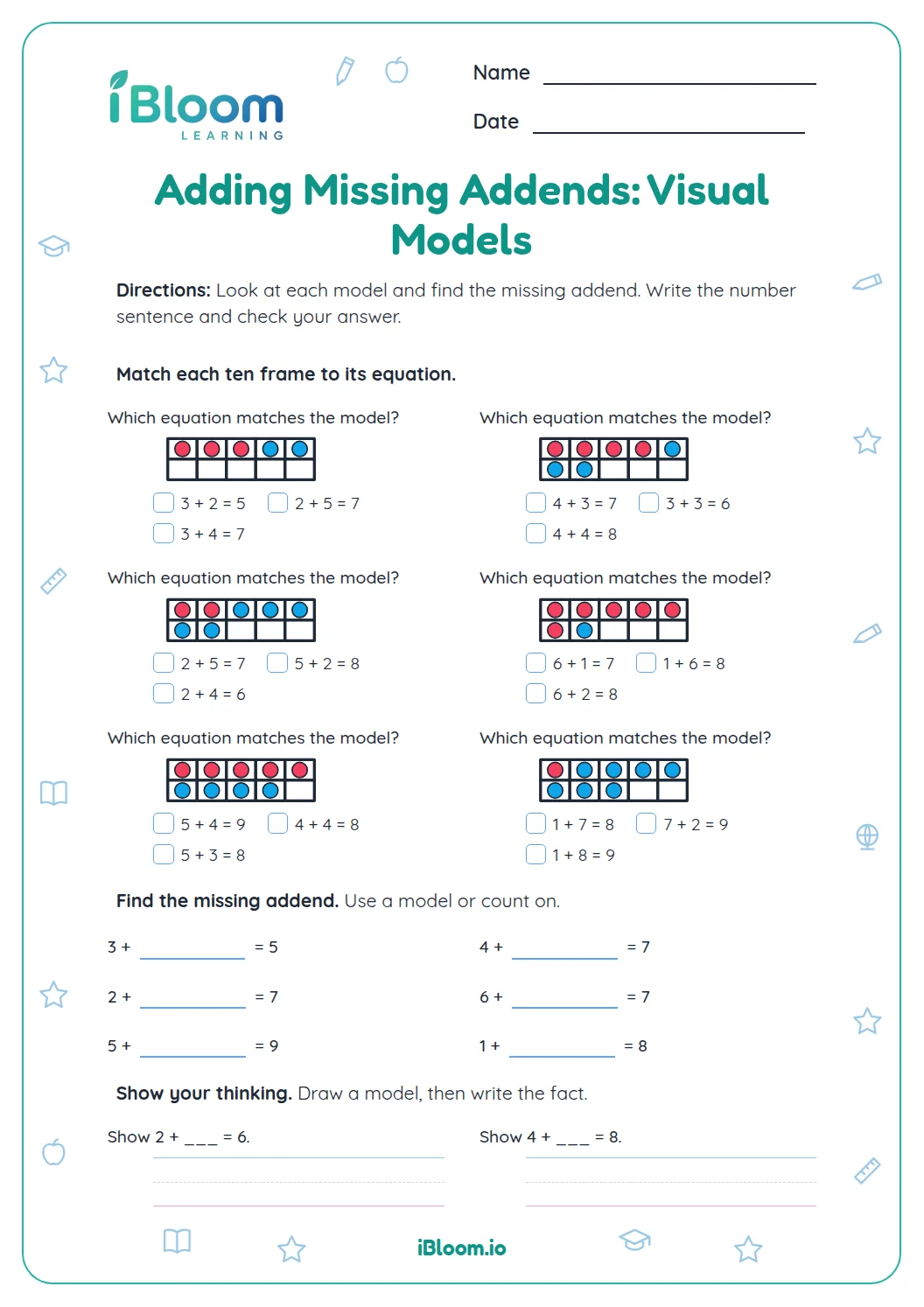
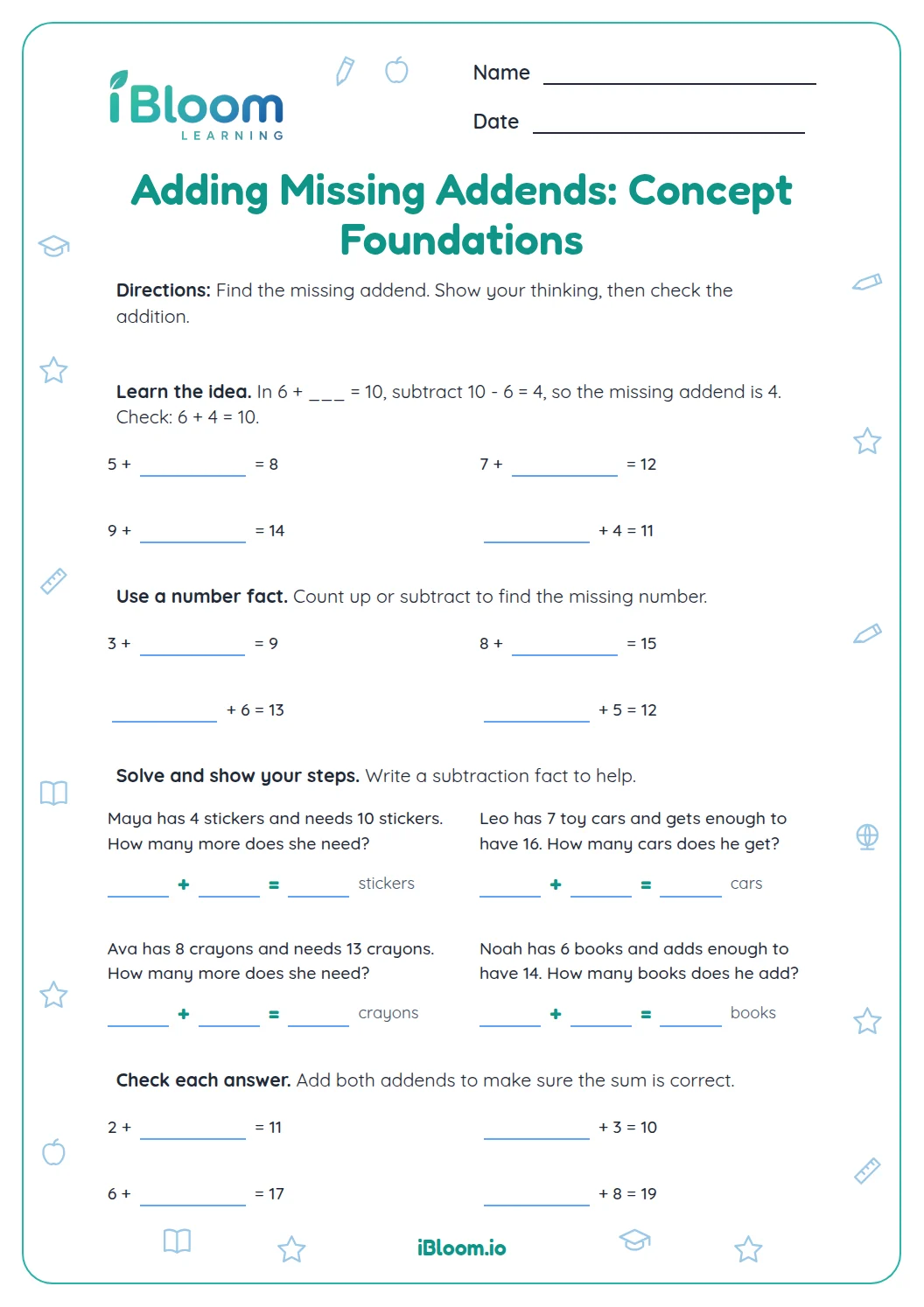
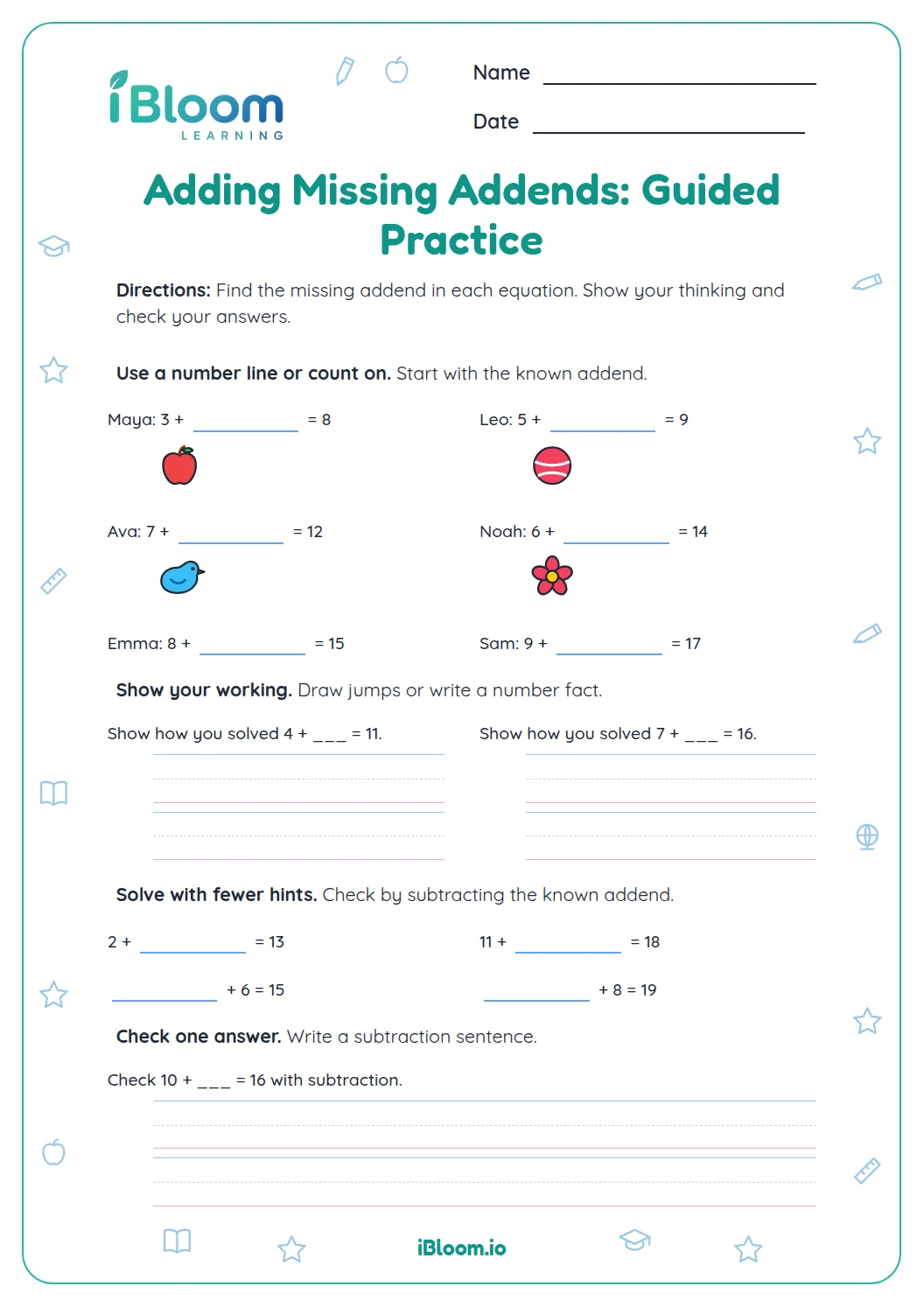
This Grade 2 concept-foundations sheet starts with number bonds and ten-frames, then moves to missing-addend equations with sums under 10. Students can count on or subtract the known part from the whole and check by adding. The key gives the missing number for each of 20 questions.
Aligned to 1.OA.D.8
How does a number bond show a missing addend?
In question 1, the whole is 7 and one part is 3. The empty part is 4 because 3 + 4 = 7. The number bond shows that the addends are parts of the sum.
- 1Whole: 7; known part: 3
- 27 − 3 = 4, so 3 + 4 = 7.
How can a ten-frame help?
A ten-frame makes the total visible. Start at the known addend and count on until you reach the total shown by the counters. In question 5, begin at 2 and count on to 6 to find the missing 4.
What questions are on the two pages?
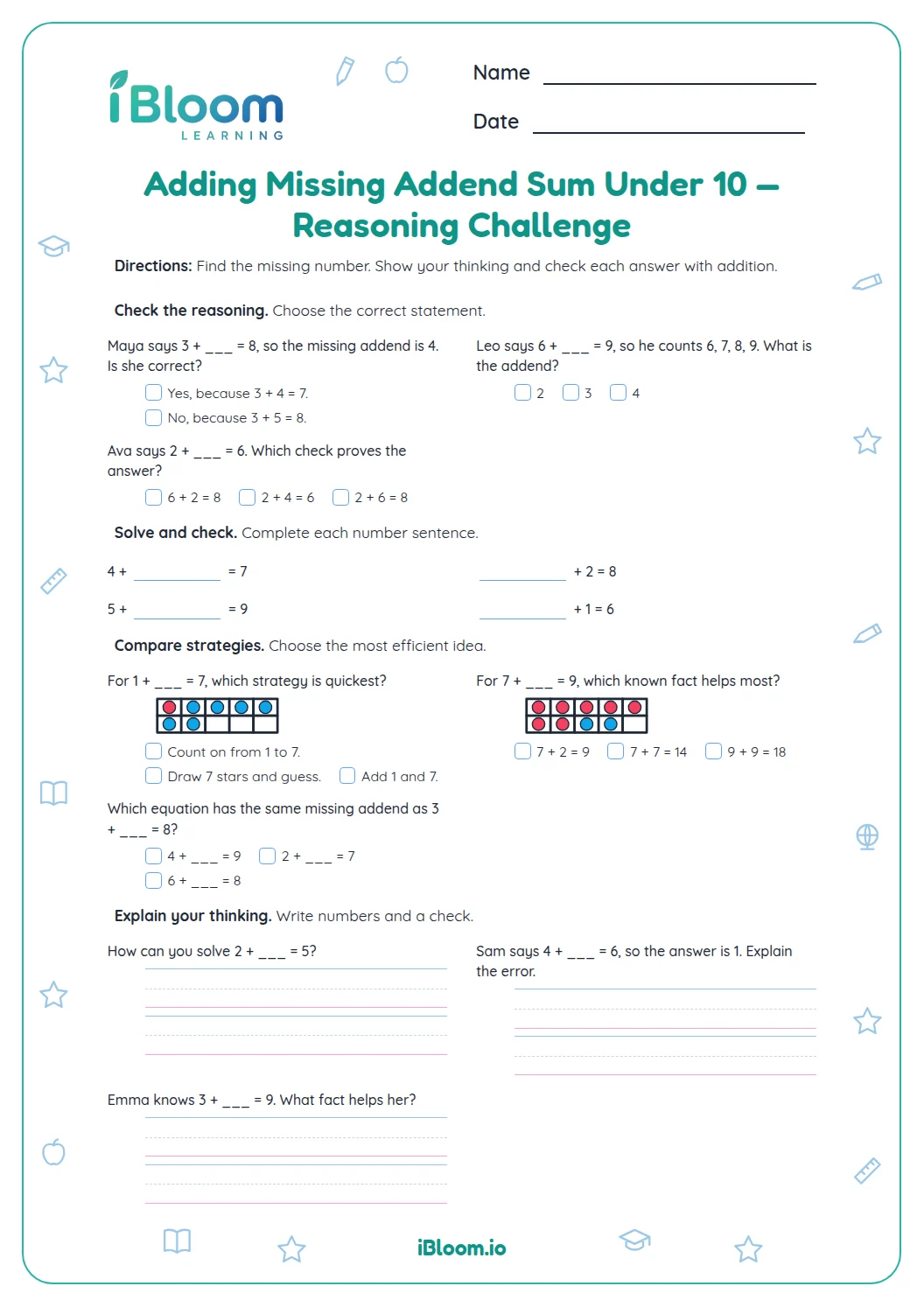
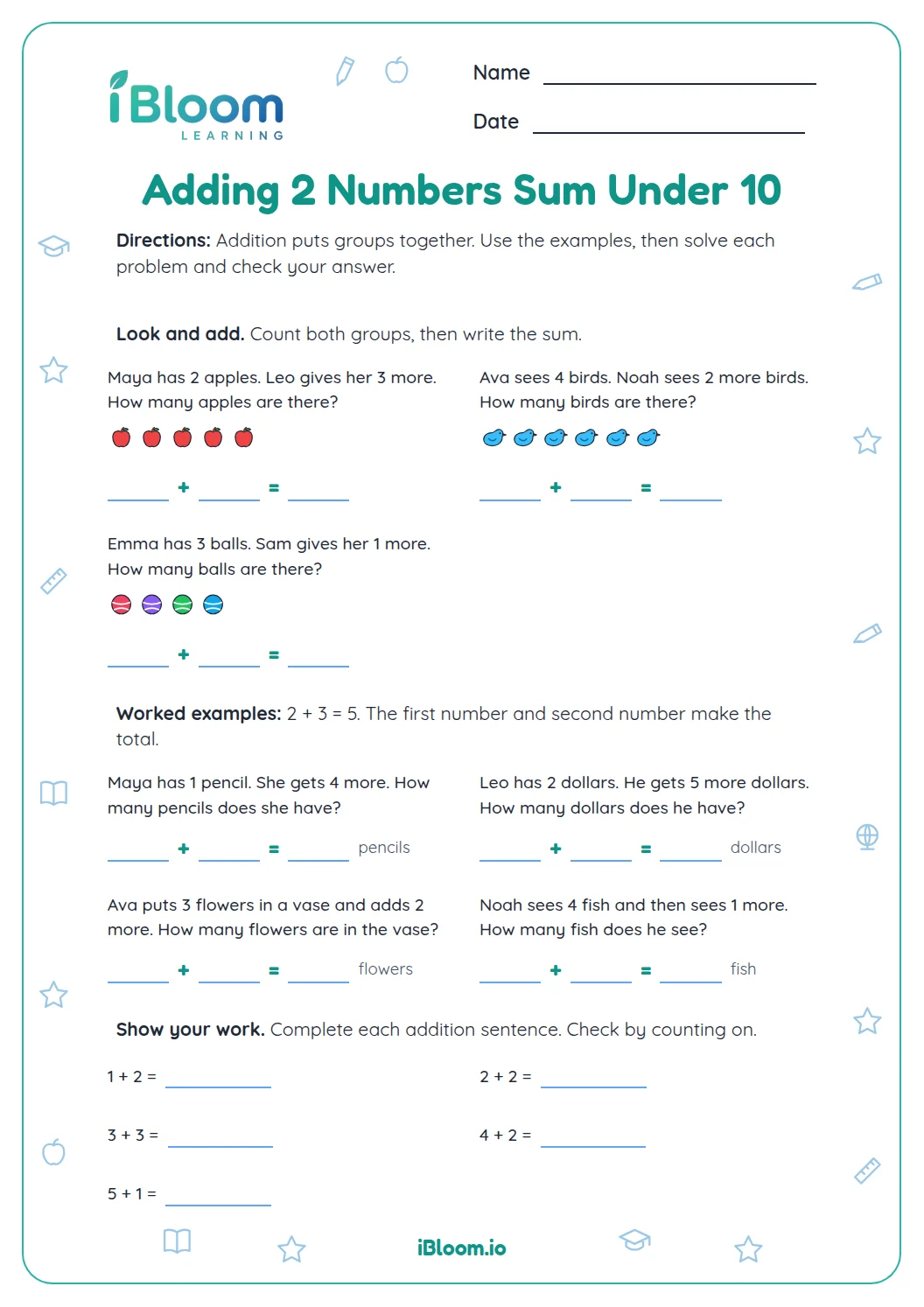
Questions 1–4 pair number bonds with missing-addend equations. Two equations later include ten-frames, and the rest give practice finding a missing part in either addend position.
How can a learner check an answer?
Put the missing number back into the equation and add. If the total matches the number on the right, the missing part is correct.
How to use this worksheet
- 1Look at the whole and known part in each number bond.
- 2Find the empty part by counting on or subtracting.
- 3For a ten-frame, count the empty spaces to the total.
- 4Write the missing addend in the equation.
- 5Add the two parts to check the sum.
Common mistakes and quick fixes
The mistake
Treating the sum as the missing addend.
The fix
Point to the whole and the two parts in the number bond.
The mistake
Subtracting the whole from the known addend.
The fix
Start with the whole, then subtract the known part.
The mistake
Stopping after finding a number.
The fix
Add both parts to make sure they equal the whole.
Common Core alignment
Learners find the unknown part in addition equations with totals below 10.
Find an unknown addend in an addition equation with a sum under 10.
On this sheet: Every equation relates three whole numbers and asks for the missing addend.
Show the official wordingHide the official wording
Determine the unknown whole number in an addition or subtraction equation relating three whole numbers.
What to practice next
Make more practice
Further reading
Questions parents and teachers ask
What does “missing addend” mean?
An addend is one of the numbers being added. A missing addend is the unknown part in a sum, such as the empty part in 3 + ___ = 7. This worksheet pairs the idea with number bonds and ten-frames before giving more equations.
Can a child count on instead of subtracting?
Yes. In 3 + ___ = 7, start at 3 and count 4, 5, 6, 7. Four counts are needed, so the missing addend is 4. The number bonds and ten-frames give a way to see or count those missing parts.
What is on the answer key?
The separate key gives the missing number for all 20 questions. Students can check a response by putting it back into the equation and adding the two parts to see whether they make the stated sum. The printed key is separate so a student can finish the problem before checking the result.
How long should this worksheet take?
Allow about 20 minutes for the two practice pages, with more time if a learner wants to draw or explain a counting strategy. The questions begin with models and then move into equations, so the early items can be done together.
Are the sums all below 10?
Yes. Each equation has a total from 5 through 9, and the number-bond and ten-frame visuals match those totals. This keeps attention on finding the unknown addend and checking the addition. These small totals let students focus on the relationship between the addends and the whole.