


About this worksheet
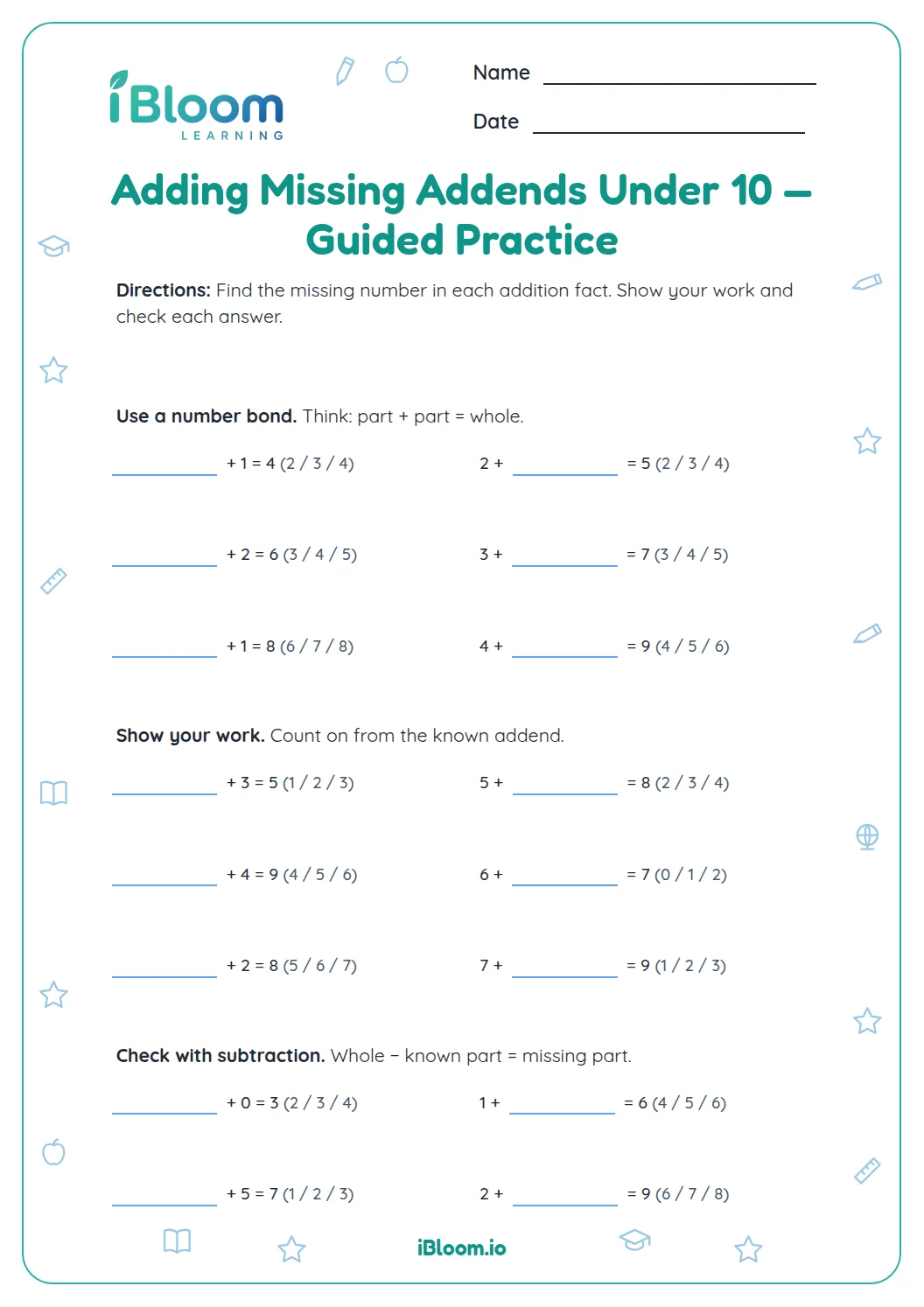
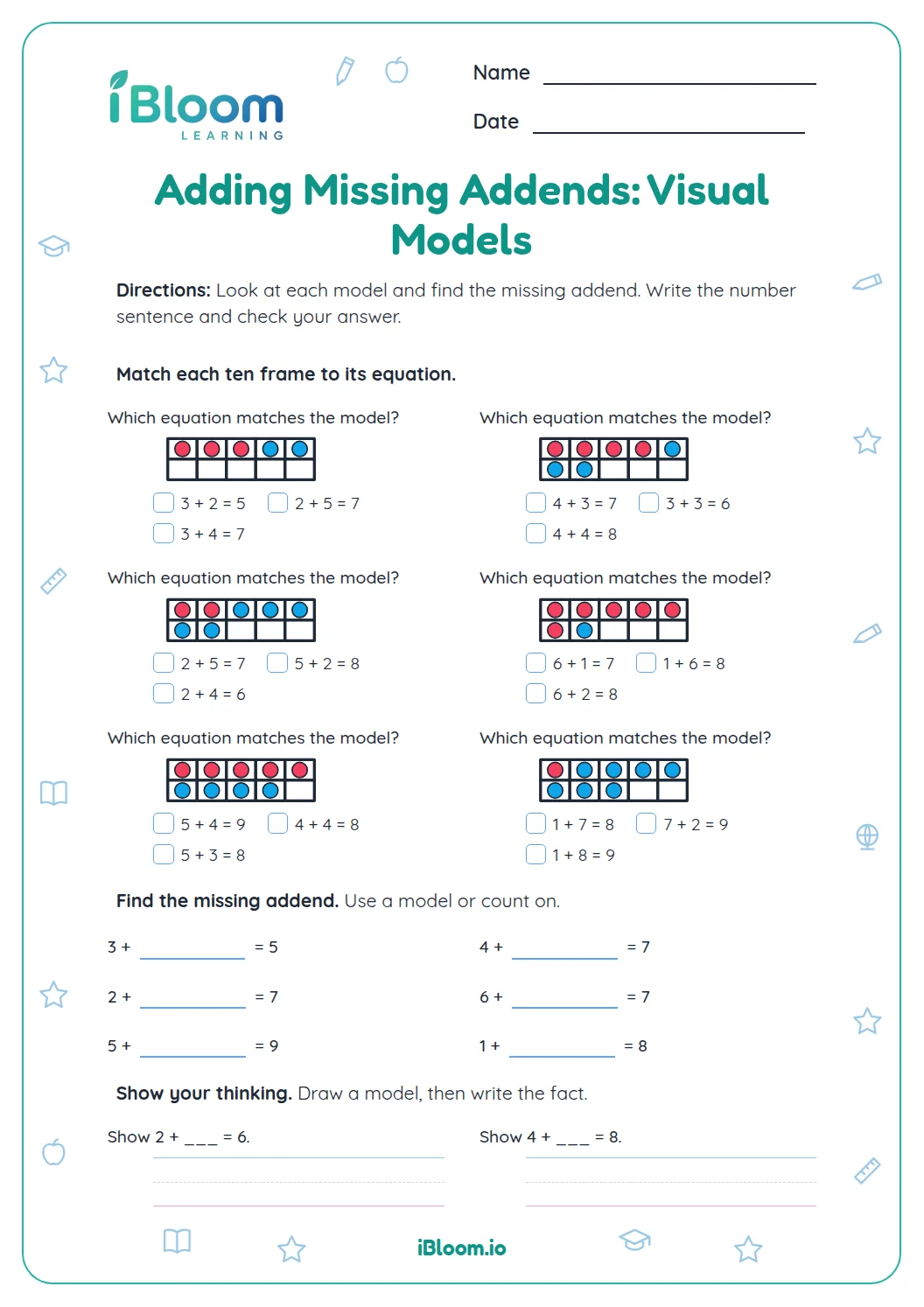
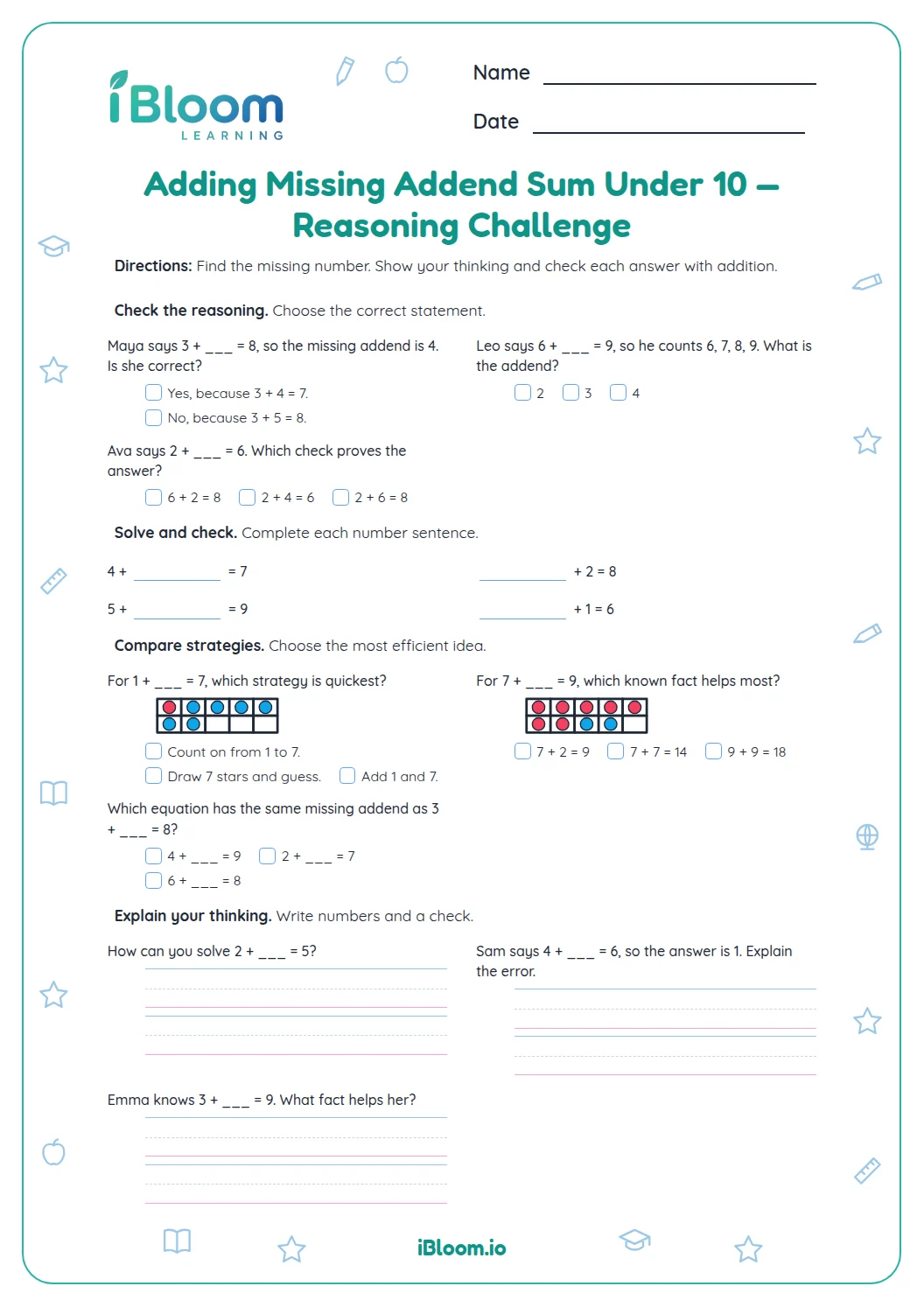
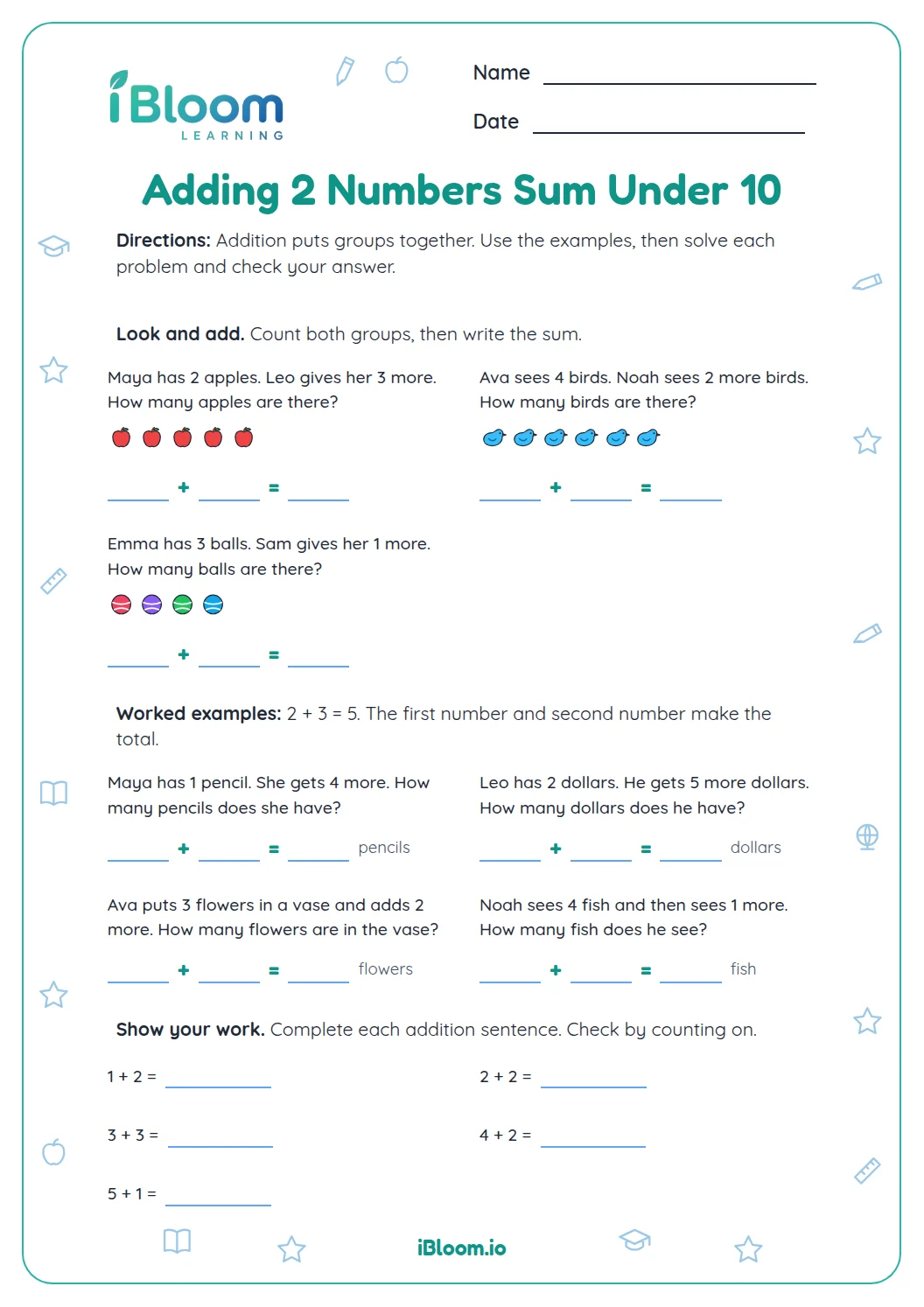
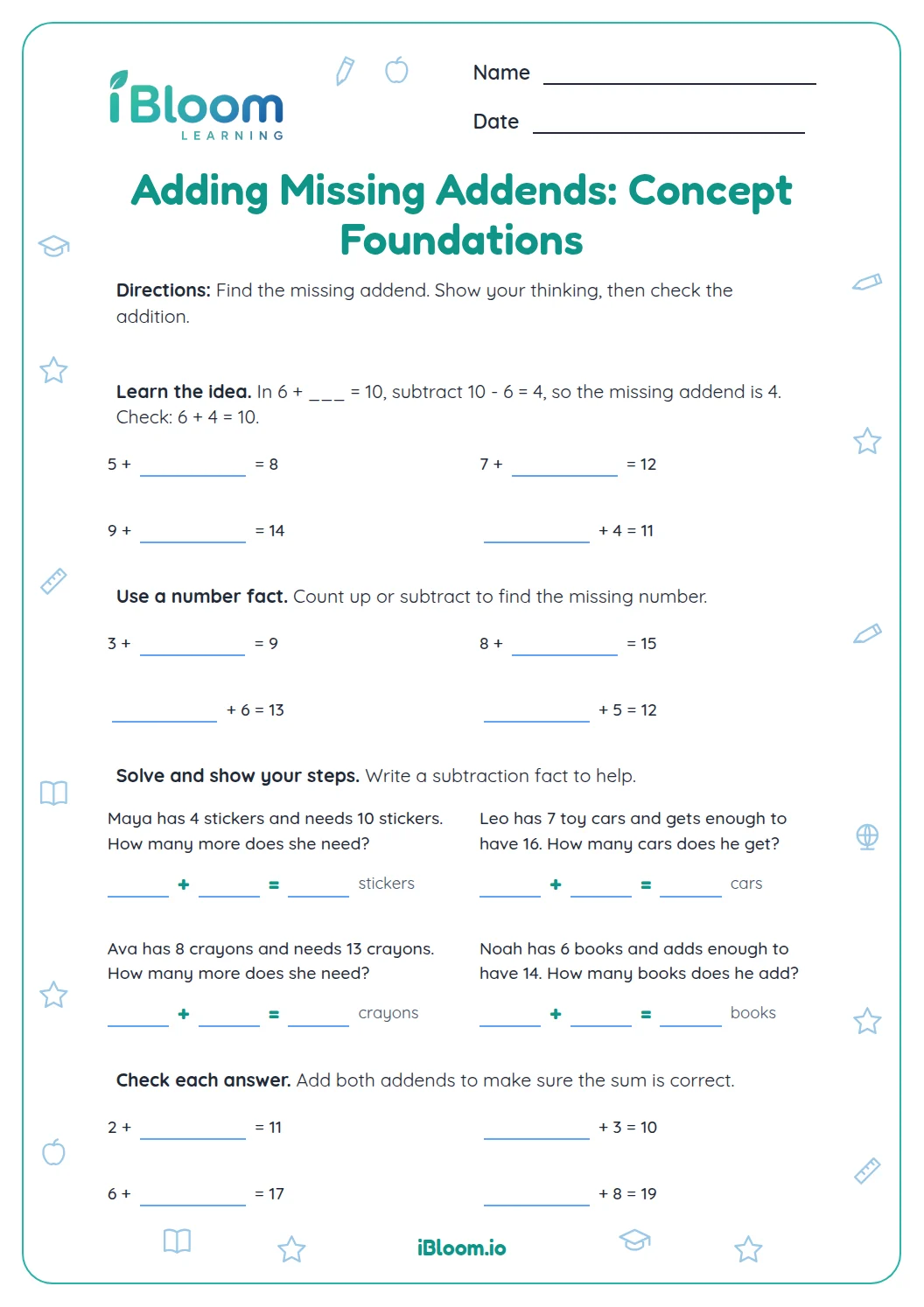
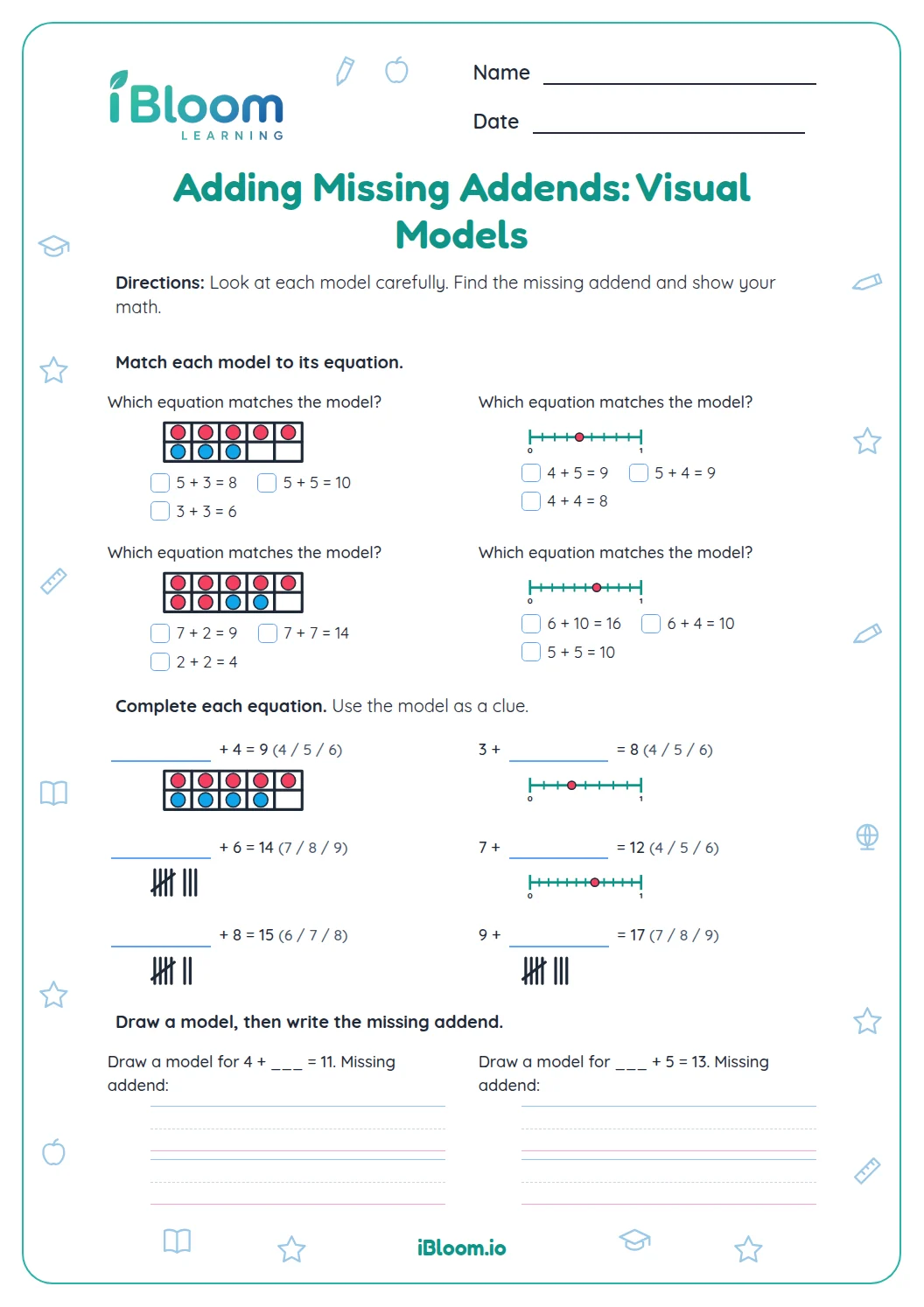
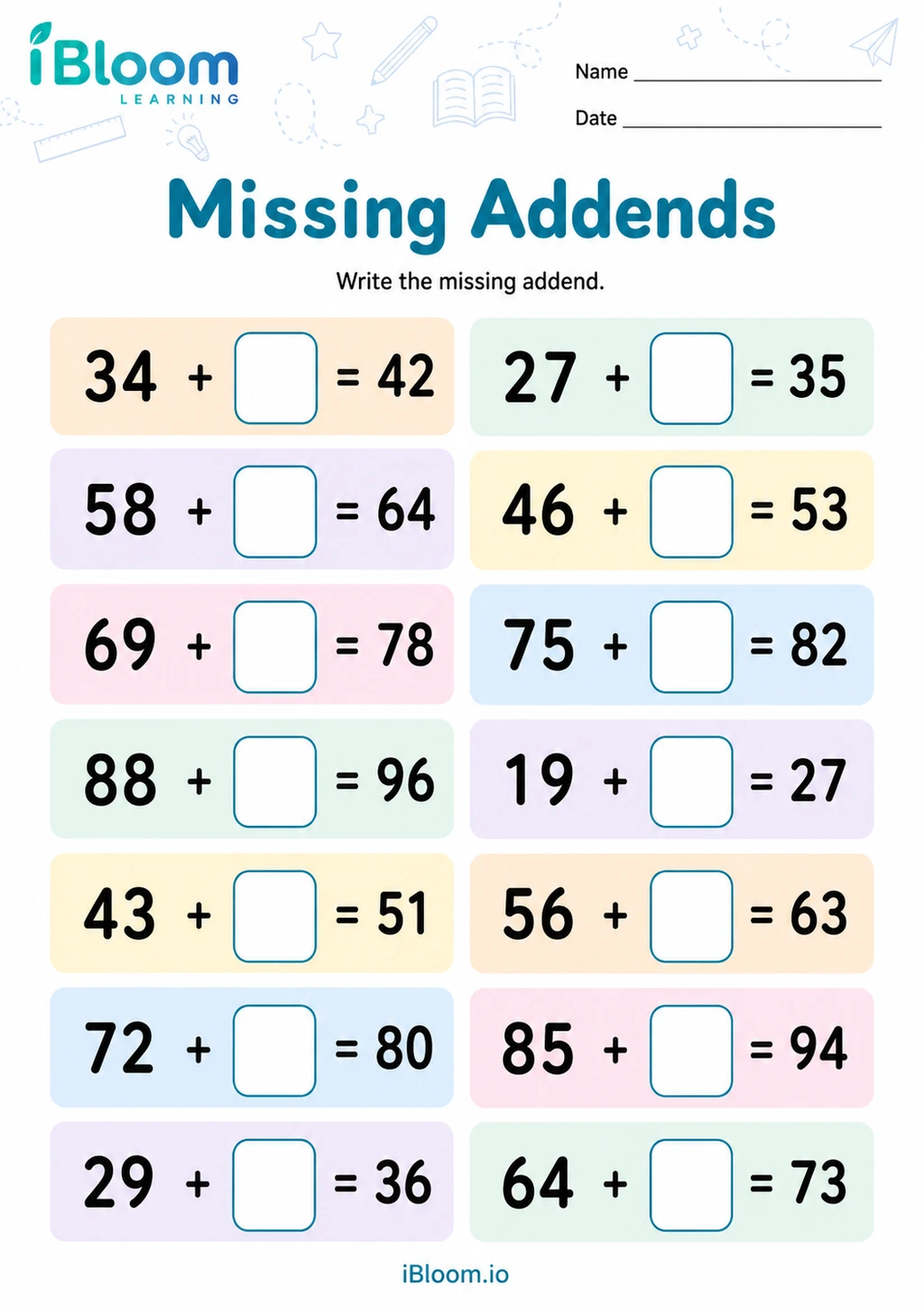
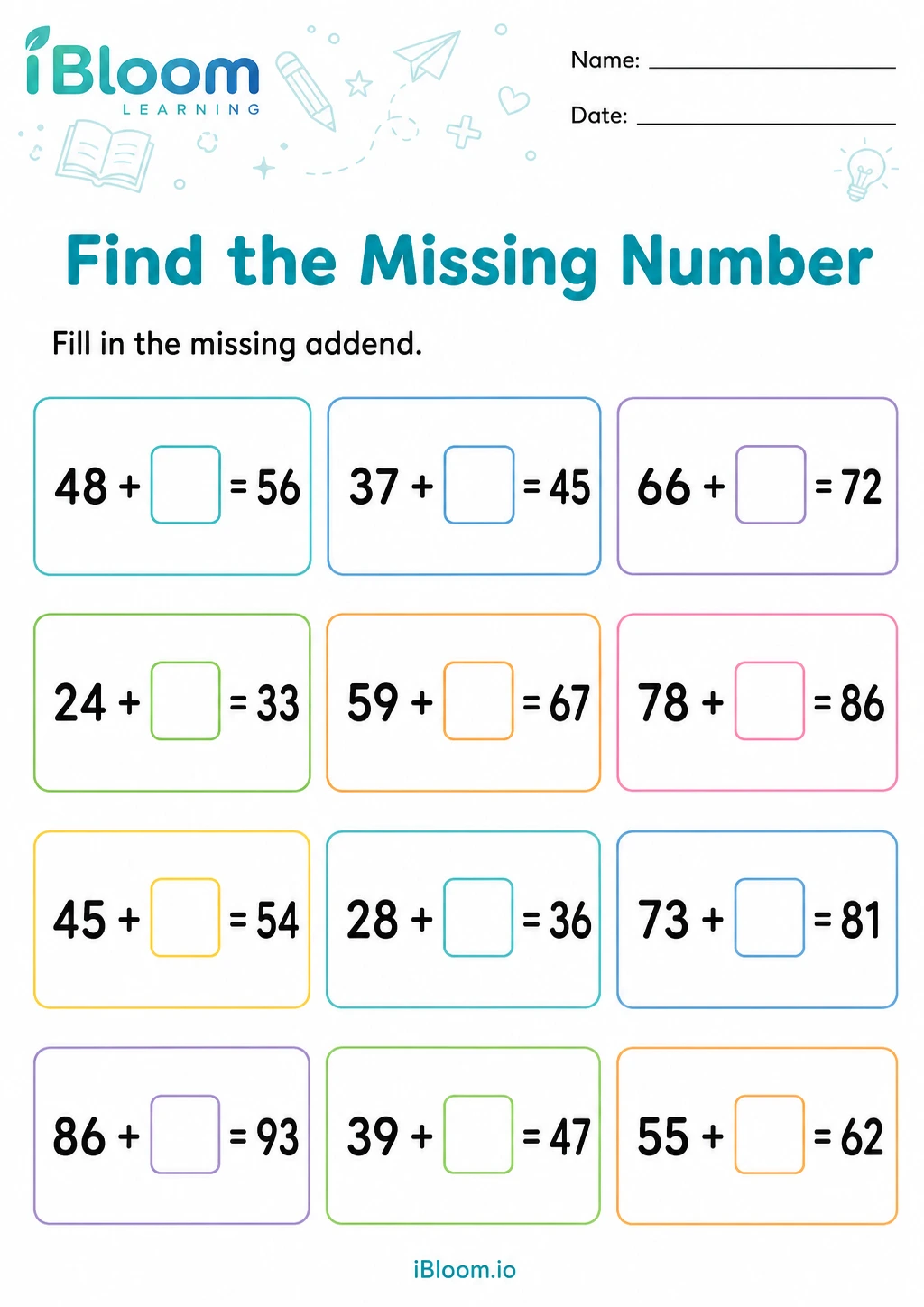
This Grade 2 addition worksheet practices missing addends through familiar stories with totals under 10. Students find how many more items are needed to reach a stated total. The 15 prompts move from direct missing-part situations to joining, combining, and separating examples. A separate answer key gives the missing number for each response.
Aligned to 2.OA.A.1
How do I find a missing addend?
Read the story to find the total and the part already known. Subtracting the known part from the total gives the missing part. In question 1, 3 beads plus an unknown number make 7, so 7 − 3 = 4.
- 13 + ___ = 7
- 27 − 3 = 4
- 3Mia needs 4 beads.
How can an equation represent the story?
Write the known part plus the missing part to equal the total. Keep the story’s numbers in their roles, then check by adding the two parts.
How do I check my answer?
Add the missing amount to the known part. If the sum matches the total in the story, the answer fits. For 3 + 4 = 7, the two parts make the stated total.
How to use this worksheet
- 1Underline the total named in the story.
- 2Mark the part that is already known.
- 3Write known part + blank = total.
- 4Find the amount that fills the blank by counting up or subtracting.
- 5Add the parts to check that they make the total.
- 6Use the final prompt to invent a matching story and solve it.
Common mistakes and quick fixes
The mistake
Answering with the total instead of the missing part.
The fix
Ask how many are already there and how many more reach the target.
The mistake
Subtracting the total from the known part.
The fix
Start with the total and take away the known part.
The mistake
Giving an answer that does not check.
The fix
Add the known part and missing part to see whether they equal the total.
Curriculum alignment
This worksheet practices the standard below.
Solve addition story problems with sums within 100; these missing parts stay below 10.
On this sheet: Solve addition story problems with sums within 100; these missing parts stay below 10.
Show the official wordingHide the official wording
Use addition and subtraction within 100 to solve one- and two-step word problems involving situations of adding to, taking from, putting together, taking apart, and comparing, with unknowns in all positions, e.g., by using drawings and equations with a symbol for the unknown number to represent the problem.
What to practice next
Make more practice
Further reading
Questions parents and teachers ask
How do I find a missing addend in a story?
Identify the total and the part already known, then find what must be added to reach the total. For Mia’s beads, 3 + ___ = 7, so the missing addend is 4. Add 3 and 4 to check.
How many problems are included?
There are 15 story questions in three parts. Each asks for a missing amount that completes a total, and the final question uses pears in a basket. Students write a number in each blank. The numbers stay within the title’s under-10 range.
Why are all totals under 10?
Each story practices missing addends with a total below 10, matching the skill in the page title. The small totals keep attention on the unknown part. Students can count up or subtract the known part. For example, 3 known with a total of 7 leaves 4.
Should my child subtract or count up?
Either approach can help. A child can subtract the known part from the total or count up from the known part until reaching the total. For 3 and 7, both approaches find 4. Students can choose the method that makes the story clear.
How can I check a missing addend?
Add the known amount and the answer. If their sum matches the story total, the missing addend is correct. For example, 3 + 4 = 7 checks the bead story. This check works with every story on the sheet.
What is the answer to the last question?
The basket has 3 pears and needs 8 in all, so 5 more pears are needed. Check by adding: 3 + 5 = 8. The missing addend is the amount still needed to meet the total. The answer key shows the same missing number.