
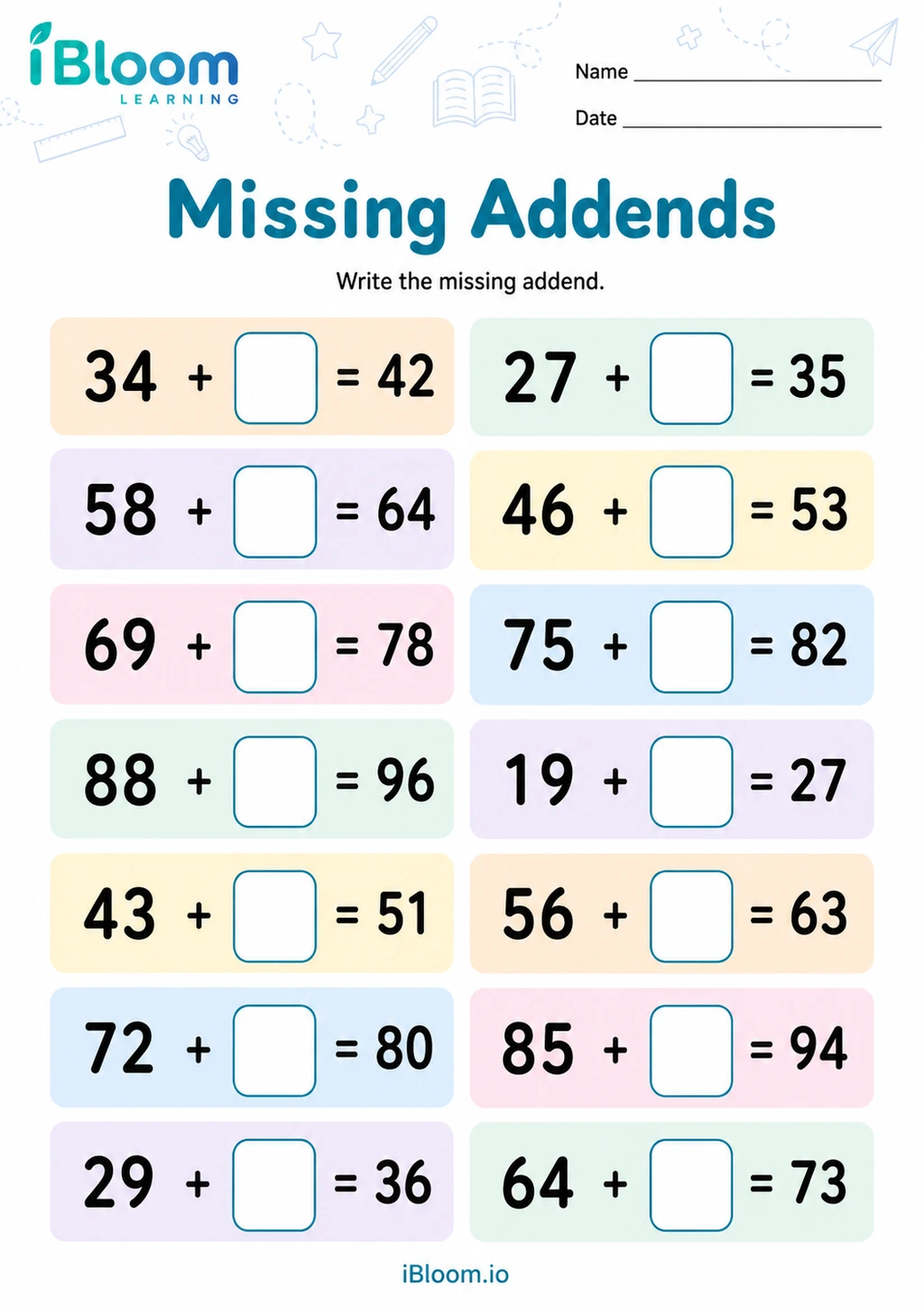
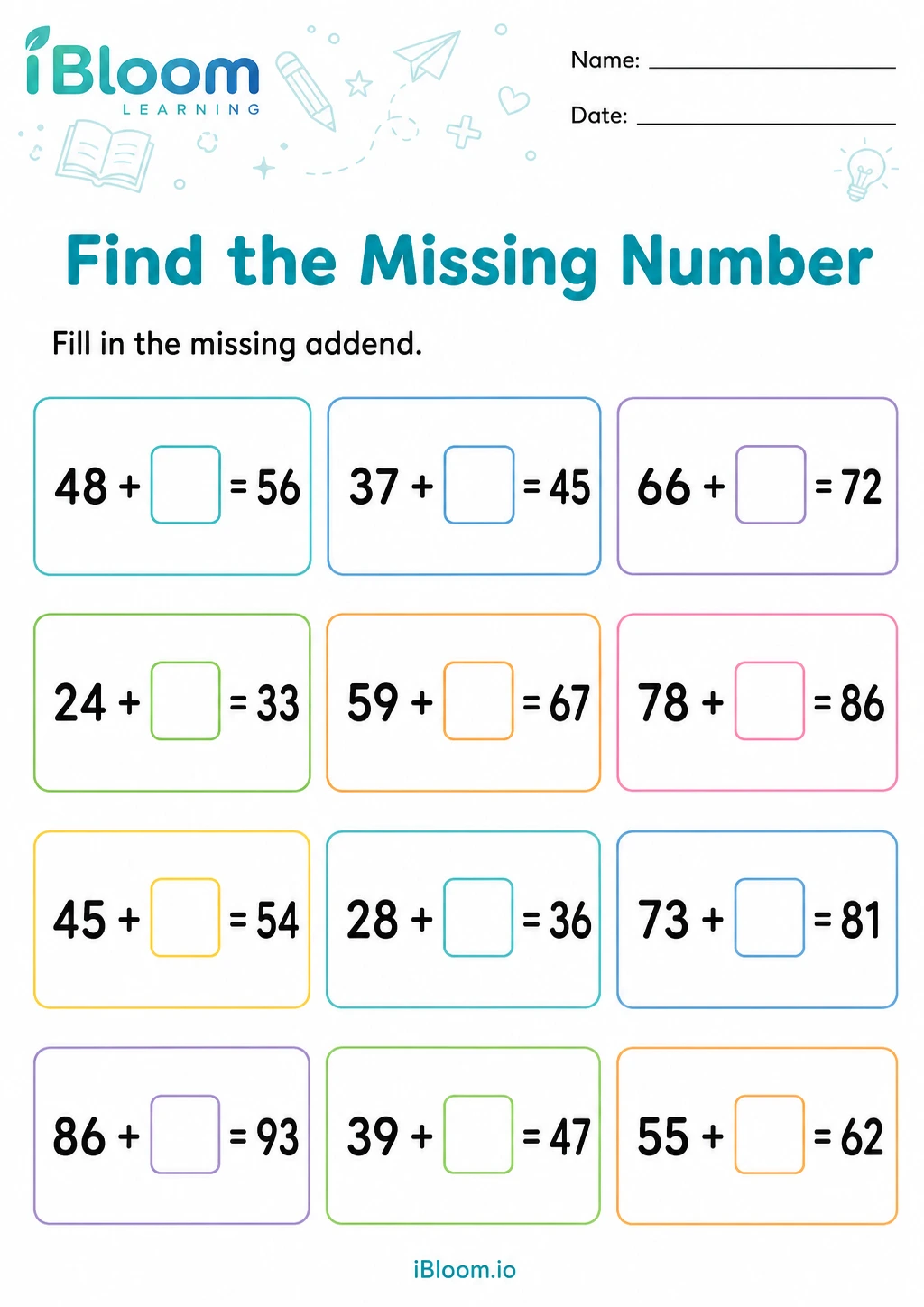
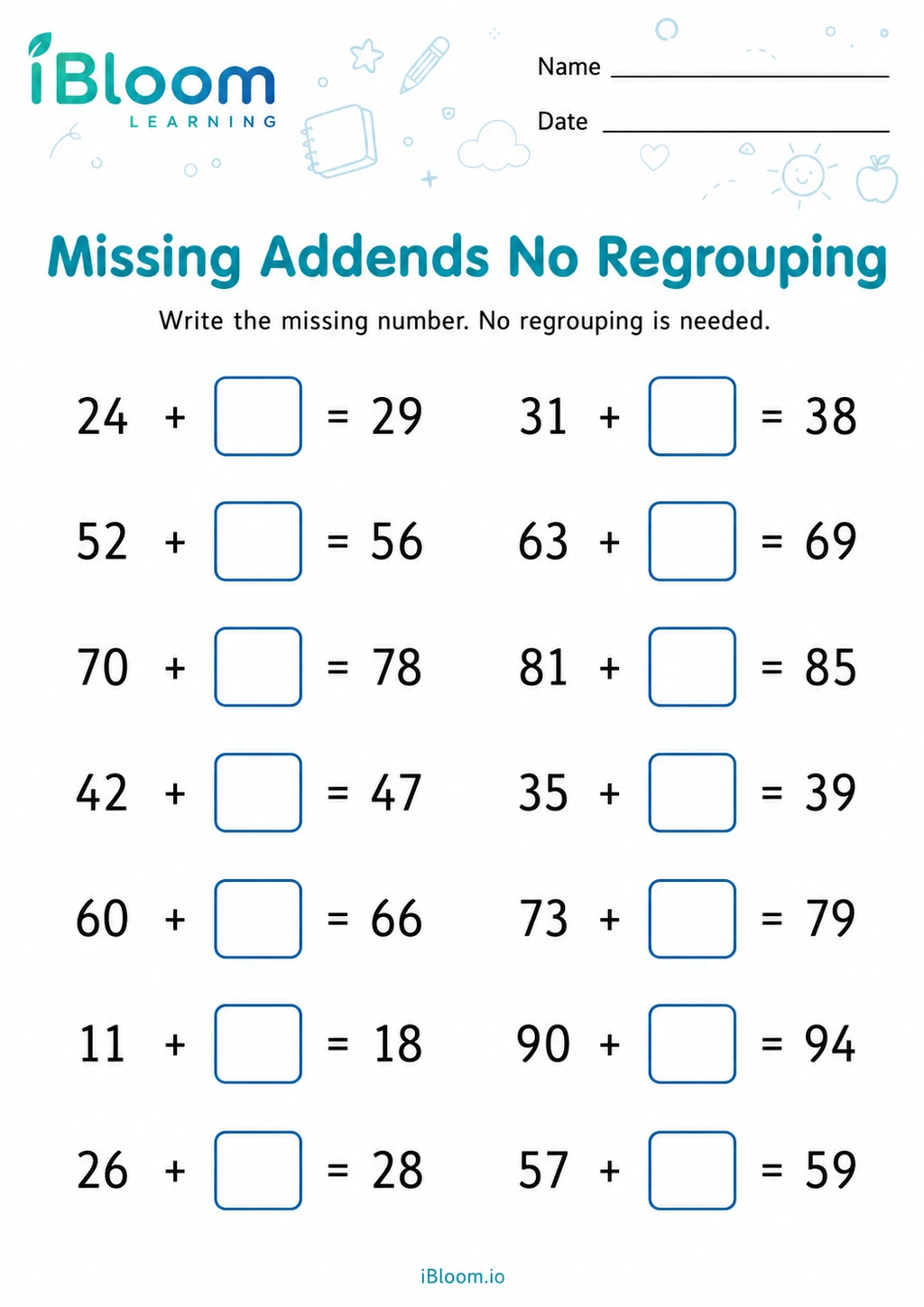
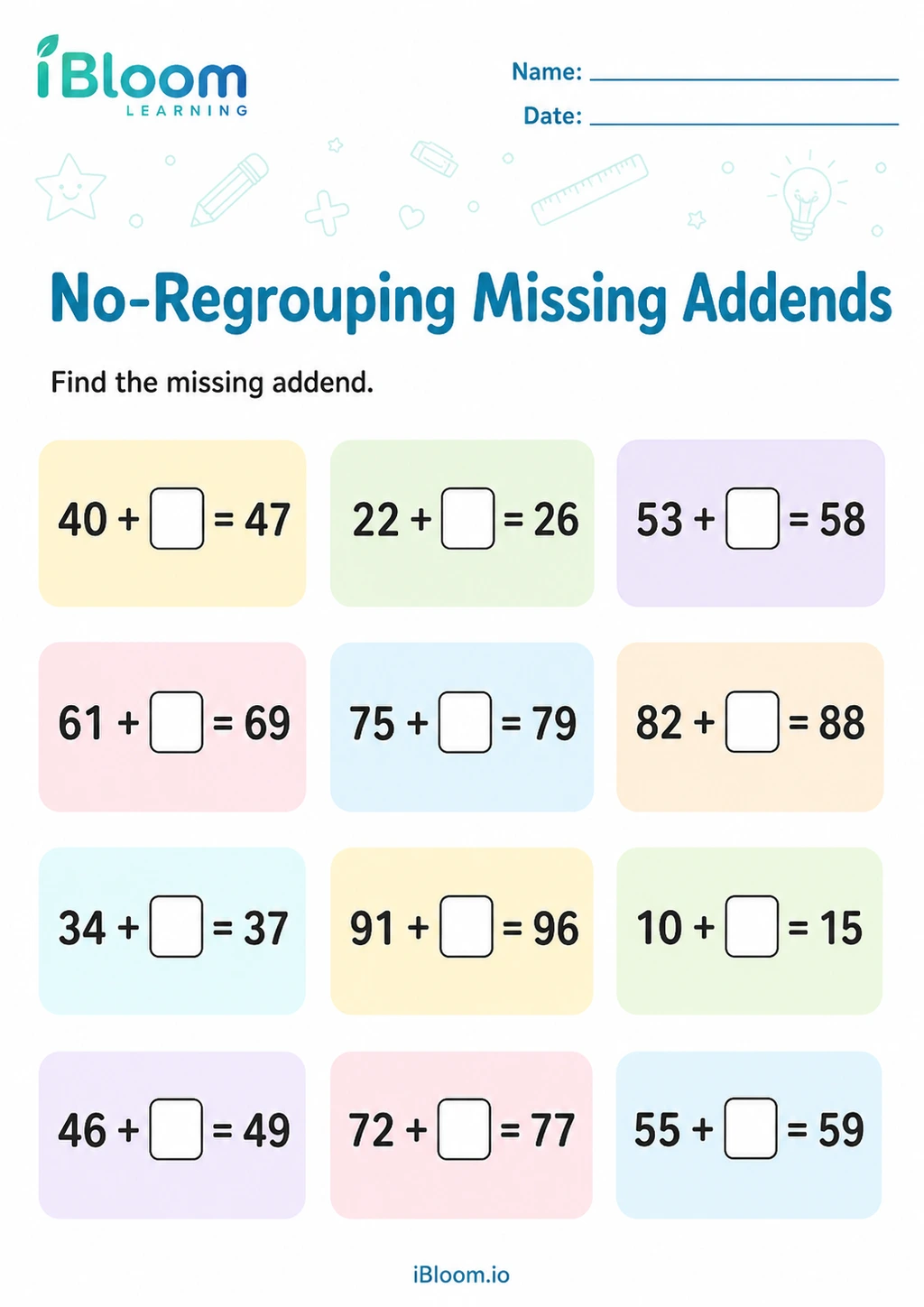
About this worksheet
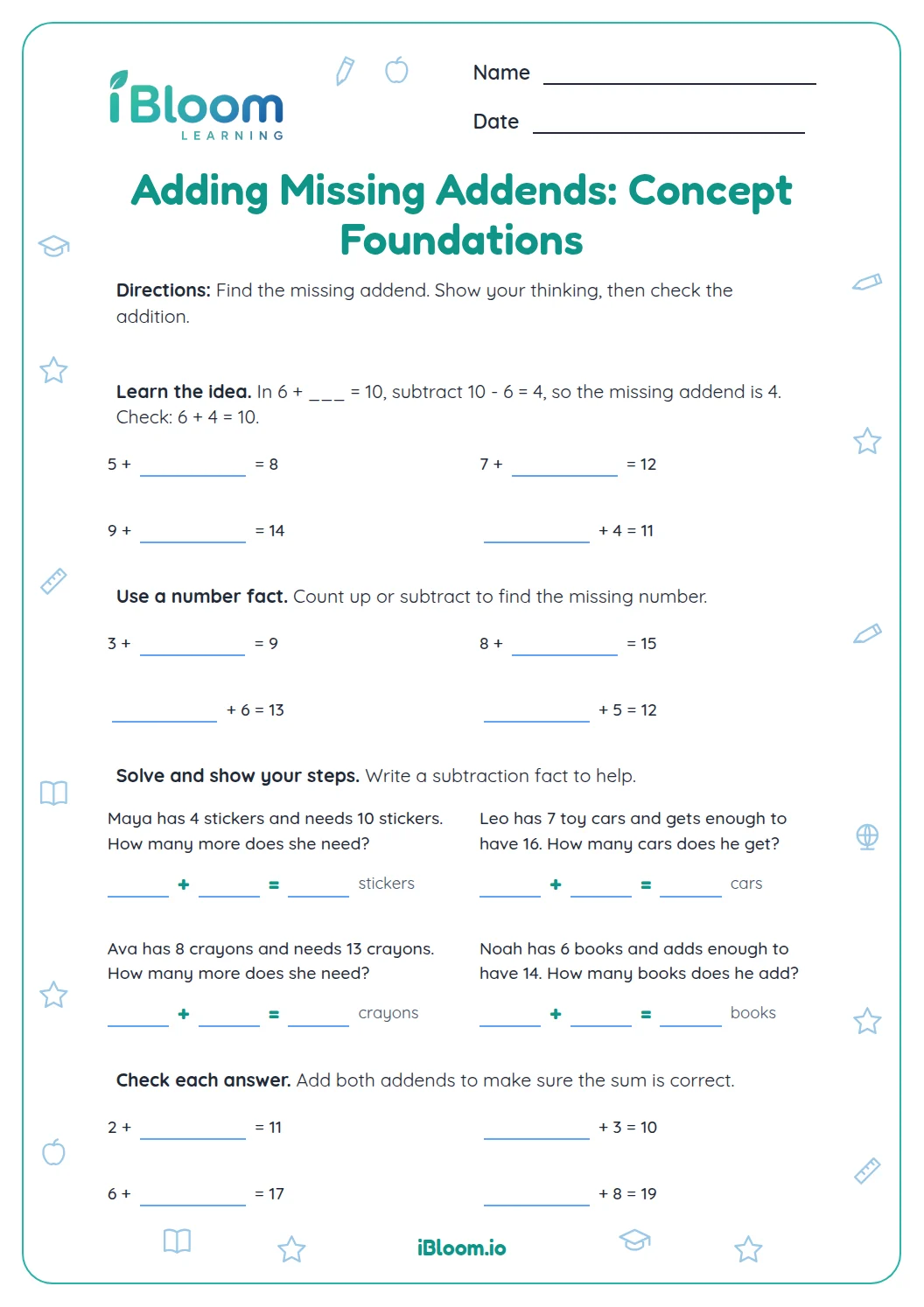
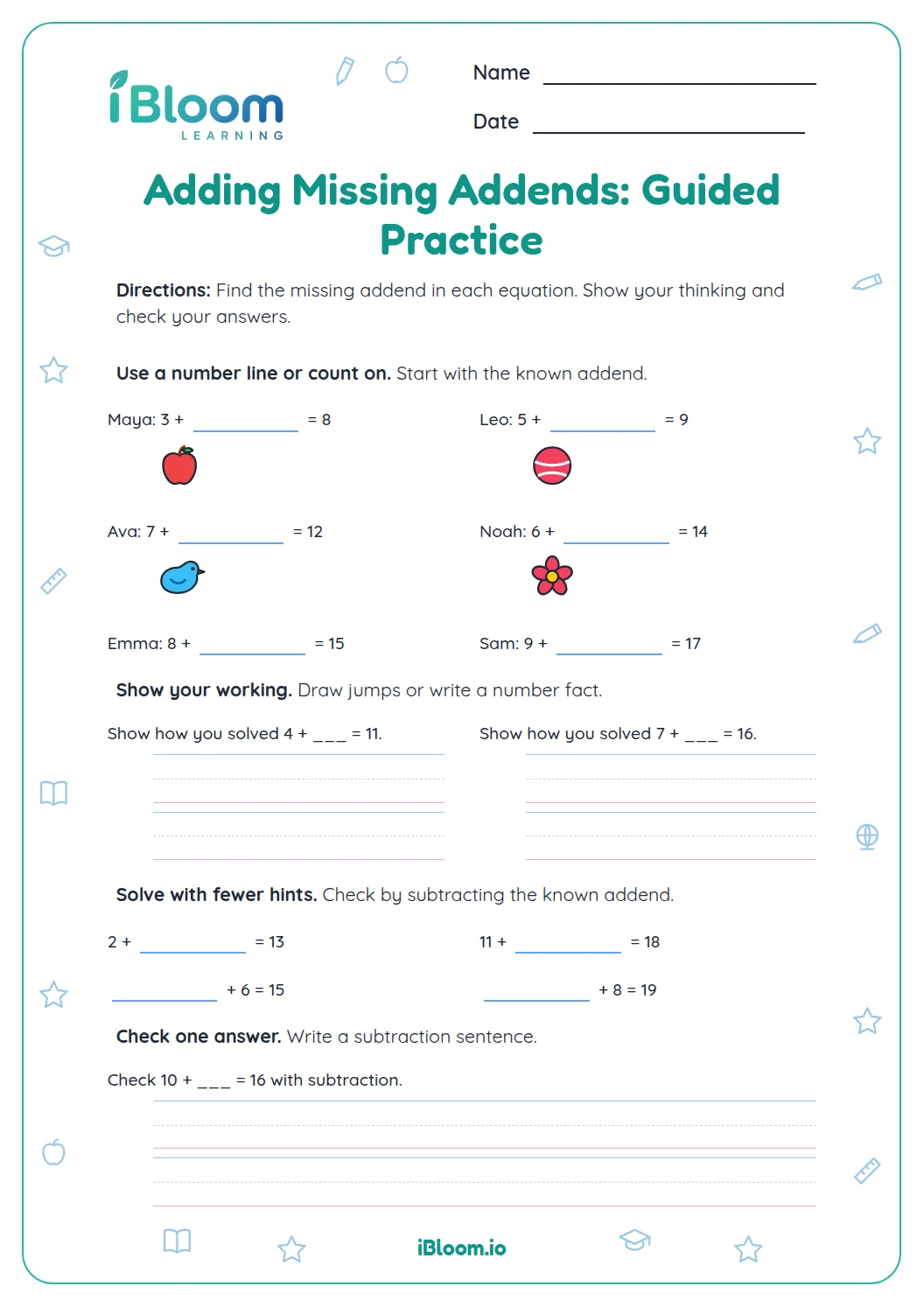
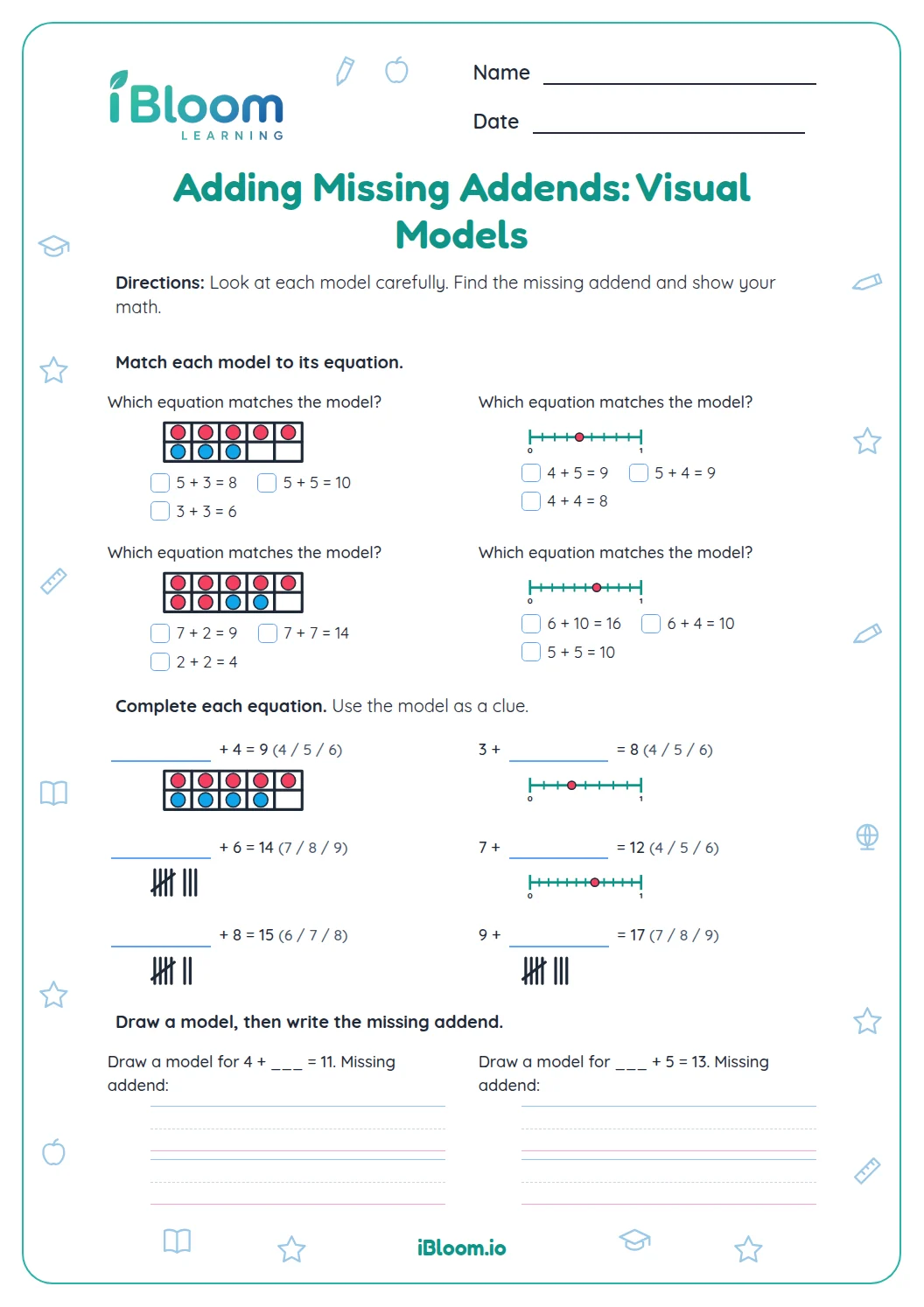
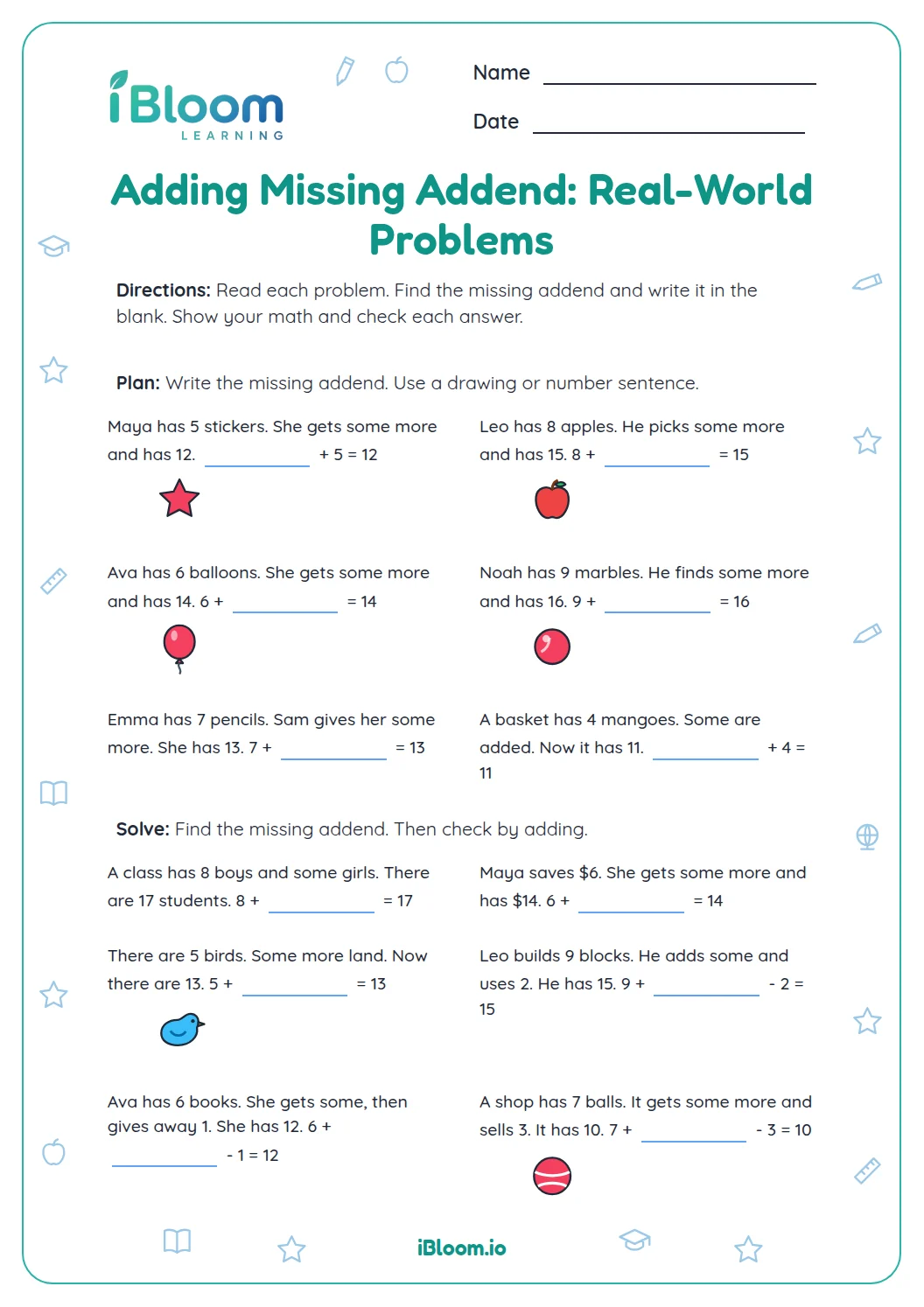
This two-page Grade 2 worksheet gives students 16 chances to find a missing addend in sums under 20. Twelve equations place the blank in different positions; four short stories apply the same skill. Students can count on or subtract the known addend from the total, then check by adding. It practices CCSS 2.OA.B.2, and a separate key lists every answer.
Aligned to 2.OA.B.2
How can a number bond help?
A number bond shows a whole split into two parts. If the whole is 14 and one part is 6, the blank part is the number that joins 6 to make 14.
Think of the addition fact: 6 + 8 = 14. You can also count on from 6 until you reach 14. The first equation section includes this example.
- 1Whole: 14
- 2Known part: 6
- 36 + ___ = 14
- 46 + 8 = 14, so the missing part is 8
How do you check a missing addend?
Put your answer back in the blank and add. For 10 + ___ = 17, try 7: 10 + 7 = 17. The equation is true, so 7 works.
The blank can appear before or after the known addend. In 13 = 5 + ___, the same fact still applies: 5 + 8 = 13.
What is on this worksheet?
The 16 questions move from equations to short story problems. The first 12 are equations with blanks in varied positions; the final four describe familiar situations. Every total is less than 20.
In each story, identify the total and known amount, then find the missing addend.
- 12 missing-addend equations
- 4 short story problems
- Every sum is under 20
How to use this worksheet at home or in class
- 1Ask your child to name the whole and the known part in the first number bond.
- 2For each equation, say the known addend and total aloud, then find what completes the sum.
- 3In the story problems, underline the total and the amount already known. Write an addition equation with a blank.
- 4Check each answer by adding the two addends.
- 5If a problem feels tricky, use counters or count on from the known addend.
Common mistakes and quick fixes
The mistake
Subtracting the known addend from the wrong number, such as 17 − 10 becoming 10 − 17.
The fix
Point to the total first. Start there and count back the known addend, or ask what joins 10 to make 17.
The mistake
Writing the total in the blank instead of the missing part.
The fix
Have your child read the equation aloud: “10 plus what equals 17?” Then check by adding.
The mistake
Treating the blank position as a different operation in 13 = 5 + ___.
The fix
Read the equation as a fact family: 5 and the missing part make 13, wherever the blank is printed.
Common Core alignment
This page practices addition fact fluency within 20, a Grade 2 expectation. Its missing-addend format also reinforces how addition and subtraction describe related parts and totals.
Fluently add and subtract within 20 using mental strategies.
On this sheet: Students find missing addends in bonds, equations, and situations with totals no greater than 20.
Show the official wordingHide the official wording
Fluently add and subtract within 20 using mental strategies. By end of Grade 2, know from memory all sums of two one-digit numbers.
What to practice next
Make more practice
Further reading
Questions parents and teachers ask
What does missing addend mean?
A missing addend is the number in an addition problem that has been left blank. In 7 + ___ = 15, the student finds the number that joins 7 to make 15. Adding 8 to 7 gives 15, so 8 is the missing addend.
What grade is this worksheet for?
This worksheet is designed for Grade 2 students practicing addition facts within 20. It starts with number bonds, then uses equations and short situations. A student who is still learning the facts can use counters, a number line, or counting on.
How can my child solve 13 = 5 + blank?
Think of the equation as asking which number joins 5 to make 13. Count on from 5 to 13, or subtract 5 from 13. Either way, the missing addend is 8, and 5 + 8 checks to 13.
Should my child subtract to find the blank?
Subtraction is one useful strategy: subtract the known addend from the total. For 10 + ___ = 17, calculate 17 − 10 = 7. Your child can also count on from 10 to 17, then check by adding 10 + 7.
How many questions are on the page?
There are 16 questions: 12 equations and four short story problems. The equations place the blank in different positions, and the stories ask students to apply the same missing-addend idea. Every total is 20 or less, keeping practice focused on addition facts within 20.
Is an answer key included?
Yes. A separate answer key gives the missing number for every question. Students can use it to check after finishing; for any missed item, ask them to put the answer back in the blank and verify that the addition equation is true.