


About this worksheet
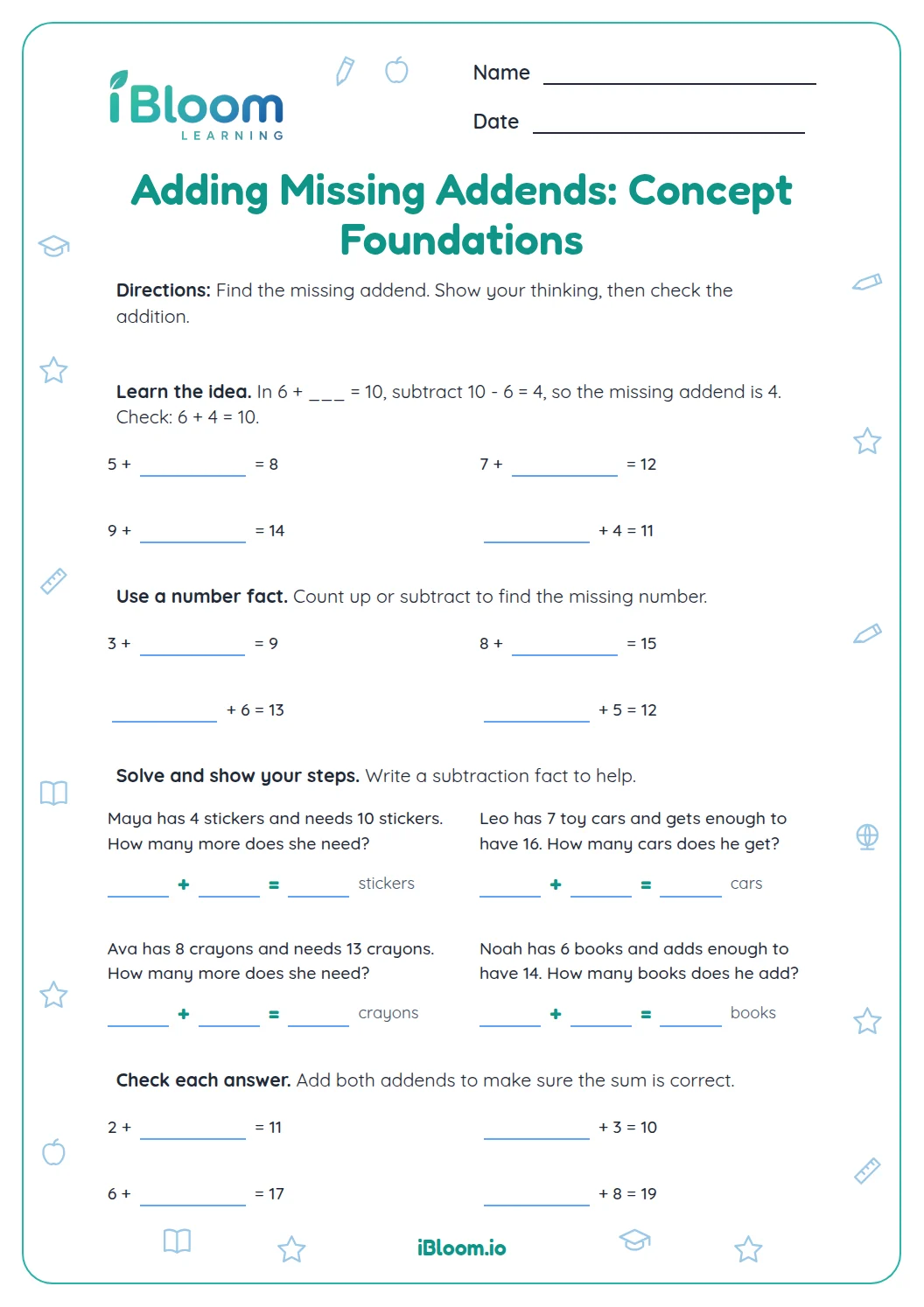
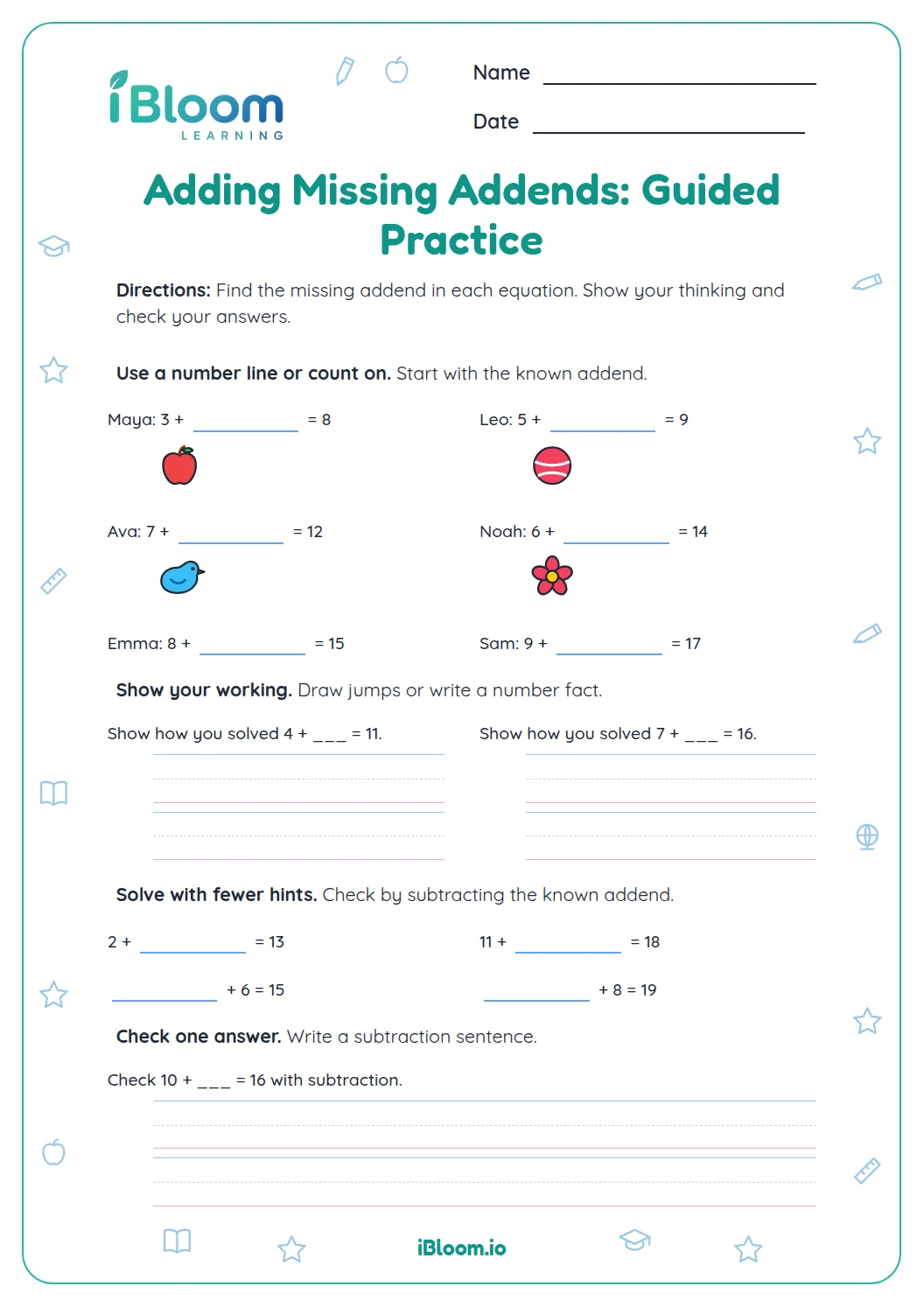
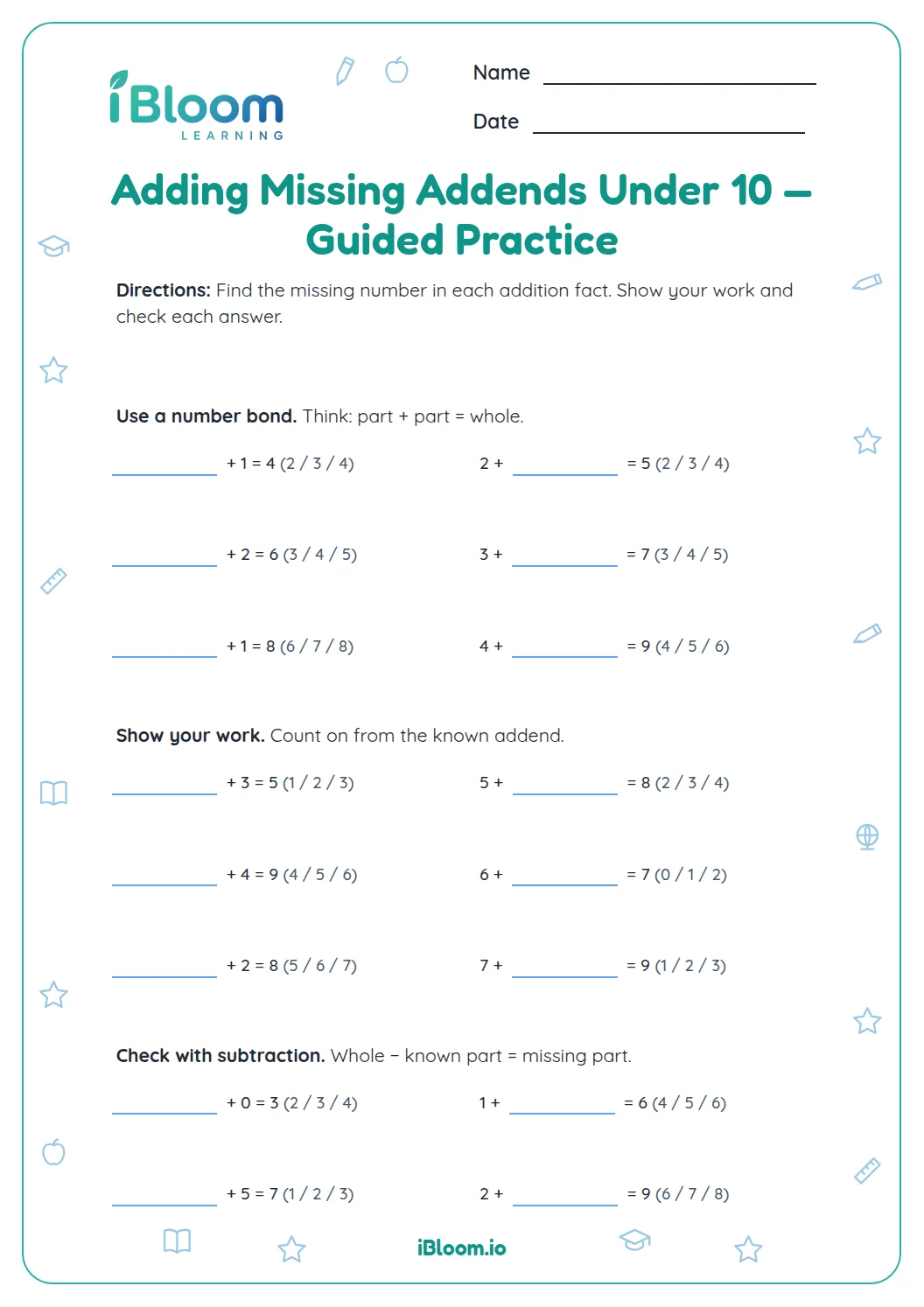
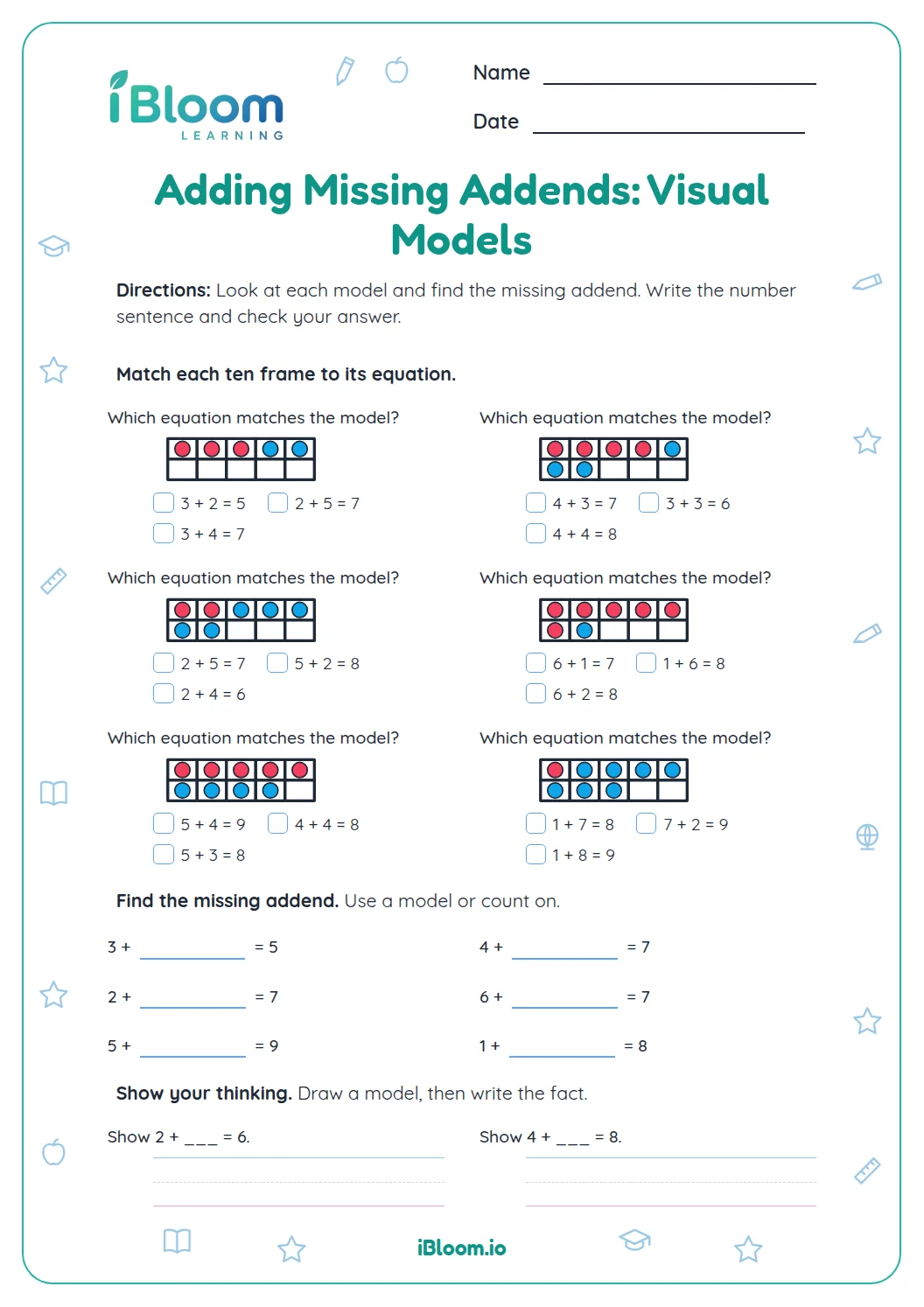
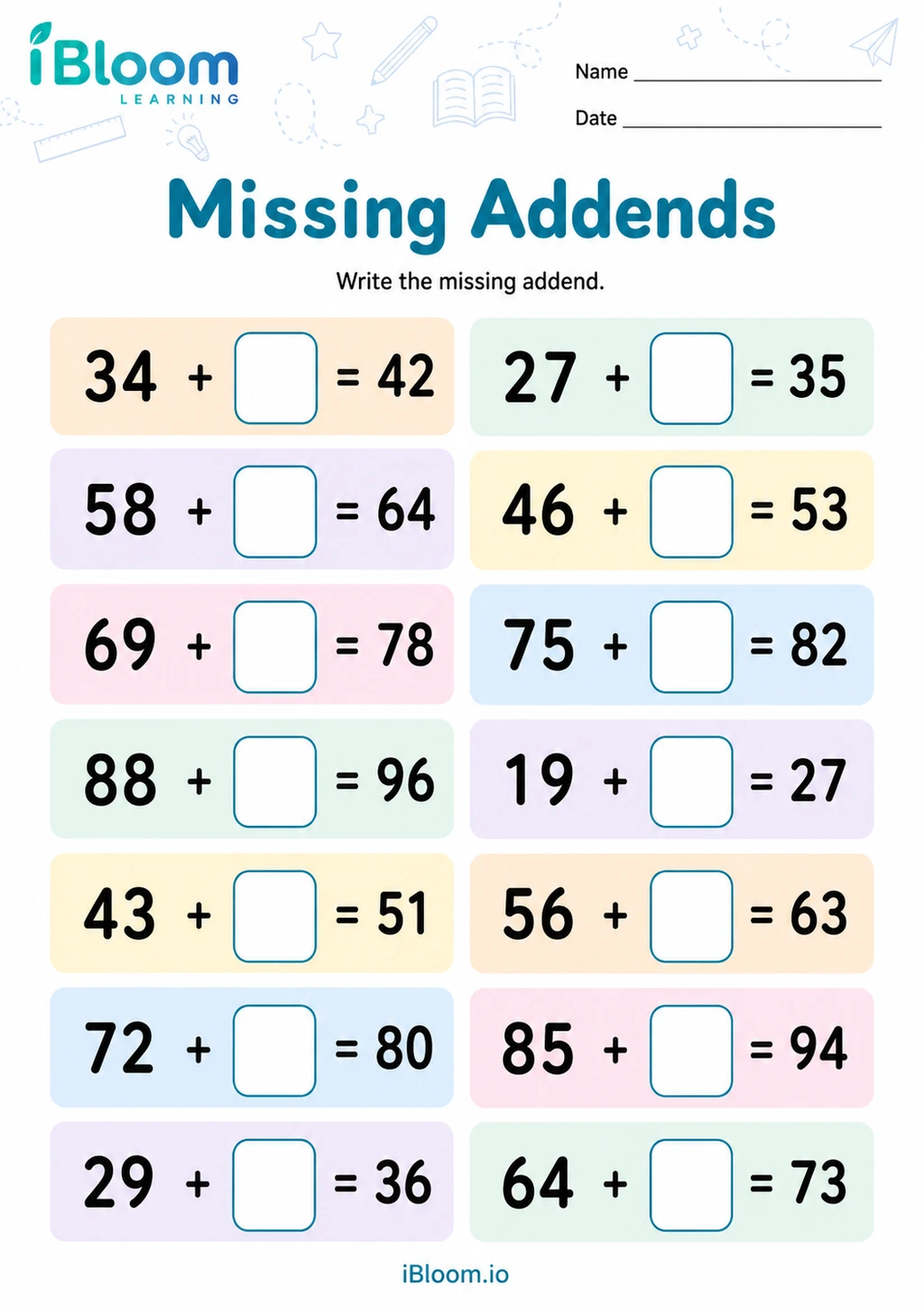
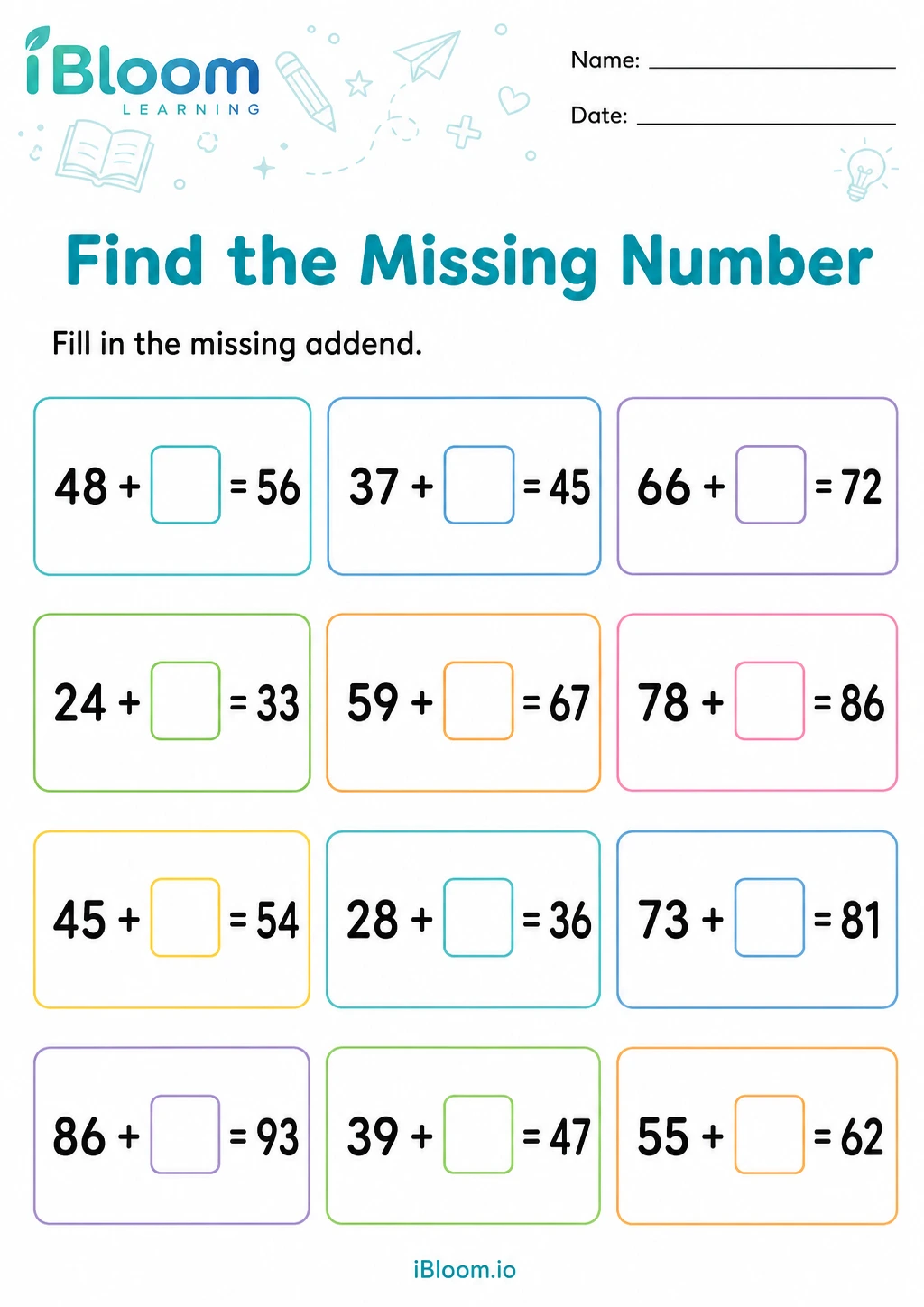
This Grade 2 printable focuses on missing addends in sums under 20. Across 16 questions, learners solve equations, complete number bonds, read marked points on number lines, and find unknown amounts in short stories. The last part asks them to explain or check an answer. A separate key gives answers, including sample reasoning for written responses.
Aligned to 2.OA.B.2
What kinds of missing-addend problems are included?
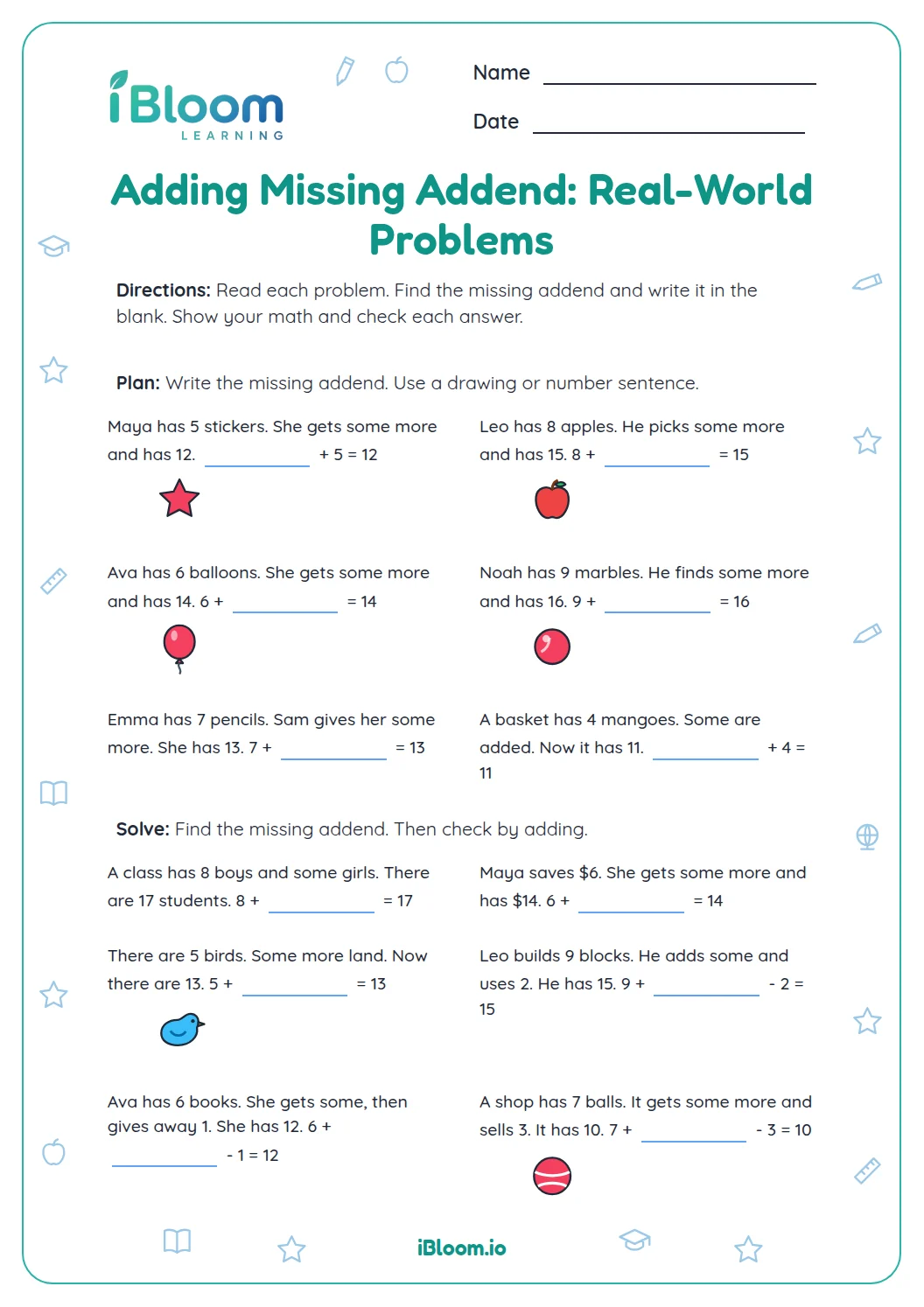
Questions 1–4 are equations with a blank addend. Questions 5–6 use number bonds, and questions 7–8 use marked number lines. Questions 9–12 apply the same unknown-part idea to short stories. Questions 13–16 solve, explain, or check an answer.
- 16 questions across equations, models, stories, and reasoning
- Four story problems use sums no greater than 17
How can subtraction reveal the missing addend?
Subtract the known addend from the total. The difference is the amount needed to complete the sum. Addition can then check the result.
- 1Question 1: 7 + ___ = 12
- 2Compute 12 − 7 = 5.
- 3Check: 7 + 5 = 12.
How do the number bonds and lines help?
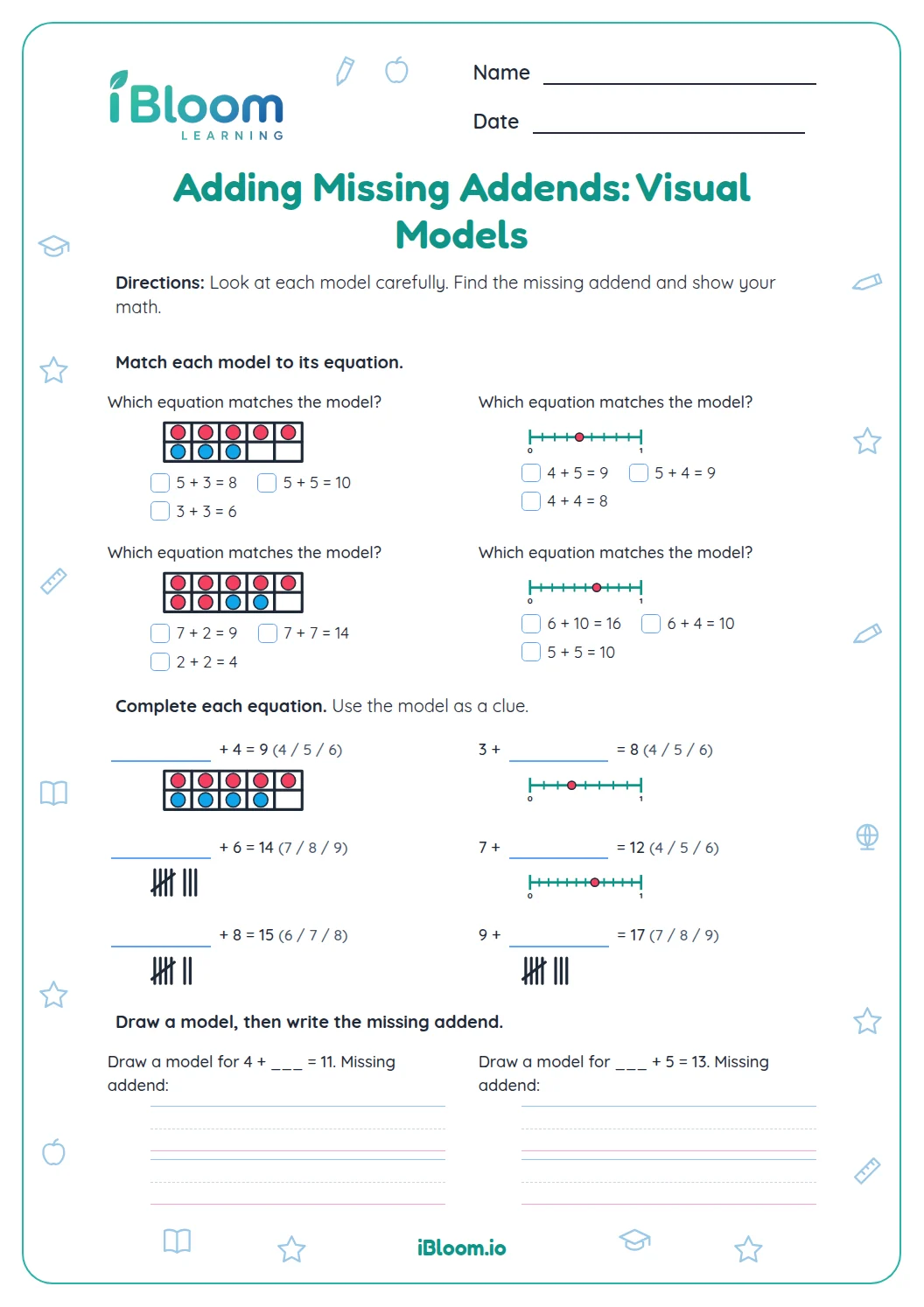
In questions 5–6, the number bond shows the whole and its parts. In questions 7–8, start at the known point and count forward; the number of jumps gives the missing amount.
How to use this worksheet
- 1Read the total and the known addend before solving.
- 2Subtract the known addend from the total, or count up to the total.
- 3Use the model or story details to identify the same two quantities.
- 4Write the missing amount with its unit when the story asks for one.
- 5Check by adding both parts to recover the total.
Common mistakes and quick fixes
The mistake
Subtracting the total from the known addend.
The fix
Start with the total and subtract the known addend.
The mistake
Stopping the number-line count before reaching the total.
The fix
Count each jump and include the final landing point.
The mistake
Giving a story answer without its unit.
The fix
Name what the amount counts, such as seats or stickers.
Common Core alignment
use addition and subtraction relationships to find unknown addends within 20
On this sheet: The questions directly practice missing addends with sums under 20.
Show the official wordingHide the official wording
Fluently add and subtract within 20 using mental strategies.
What to practice next
Make more practice
Further reading
Questions parents and teachers ask
What does “missing addend” mean?
An addend is a number being added. In 7 + ___ = 12, the missing addend is the amount that joins 7 to make 12; it is 5. Learners can solve these with subtraction or by counting forward; either method should produce an addend that restores the sum.
How many problems are included?
The worksheet has 16 questions: four equations, two number bonds, two number lines, four short stories, and four solve-or-explain items. The answer key is separate from the student sheet. The different formats let learners apply the same unknown-part relationship with symbols, drawings, and everyday quantities.
Can subtraction be used to solve these problems?
Yes. Subtract the known addend from the sum to find the unknown part. For example, 12 − 7 = 5, so 7 + 5 = 12; adding back checks the result. Number bonds show the total and its parts; number lines make the distance from a known addend to the sum visible.
What models appear on the worksheet?
Questions 5–6 use number bonds, while questions 7–8 show marked points on number lines. Learners use each model to find a missing amount before applying the idea to the stories. Each model represents the same relationship between a whole, one known part, and the part to find.
Are the story problems within 20?
Yes. Each story asks for an unknown part in a total of 12 to 17. The answer key includes units such as stickers, seats, crayons, and points where they clarify what the number represents. For open responses, the key gives a model of the reasoning; accept equivalent equations that show the same relationship.