




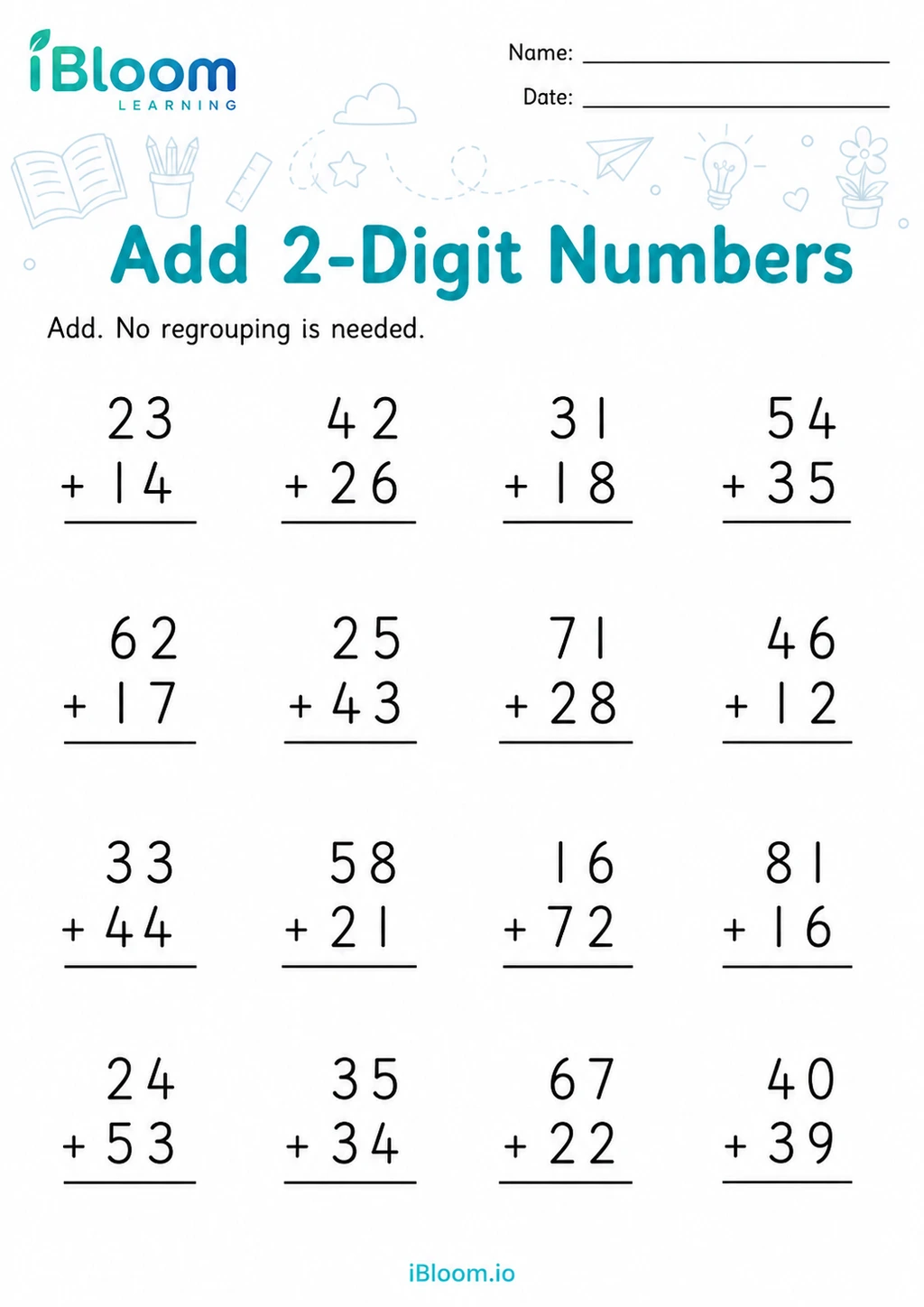
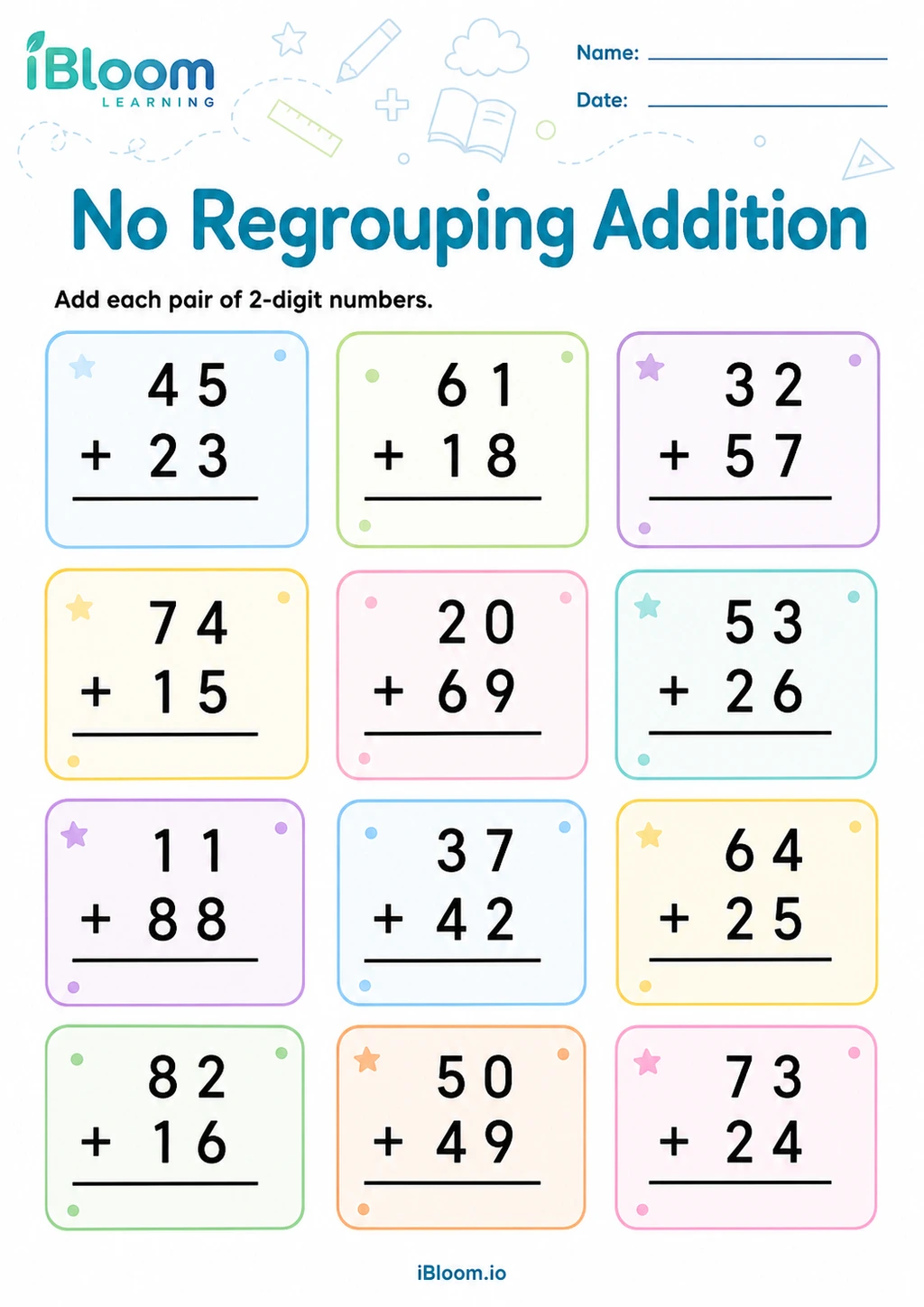
About this worksheet
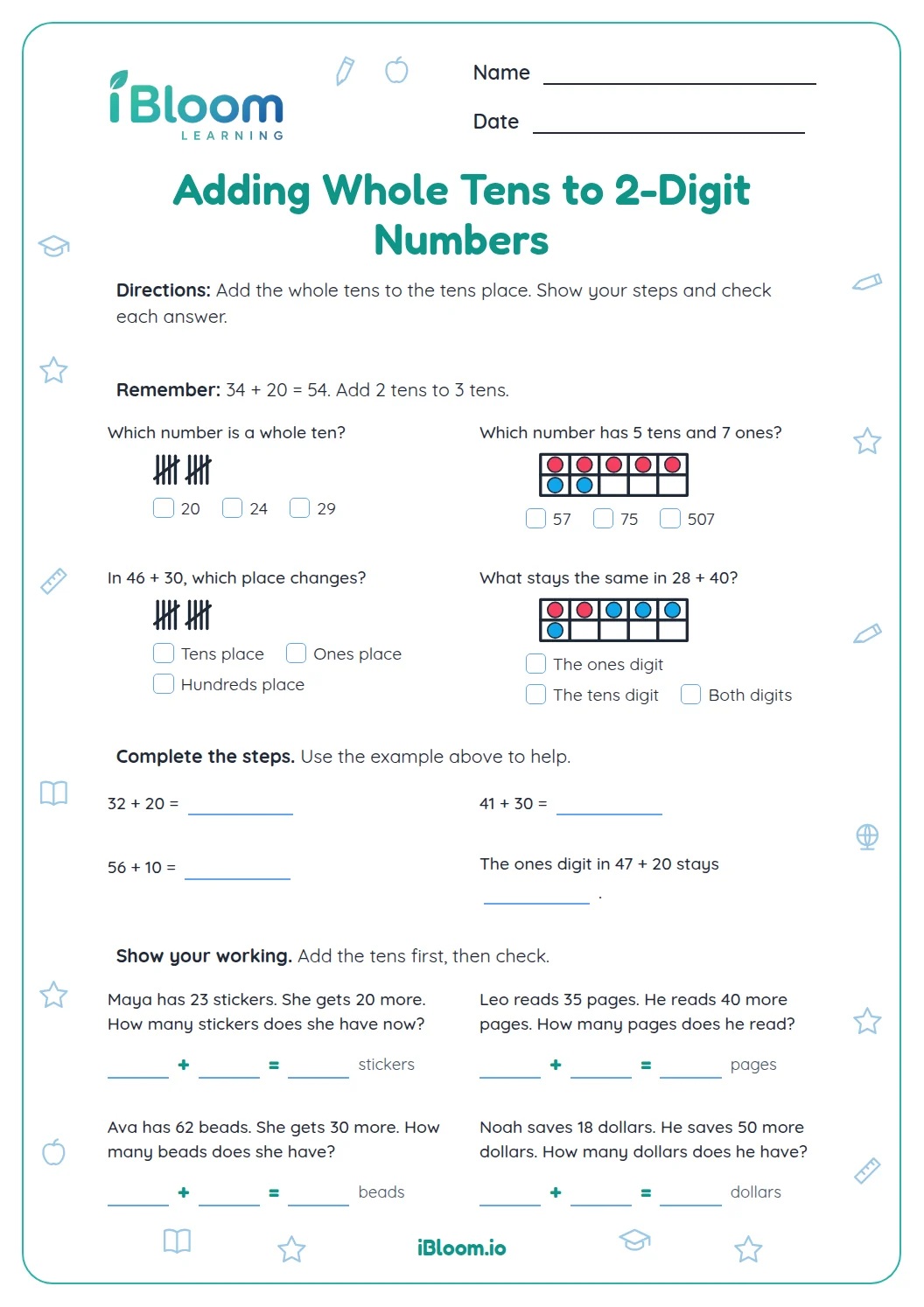
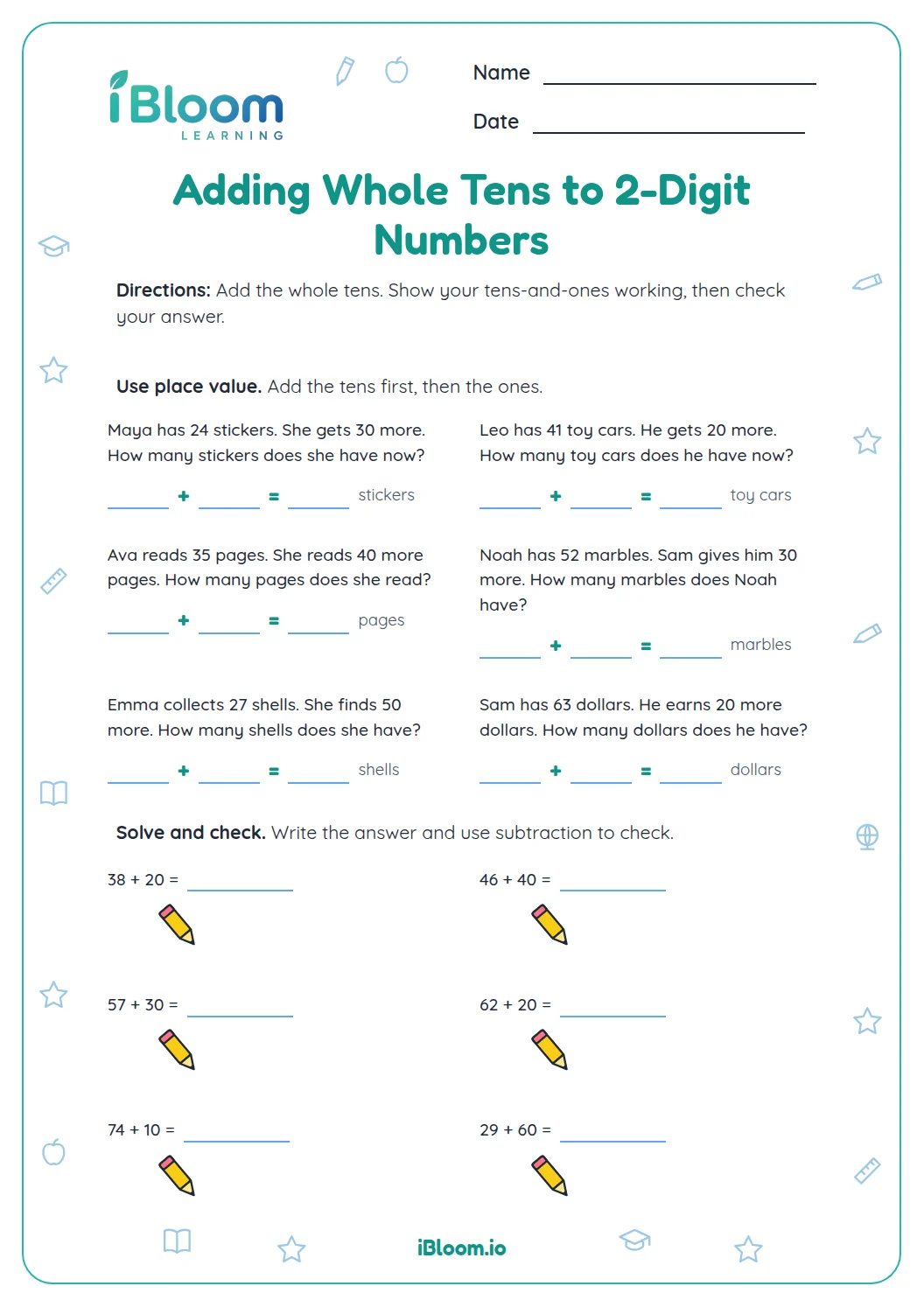
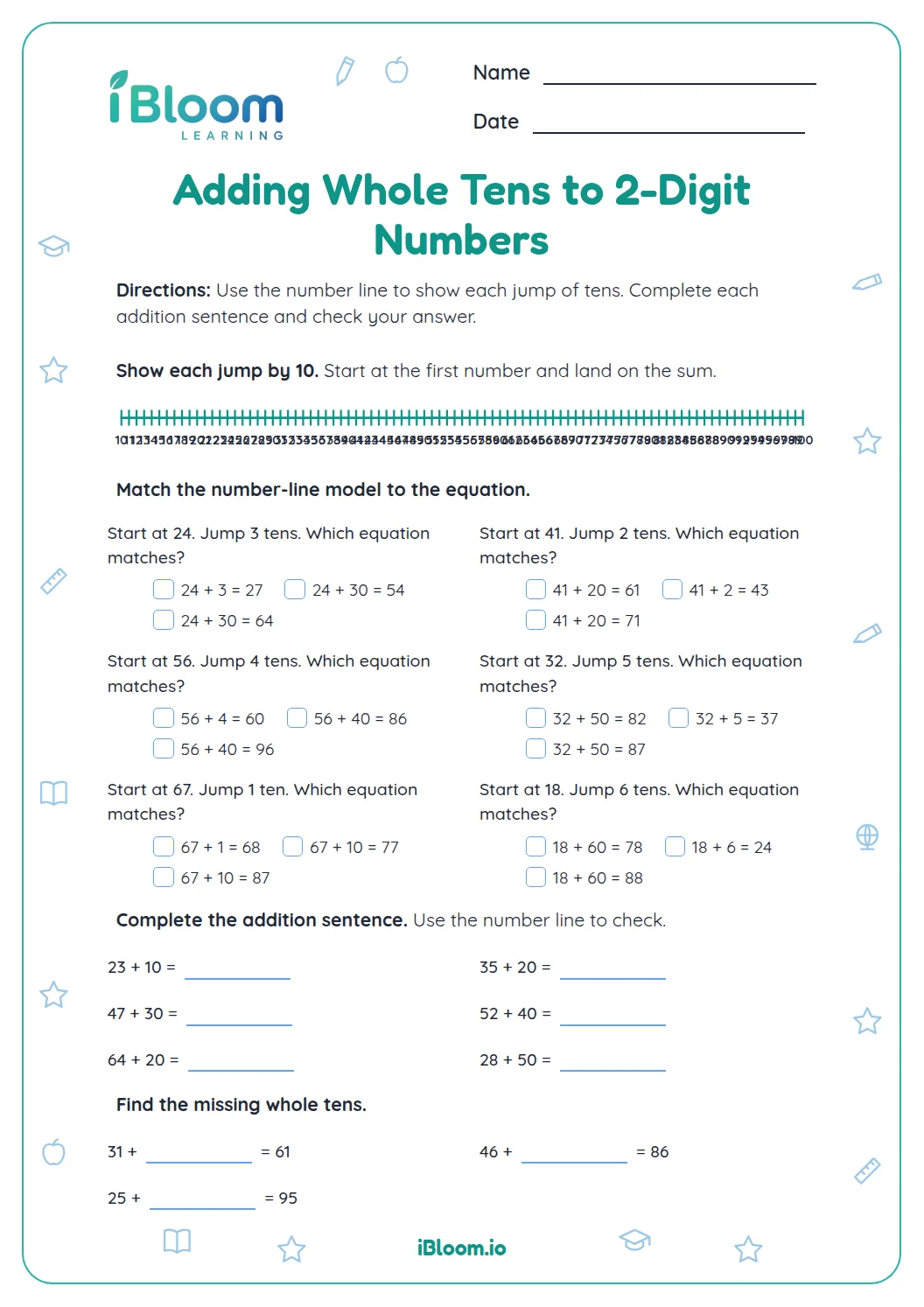
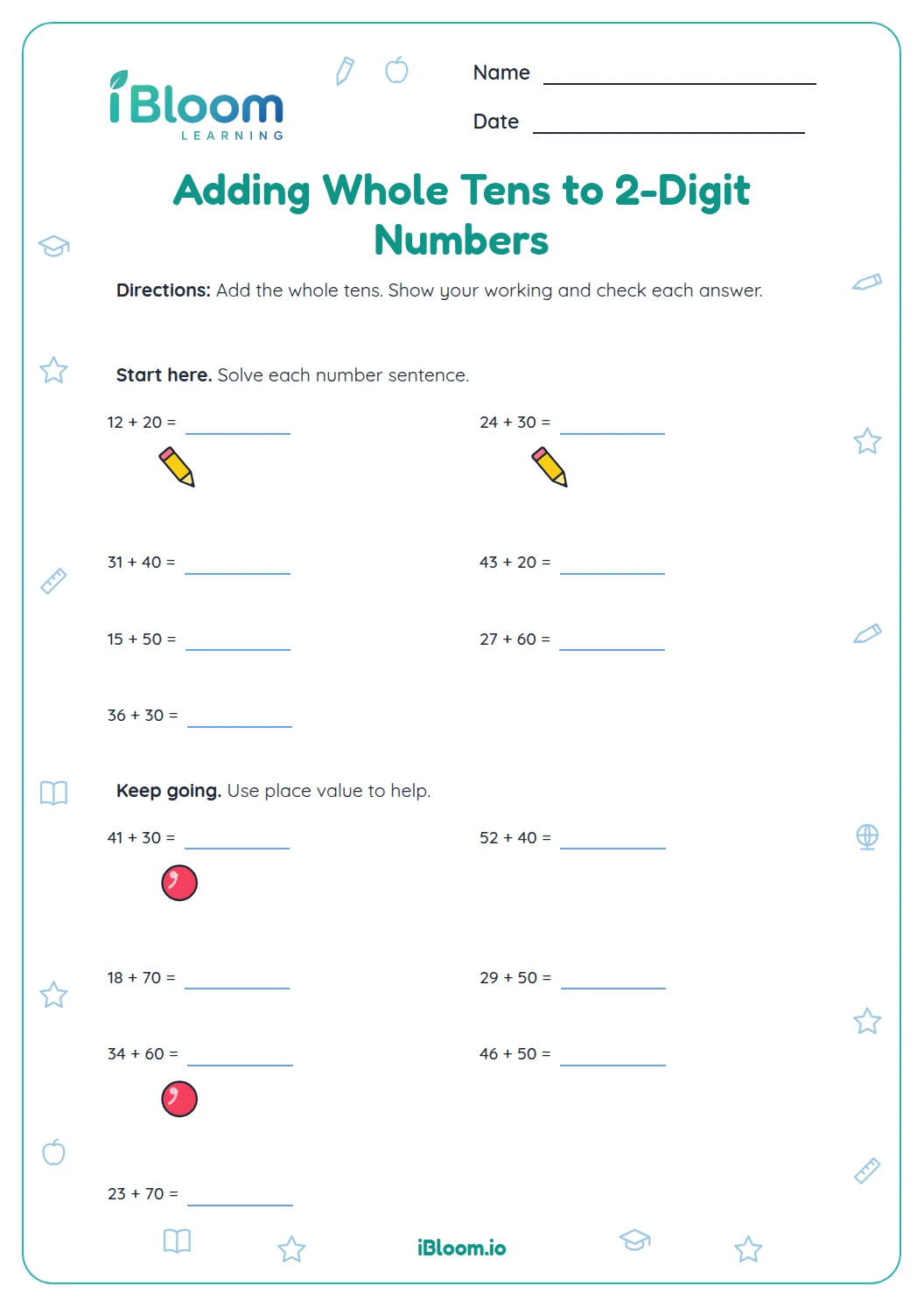
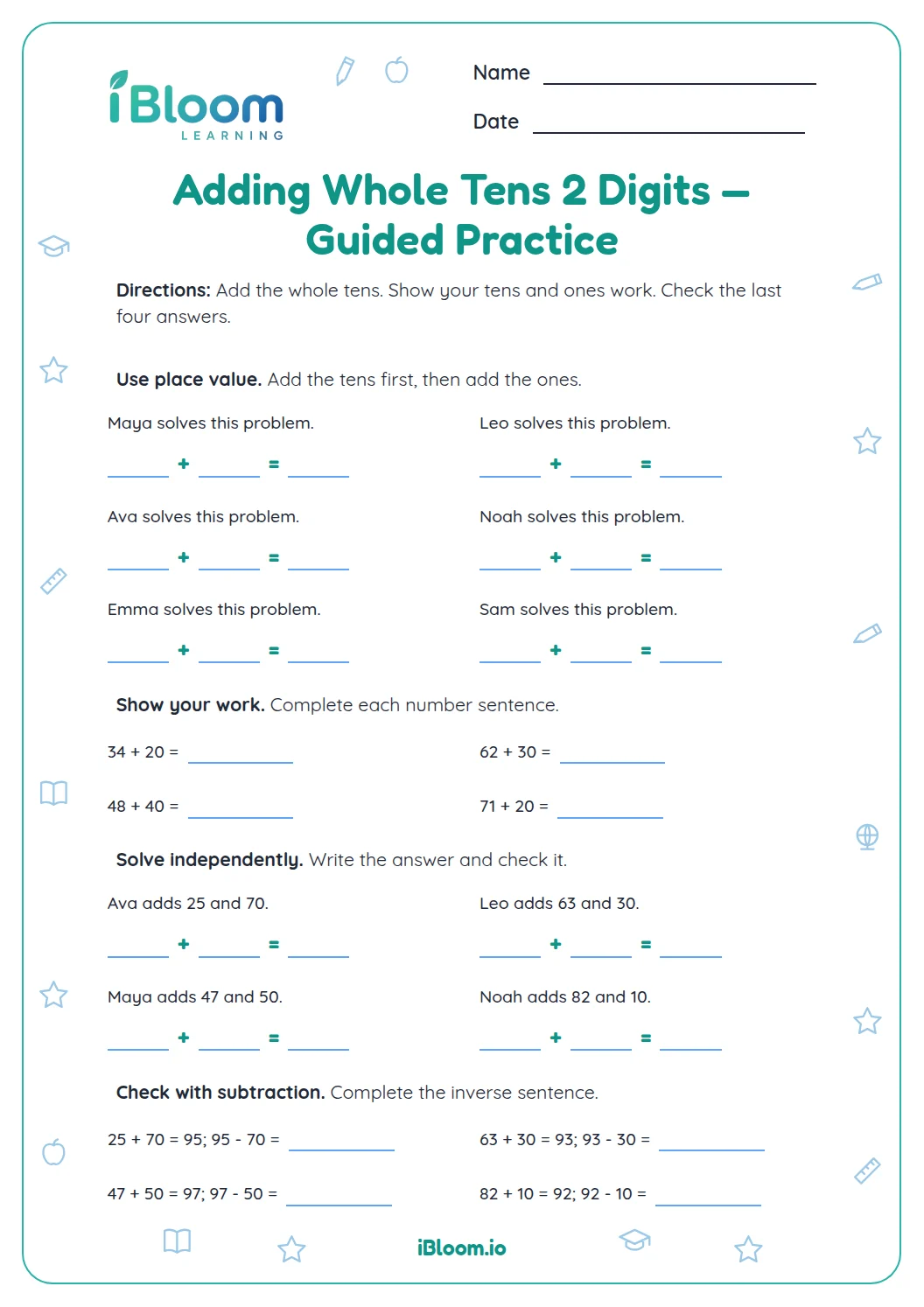
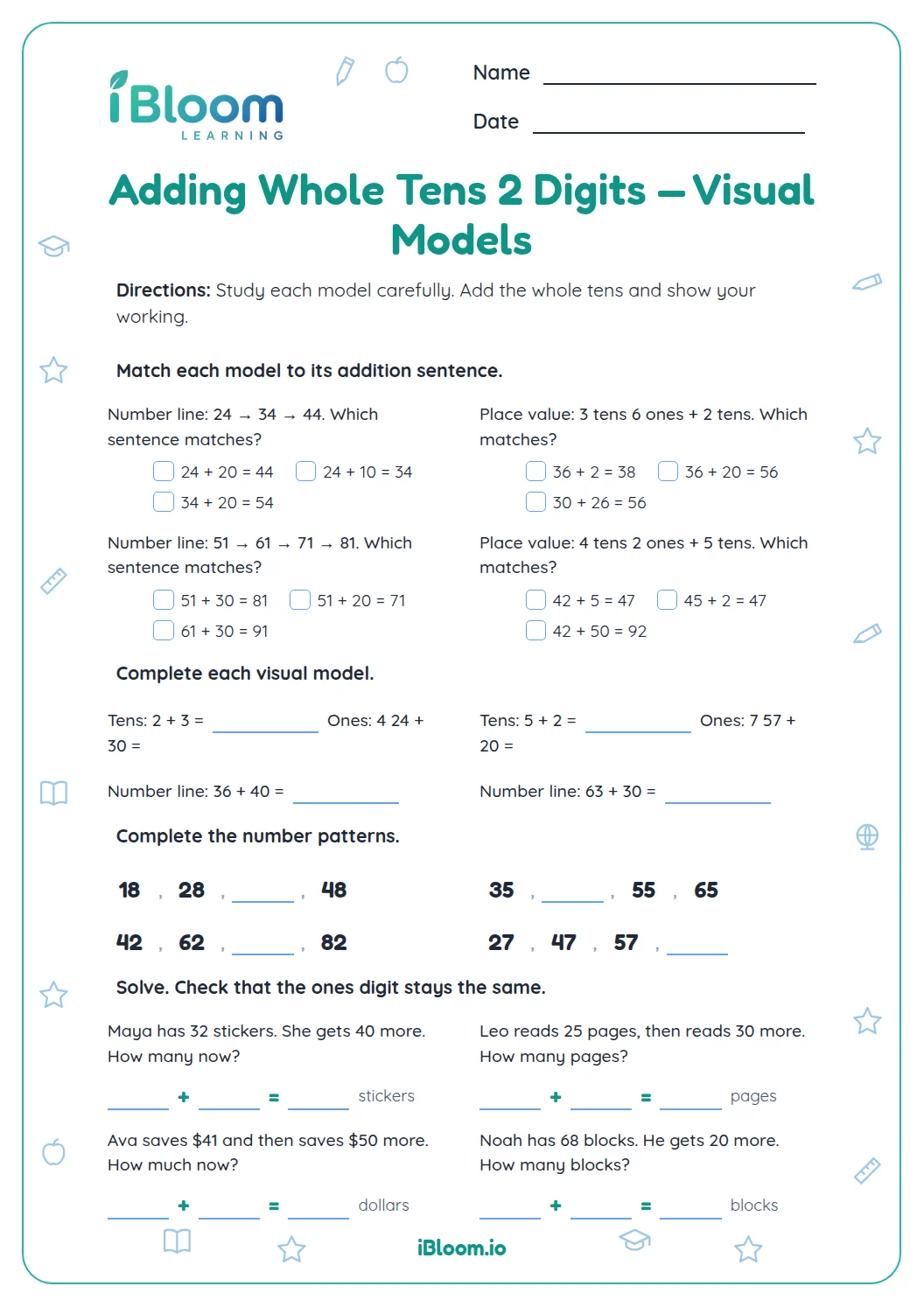
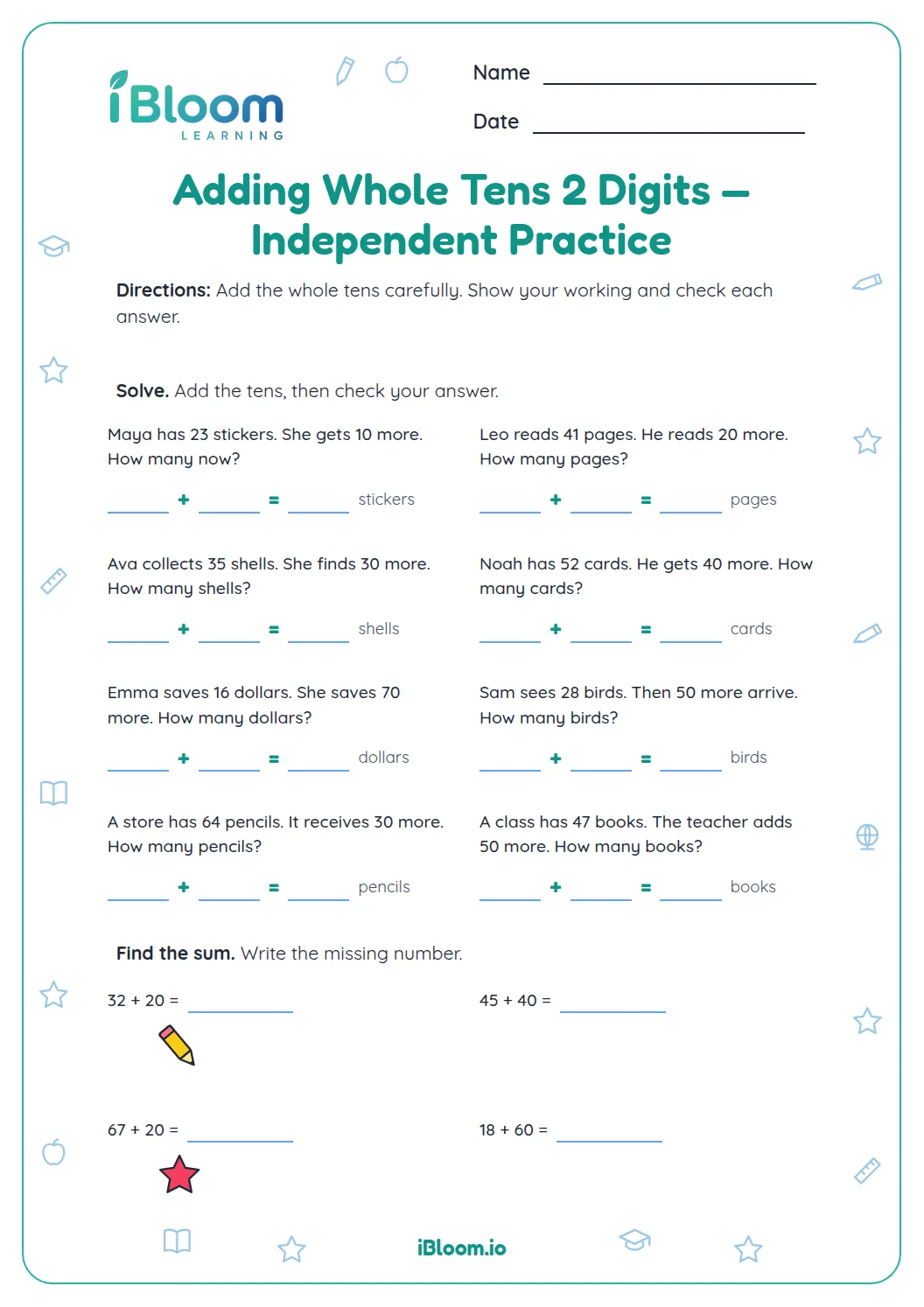
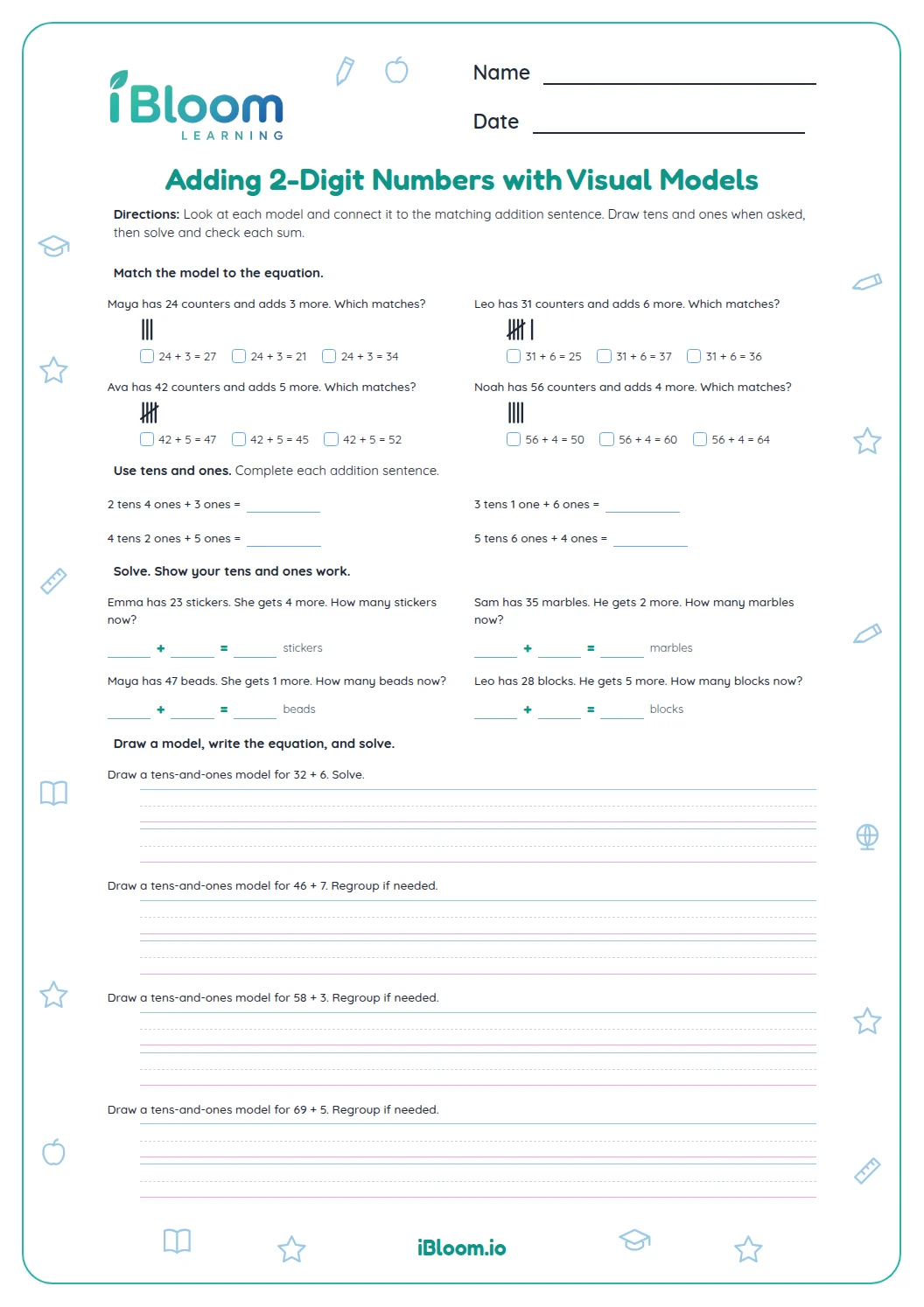
This Grade 2 worksheet practices adding whole tens to two-digit numbers through brief stories about books, crayons, pages, and other familiar quantities. Students choose matching equations or totals and solve each addition situation. It includes 15 questions and a separate answer key, aligned with CCSS 2.NBT.B.5.
Aligned to 2.NBT.B.5
How do story problems become addition equations?
Find the starting amount and the amount added. Words such as gets, adds, and then more signal that the quantities join. Choose the total that matches the story.
For example, in question 2, 47 + 30 is 77. Four tens plus three tens make seven tens, and the seven ones stay the same. Choose 77 pages.
- 147 pages + 30 pages
- 24 tens + 3 tens = 7 tens
- 37 ones stay the same
- 4Choose: 77 pages
What happens to the ones digit?
A whole ten has zero ones, so adding it does not change the ones digit. Add the tens digits to find the new tens amount, then compare with the choices.
How can children check a story answer?
Read the question again and attach the unit to the total. A result of 77 pages answers a question about pages; then check that 47 + 30 is 77.
How to use this worksheet
- 1Read the story and find the starting amount and the added tens.
- 2Add the tens while keeping the ones digit.
- 3Compare the result with all answer choices.
- 4Check that the unit matches the story.
- 5Use the answer key to review any missed item.
Mistakes to watch for
The mistake
Adding the tens digit instead of the whole ten, as in 47 + 3.
The fix
Write 30 as 3 tens so the value of the add-on stays clear.
The mistake
Changing the ones digit by mistake.
The fix
Check that adding a number ending in zero leaves the ones digit unchanged.
The mistake
Giving a total without its unit.
The fix
Reread the story and answer with pages, chairs, or the matching item name.
Common Core alignment
This practice builds on adding within 100 using place-value strategies.
Fluently add within 100 using place value and operation properties.
On this sheet: The story totals add whole tens to two-digit numbers while preserving the ones digit.
Show the official wordingHide the official wording
Fluently add and subtract within 100 using strategies based on place value, properties of operations, and/or the relationship between addition and subtraction.
What to practice next
Make more practice
Further reading
Questions parents and teachers ask
What does “whole ten” mean?
A whole ten is a multiple of ten, such as 20, 40, or 60. In these questions it is added to a two-digit amount, so the ones digit stays the same. Adding 40 to 35 gives 75: the tens increase while the 5 ones remain.
How many story problems are included?
All 15 questions use everyday addition situations, such as adding books, beads, or pages. Several ask for a total directly, while three ask learners to match a story to an equation or choose its matching total. The choices and separate key help check the answers.
Should learners write an equation?
Writing the starting amount plus the added tens can help connect a story to its calculation. The sheet uses answer choices, so learners may write an equation on scrap paper before selecting the matching total. For example, 47 + 30 = 77 pages.
Why include units in the answers?
A unit names what the total counts, such as pages or crayons. It makes the answer complete: 34 crayons plus 20 crayons is 54 crayons. The final check items focus on matching an equation or story to an addition expression.
Do any questions require regrouping?
The story totals add a two-digit number and a multiple of ten. Since the added amount has zero ones, it changes the tens digit while leaving the ones digit as it is. Children can still check each sum by adding the tens and reading the full total.
What does the key include?
The separate answer key lists the correct total for each story and the matching answer for the three final checks. Each story answer includes its unit where needed, so learners can compare both the number and what it counts.