



About this worksheet
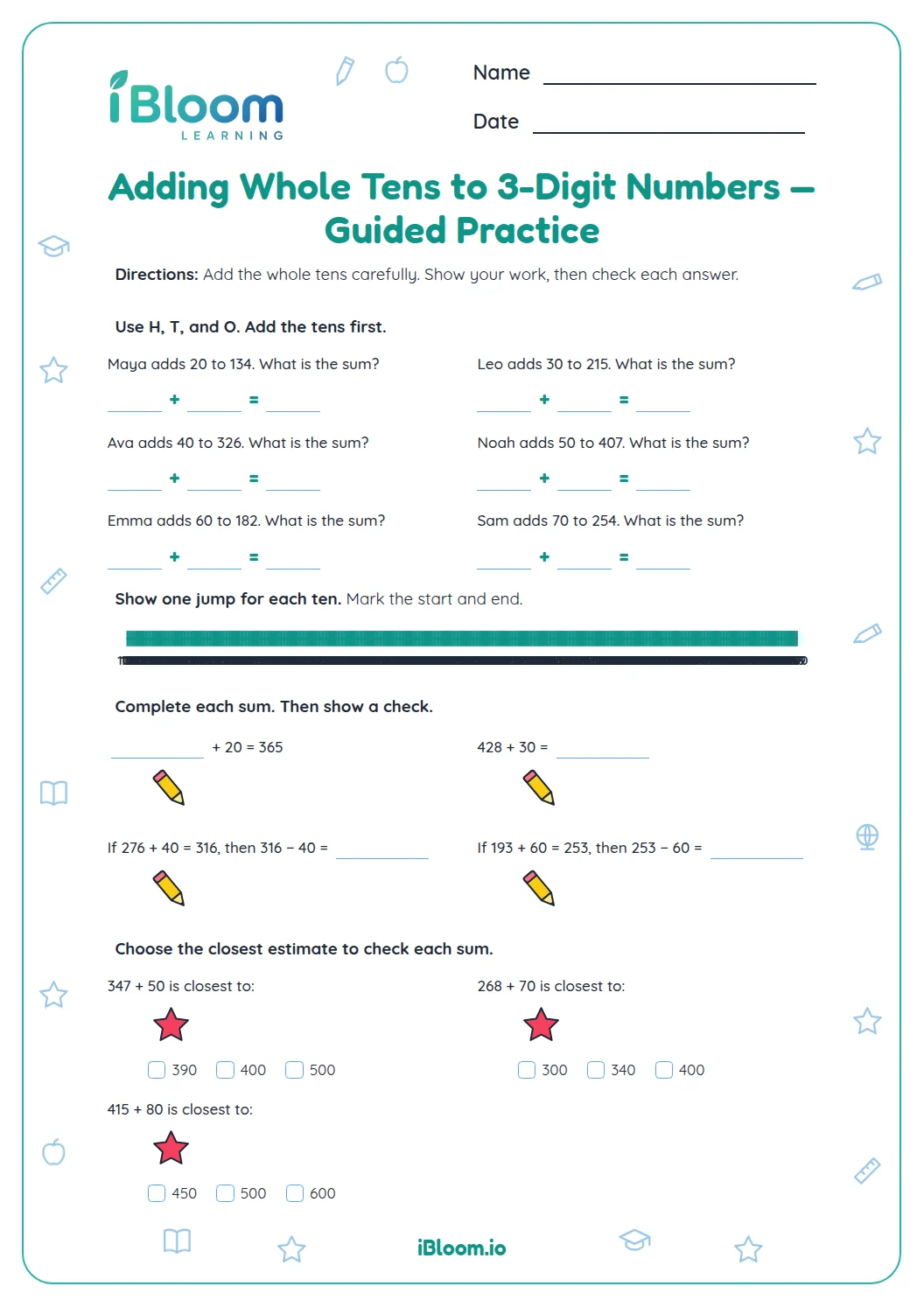
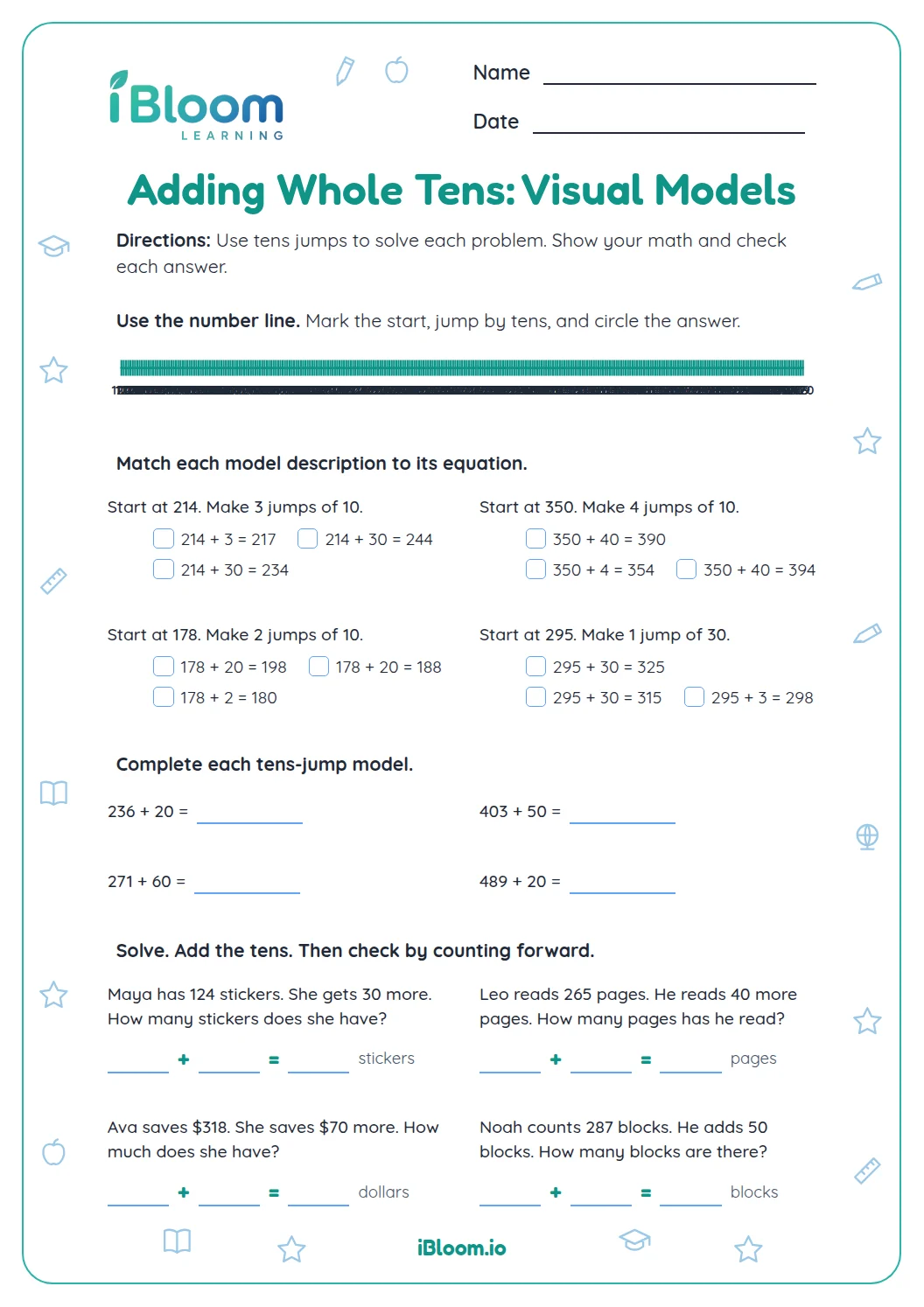
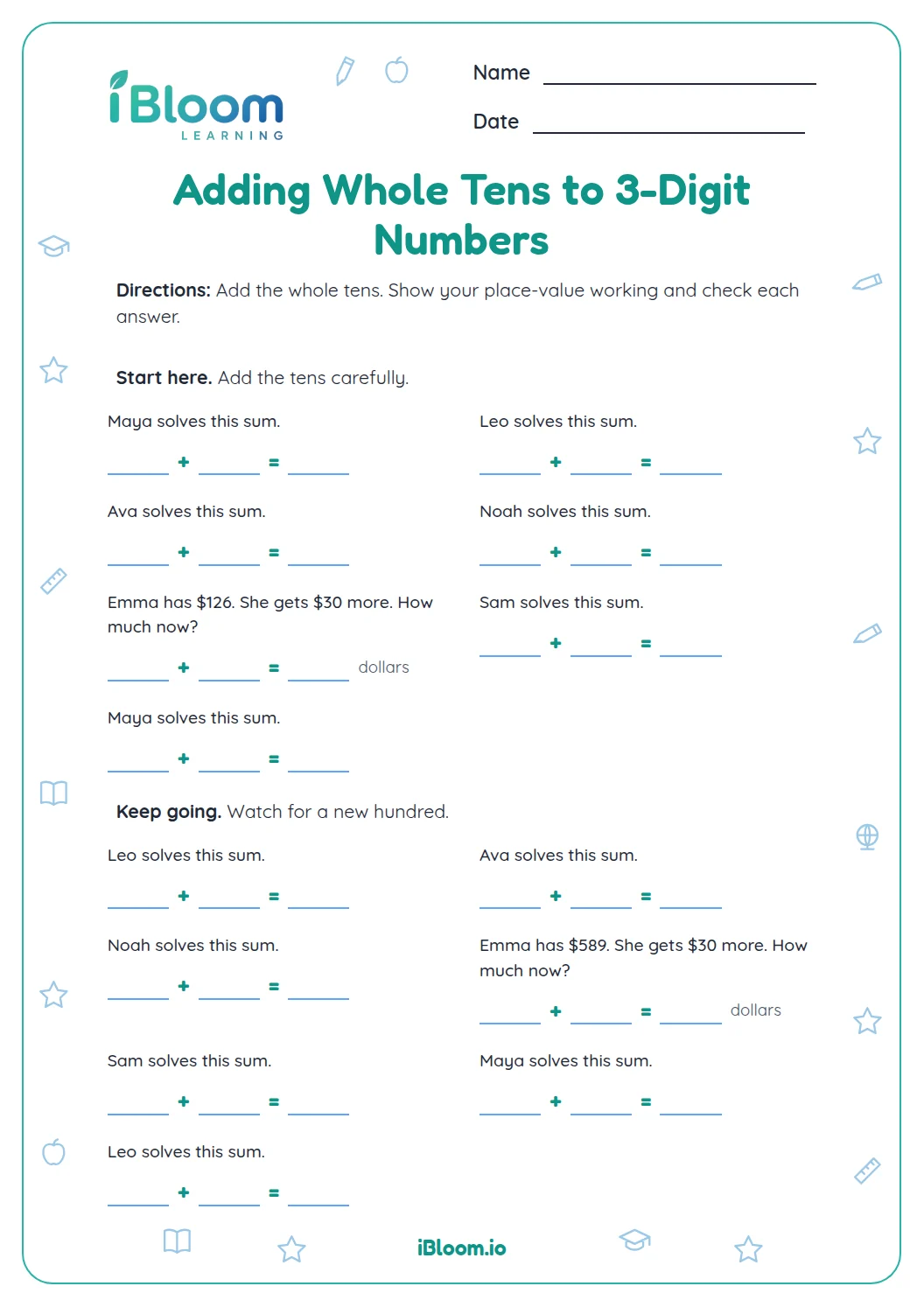
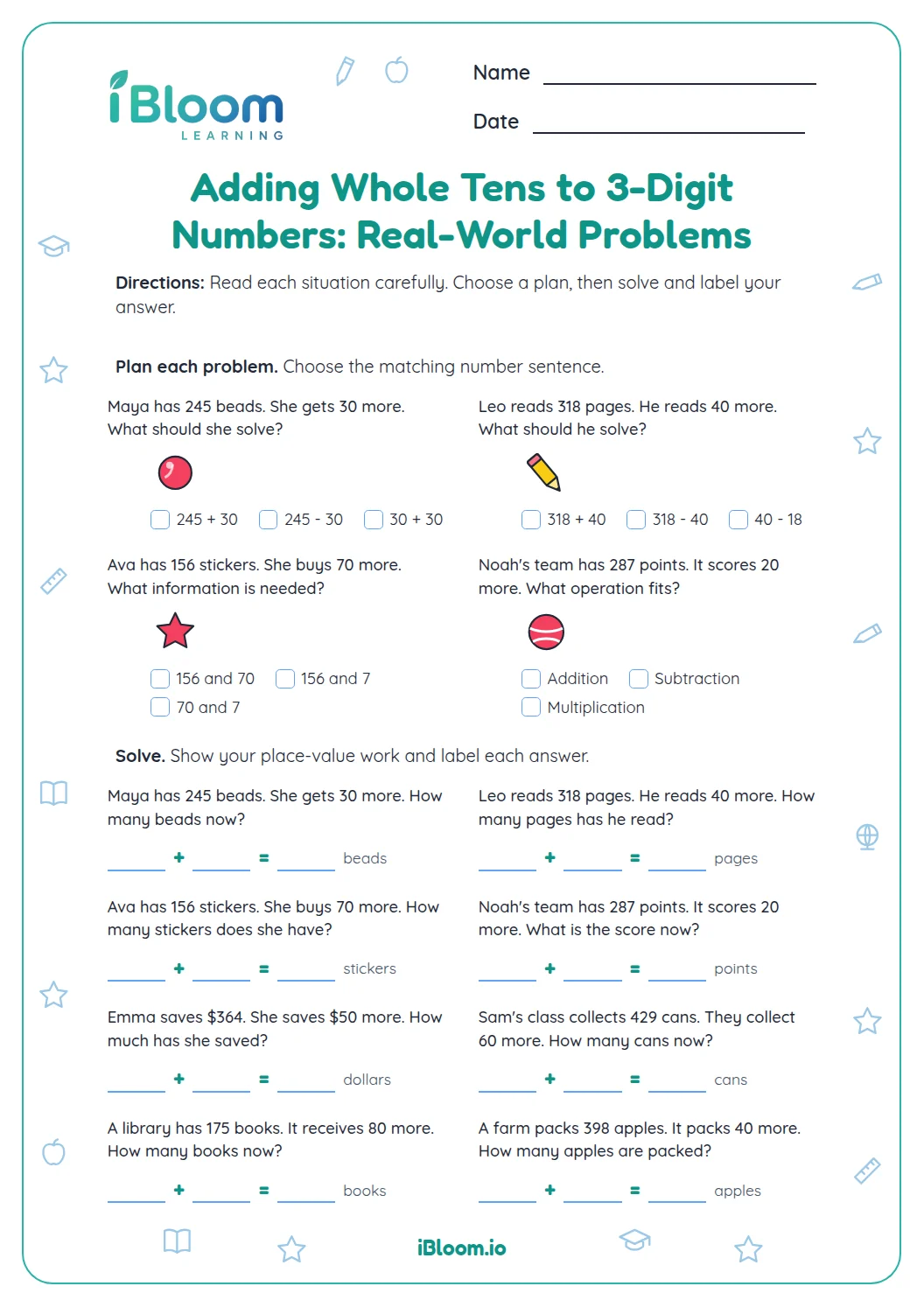
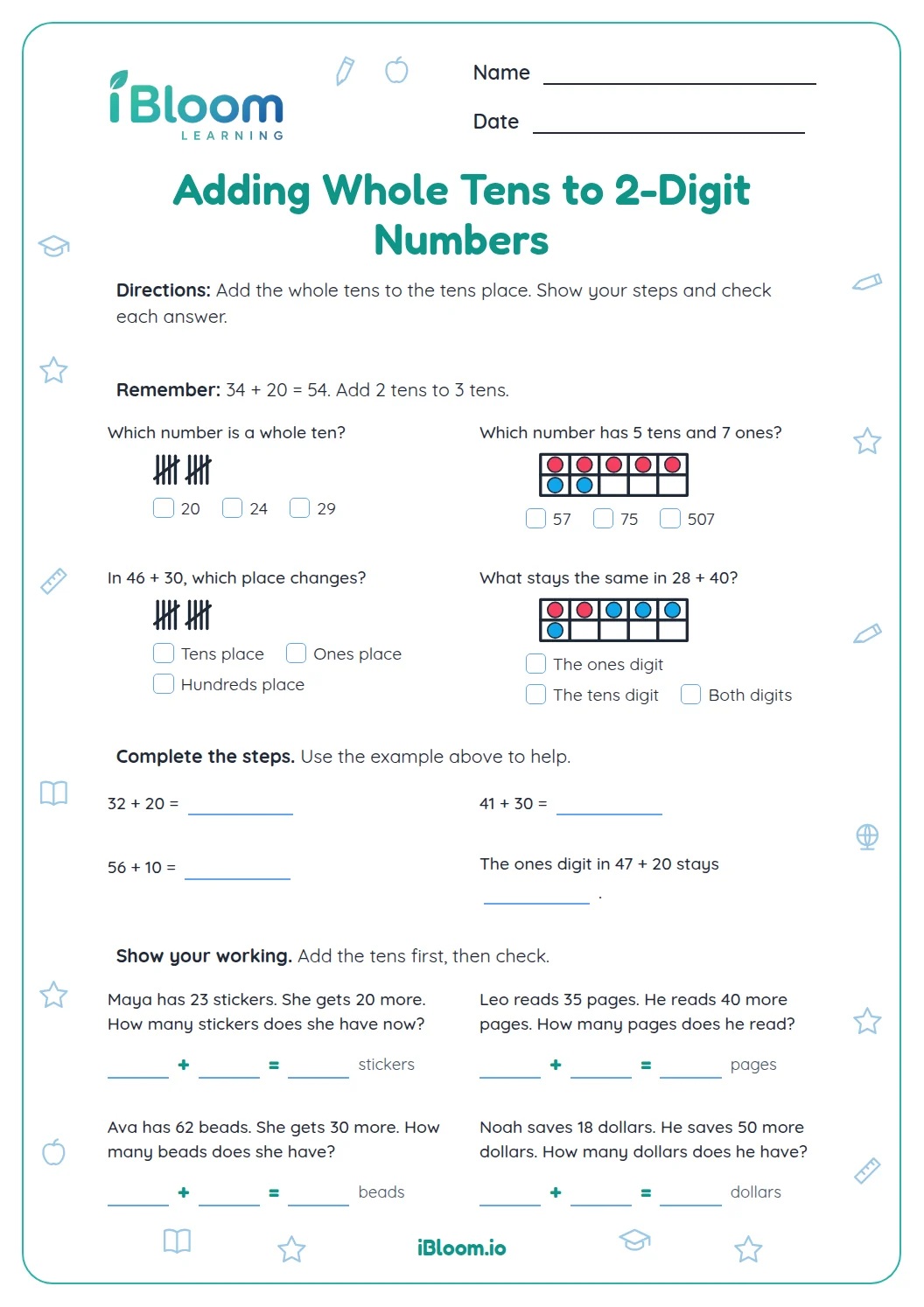
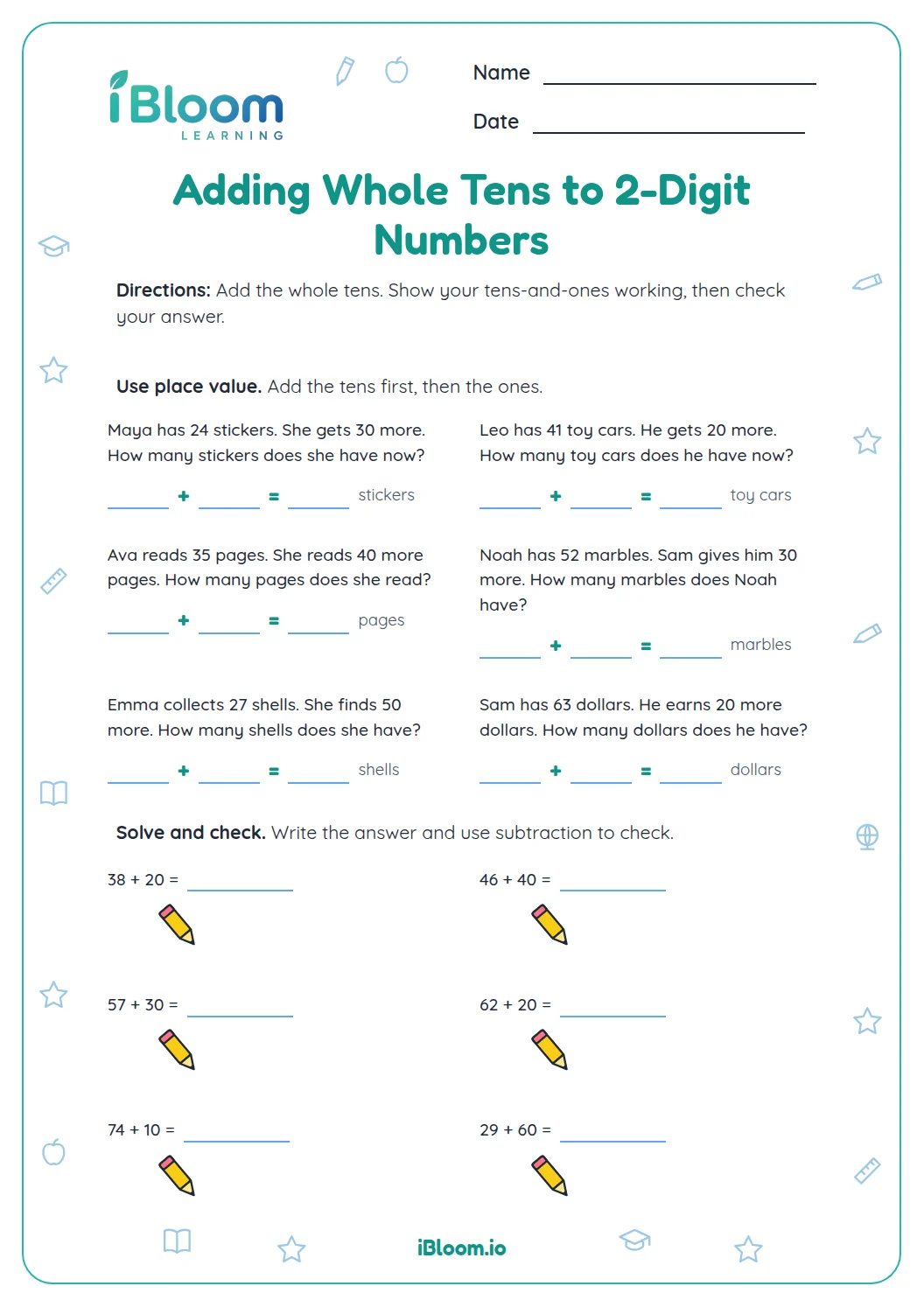
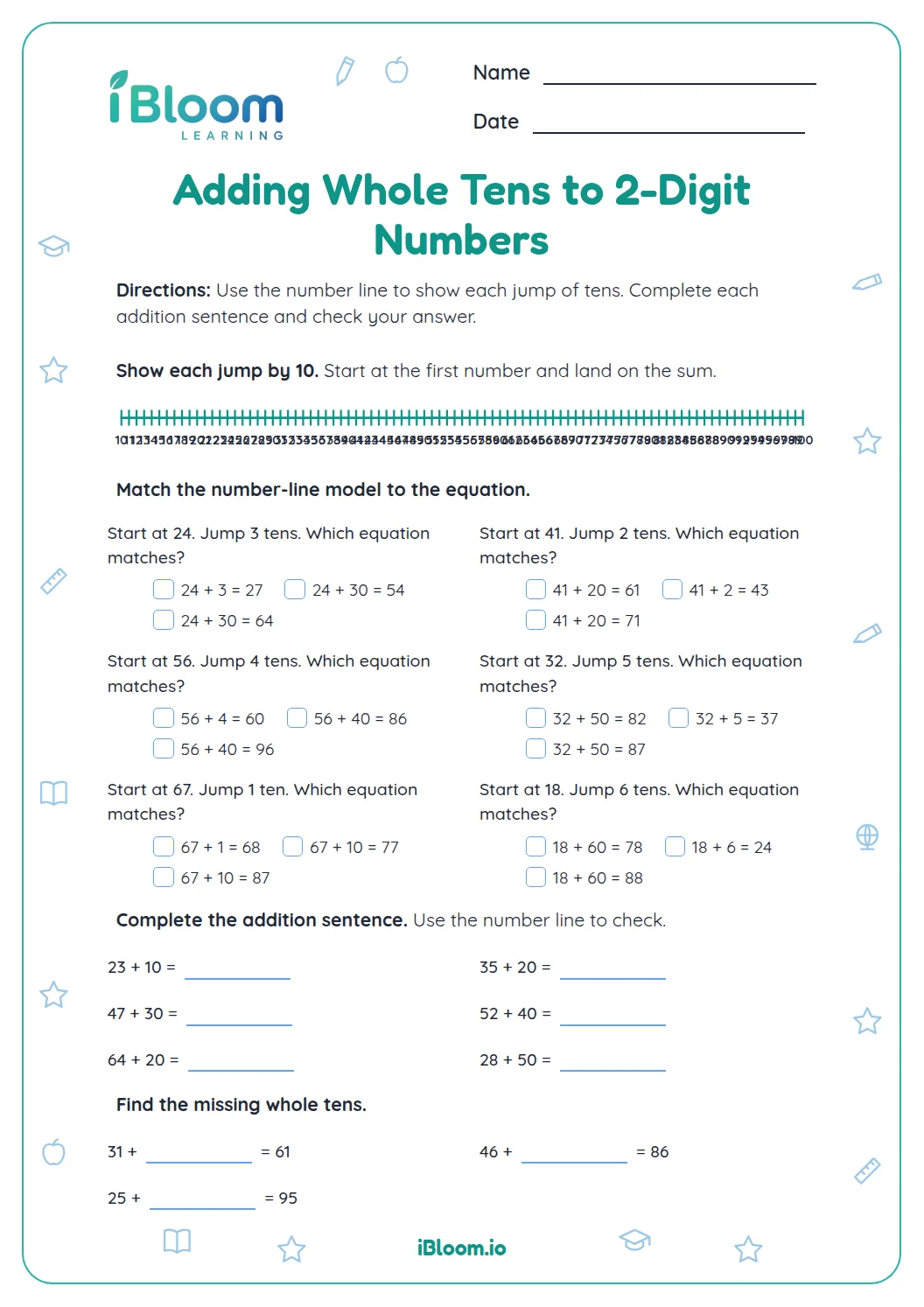
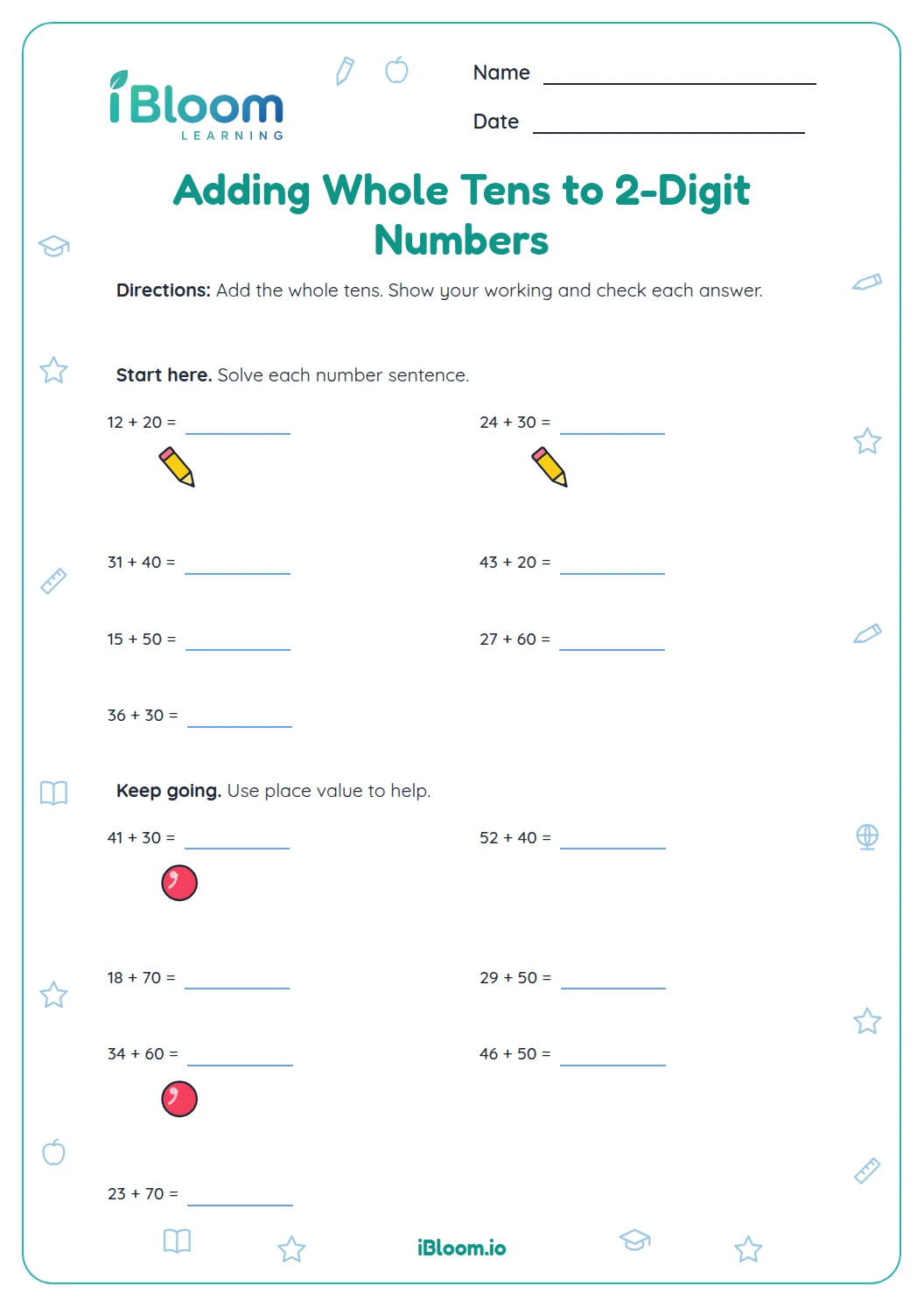
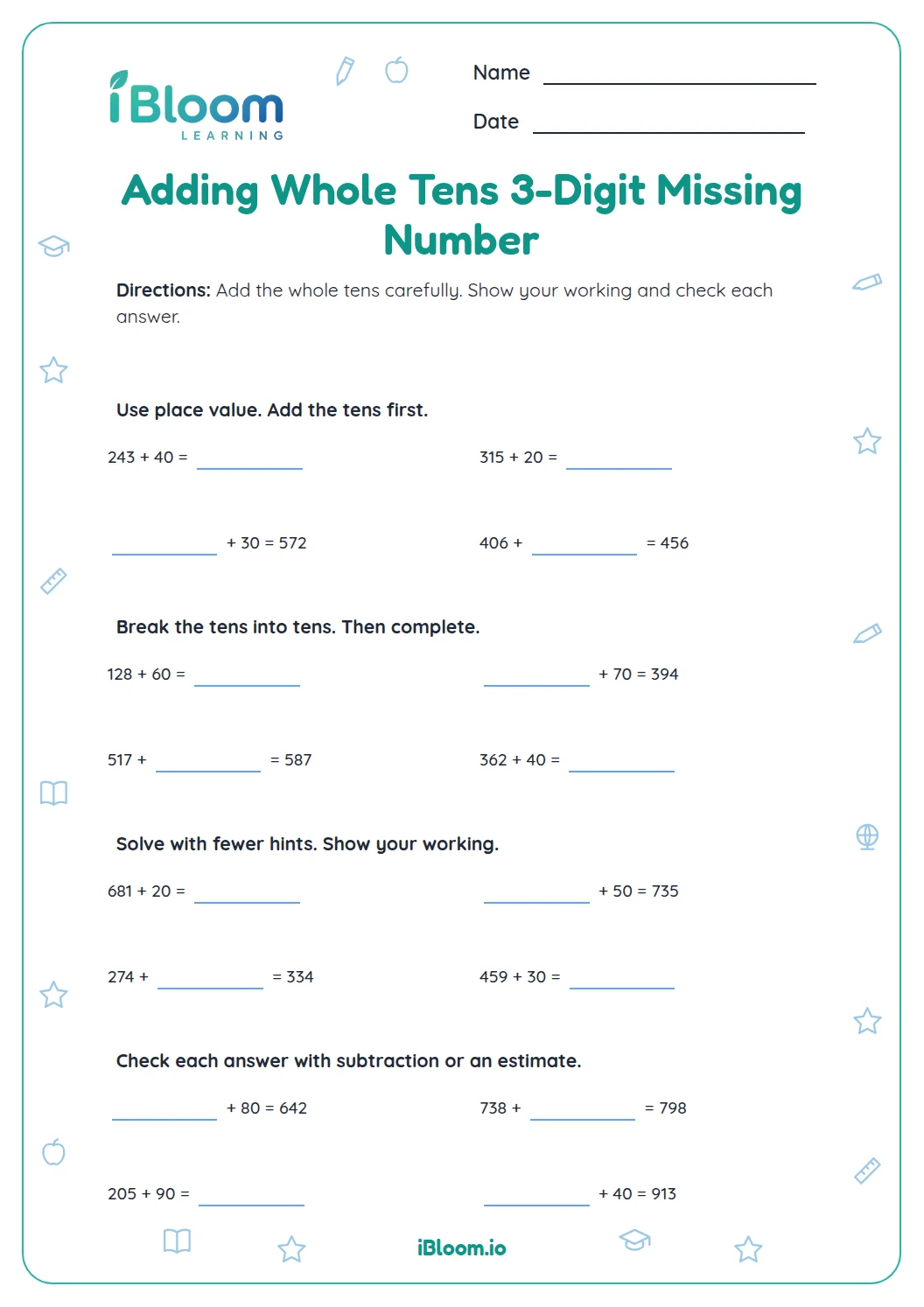
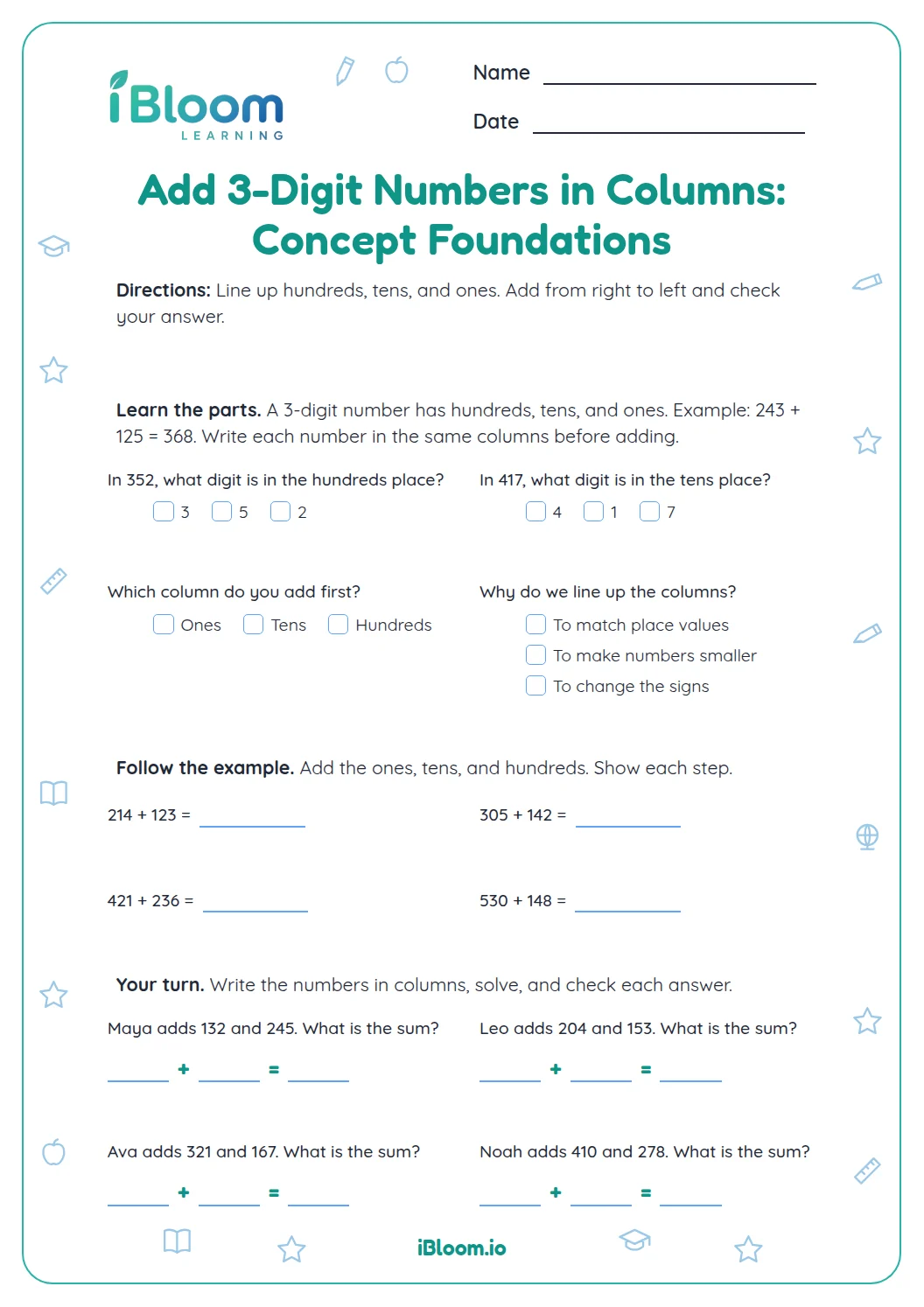
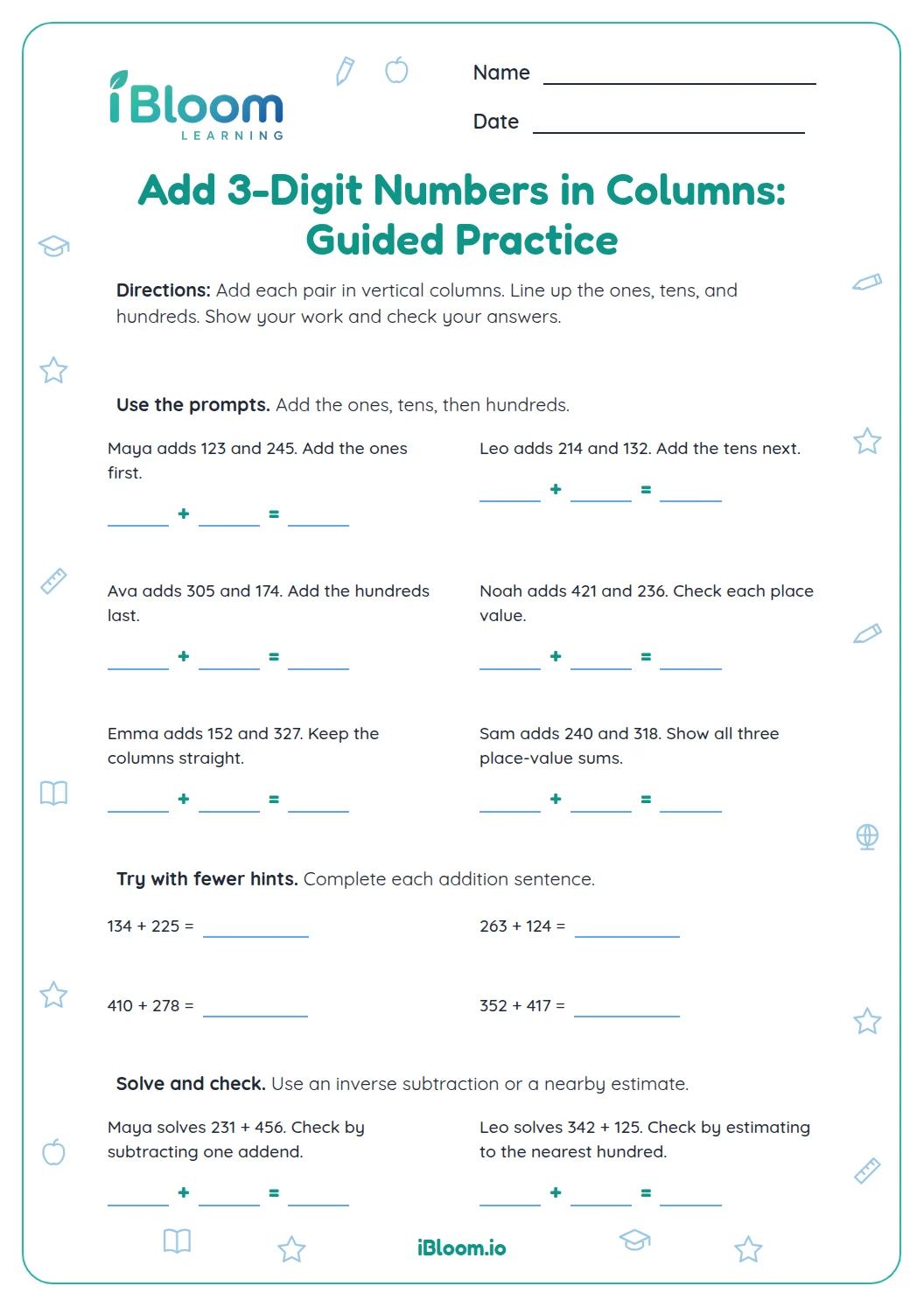
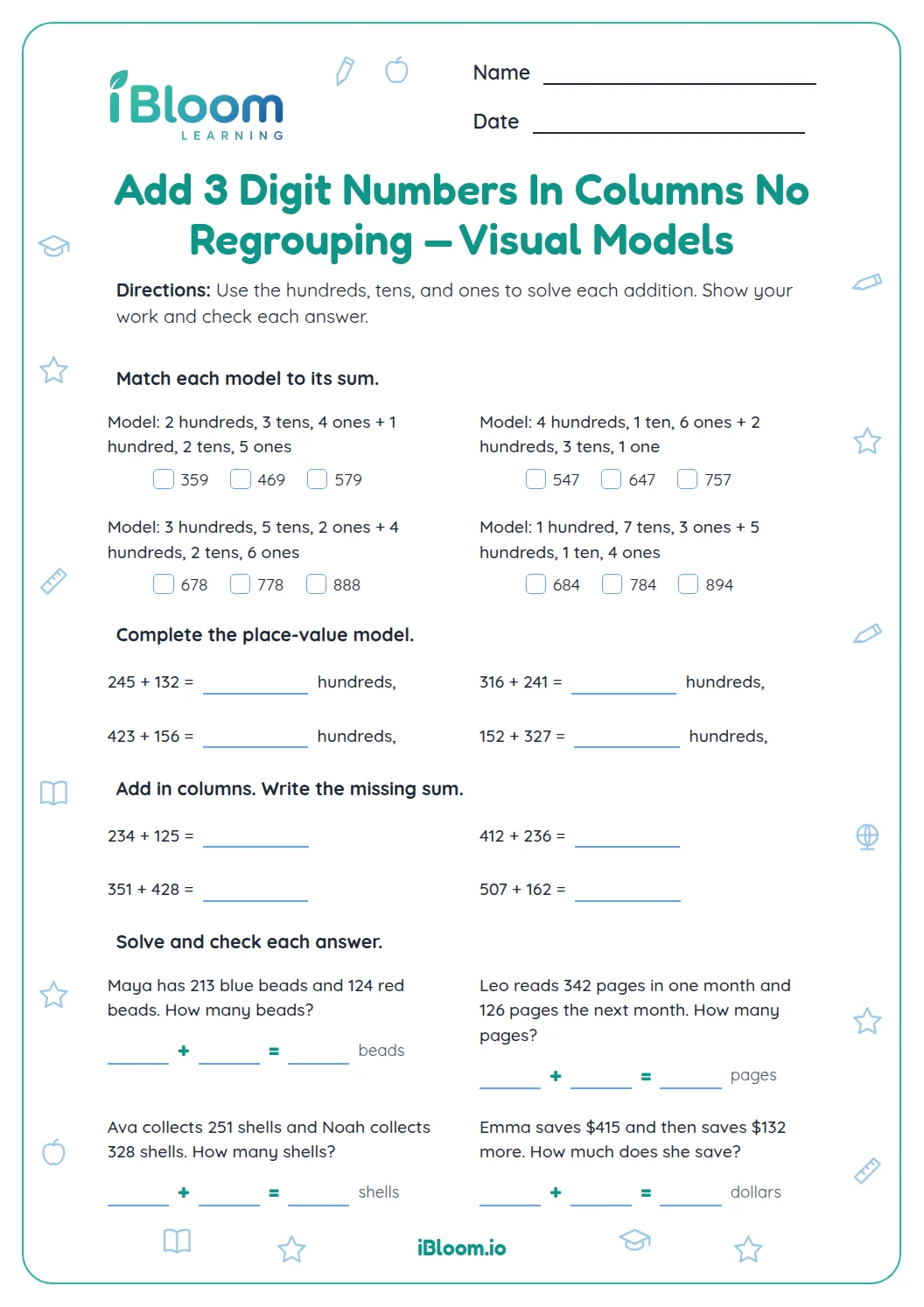
This Grade 2 printable gives 16 problems adding whole tens to three-digit numbers. Twelve equations build fluency, and four base-ten models connect the written sum to hundreds, tens, and ones. Children practice regrouping when ten tens make another hundred. The separate answer key lists all 16 sums.
What changes when tens are added?
Adding whole tens changes the tens value while the ones stay the same. When the tens reach ten, regroup them as one hundred. The base-ten models in the last part connect the written number with hundreds, tens, and ones.
How do base-ten blocks show the starting number?
The final four questions show hundreds, tens, and ones before adding whole tens. In a problem such as 372 + 40, the tens become 11 tens, which regroup as 1 hundred and 1 ten.
- 1243 + 30 = ___
- 230 is 3 tens.
- 32 hundreds, 4 tens, 3 ones become 2 hundreds, 7 tens, 3 ones.
- 4Answer: 273
When does a new hundred appear?
For a problem such as 516 + 20, think of 20 as two tens. Add two to the tens value and keep the hundreds and ones in their places. Use the blocks in questions 13–16 to read the starting number before adding.
How to use this worksheet
- 1Read the three-digit number by hundreds, tens, and ones.
- 2Rewrite the added amount as a number of tens.
- 3Add those tens and regroup ten tens as one hundred if needed.
- 4Keep the ones value unchanged.
- 5Check the sum with the answer key and compare the place values.
Common mistakes and quick fixes
The mistake
Adding the tens digit instead of the tens value.
The fix
Remember that 30 means three tens, not three ones.
The mistake
Changing the ones digit.
The fix
Check that the ones in the starting number and total match.
The mistake
Forgetting a new hundred after ten tens.
The fix
Bundle ten tens as one hundred and update the hundreds place.
What to practice next
Make more practice
Further reading
Questions parents and teachers ask
What does adding a whole ten mean?
A whole ten is a multiple of 10, such as 20, 50, or 80. When it is added to a three-digit number, the tens value changes while the hundreds and ones stay in their places. The questions give practice noticing that place-value pattern.
How can a child add 40 to 372?
Think of 372 as 3 hundreds, 7 tens, and 2 ones. Adding 4 tens makes 11 tens, which is 1 hundred and 1 ten, so the total is 412. Children may also count by tens from 372: 382, 392, 402, 412.
Why are base-ten blocks included?
The last four questions show hundreds, tens, and ones before adding a whole ten. The blocks make the starting number visible, so children can connect the written equation with the value of each digit. They still need to calculate and write the new total.
Do the hundreds or ones change?
The value of the tens place changes when tens are added. If that change makes ten tens, it can be regrouped as one hundred, so the hundreds digit may change too. The ones stay the same because no ones are being added.
What does the answer key include?
The separate key gives the sum for every one of the 16 questions. For the model questions, the answer is the resulting total; children can check it by reading the hundreds, tens, and ones in the drawing and adding the stated tens.
How long does the worksheet take?
Plan for about 15 minutes. Learners who use blocks or count forward by tens may need extra time, especially when ten tens make a new hundred. Encourage them to explain what changed in the tens place instead of racing through the equations.