


About this worksheet
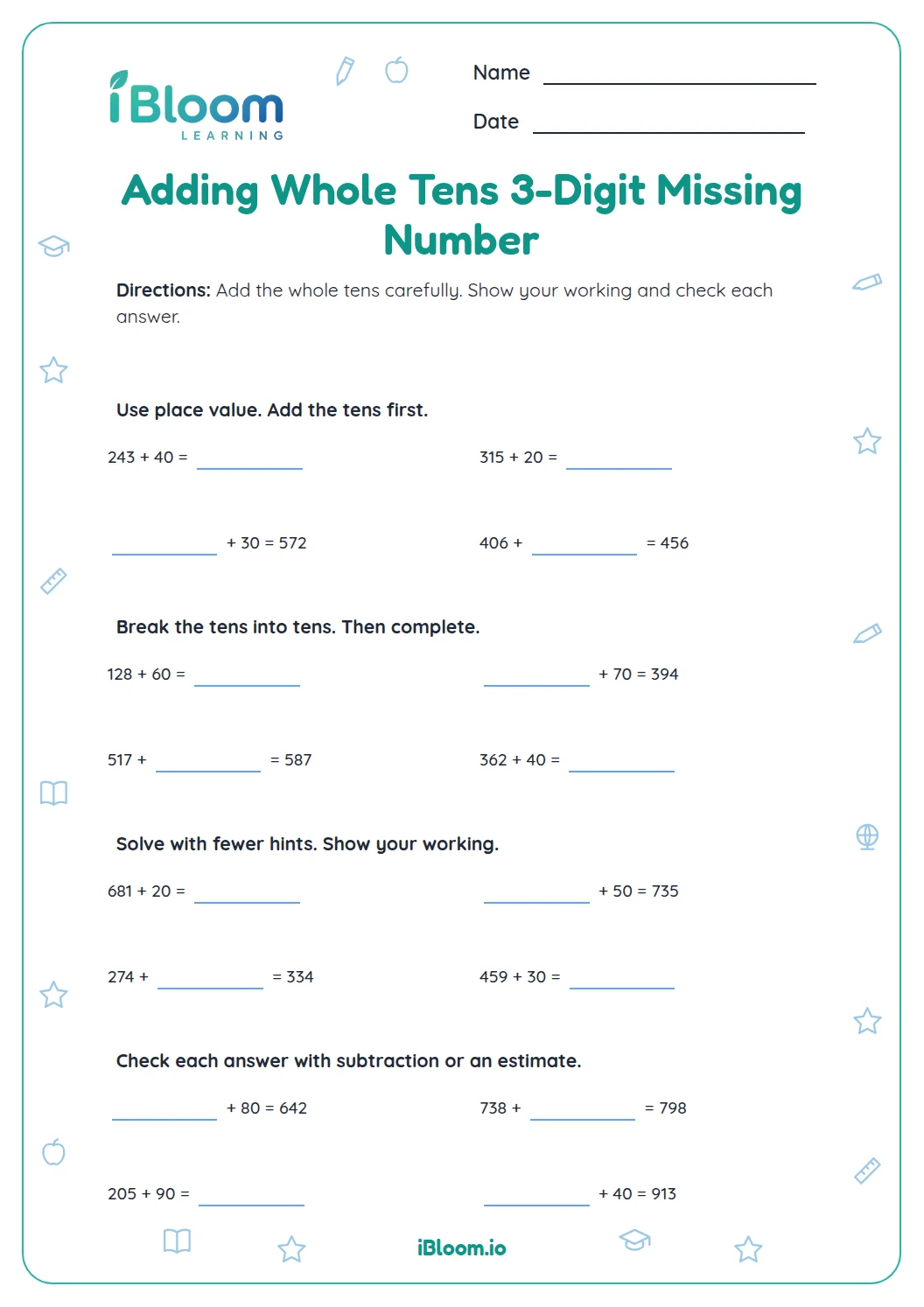
This Grade 2 addition worksheet focuses on missing whole tens in three-digit equations. Students find unknown addends such as 240 + ___ = 290, use the relationship between addition and subtraction to check, and apply the idea to a shelf with 245 books and 30 more added. It aligns with CCSS 2.NBT.B.7 and includes a separate answer key.
Aligned to 2.NBT.B.7
How do you find the missing addend in 240 + ___ = 290?
When a whole-ten addend is missing, compare the total with the known addend. In question 1, 290 − 240 = 50, so 240 + 50 = 290. Check by adding the known addend and your answer.
- 1240 + ___ = 290
- 2290 − 240 = 50
- 3240 + 50 = 290
How can addition and subtraction check each other?
If the unknown is an addend, subtract the known addend from the sum. Then place the answer back into the original equation. For question 6, 376 − 40 = 336, and 336 + 40 returns to 376.
Where does the worksheet use the skill in a story?
Question 15 adds 30 books to 245. The total is 275 books. In question 16, find the number that joins 390 to make 460: 460 − 390 = 70.
A place-value routine for missing tens
- 1Read the total and the addend that is already known.
- 2Subtract the known addend from the total.
- 3Check whether the difference is a whole number of tens when the problem asks for whole tens.
- 4Write the missing addend in the equation.
- 5Add the two addends to confirm the total.
- 6For the book problem, include the unit in the answer.
Common missing-addend errors
The mistake
Adding the known tens to the total instead of finding the gap.
The fix
Use total minus known addend to find what is missing.
The mistake
Changing the hundreds digit when only tens are added.
The fix
Track each place value; adding 30 to 245 changes the tens and may cross into the next hundred.
The mistake
Giving the missing number without checking the equation.
The fix
Substitute it back and verify that both addends make the stated sum.
Curriculum alignment
This worksheet practices the following standard.
Use place-value models and strategies to add three-digit numbers.
On this sheet: Find missing addends by reasoning about place value and using the relationship between addition and subtraction.
Show the official wordingHide the official wording
Add and subtract within 1000, using concrete models or drawings and strategies based on place value, properties of operations, and/or the relationship between addition and subtraction; relate the strategy to a written method. Understand that in adding or subtracting three-digit numbers, one adds or subtracts hundreds and hundreds, tens and tens, ones and ones; and sometimes it is necessary to compose or decompose tens or hundreds.
What to practice next
Make more practice
Further reading
Questions parents and teachers ask
What is the missing number in 240 + ___ = 290?
The missing number is 50. Subtract 240 from 290 to find the gap: 290 − 240 = 50. Check by adding 240 + 50, which equals 290. The same relationship helps with the other missing-addend equations on the worksheet.
Why does subtraction help with a missing addend?
Addition and subtraction undo one another. When a total and one addend are known, subtract the known addend from the total to find the other addend. For example, 470 − 30 gives 440 in the equation ___ + 30 = 470.
How should students solve 245 books plus 30 more?
Add three tens to 245. The hundreds stay 2, the tens increase from 4 to 7, and the ones stay 5, giving 275 books. The answer key includes the unit so the response tells what the number counts.
Does every problem ask for a missing number?
Most questions ask for a missing addend. The final part includes a subtraction check, a short story about adding books, and a question that asks what number joins 390 to make 460. Together, the items apply the same addition and subtraction relationship in several ways.
Is a key included for the equations?
Yes. The separate two-page answer key fills in each missing addend and gives responses for the check, subtraction question, and story problem. It includes the units for story totals and the number that completes each addition equation. Check each response beside its numbered question.