




About this worksheet
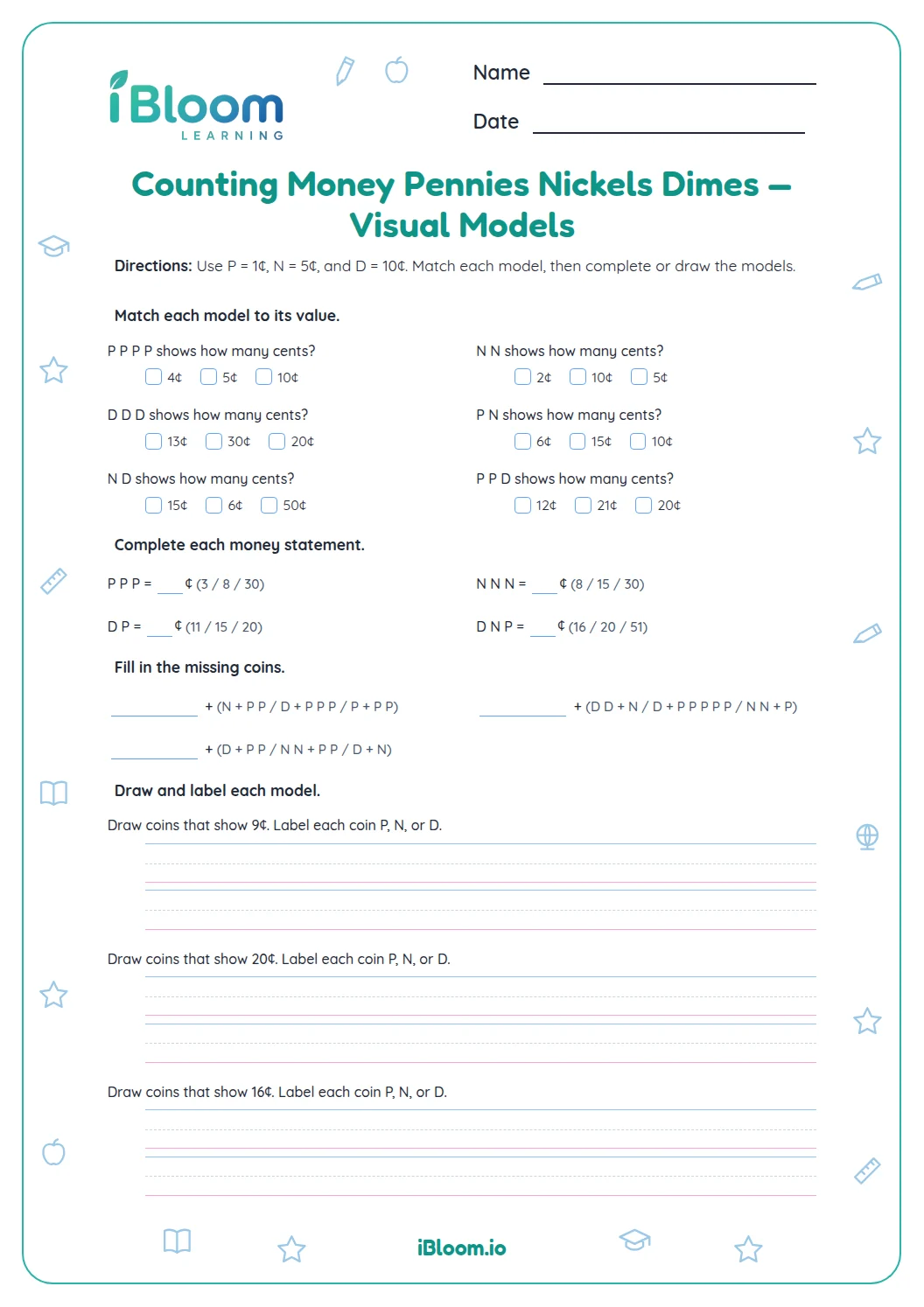
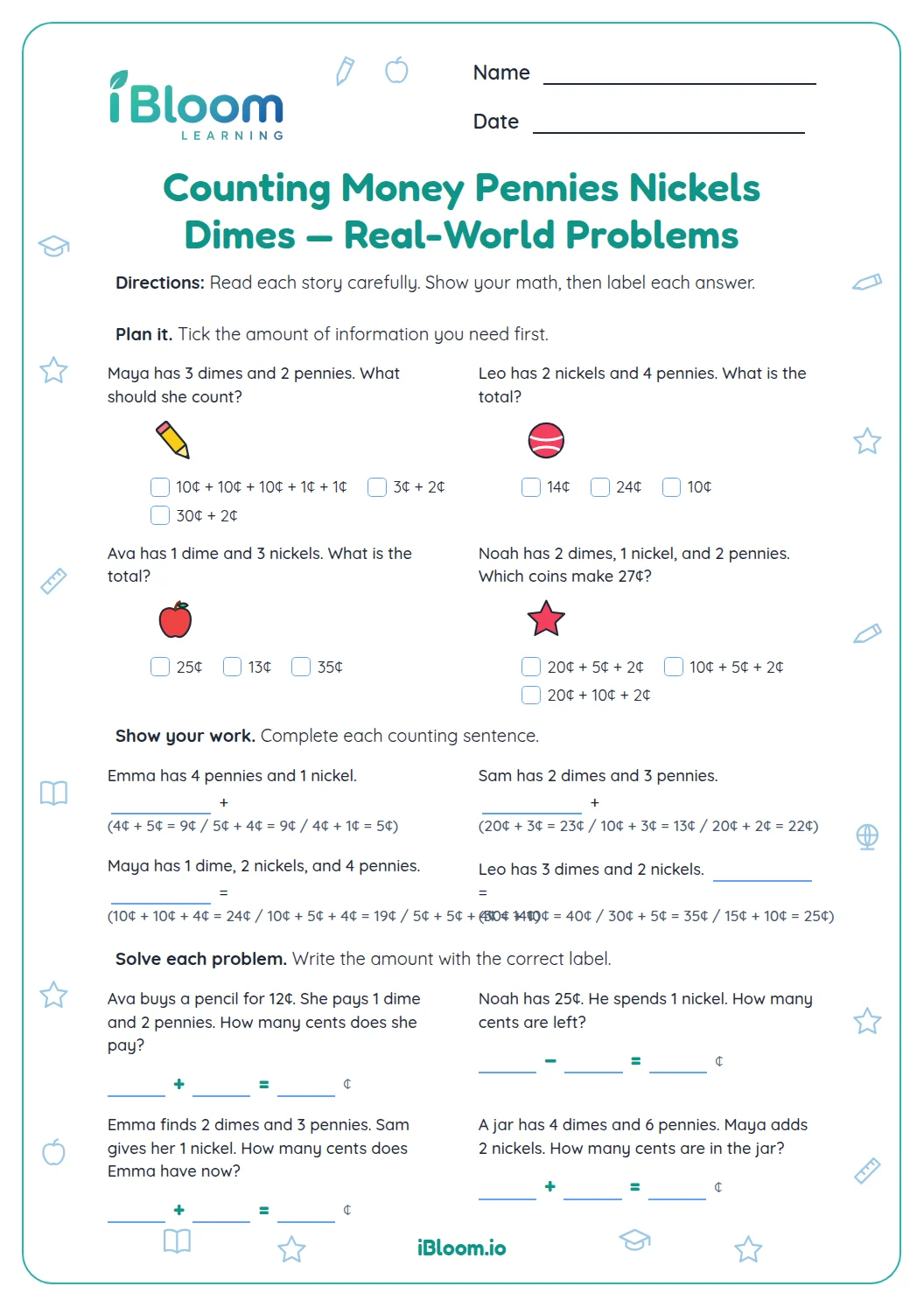
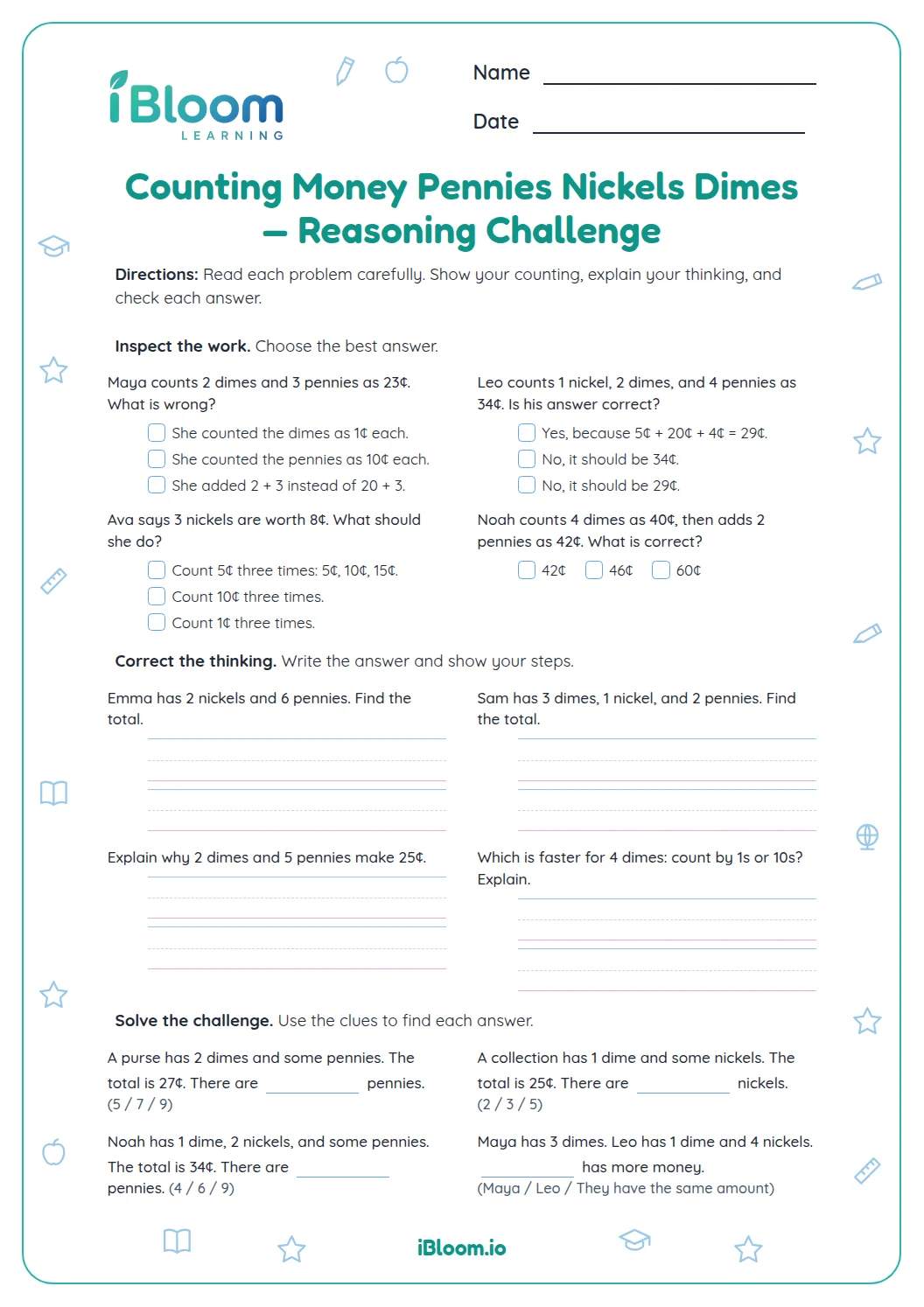
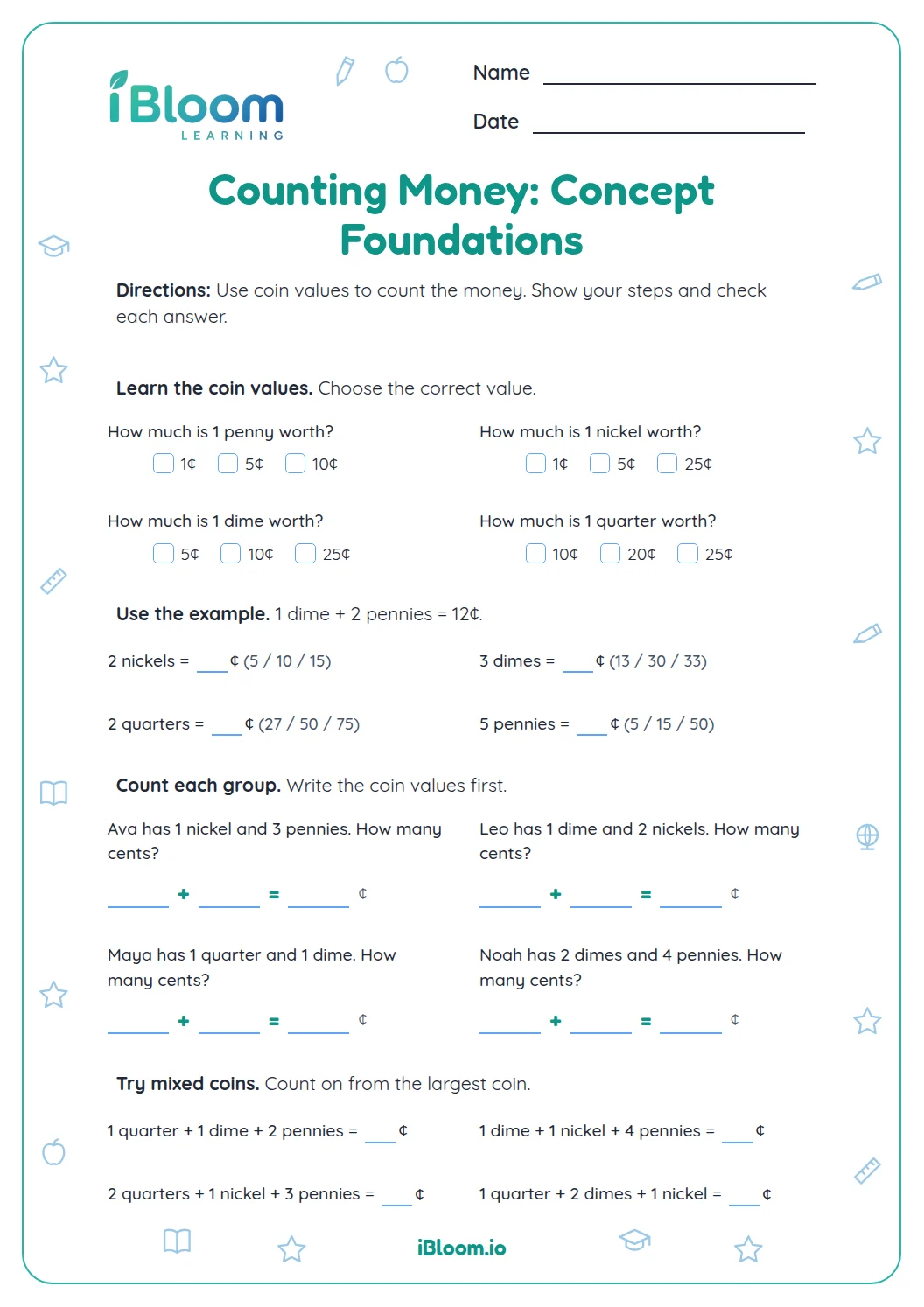
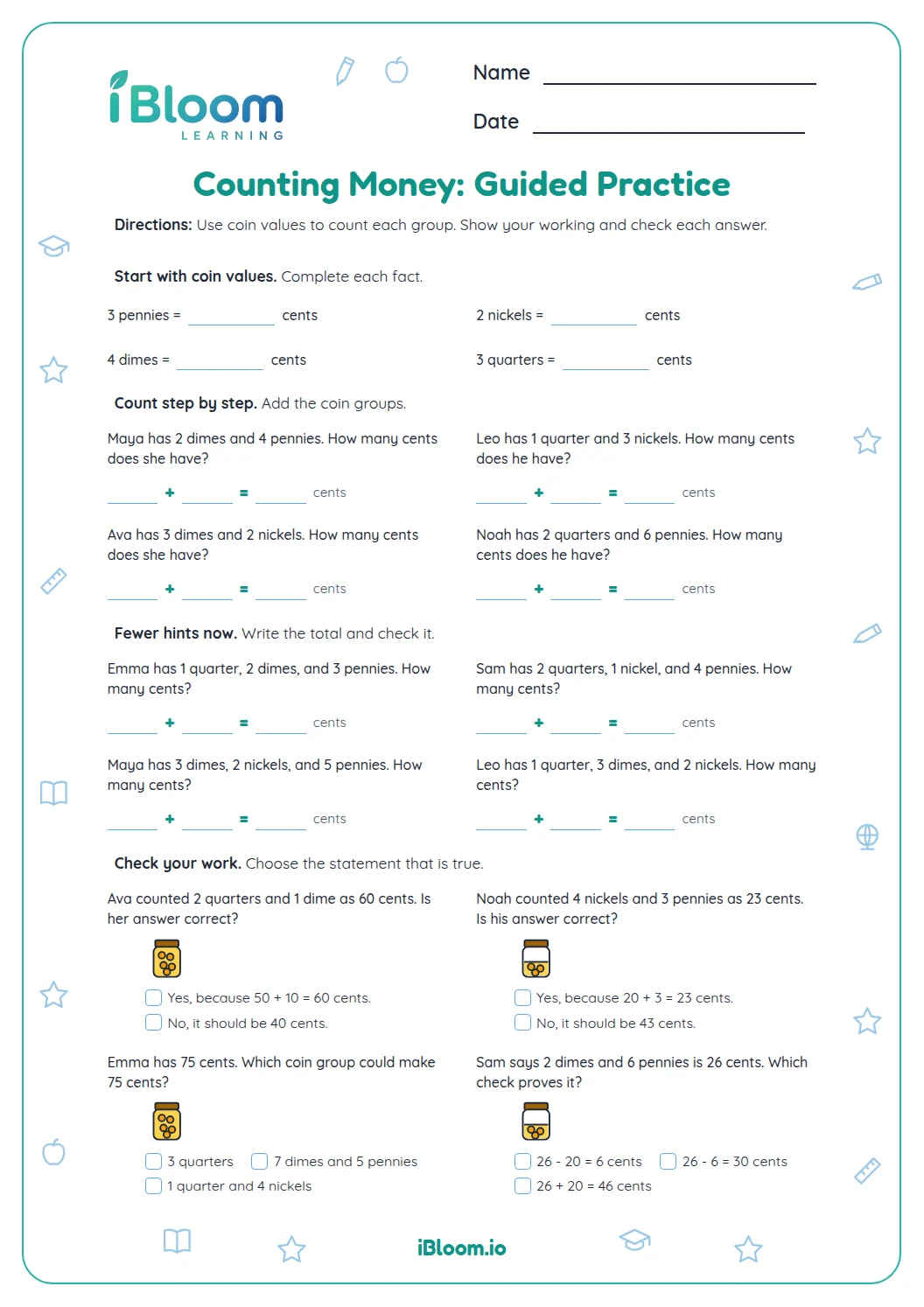
This Grade 2 worksheet gives 16 short problems counting pennies, nickels, and dimes. Six illustrated groups and ten written coin stories ask children to identify each value, add the amounts, and write a total in cents. The separate answer key lists every total.
Aligned to 2.MD.C.8
What is each coin worth?
A penny is 1 cent, a nickel is 5 cents, and a dime is 10 cents. Children can first sort the coins by type, then count each group. A quick strategy is to count the dimes by tens and nickels by fives before adding pennies.
How do you add different coin values?
Keep a running total as you count. For example, with a dime, nickel, and penny, say 10, then 15, then 16 cents. The pictures make the coin types visible; the child still needs to determine each value.
- 1Coins: dime and nickel
- 2Dime = 10¢; nickel = 5¢
- 310 + 5 = 15
- 4Answer: 15¢
What can children do if they lose track?
Group coins with the same value or point to each one as it is counted. Check the result by adding in a different order. If a child counts a nickel as ten, pause and compare its value with a dime before continuing.
How to use this worksheet
- 1Name each coin before counting.
- 2Count dimes by tens and nickels by fives.
- 3Add penny values one at a time or as a group.
- 4Write the total with the cent symbol.
- 5Use the key to check the count and revisit any coin value that was mixed up.
Common mistakes and quick fixes
The mistake
Counting every coin as one cent.
The fix
Say the coin name and value before adding.
The mistake
Treating a nickel like a dime.
The fix
Compare the values: nickel is 5¢ and dime is 10¢.
The mistake
Skipping a coin while counting.
The fix
Point to each coin once and keep a running total.
Common Core alignment
Solve coin word problems by adding penny, nickel, and dime values in cents.
On this sheet: Each question is a coin word problem asking children to count pennies, nickels, and dimes and report cents.
Show the official wordingHide the official wording
Solve word problems involving dollar bills, quarters, dimes, nickels, and pennies, using $ and ¢ symbols appropriately. Example: If you have 2 dimes and 3 pennies, how many cents do you have?
What to practice next
Make more practice
Further reading
Questions parents and teachers ask
How much is a penny, nickel, and dime?
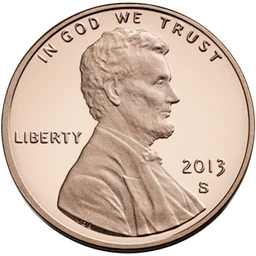
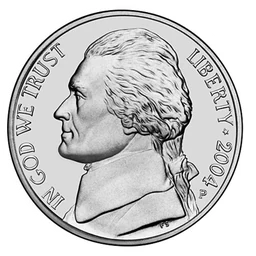
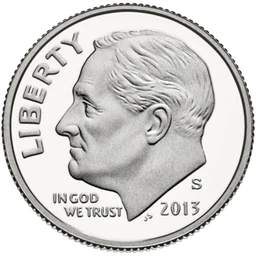
A penny is worth 1 cent, a nickel is worth 5 cents, and a dime is worth 10 cents. The coin drawings use those familiar US coins. Children can name each one and add the values to find the total in each question.
How can my child count a mixed group of coins?
Start with the coin worth the most, then count the smaller values. For a dime, a nickel, and a penny, count 10, 15, 16 cents. The worksheet includes groups with repeated coins and mixed denominations so children can practice both patterns.
Why does the worksheet say cents instead of dollars?
All pictured groups total less than one dollar, so cents are a clear unit for every answer. Children write the cent symbol with each total. The worksheet focuses on the penny, nickel, and dime values named in its title; larger amounts can be explored with additional coin types.
What are the answers to the coin drawings?
The separate key lists a total for all 16 questions. For example, a dime and a nickel total 15¢, while two dimes and one penny total 21¢. Ask the child to say each coin value aloud before checking the answer.
Can children use a coin chart or real coins?
Yes. A value chart or real coins can support early practice. Have the child match each pictured coin to its value, then add the amounts. Once the values are familiar, the same questions can be solved mentally or with a written number sentence.
How long does the practice take?
Plan for about 15 to 20 minutes for 16 coin groups. Learners may take extra time to identify coin faces or organize the values. Encourage them to count by tens for dimes and fives for nickels, then add any pennies.