



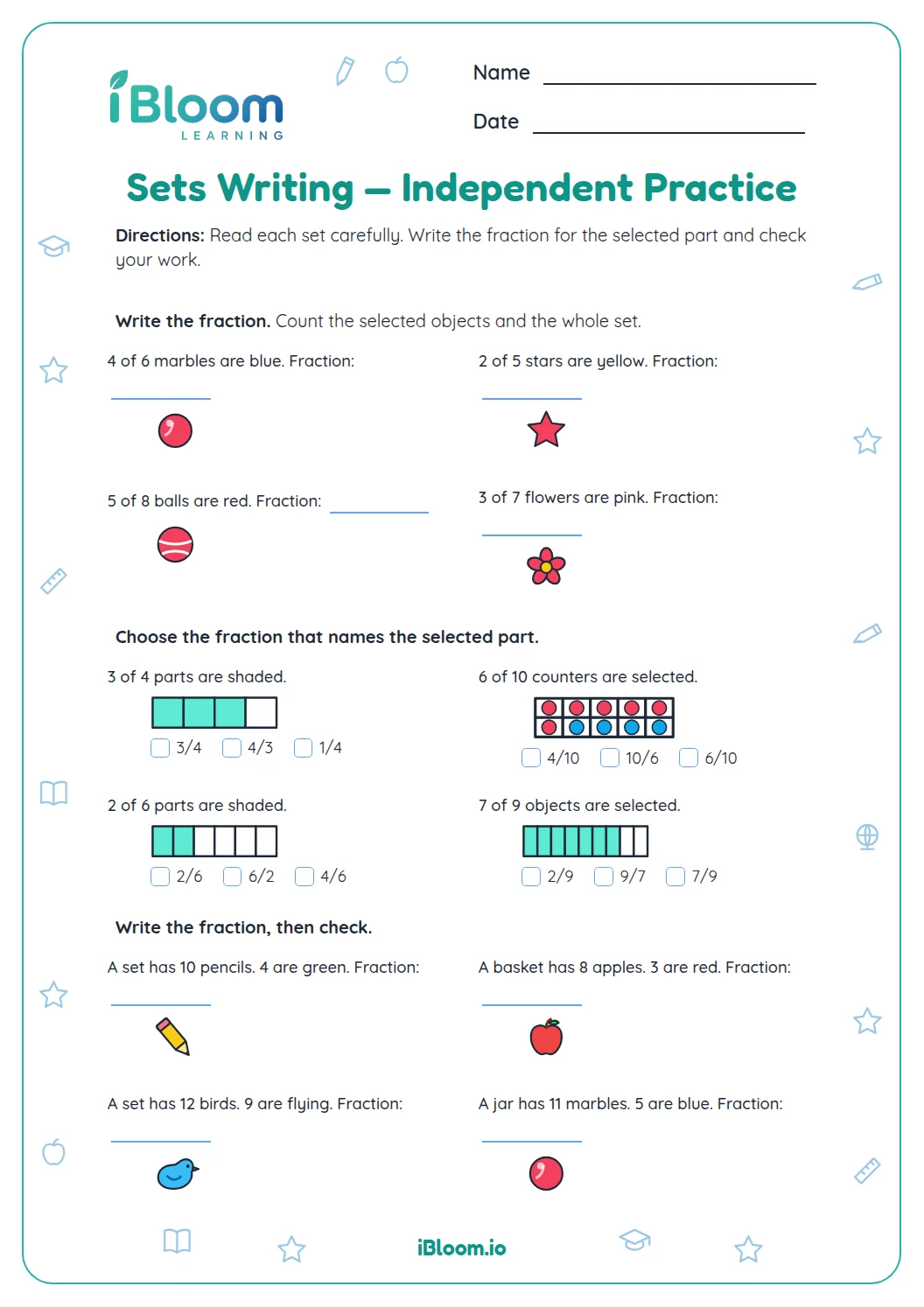
About this worksheet
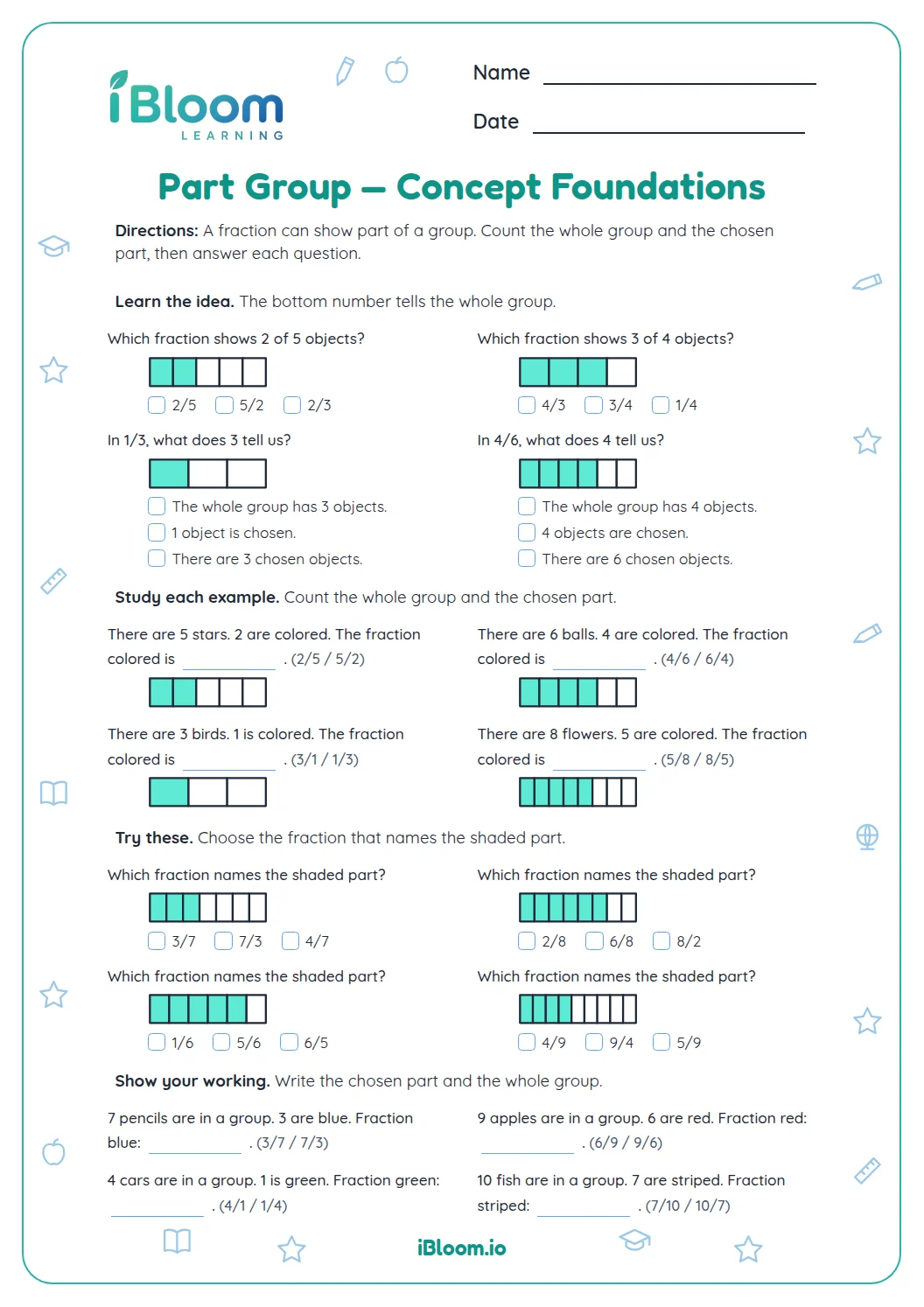
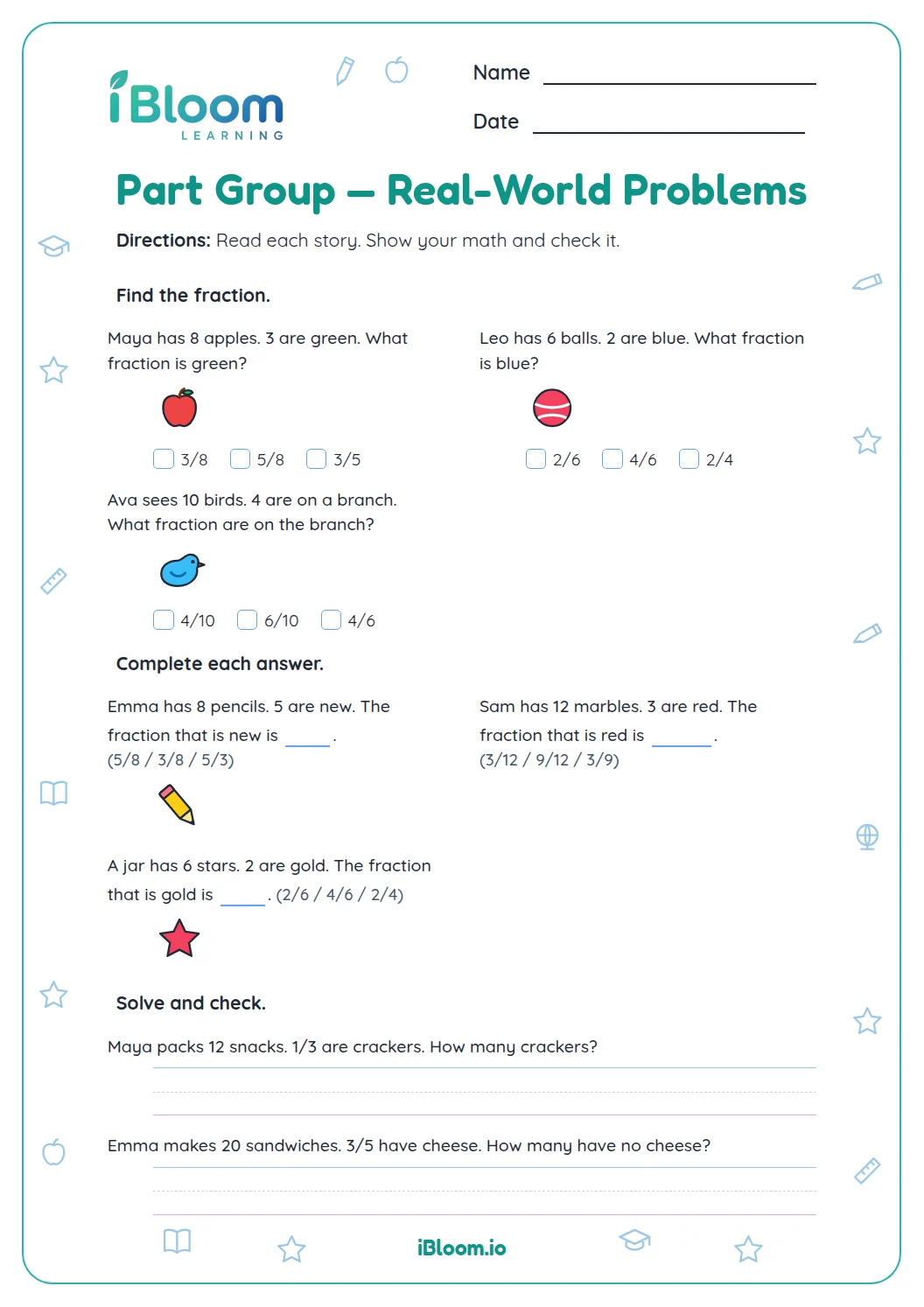
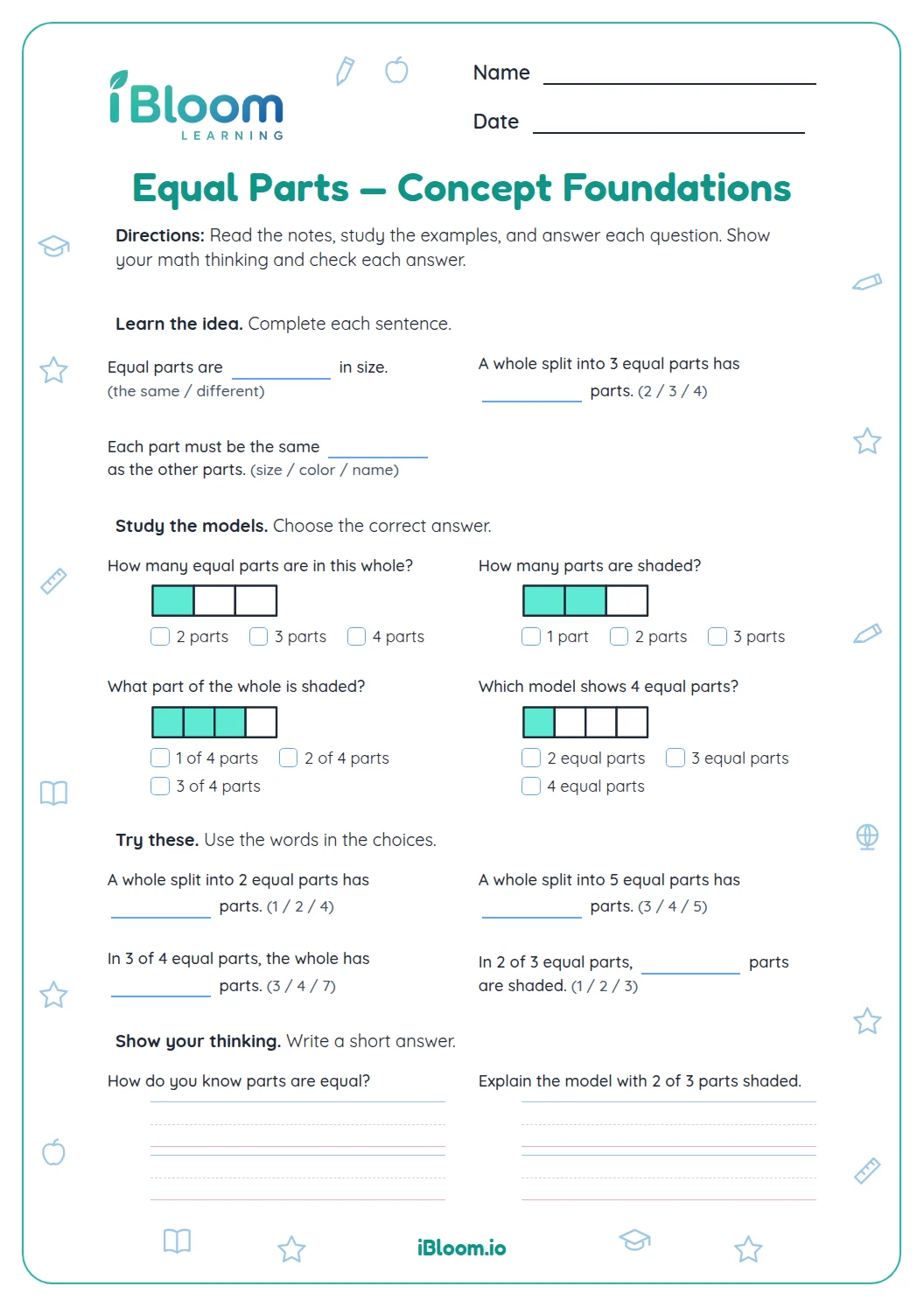
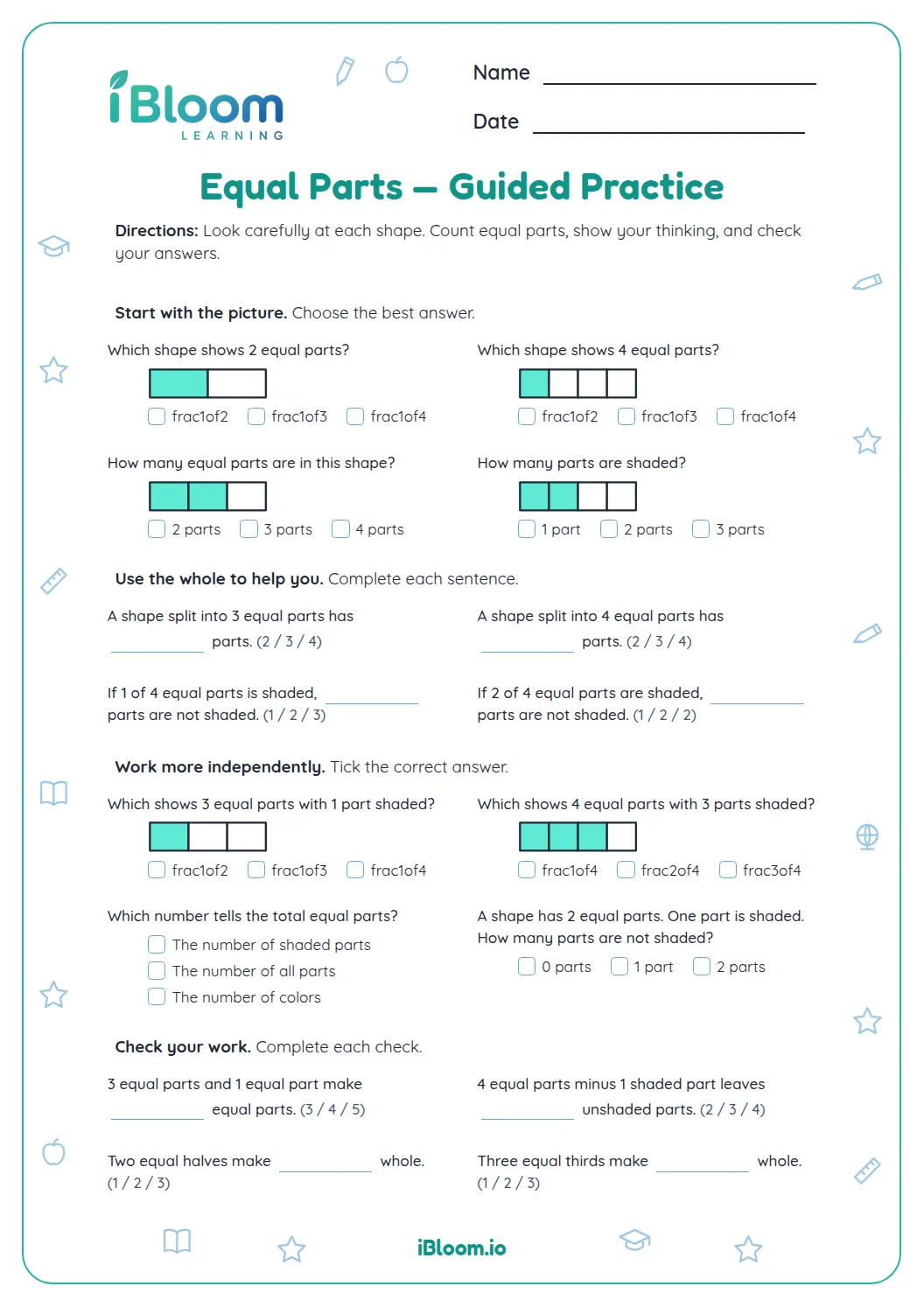
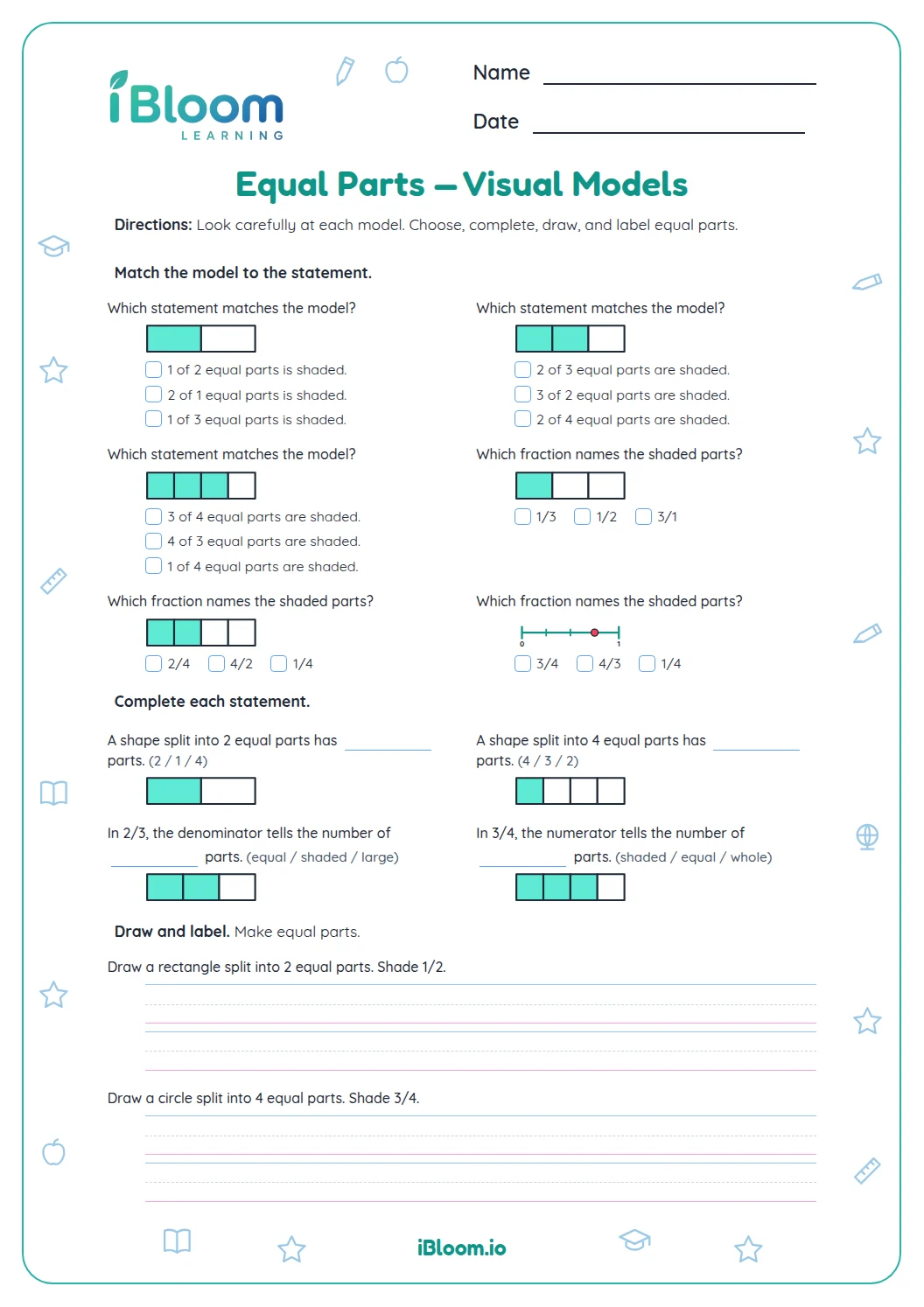
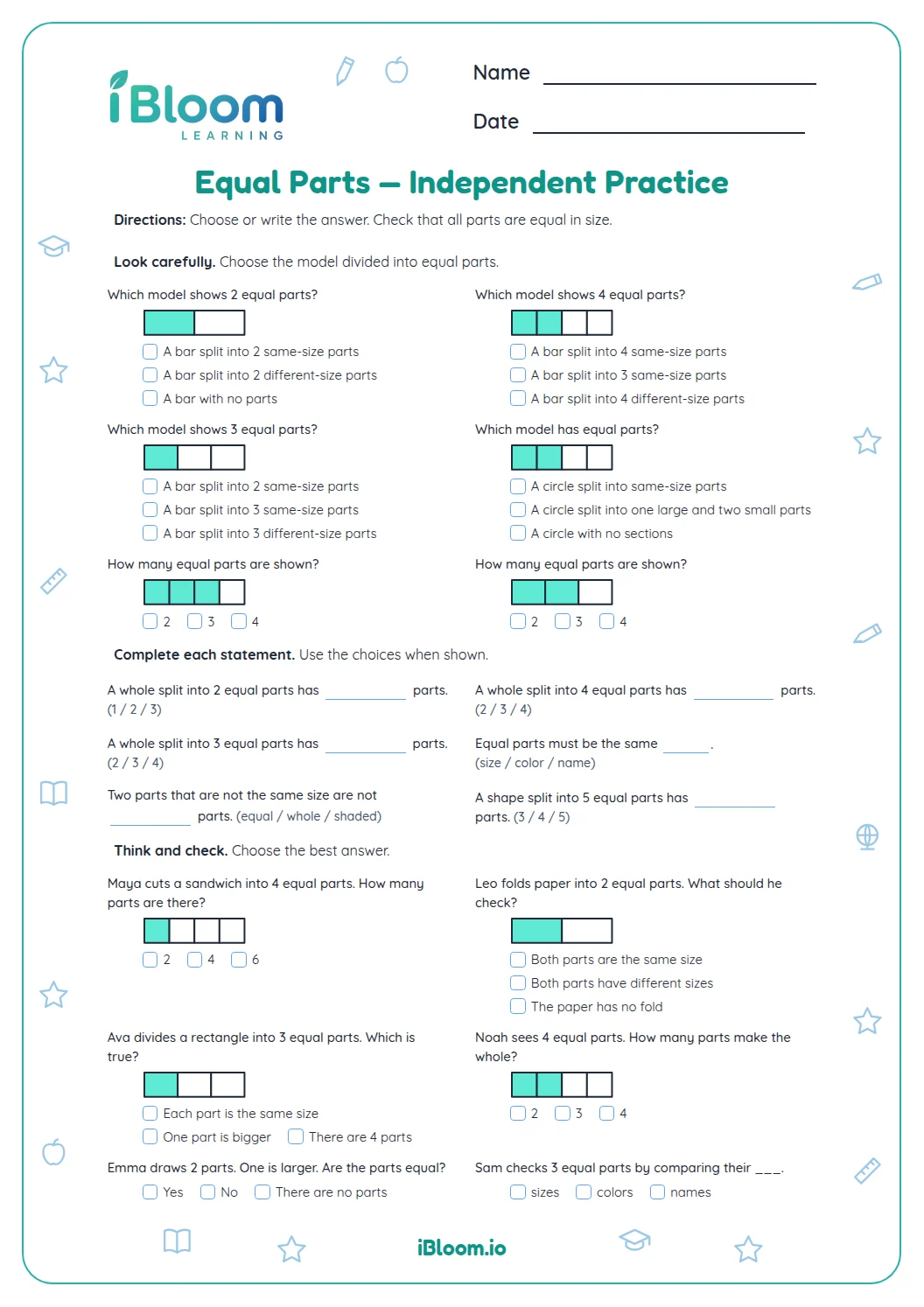
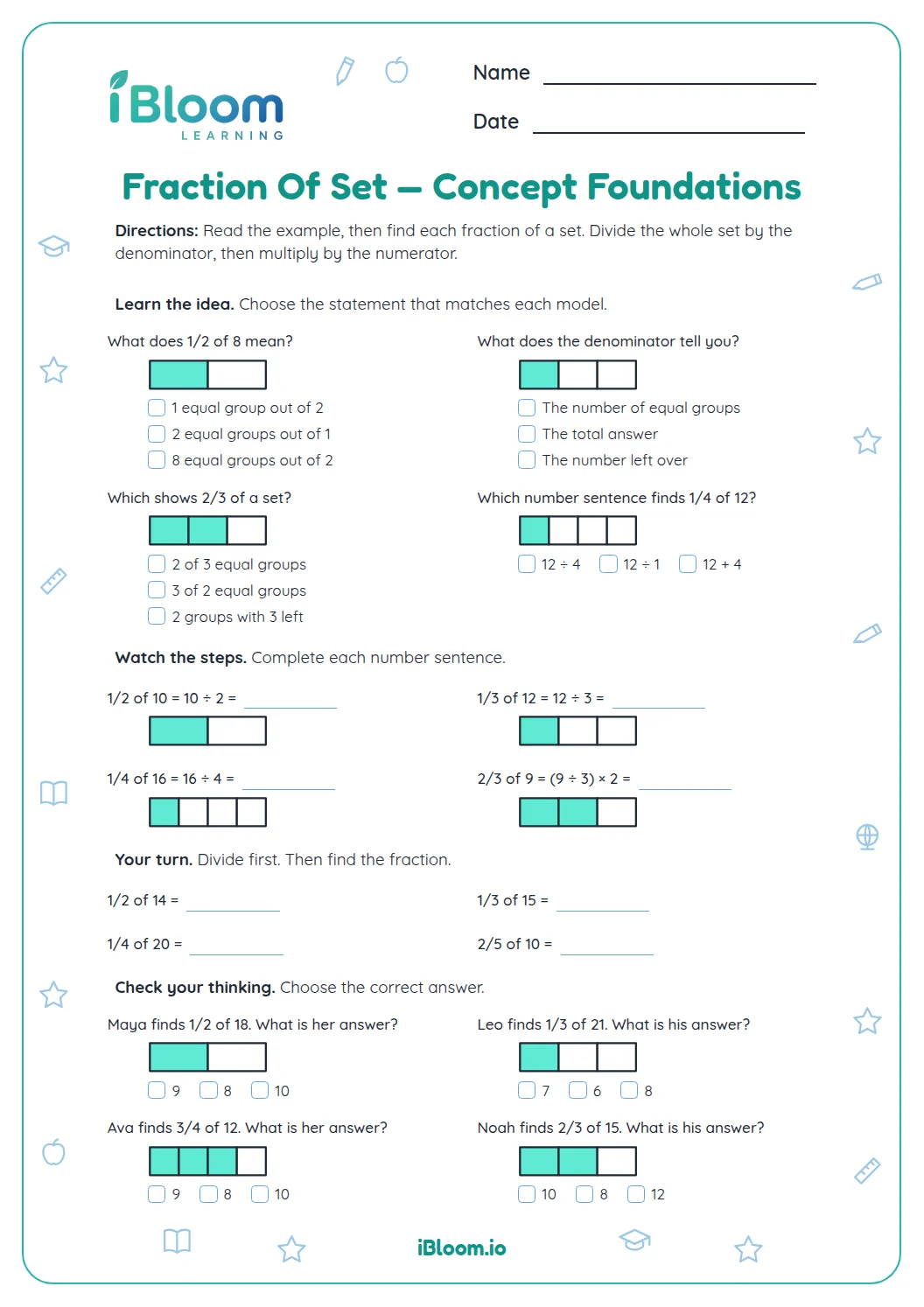
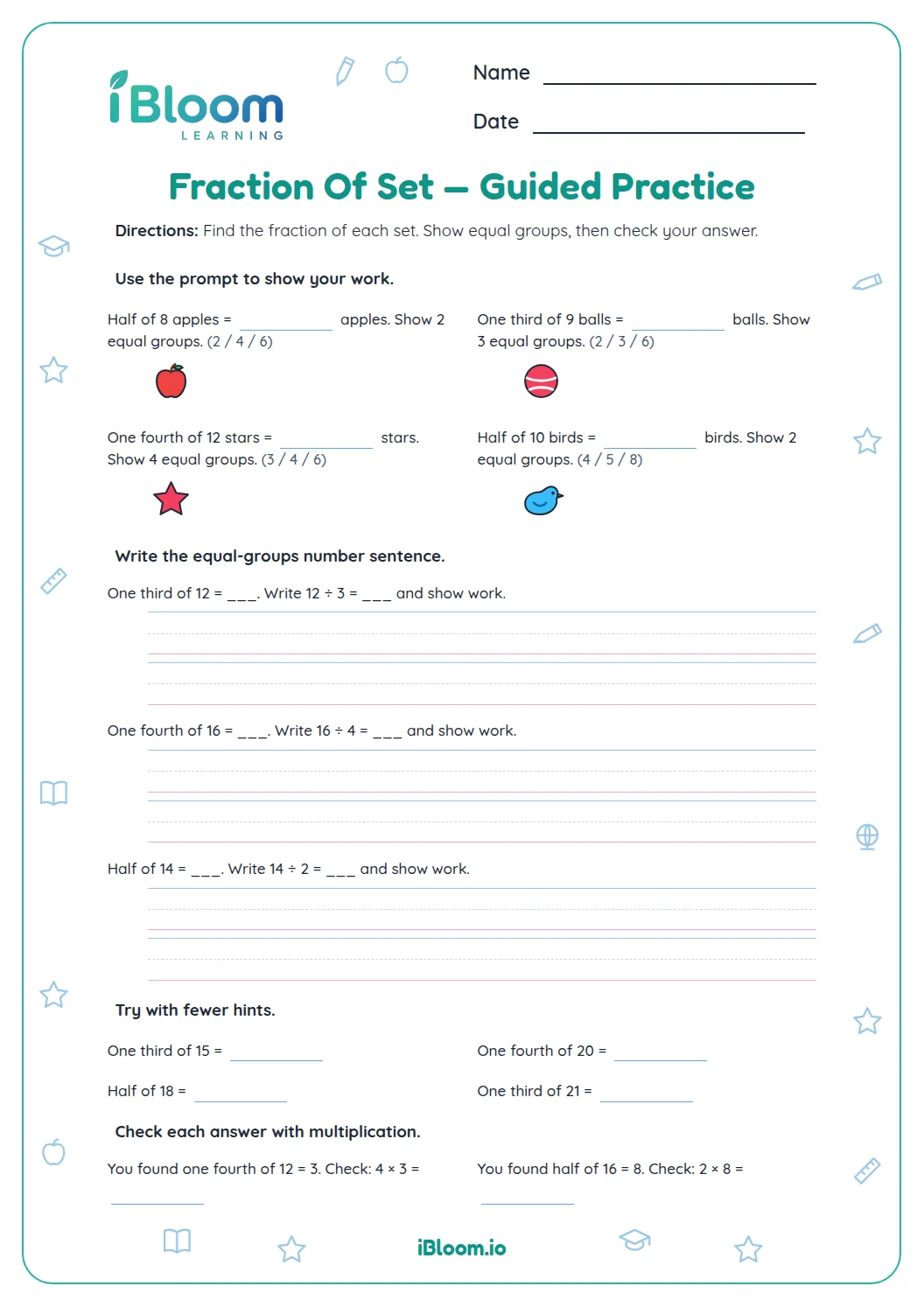
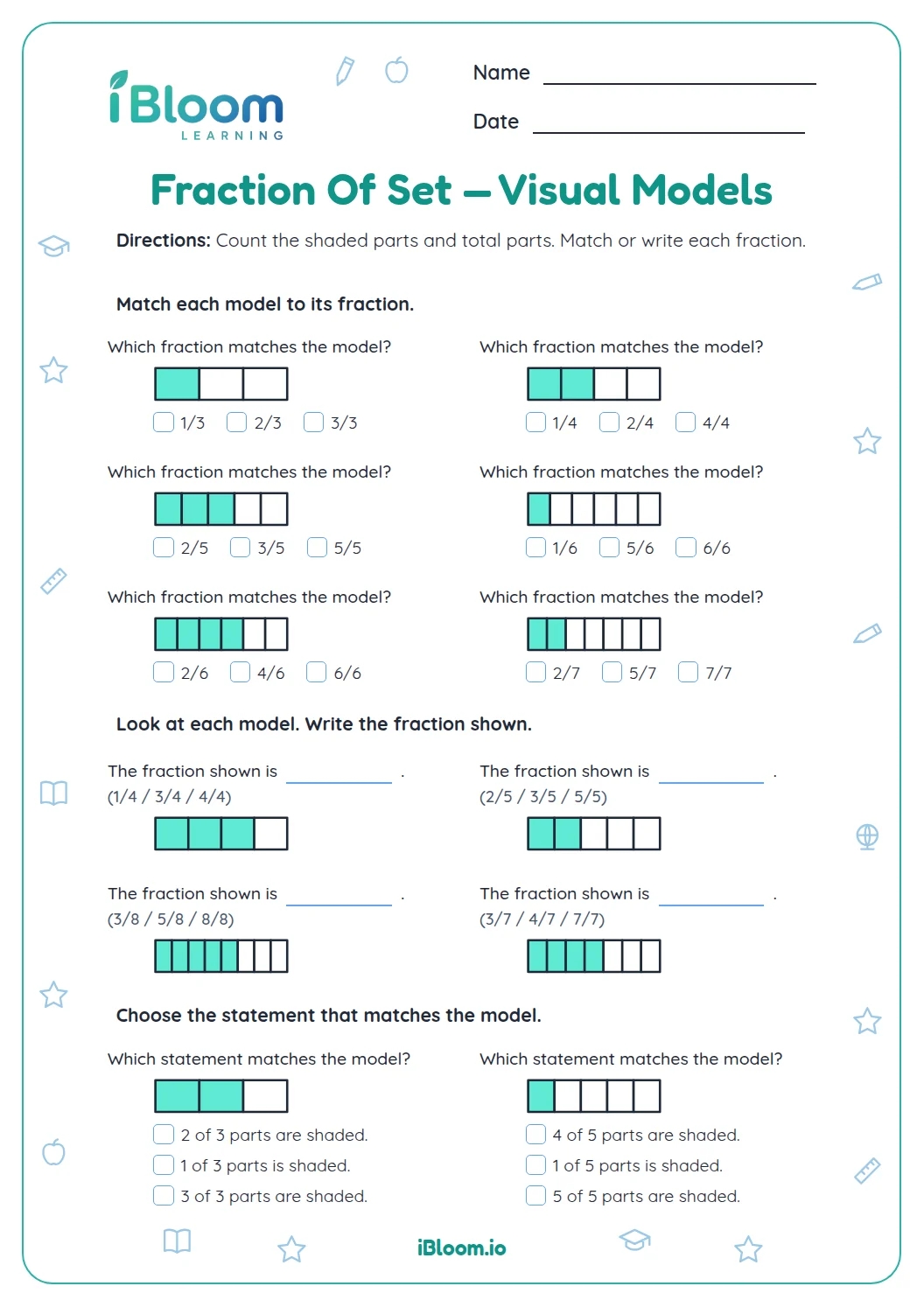
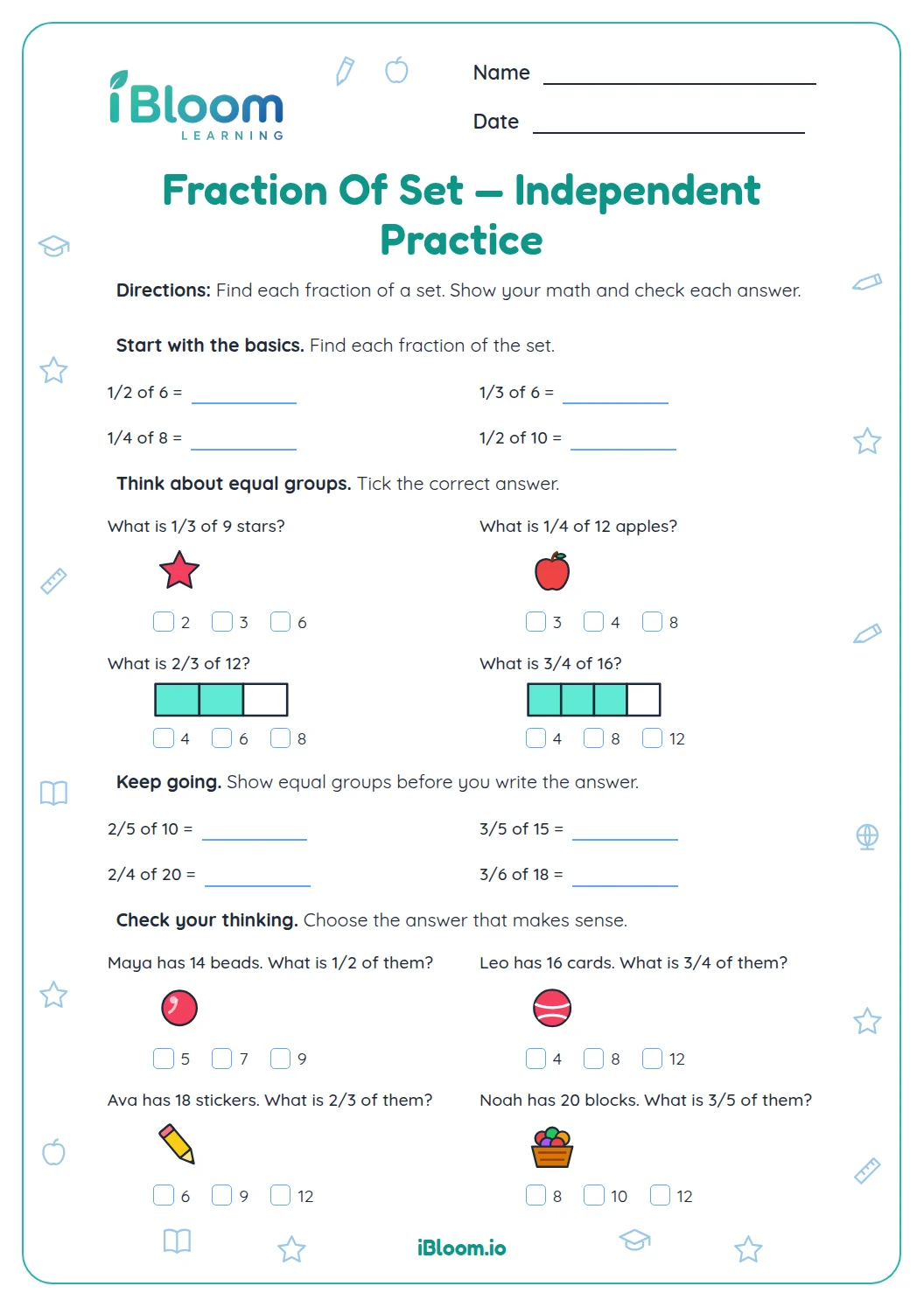
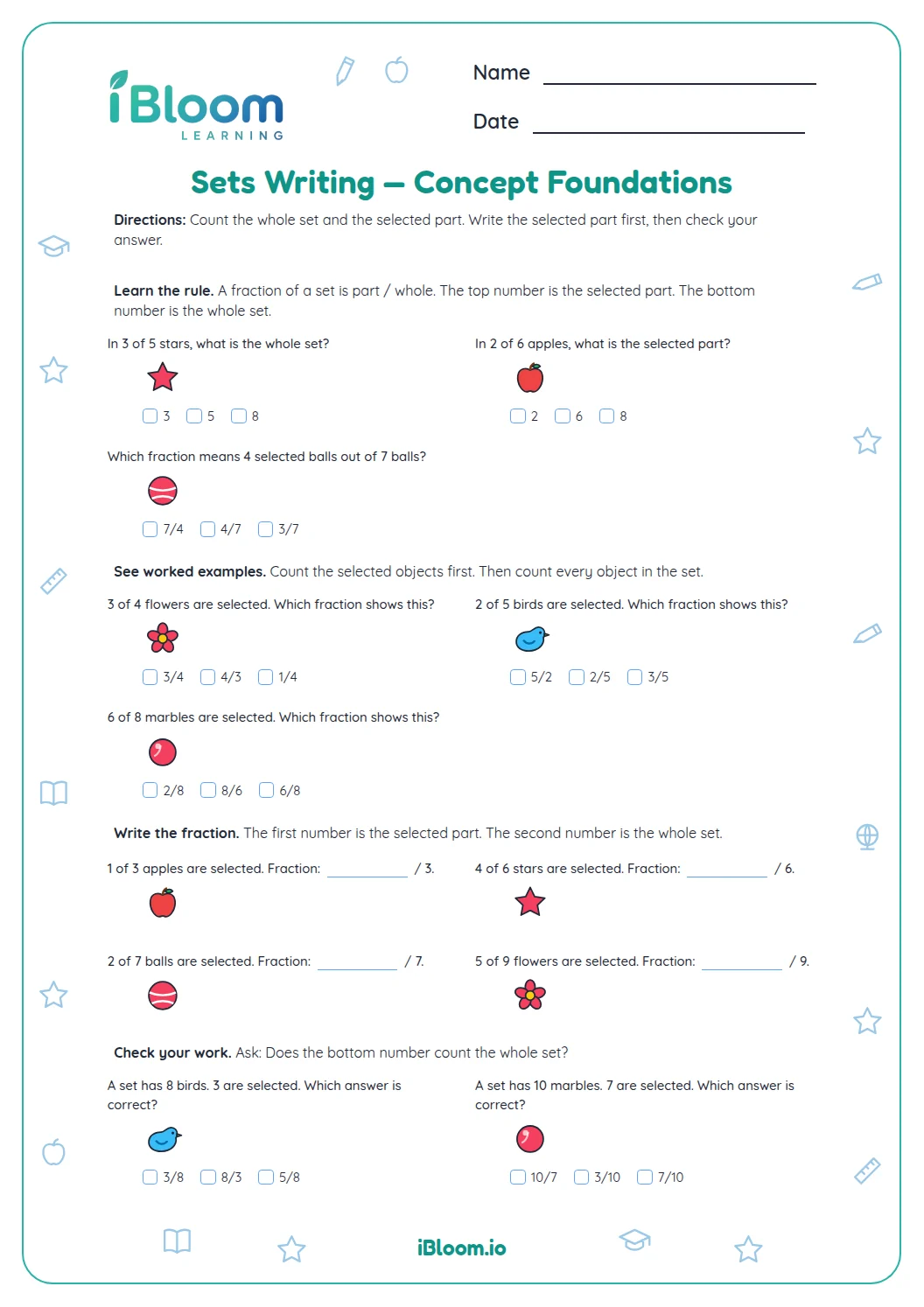
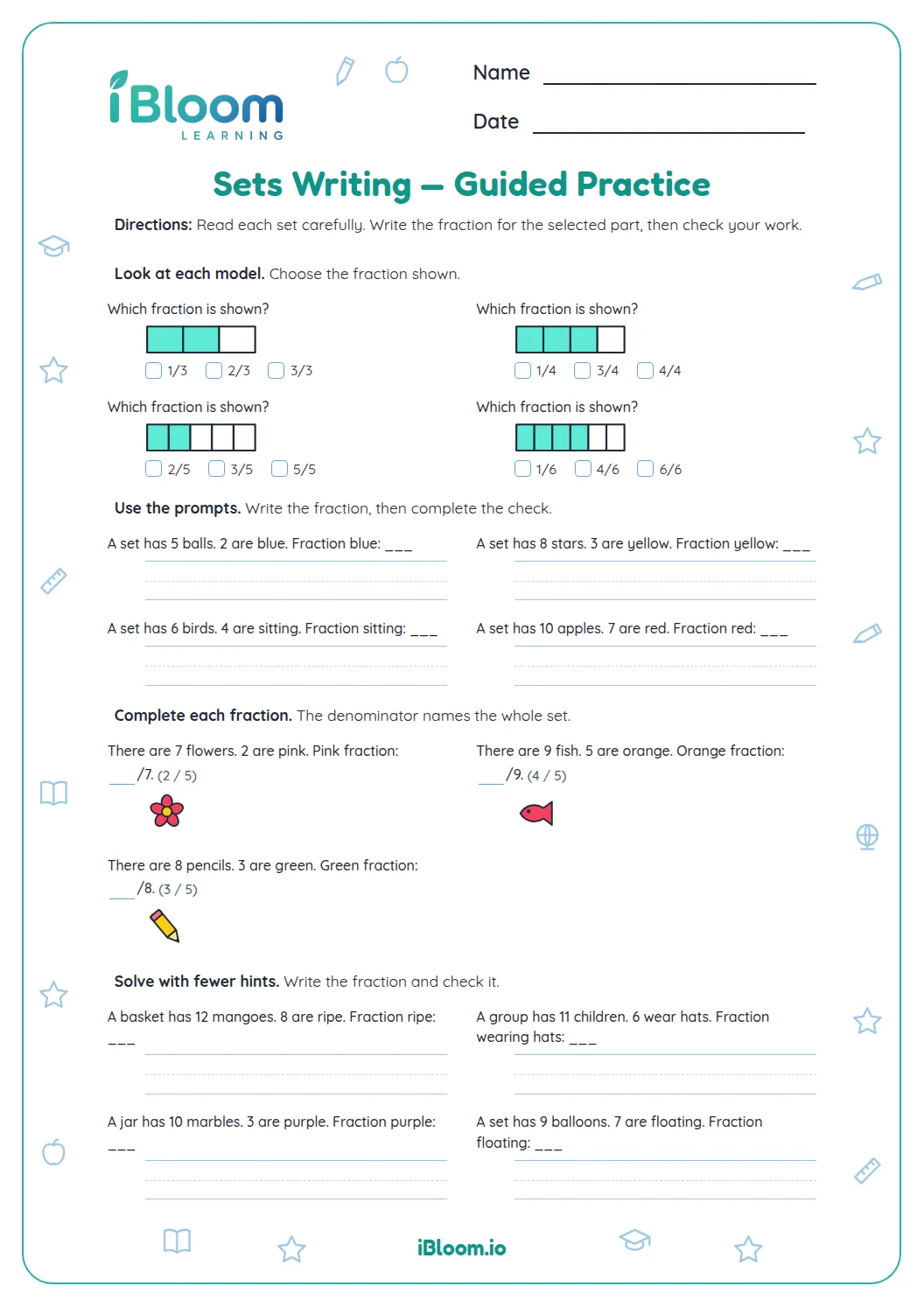
This free printable Grade 2 worksheet connects shaded parts of a whole with fractions of a group. Part A has four bars showing halves, thirds, fourths and fifths. Part B guides children through six calculations with groups of apples, including sixths and shares with a numerator greater than one. Part C gives four checks using equal groups. Children divide to find one share and multiply when they need more than one share. The four bars practice Common Core 3.NF.A.1 by showing equal parts and shaded shares. The group questions build on that fraction language with equal-group calculations. A separate answer key gives all fourteen responses.
Aligned to 3.NF.A.1
How do the bars show fractions?
Each bar is one whole divided into equal parts. The denominator counts all the parts; the numerator counts the shaded parts. Question 4 has five equal parts and two shaded parts, so its fraction is 2/5.
For a collection, the whole is all the objects. Finding two fifths of 15 apples means splitting the apples into five equal groups and taking two of those groups. The bar questions focus on naming equal parts; the apple questions apply fraction language to a set.
How do children find more than one share?
Find one share first. In question 8, dividing 15 apples into five equal groups gives three apples in each group. Two groups contain six apples. The printed steps keep the size of one share separate from the number of shares needed.
- 1Find two fifths of 15 apples.
- 215 ÷ 5 = 3 apples in one fifth.
- 33 × 2 = 6 apples in two fifths.
How do the last four questions check the method?
Questions 11–13 multiply the size of one share by the number of shares to rebuild the whole. If half of eight is four, two groups of four must make eight.
Question 14 returns to two fifths of 15 using words instead of a printed calculation. Children can make five groups of three counters and count two groups to check that the answer is six.
How to use this worksheet
- 1Point to each bar and count all equal parts before the shaded parts.
- 2Use eight counters to model two equal groups for question 5.
- 3Read each Part B calculation aloud, naming the size of one share.
- 4For two fifths and three fifths, count the requested number of equal groups.
- 5Complete Part C and compare the answers with the key.
Mistakes to notice and fix
The mistake
Counting only the shaded parts when choosing the denominator.
The fix
Count every part of the bar. In question 4, two shaded parts out of five make 2/5.
The mistake
Multiplying 15 by 5 when finding two fifths of 15.
The fix
Divide by five to find one fifth: 15 ÷ 5 = 3. Then take two groups: 3 × 2 = 6.
The mistake
Stopping at 4 when finding three fifths of 20.
The fix
Four is the size of one share. Three shares contain 4 × 3 = 12 apples.
Common Core alignment
Name shaded fractions as one or more equal parts of a whole.
On this sheet: Four divided bars connect the total number of equal parts and the shaded parts to fraction notation.
Show the official wordingHide the official wording
Understand a fraction 1/b as the quantity formed by 1 part when a whole is partitioned into b equal parts; understand a fraction a/b as the quantity formed by a parts of size 1/b.
What to practice next
Make more practice
Further reading
Questions parents and teachers ask
Which fractions do children practice?
Children name halves, thirds, fourths and fifths on shaded bars. They then find halves, thirds, fourths, fifths and sixths of groups of apples. The two fifths and three fifths questions ask for several equal shares, using a divide step followed by a multiply step.
Why use both bars and groups of apples?
The bars make the fraction notation visible before children calculate a share of a collection. In question 4, two of five equal parts are shaded. In question 8, two fifths means two of five equal groups of apples, so the same fraction describes the shares.
How much help do the calculations give?
Part B prints the division needed to find one equal share. For two fifths and three fifths, it also shows the size of that share and the multiplication step. Children complete the final count, then use the last part to check their understanding of equal groups.
Can we use objects while completing the sheet?
Yes, counters or small blocks can stand for the apples. Build the total named in the question and arrange it in the required number of equal groups. Move the chosen groups aside and count their objects. For question 14, take two groups of three.
What should I check in the answer key?
Check the four shaded fractions, six calculated counts and four equal-group responses. If a count is wrong, ask whether the child found one share or all the requested shares. Question 8 needs six apples, because each fifth has three apples and the question asks for two fifths.