

About this worksheet
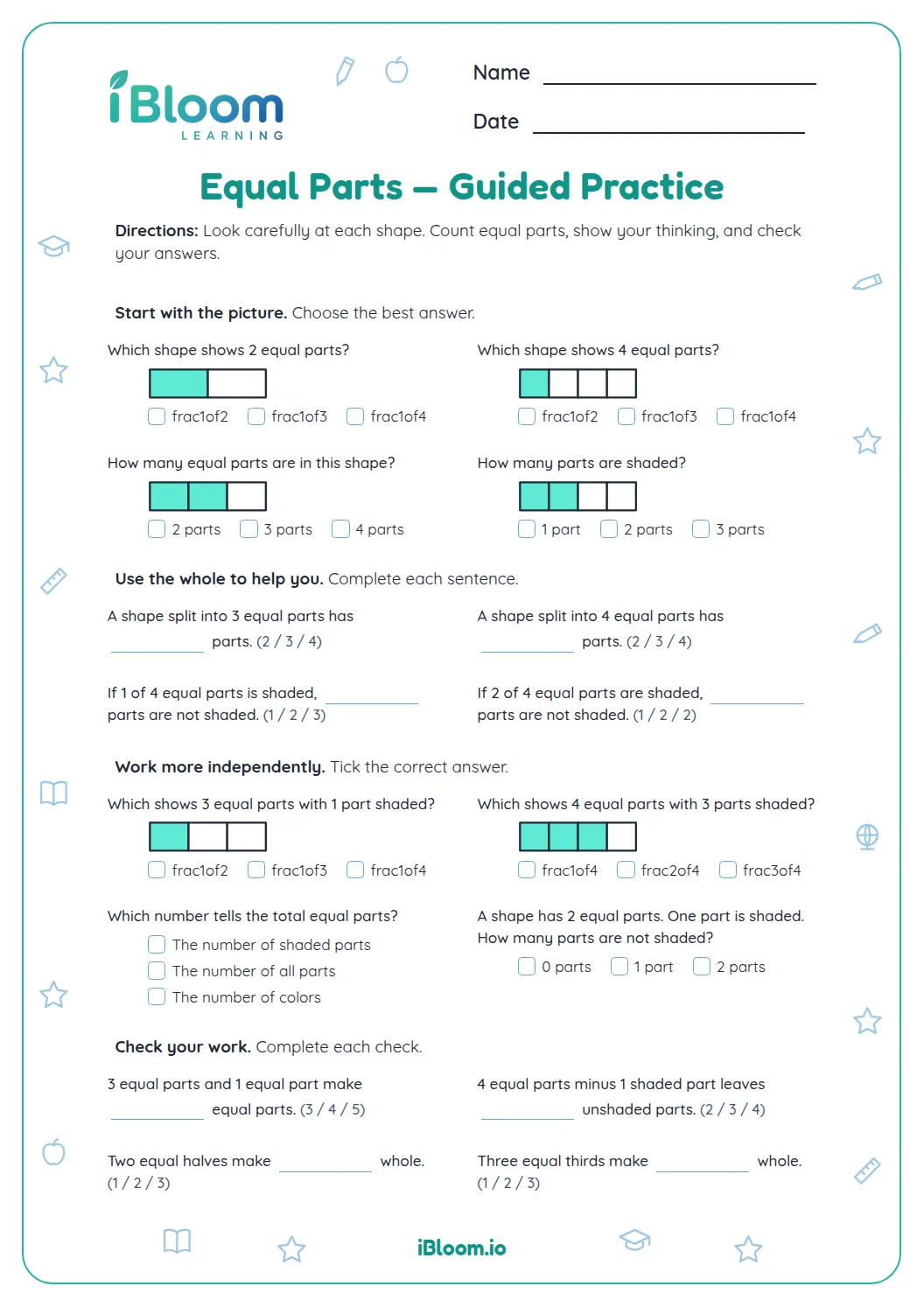
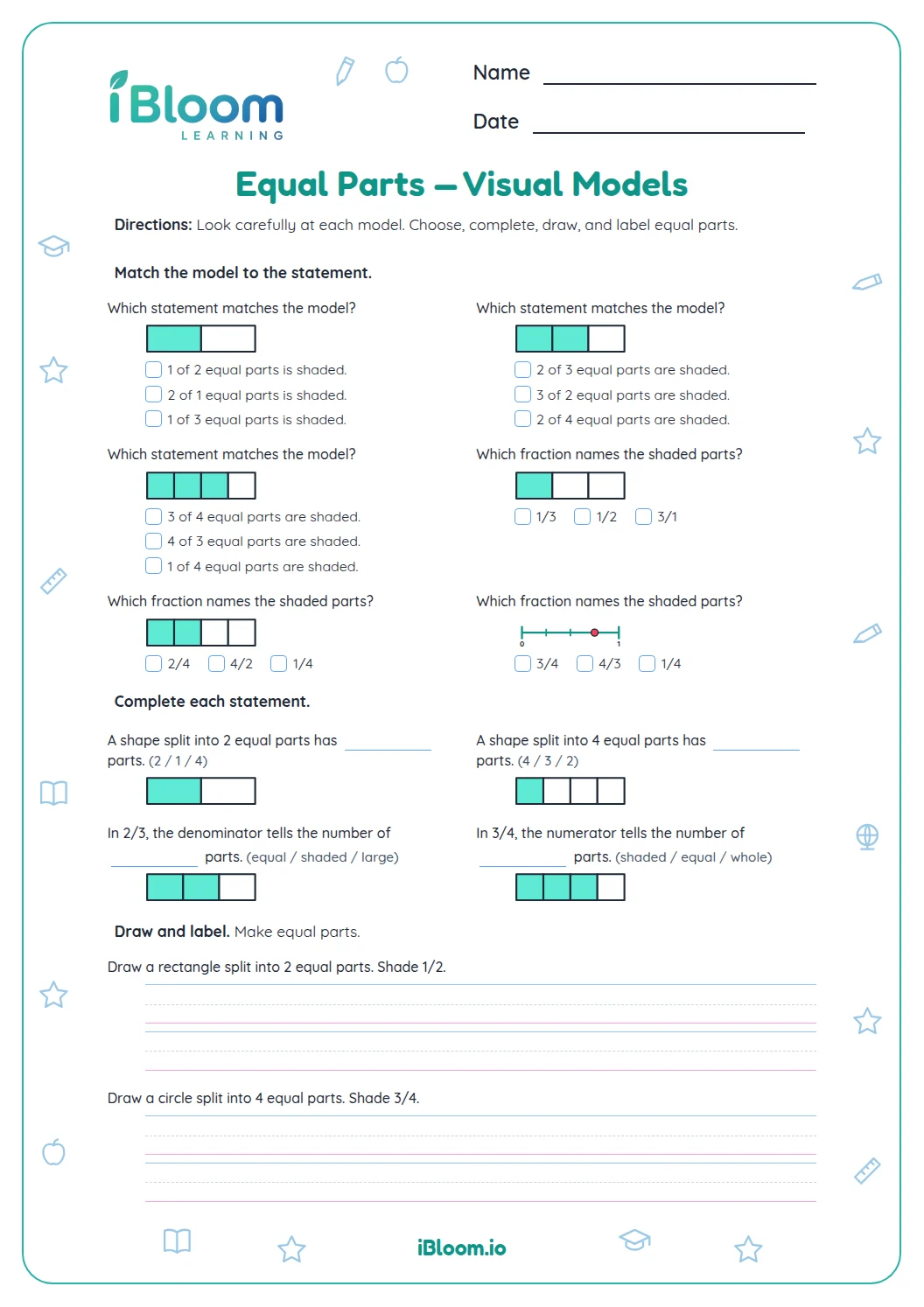
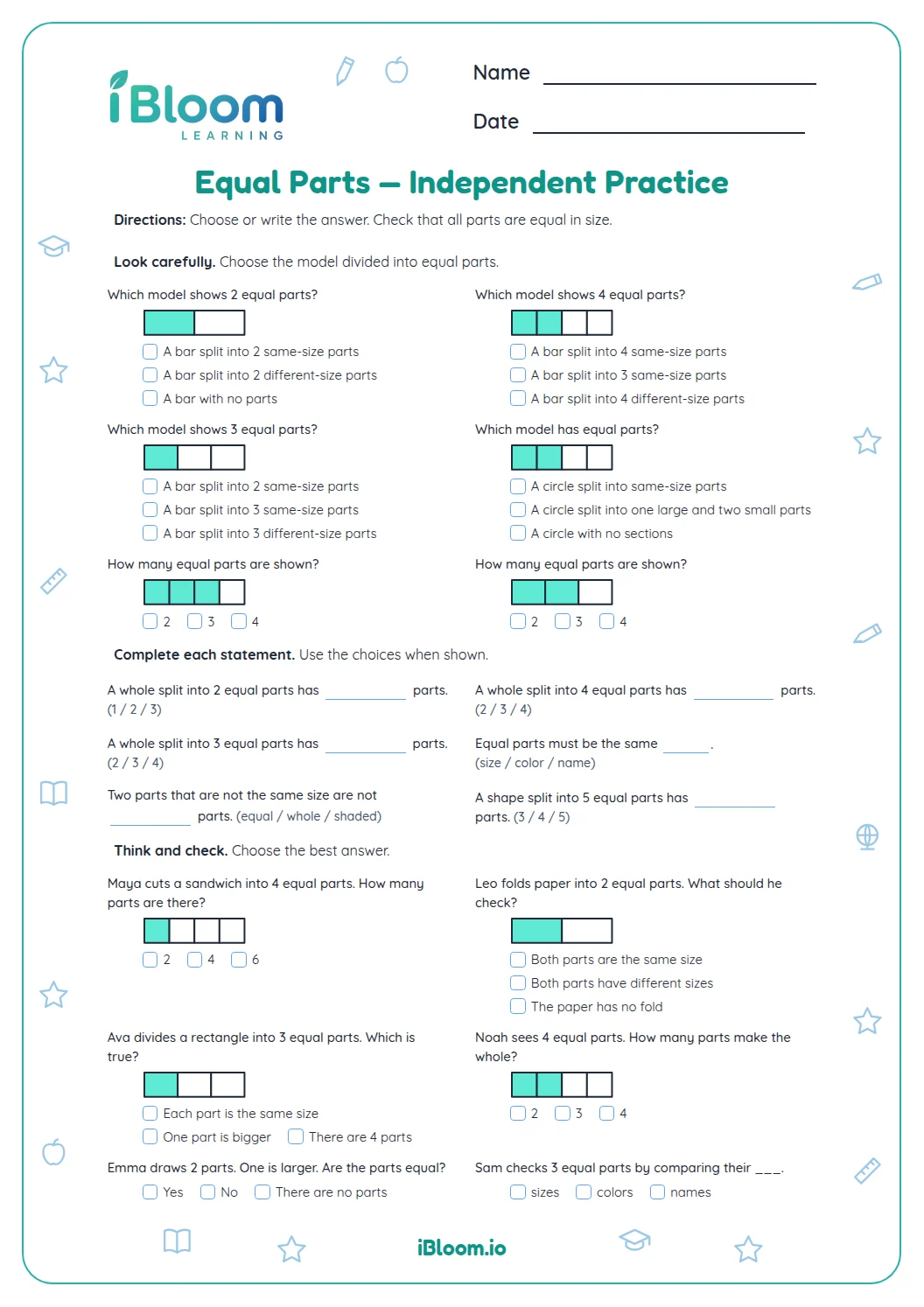
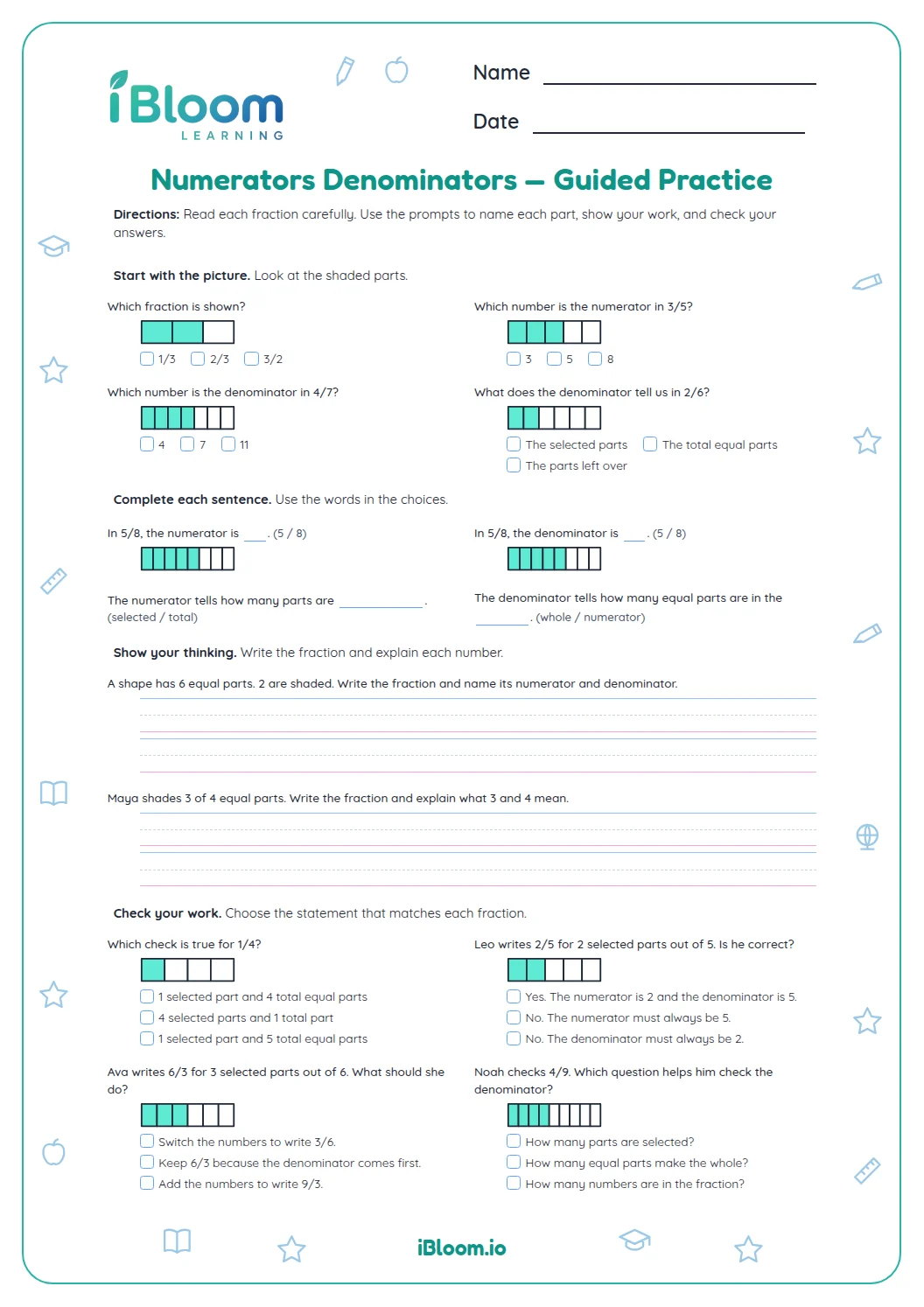
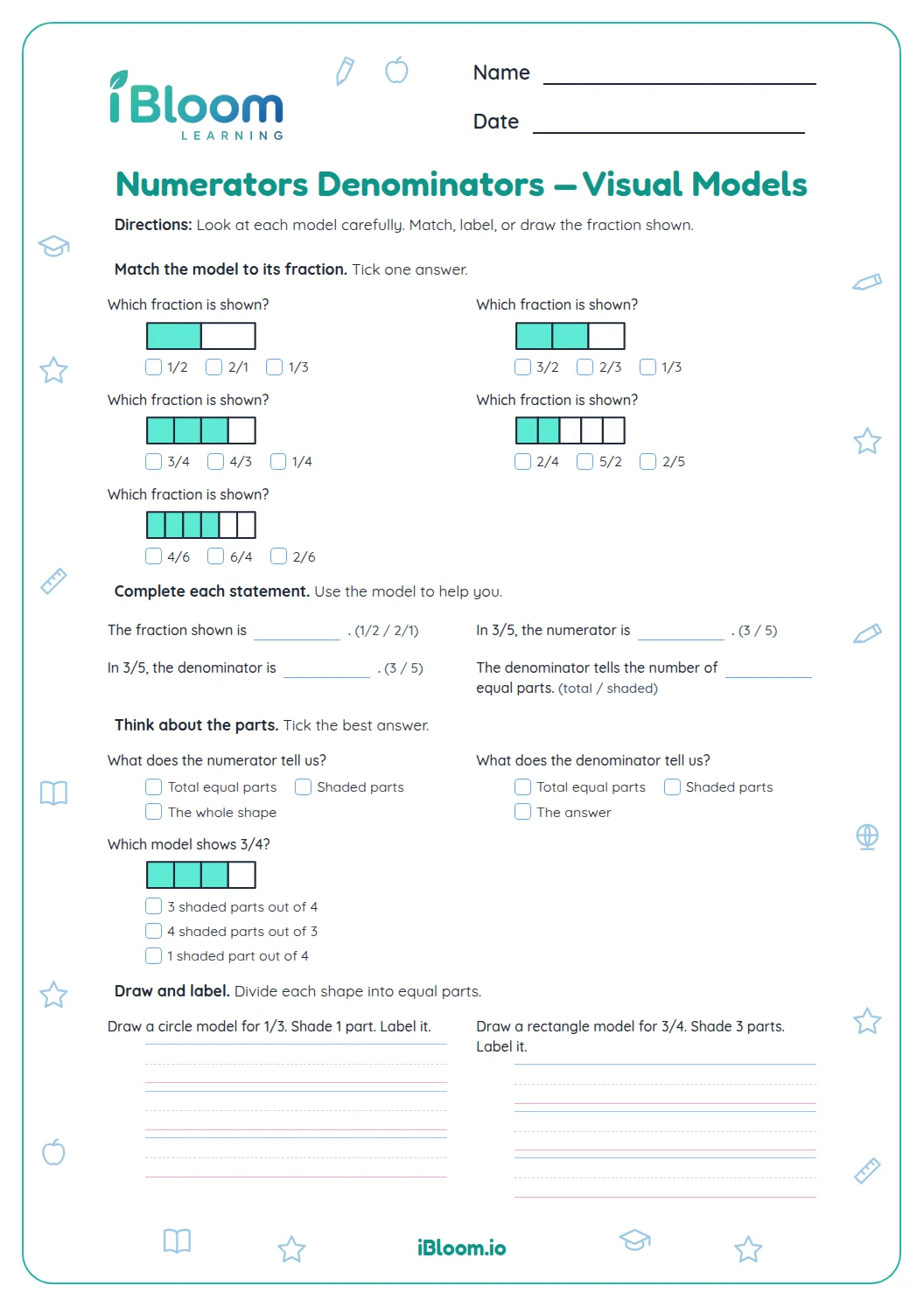
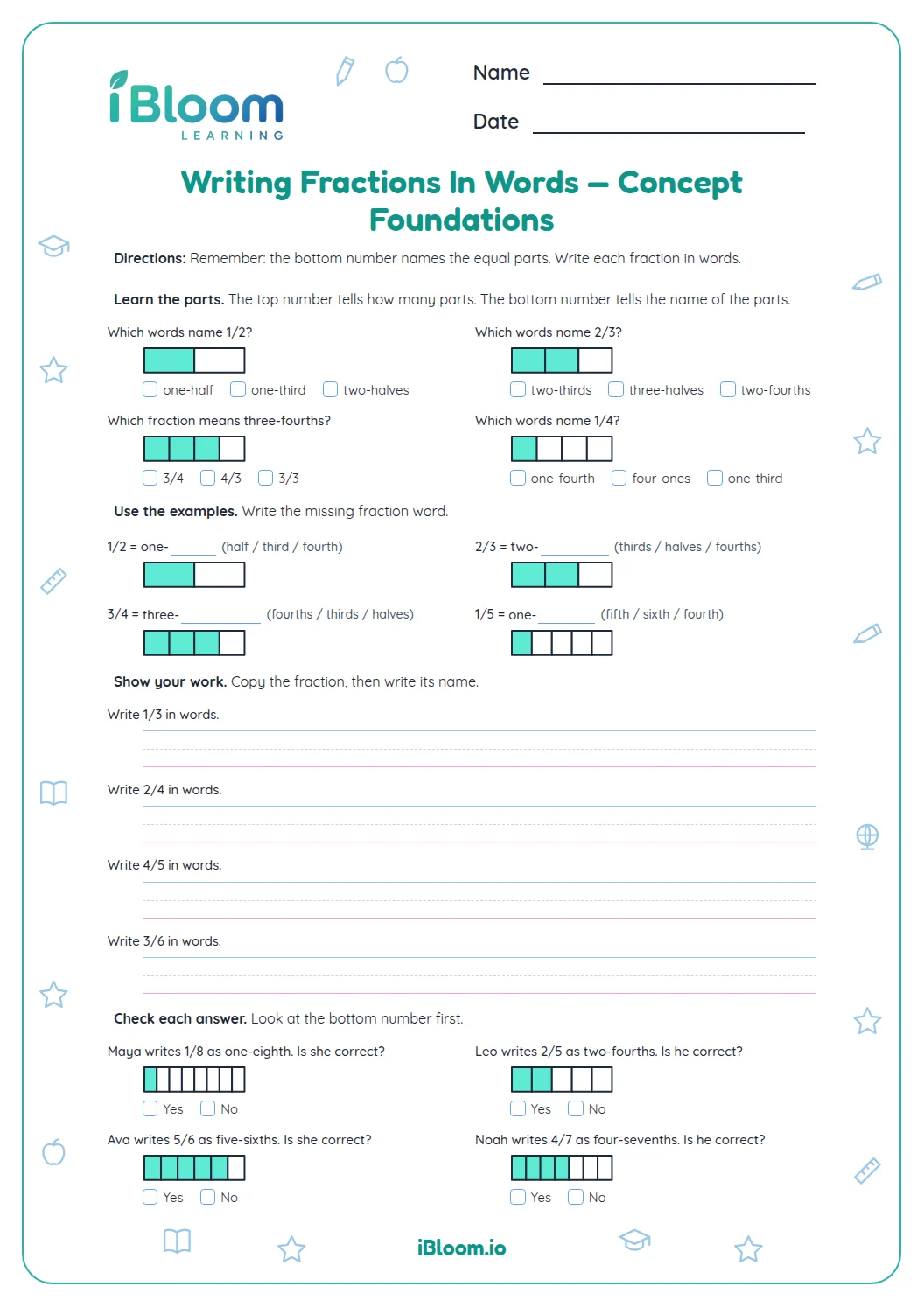
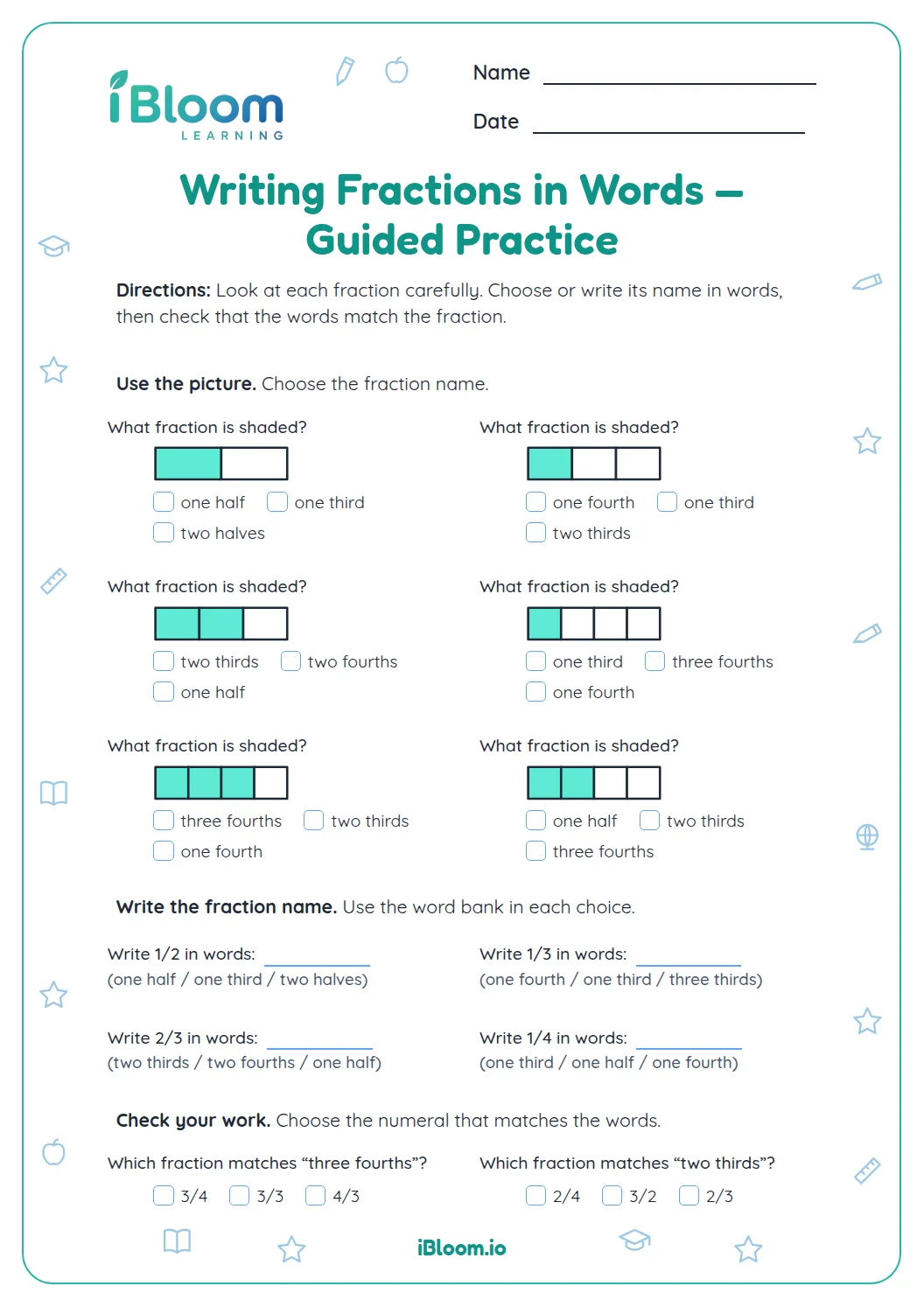
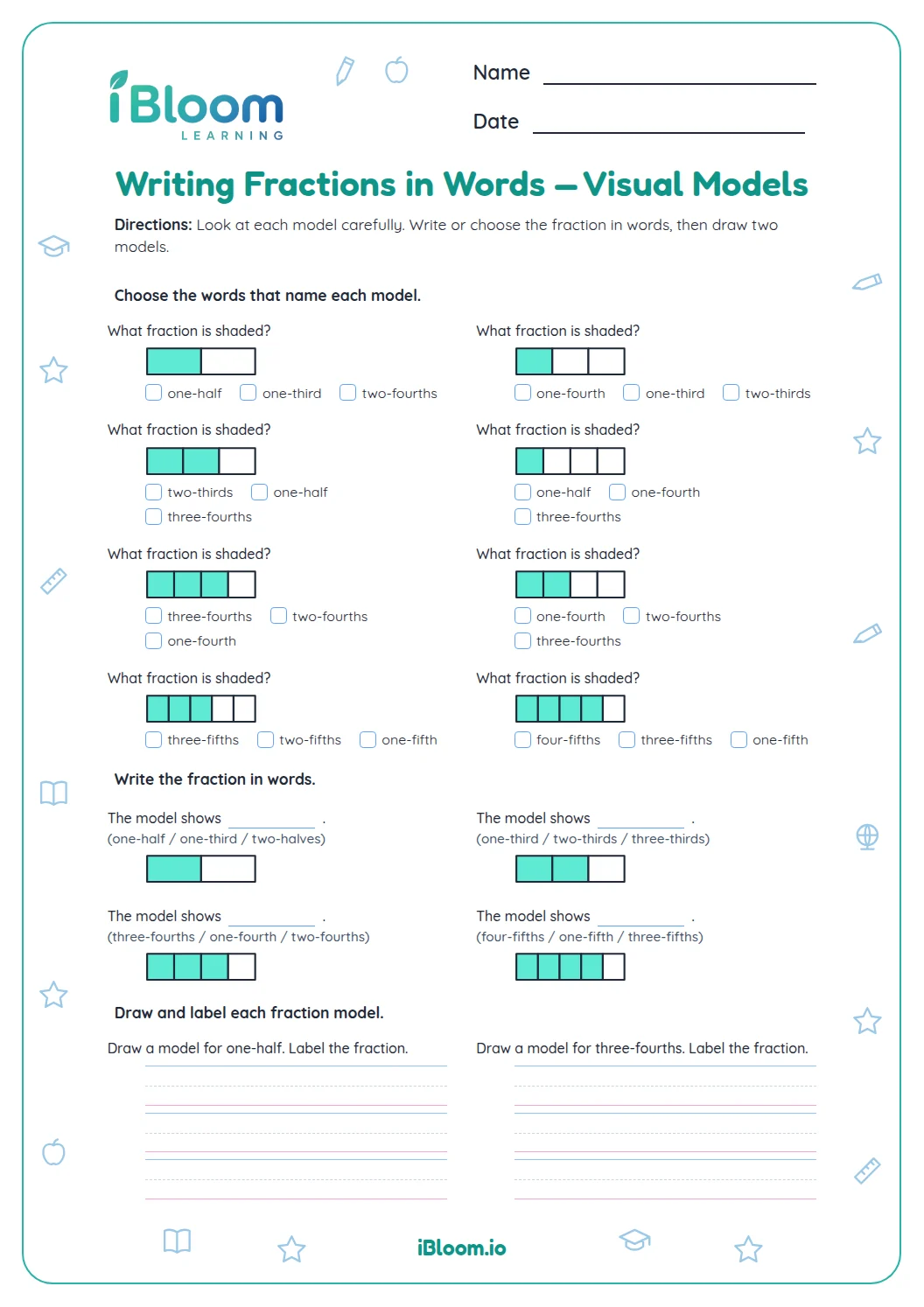
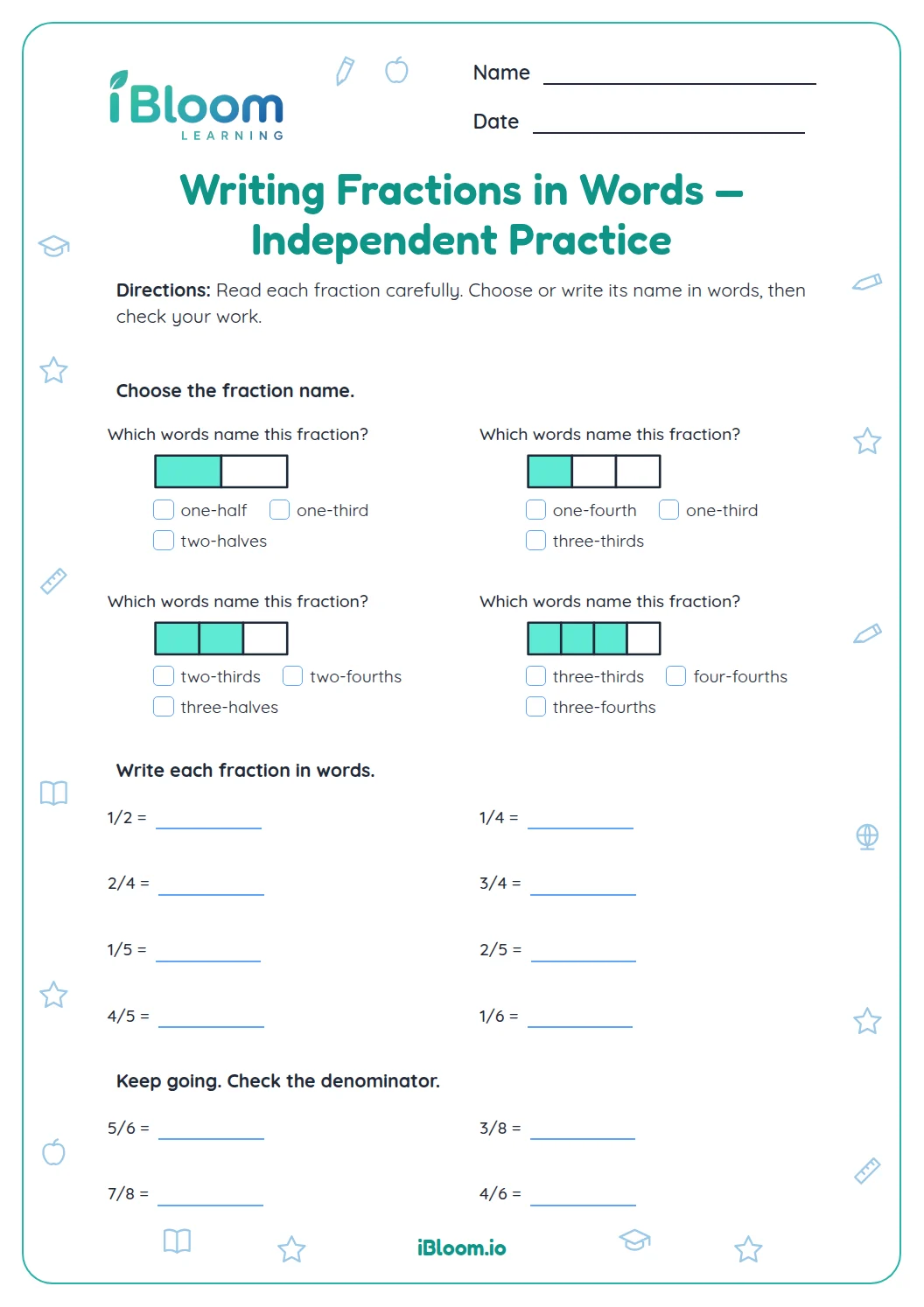
This free printable worksheet helps Grade 2 students read fractions from a picture. Each bar, circle or square is cut into equal parts, some of them shaded, and children pick the fraction it shows: 1/2, 3/4, 2/3 or 1/4. They then match fractions to their words, such as three-fourths, say what the bottom number tells, and solve one short ribbon problem. It practices Common Core 2.G.A.3 using halves, thirds and fourths, and a separate answer key shows every answer.
Aligned to 2.G.A.3
What does it mean to read a fraction?
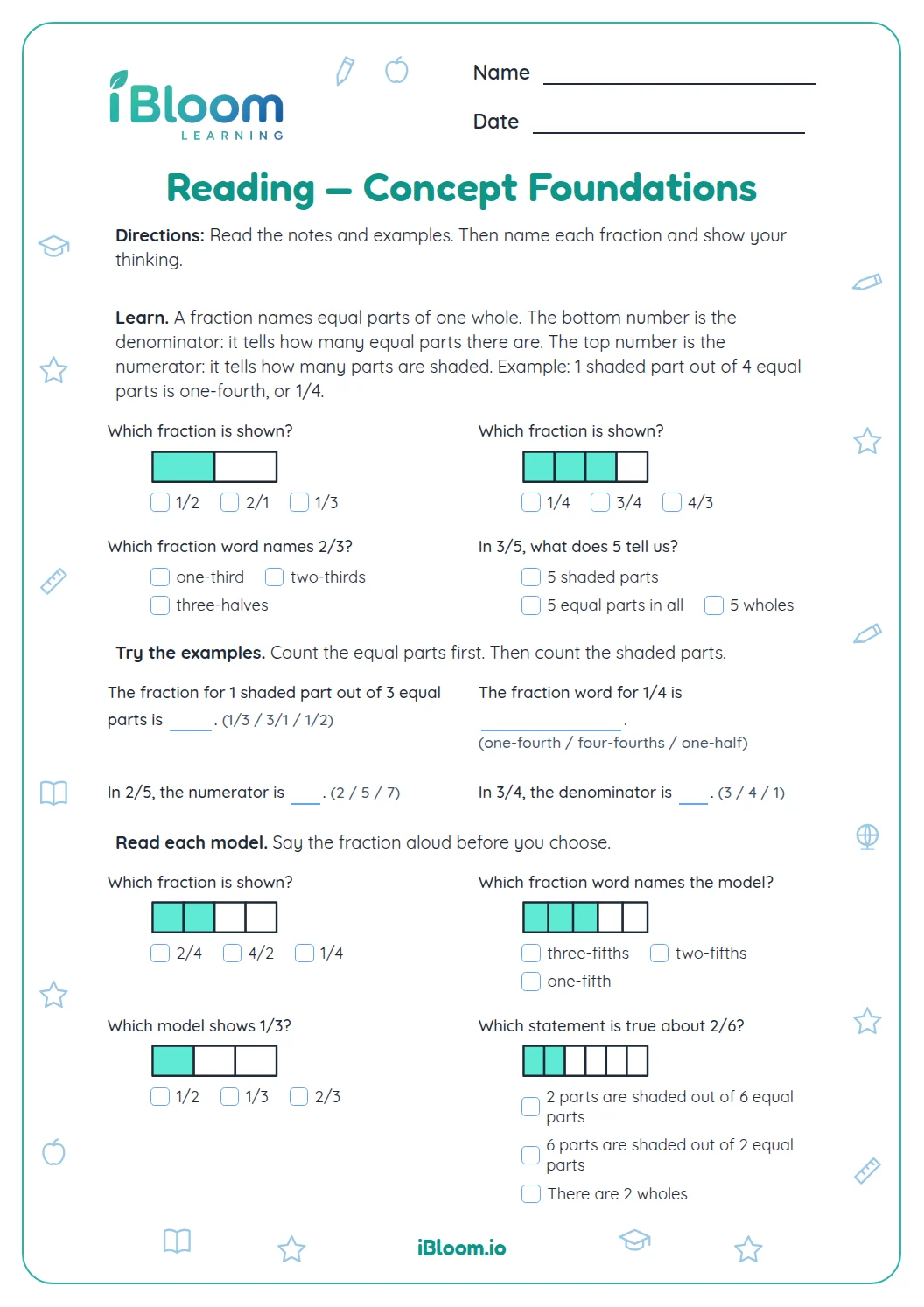
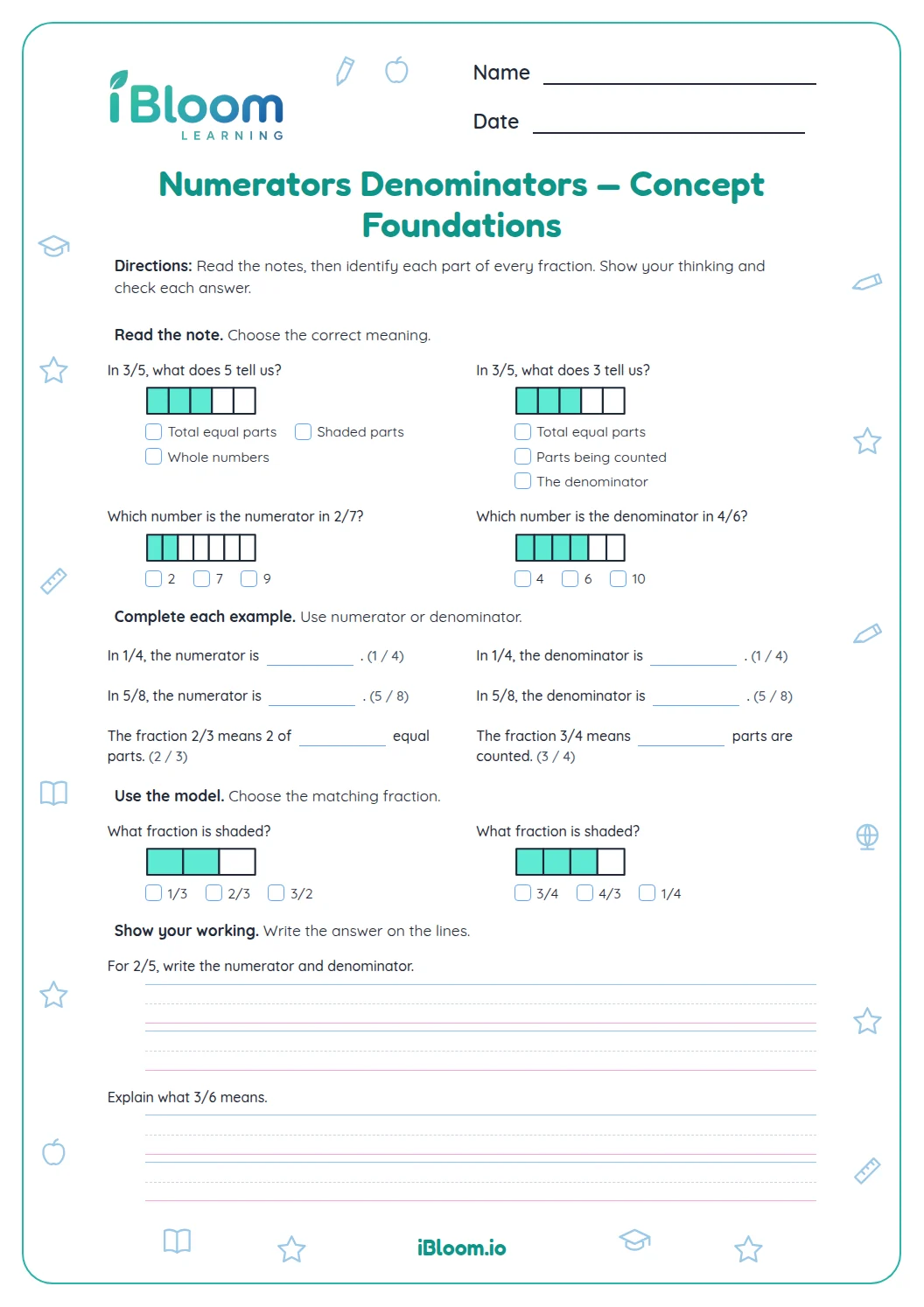
Reading a fraction means saying how much of a shape is shaded. A fraction has two numbers. The bottom number counts all the equal parts in the whole, and the top number counts the parts that are shaded or used.
A quick slip is to count only the shaded parts and write that number alone. The four pictures in Part A have children count the whole shape first, so 3 shaded parts out of 4 becomes 3/4 and not just 3.
How do you say a fraction in words?
Say the top number, then name the size of the parts. Two equal parts are halves, three are thirds and four are fourths. So 1/2 is one-half, 2/3 is two-thirds and 3/4 is three-fourths. When there is more than one part, the name ends in s: fourths, thirds.
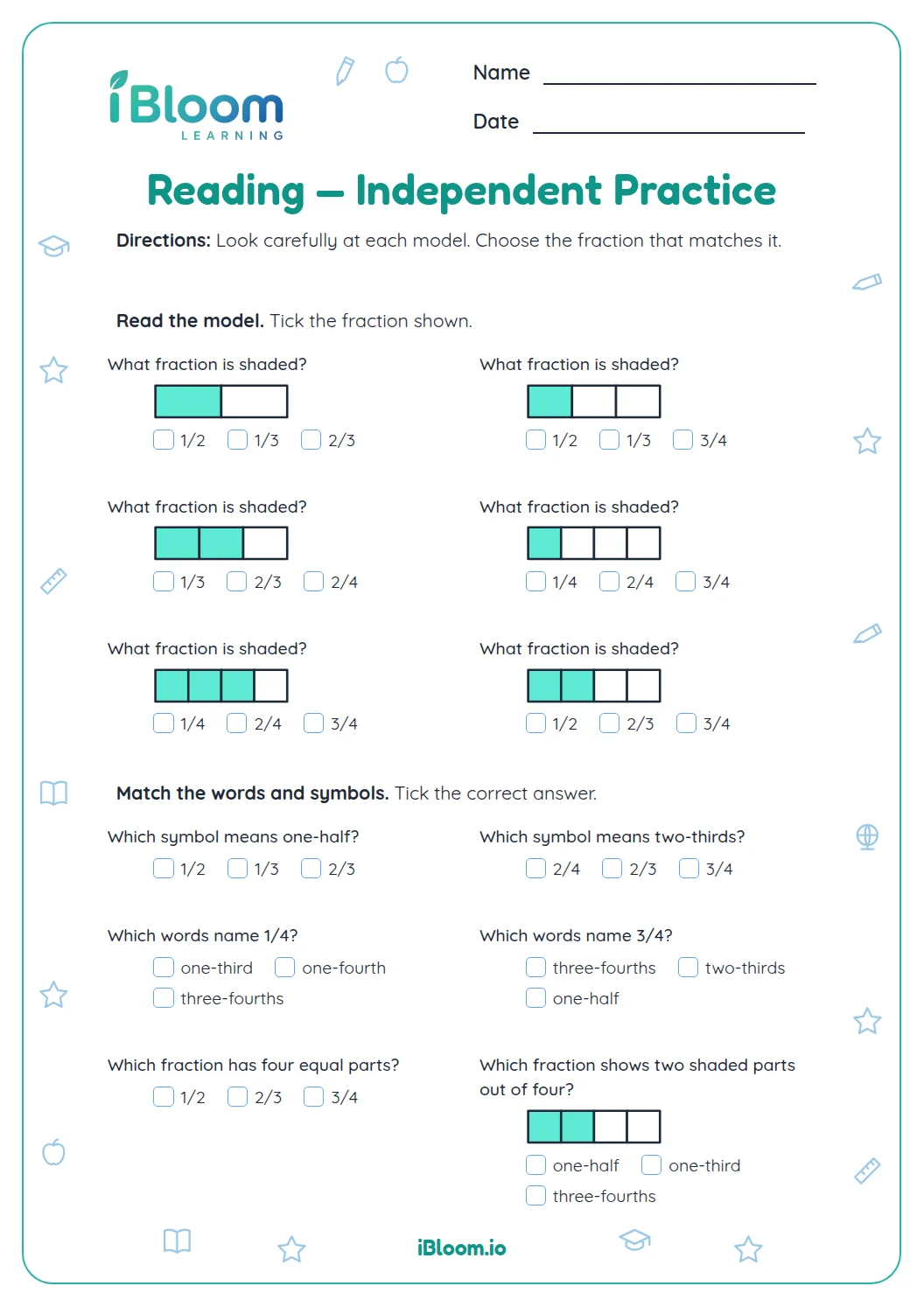
Parts B and C ask children to match symbols to words and to finish sentences such as "3/4 is read as three-___." Reading each fraction aloud while pointing at the picture helps the words stick.
- 1A circle is cut into 4 equal parts
- 23 parts are shaded
- 3Bottom number: 4 equal parts
- 4Top number: 3 shaded parts
- 5The fraction is 3/4, read three-fourths
Why do the parts have to be equal?
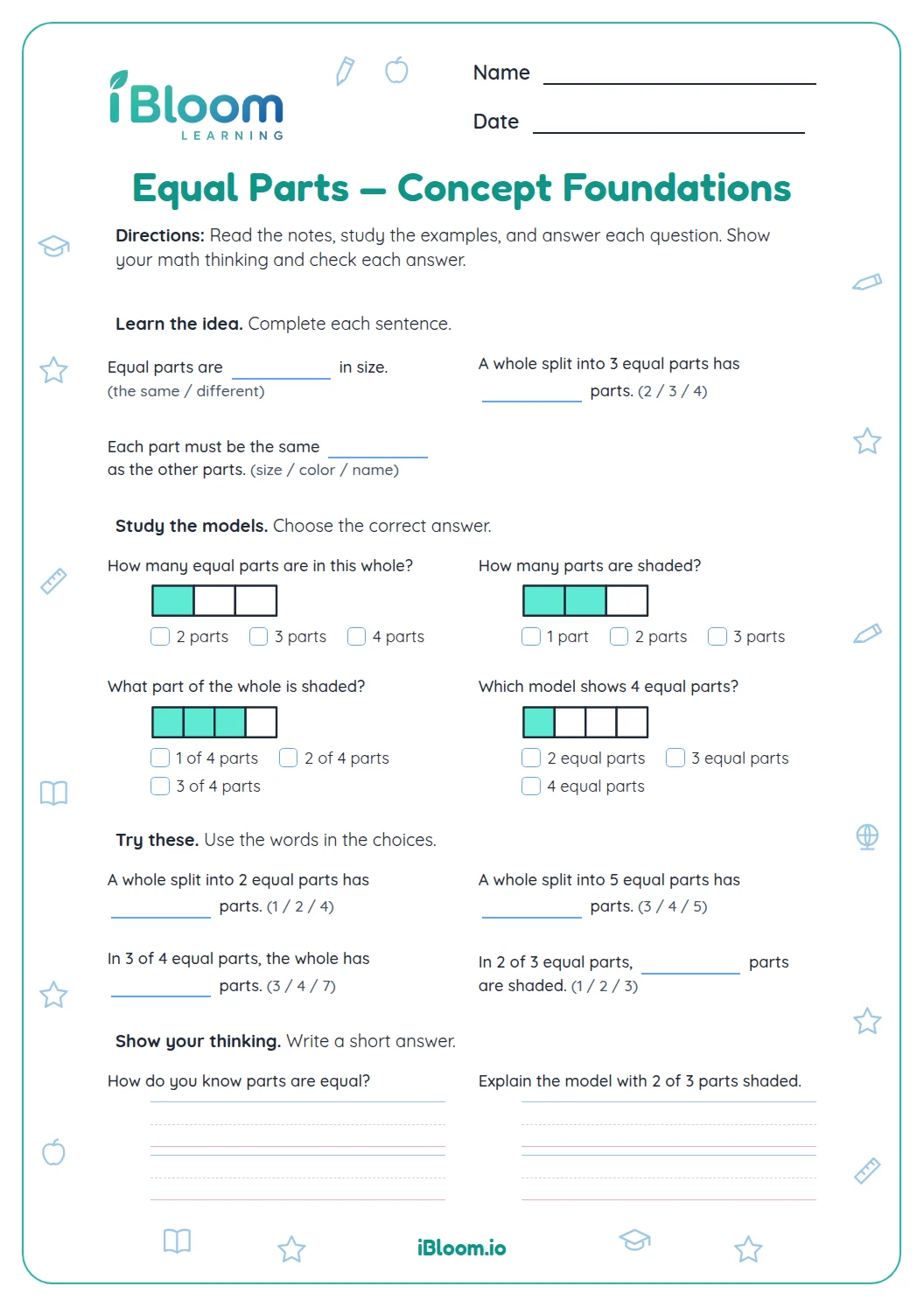
A fraction names equal shares of one whole, so every shape on the sheet is cut into parts of the same size. In question 8, all 3 equal parts of a pie are eaten, which makes the whole: 3/3. Seeing a whole as three thirds, or four fourths, is an idea students use again when they add fractions.
What is on this worksheet?
Eleven questions on two pages, in four parts, from reading a picture to explaining a fraction:
- Part A: 4 questions, read the fraction shown by a bar, circle or square
- Part B: 4 questions, match fractions to words and say what the bottom number tells
- Part C: 2 questions, finish the word in three-fourths and one-half
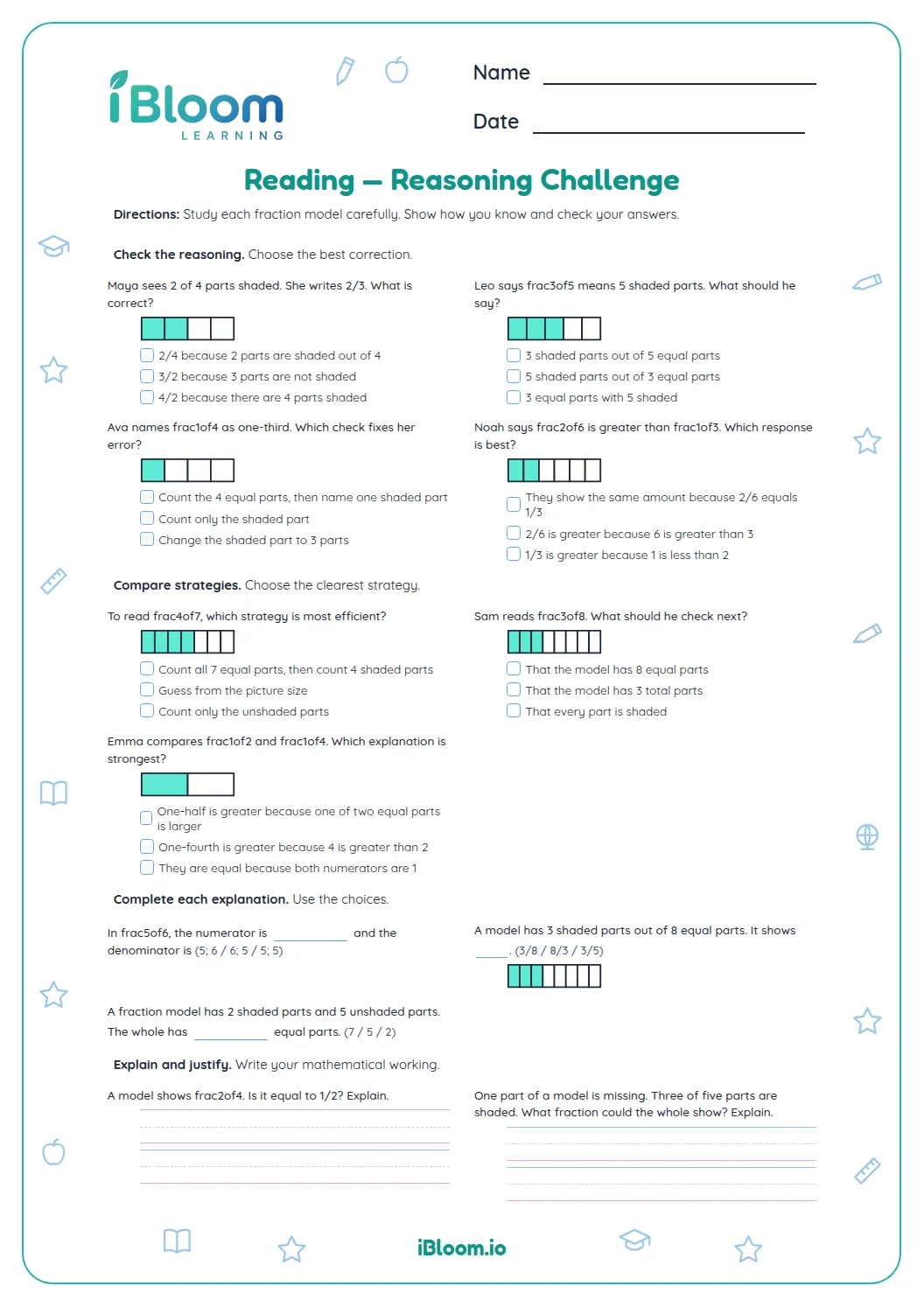
- Part D: 1 word problem about a ribbon, with space to work
- A two-page answer key
How to use this worksheet at home or in class
- 1Fold a paper strip into 4 equal parts and color 3. Ask how many parts in all and how many are colored.
- 2Say the fraction together: "three-fourths." Write 3/4 and point to each number as you explain it.
- 3Do question 1 together. Have your child count the parts out loud before choosing.
- 4Let your child finish Part A on their own, then read each answer aloud as a fraction word.
- 5In Part B, ask your child to read the fraction in words before picking a choice.
- 6In Part D, ask for a quick drawing of the ribbon cut into 3 pieces, then check it against the answer key.
Common mistakes and quick fixes
The mistake
Comparing shaded parts to unshaded parts, writing 3/1 for a circle with 3 of its 4 parts shaded.
The fix
The bottom number counts every equal part, shaded or not. Touch and count all 4 parts first, then the 3 shaded ones: 3/4.
The mistake
Turning the fraction upside down, writing 4/3 or 4/1 instead of 3/4 or 1/4.
The fix
Ask which number tells how many parts are in the whole. That one goes on the bottom, and on this sheet it is never smaller than the top number.
The mistake
Counting the unshaded parts, answering 1/4 for a circle with 3 of 4 parts shaded.
The fix
Color the shaded parts with a crayon and count only those. The fraction asks how much is shaded, not how much is left.
Common Core alignment
Most US states use the Common Core standards or a close state version. This Grade 2 geometry standard is where halves, thirds and fourths are taught.
Describe equal shares as halves, thirds and fourths, and a whole as thirds or fourths.
On this sheet: Children read halves, thirds and fourths from shaded shapes, name them in words, and see in question 8 that 3 thirds make a whole.
Show the official wordingHide the official wording
Partition circles and rectangles into two, three, or four equal shares, describe the shares using the words halves, thirds, half of, a third of, etc., and describe the whole as two halves, three thirds, four fourths. Recognize that equal shares of identical wholes need not have the same shape.
What to practice next
Make more practice
Further reading
Questions parents and teachers ask
What fractions are on this worksheet?
The sheet uses halves, thirds and fourths: 1/2, 1/3, 2/3, 1/4 and 3/4, plus 3/3 for a whole pie. These are the equal shares Grade 2 students work with. The shapes are bars, circles and squares, and each one is cut into equal parts before any part is shaded.
What do the top and bottom numbers of a fraction mean?
The bottom number tells how many equal parts the whole is cut into. The top number tells how many of those parts are shaded or used. In 3/4, the whole has 4 equal parts and 3 are shaded. Question 7 asks children to say what the bottom number tells.
How do you read 3/4 aloud?
Read 3/4 as three-fourths. Say the top number first, then the name of the parts: halves for 2 equal parts, thirds for 3 and fourths for 4. When the top number is 1, the name has no s, as in one-fourth or one-half. Parts B and C practice exactly these reading choices.
Why does question 8 use all the parts?
Because a whole can be written as a fraction too. When all 3 parts of a pie are eaten, the amount is 3/3, or three thirds, which is the whole pie. It is the same idea as 2/2 for two halves or 4/4 for four fourths.
What if my child writes 3 instead of 3/4?
That means they counted only the shaded parts. Ask them to count every equal part in the whole shape and write that number below a line, then write the shaded count above it. Doing this out loud for the four Part A pictures, while touching each part, shows why both numbers are needed.
Is there an answer key for this worksheet?
Yes. A separate answer key shows the fraction for each picture in Part A, the word choices in Part B, the missing words in Part C, and the answer to the ribbon problem in Part D. You can print the worksheet alone, keep the key for checking, or download both as a PDF.