



About this worksheet
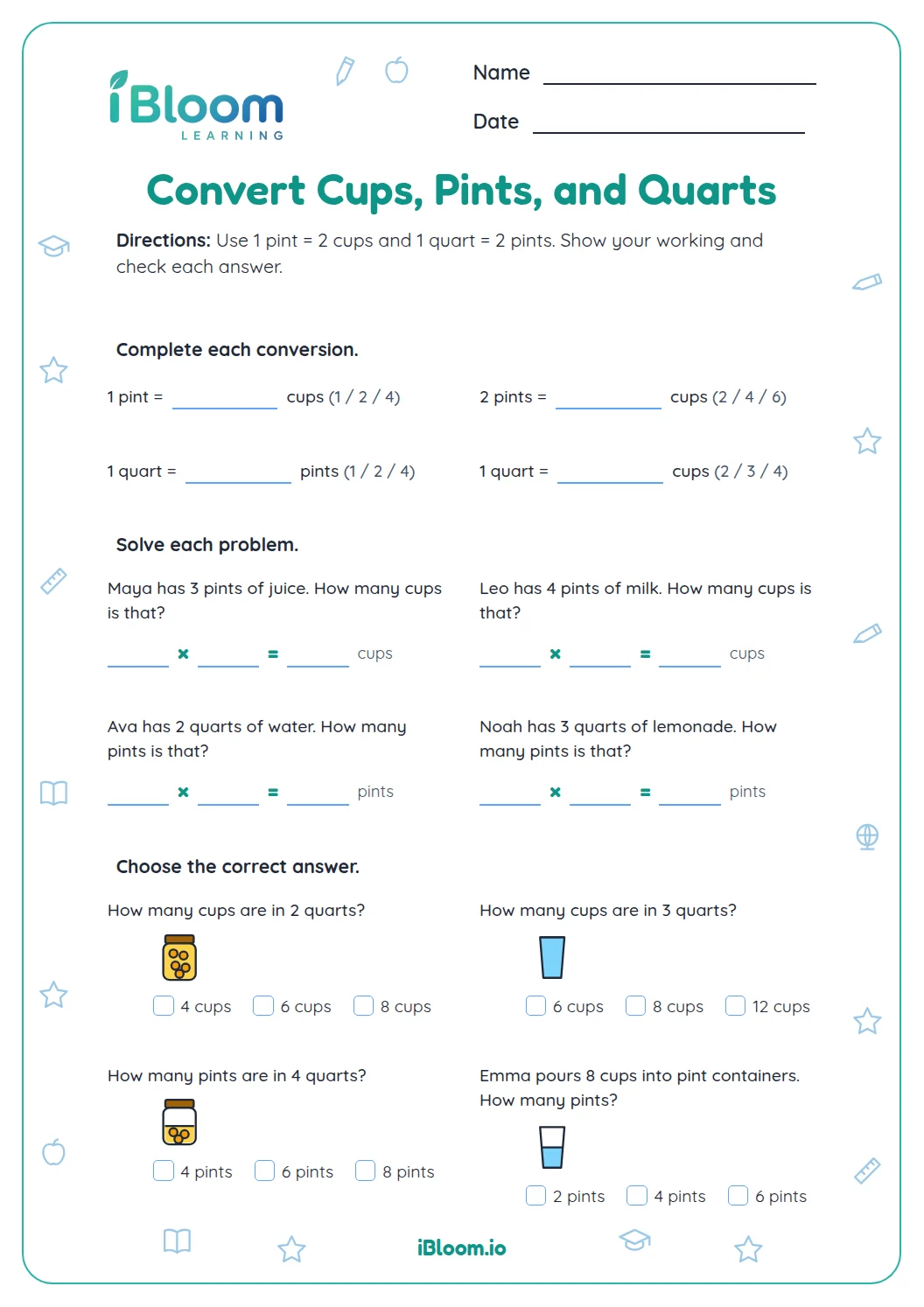
This Grade 4 capacity worksheet practices customary conversions among cups, pints, and quarts. Students complete four visual tables, convert amounts in both directions, and compare quantities in familiar situations. It practices CCSS 4.MD.A.1 by recording equivalent amounts in tables and expressing a larger unit in terms of a smaller unit. The answer key lists all 14 results.
Aligned to 4.MD.A.1
Which equal amounts connect the units?
Two cups make one pint, and two pints make one quart. Together, those facts show that four cups make one quart. The first four questions model these relationships in small tables.
How do you convert pints to cups?
Multiply the number of pints by two cups per pint. For example, 3 pints are 3 groups of 2 cups, or 6 cups. Use the table relationships to check the conversion.
- 13 pints means 3 groups of 2 cups.
- 22 + 2 + 2 = 6 cups.
How can a table check a conversion?
The tables list matching amounts for two or three units, with one cell left blank. Fill the missing value from the conversion facts, then use those relationships again in the later problems.
How can you compare two capacity amounts?
Convert both amounts to the same unit before comparing. One quart is four cups, so one quart holds more than three cups.
How to solve a capacity conversion
- 1Read the unit named in the question.
- 2Use 2 cups = 1 pint or 2 pints = 1 quart.
- 3For a larger amount, count equal groups.
- 4Convert both amounts to one unit before comparing.
- 5Write the correct unit and check with the key.
Capacity conversion slips to watch for
The mistake
Treating 2 cups as a full quart.
The fix
Remember that 2 cups make 1 pint; a quart holds 2 pints.
The mistake
Writing the number without its unit.
The fix
Copy the requested unit into the answer.
The mistake
Comparing cups directly with quarts.
The fix
Convert one amount so both use the same unit.
Common Core alignment
This page uses measurement tables to show equivalent capacity amounts and express larger units in smaller units.
Record equivalent capacity amounts in tables and express larger units in smaller units.
On this sheet: Use equivalent unit relationships and record measurement conversions in tables.
Show the official wordingHide the official wording
Know relative sizes of measurement units within one system of units including km, m, cm; kg, g; lb, oz; l, ml; hr, min, sec. Within a single system of measurement, express measurements in a larger unit in terms of a smaller unit. Record measurement equivalents in a two-column table.
What to practice next
Make more practice
Further reading
Questions parents and teachers ask
How many cups are in one pint?
One pint equals 2 cups. The first table shows 2 cups beside 1 pint. In the second table, 4 cups equal 2 pints and 1 quart, so 2 cups represent half a quart. For 3 pints, count three groups of 2 cups to get 6 cups total.
How many pints are in one quart?
One quart equals 2 pints. Each pint is 2 cups, so a quart also equals 4 cups. The tables line up matching amounts in all three units, making it possible to use the fact in either direction. Keeping the three units in the same row helps check the amount.
What does the worksheet ask students to practice?
There are 14 questions: four visual tables with a missing amount, followed by conversions and comparisons. Students work with cups, pints, and quarts, and the separate answer key lists each completed amount with its unit. They then apply the facts to familiar measurement situations.
Why do the tables show half a quart?
Two cups are half of four cups, and four cups equal one quart. The first table pairs 2 cups with 1 pint, while the second connects 4 cups, 2 pints, and 1 quart. Together those facts show why 2 cups are half a quart.
How should students compare cups and quarts?
Convert one amount so both use the same unit. For example, 1 quart is 4 cups, and 4 cups is more than 3 cups. Then select the larger amount and keep its original unit in the response. This same-unit comparison is the quickest way to decide which amount is greater.