


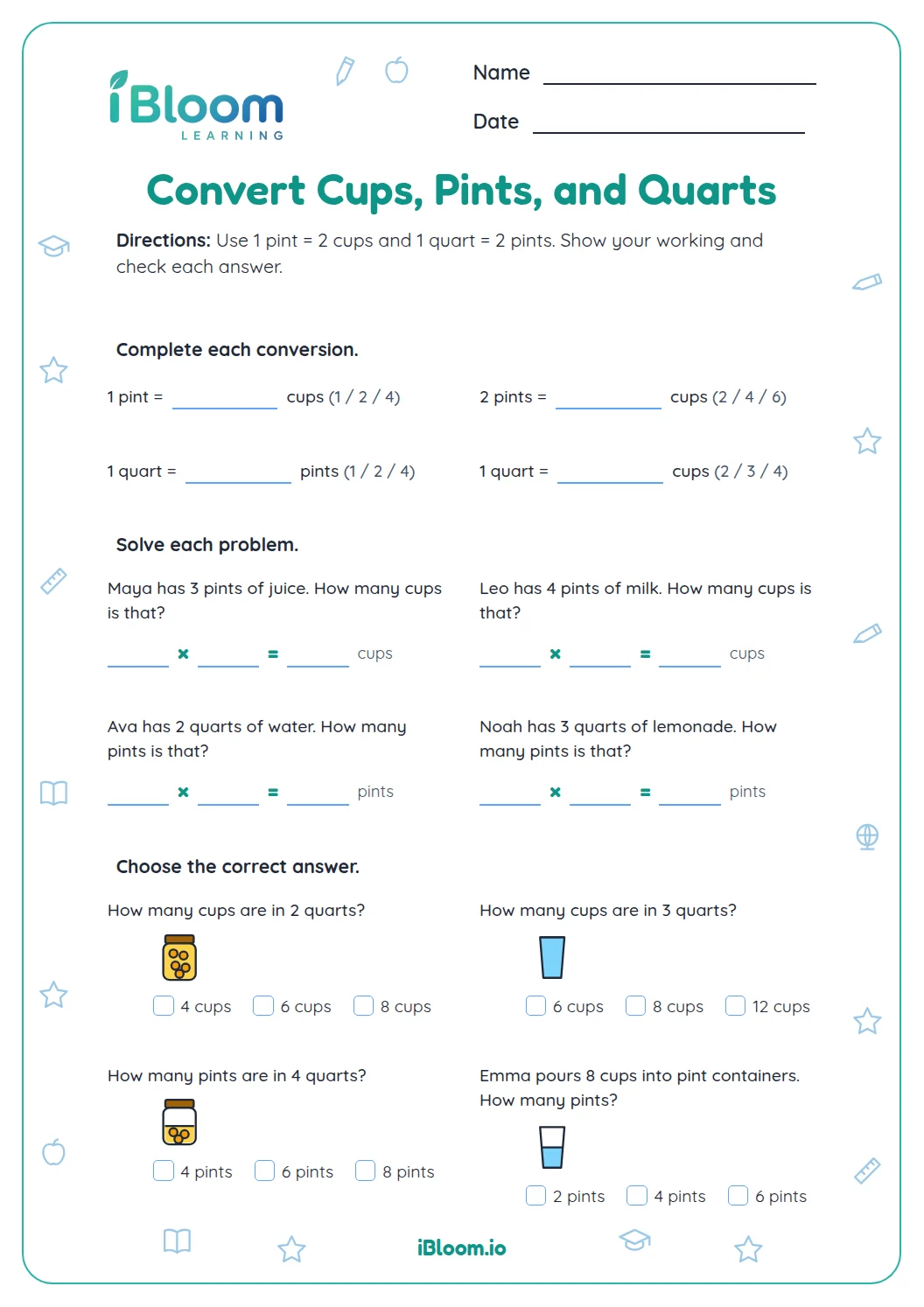
About this worksheet
This customary-capacity worksheet practices the relationships 2 cups = 1 pint and 2 pints = 1 quart. Students begin with direct conversions, then compose larger amounts and solve short kitchen situations. The answer key includes the unit in each response. The questions ask students to reason about capacity and use the stated unit relationships.
What does the worksheet practice?
Part A reviews the cup, pint, and quart relationships. Part B uses those facts for larger amounts, including remainders in smaller units.
Part B uses those facts for larger amounts, including remainders in smaller units. Part C checks an equivalent amount and applies the relationships in kitchen stories.
How can students convert an amount?
Use the stated facts as a path: two cups make one pint, and two pints make one quart. To rename 14 cups, first make 3 full quarts (12 cups), leaving 2 cups. Write the amount as 3 quarts and 2 cups.
What to practice next
Questions parents and teachers ask
What unit facts does the worksheet use?
It uses 2 cups = 1 pint and 2 pints = 1 quart. Together, those facts show that 4 cups = 1 quart. Keep the relationships nearby while solving the larger conversions and kitchen stories on the second page.
How can a student check a conversion?
Rename the answer back to the starting unit to check it. For example, 3 quarts equal 6 pints because each quart contains 2 pints. Converting back should return to the amount in the question. Students can also use 4 cups per quart as a second check.
How should mixed-unit answers be written?
Make as many full larger units as possible, then name the remainder in the smaller unit. For example, 7 pints equal 3 quarts and 1 pint because 6 pints make 3 quarts, with 1 pint left over. The remaining pint cannot make another full quart.
What does the answer key include?
The key gives the equivalent amount and its unit for direct conversions, then the larger and leftover units for mixed amounts. For story questions, check that the final unit answers what the problem asks. A conversion step can help show how the student got there.
Can I use this with a younger student?
The sheet is intended for students ready to work with capacity relationships across several steps. An adult can read the facts aloud and model a conversion first, then invite the student to try the remaining questions independently. The answer key can help check the unit names.