


About this worksheet
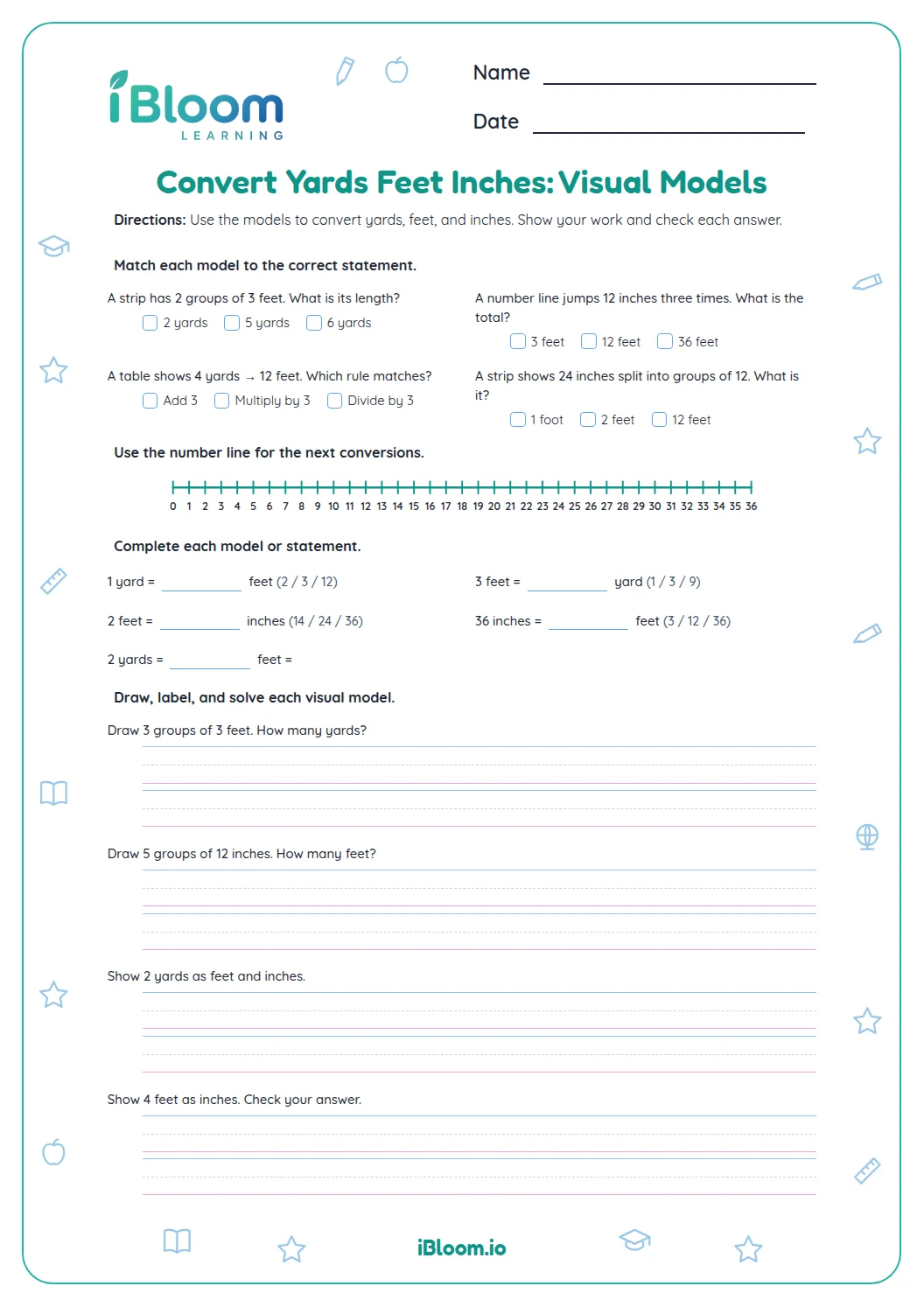
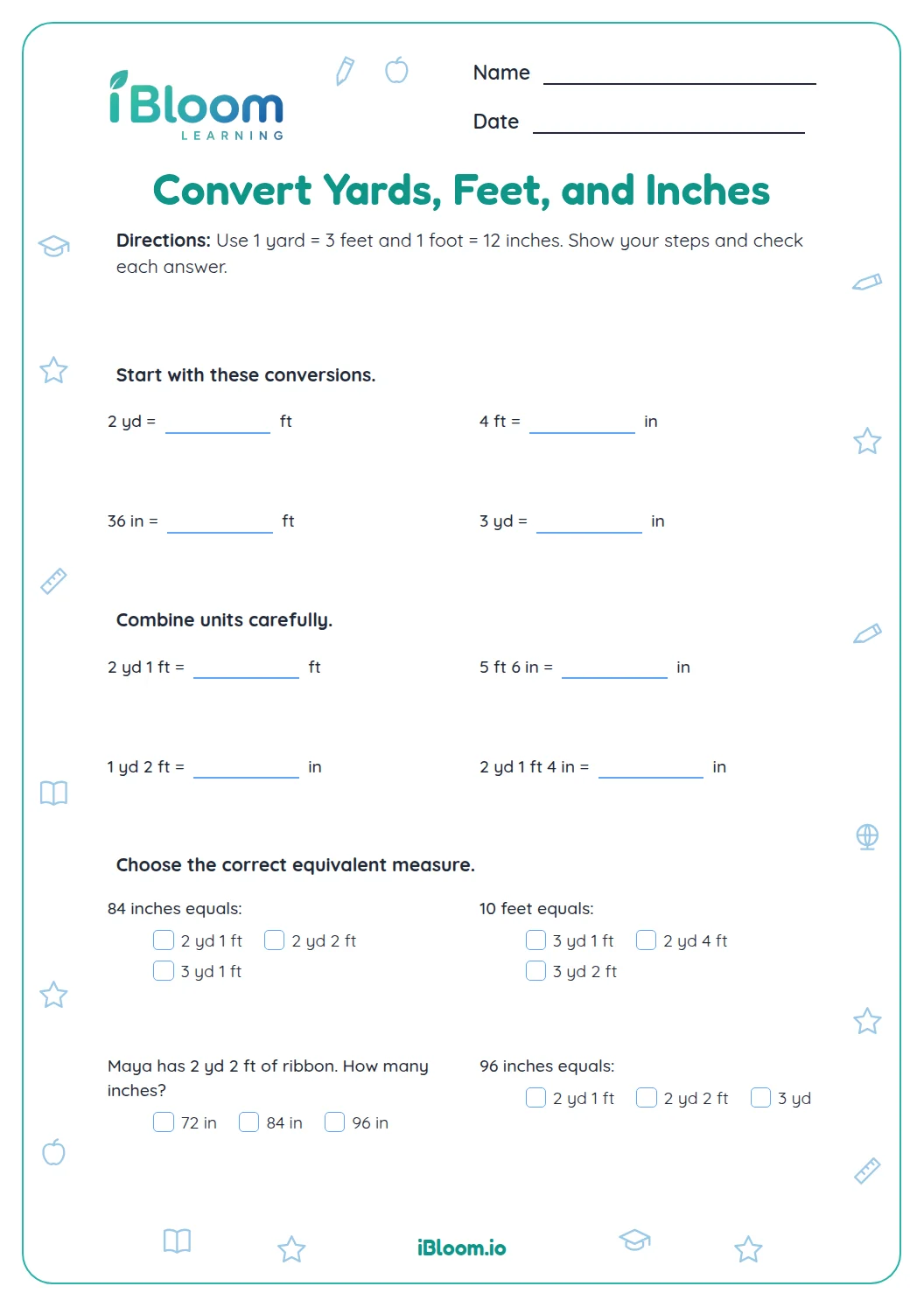
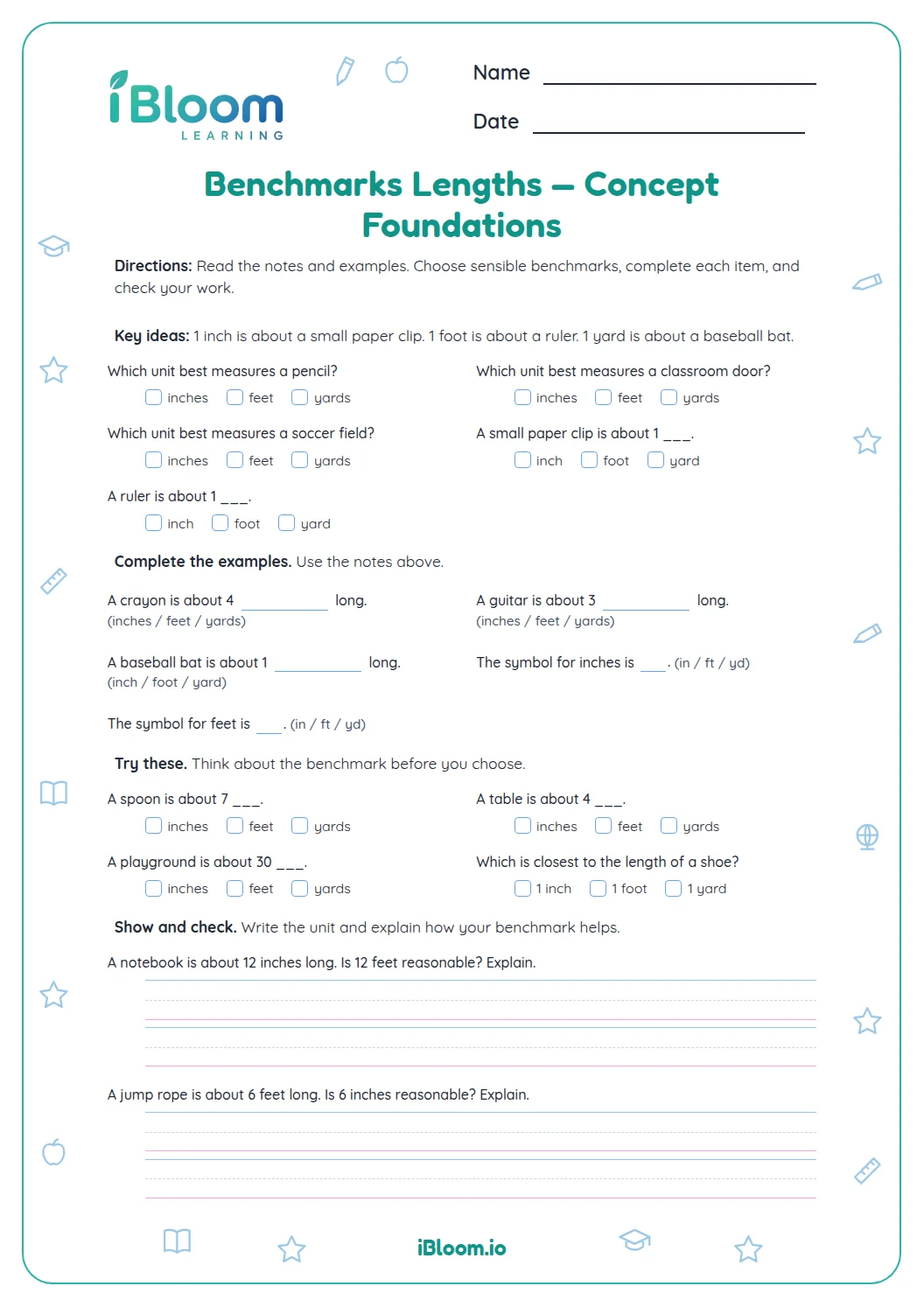
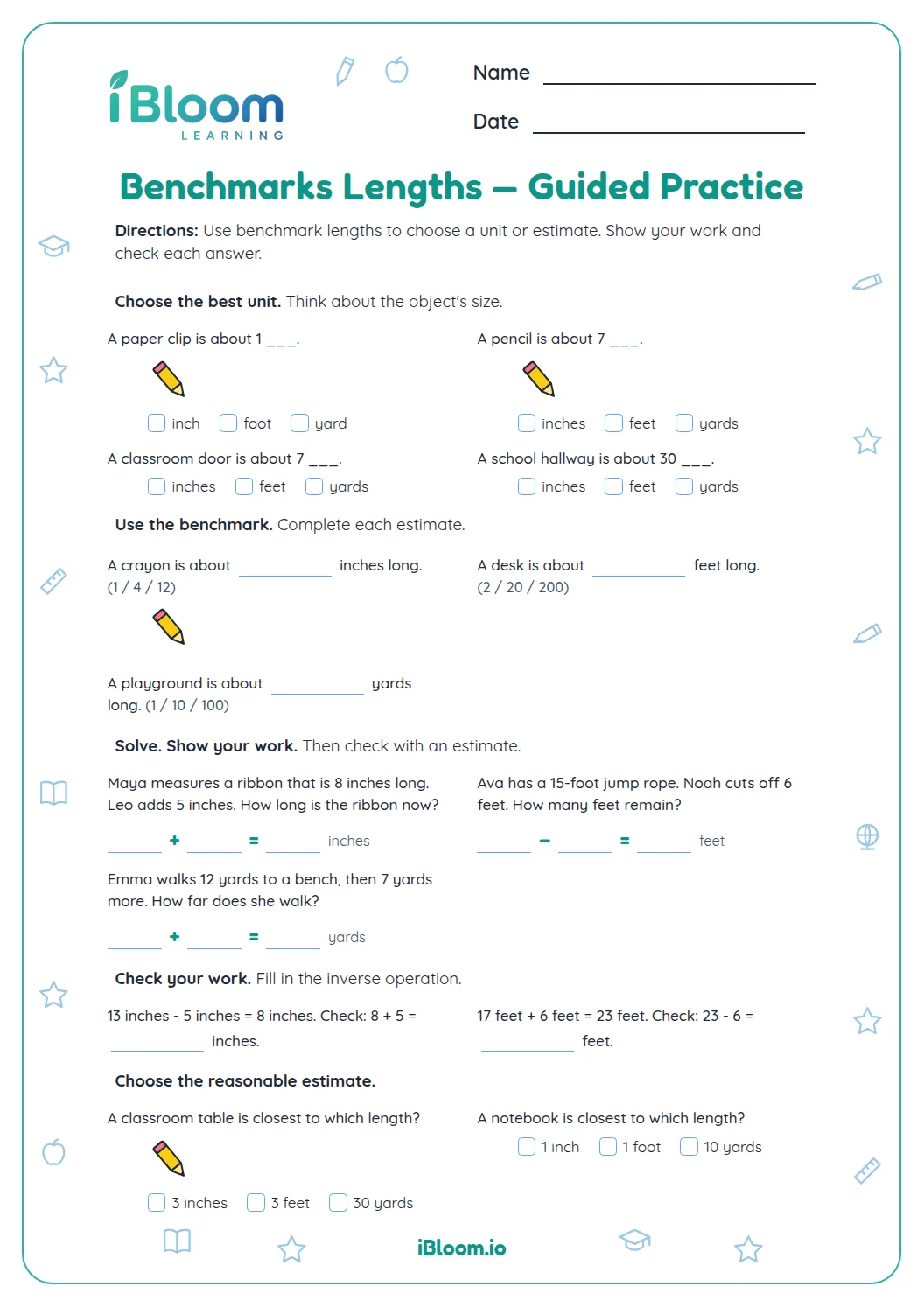
This Grade 2 printable introduces the customary length relationships named in its title: 3 feet make 1 yard, and 12 inches make 1 foot. Students choose unit facts, convert familiar lengths, and solve short comparison and measurement situations. The conversion practice aligns with CCSS 4.MD.A.1, which addresses expressing measurements in larger units as smaller units within one system.
Aligned to 4.MD.A.1
What are the two unit links?
One yard equals 3 feet. One foot equals 12 inches. Keep each relationship visible while solving.
- 12 yards → 2 groups of 3 feet → 6 feet
How do equal groups help with conversion?
Multiply the number of groups by the amount in one group, or count groups when the numbers are small. Check the unit in the question and answer.
How do the story problems use length?
Part B places the same unit relationships in ribbons, signs and toy lengths. The story names the starting unit so the conversion has one clear direction.
How to use this worksheet
- 1Recall 3 feet = 1 yard and 12 inches = 1 foot.
- 2Underline the starting unit and the unit requested.
- 3Count equal groups or multiply by the amount in one group.
- 4Write the answer with its unit.
- 5Check that the conversion direction makes sense.
Common mistakes and quick fixes
The mistake
Using 12 inches for 1 yard.
The fix
First change a yard to 3 feet; each of those feet has 12 inches.
The mistake
Dividing when changing yards to feet.
The fix
More small units fit in a larger unit, so multiply by 3.
The mistake
Leaving off feet or inches in a story answer.
The fix
Copy the requested unit into the final answer.
Common Core alignment
Express measurements in larger units as smaller units within one system.
On this sheet: Students use customary-unit relationships to express yards and feet in smaller units.
Show the official wordingHide the official wording
Know relative sizes of measurement units within one system of units including km, m, cm; kg, g; lb, oz.; l, ml; hr, min, sec. Within a single system of measurement, express measurements in a larger unit in terms of a smaller unit. Record measurement equivalents in a two-column table.
What to practice next
Make more practice
Further reading
Questions parents and teachers ask
How many feet are in a yard?
There are 3 feet in 1 yard. The worksheet uses that relationship to convert one or more yards to feet and to recognize when 3 feet make 1 yard. Invite the learner to explain the clue and point to the words that support the answer.
How many inches are in a foot?
There are 12 inches in 1 foot. Children use that fact to change feet into inches, such as finding the inches in a 4-foot ribbon. Invite the learner to explain the clue and point to the words that support the answer.
What is in Part A?
Part A reviews the basic unit links and begins with direct questions. The later questions ask children to use those links in conversions and familiar measurement situations. Invite the learner to explain the clue and point to the words that support the answer.
How can a child show the conversion steps?
Write the equal-group relationship first, then count the groups. For 2 yards, use 2 groups of 3 feet to find 6 feet. Invite the learner to explain the clue and point to the words that support the answer. Invite the learner to explain the clue and point to the words that support the answer.
What should I do if this unit conversion is new?
Use a ruler, yardstick or tape and point out the units while counting. Say the relationship aloud, then let the child use it in a single problem before trying the next one. Invite the learner to explain the clue and point to the words that support the answer.