




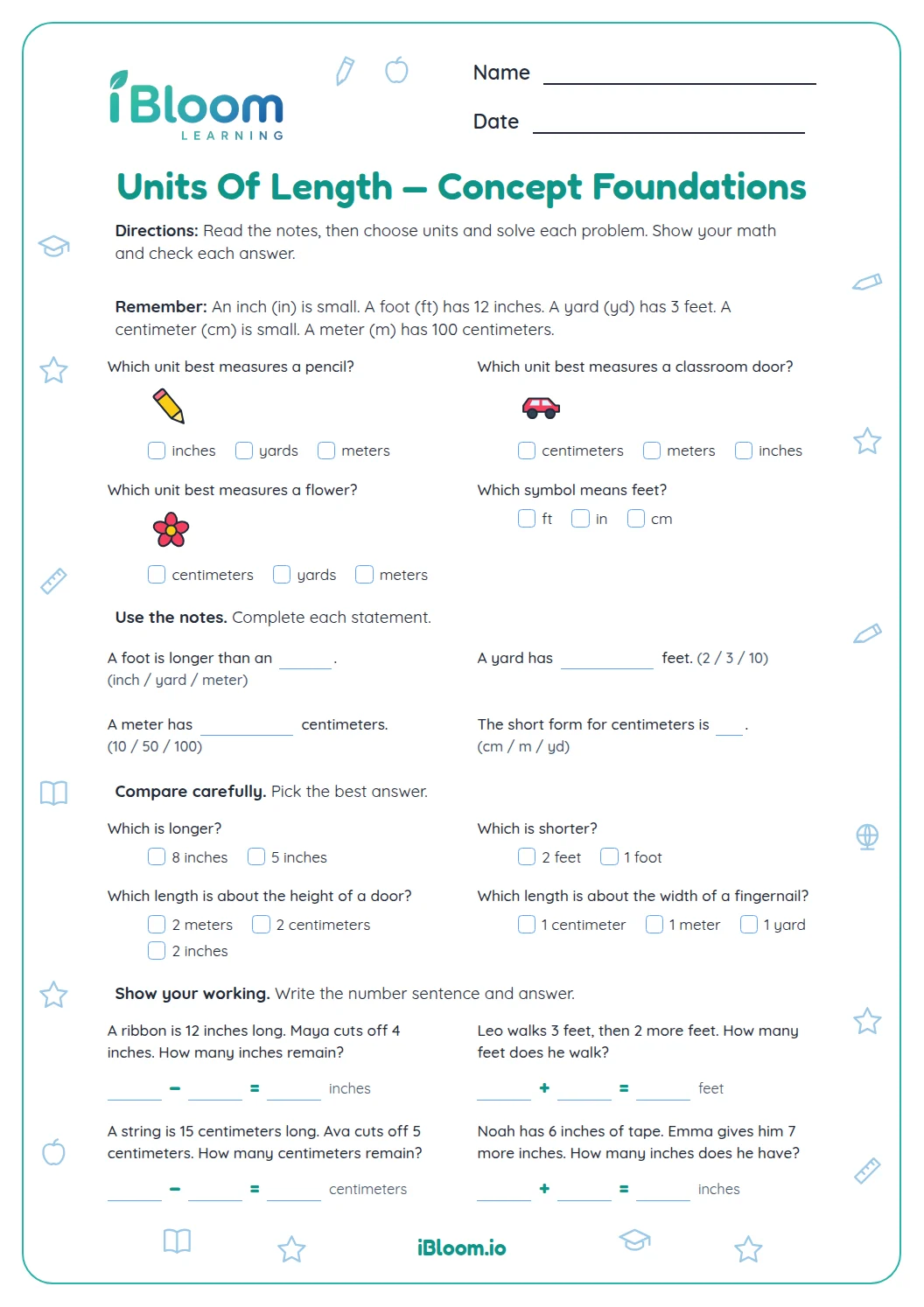
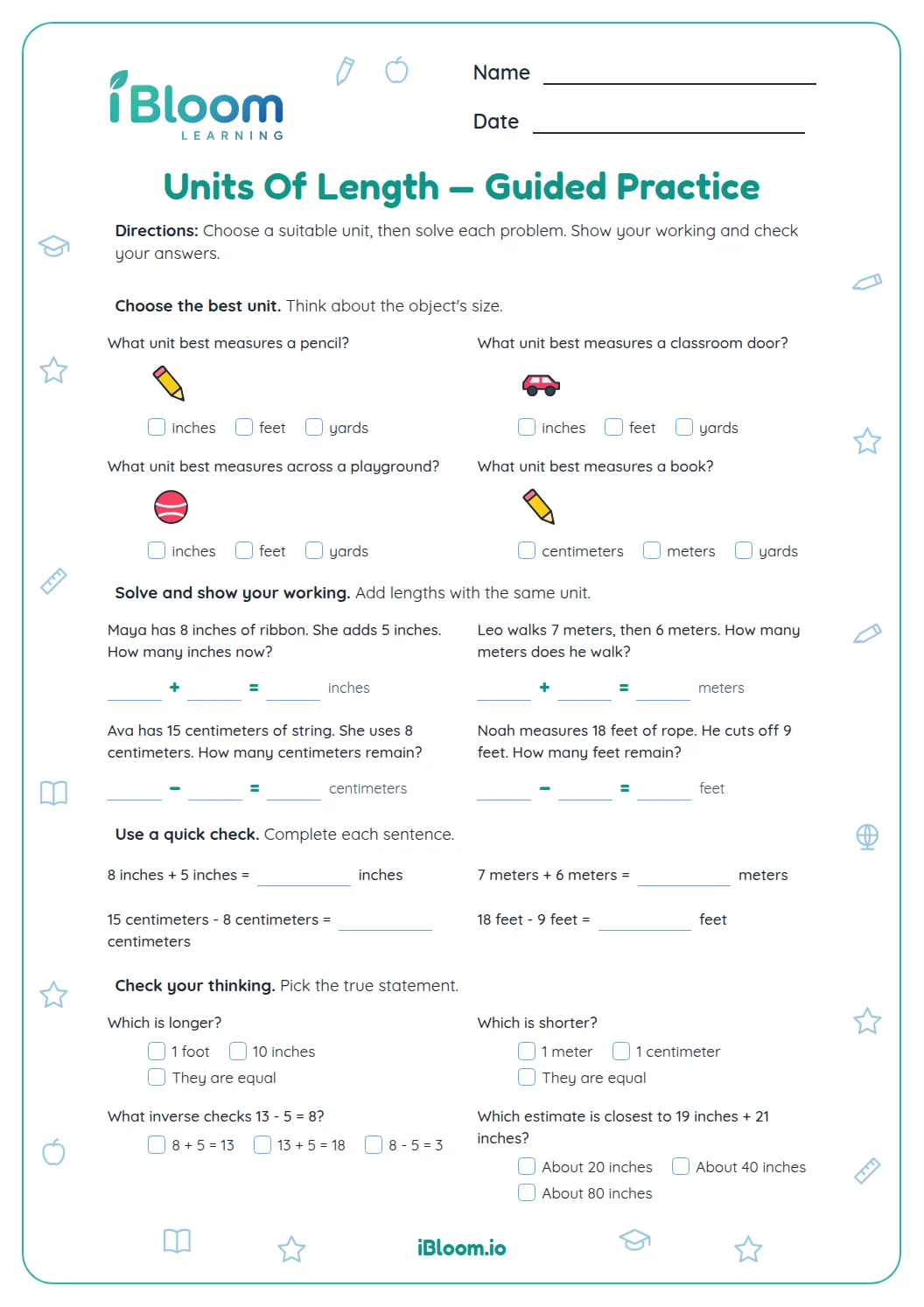

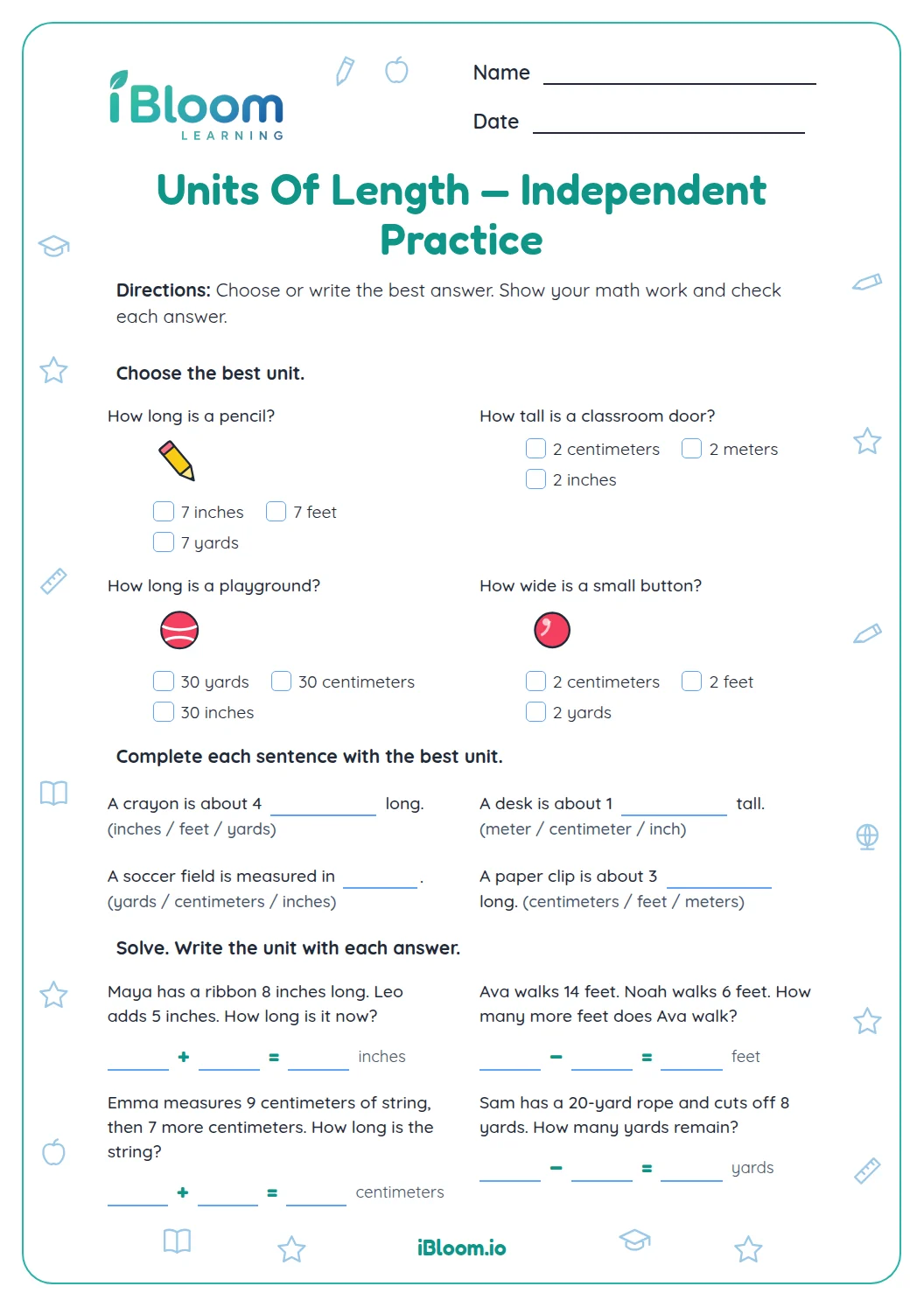
About this worksheet
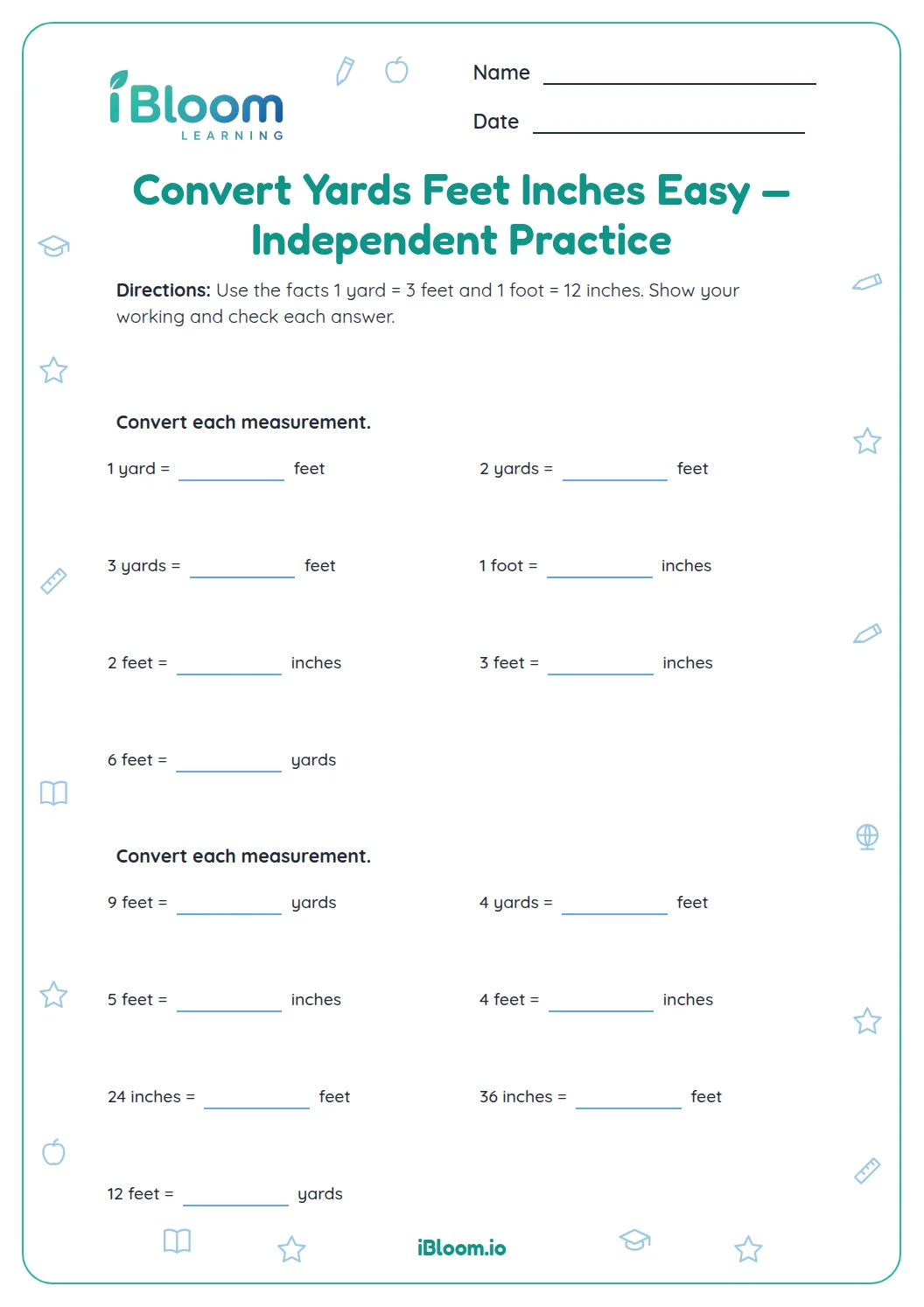
This Grade 2 challenge introduces the named customary length relationships with small equal groups. Students use 3 feet per yard and 12 inches per foot to find totals in conversions and short situations. The answer key lists each result. The page cites CCSS 4.MD.A.1 for the measurement conversion skill named in the title.
Aligned to 4.MD.A.1
Which unit facts help with conversions?
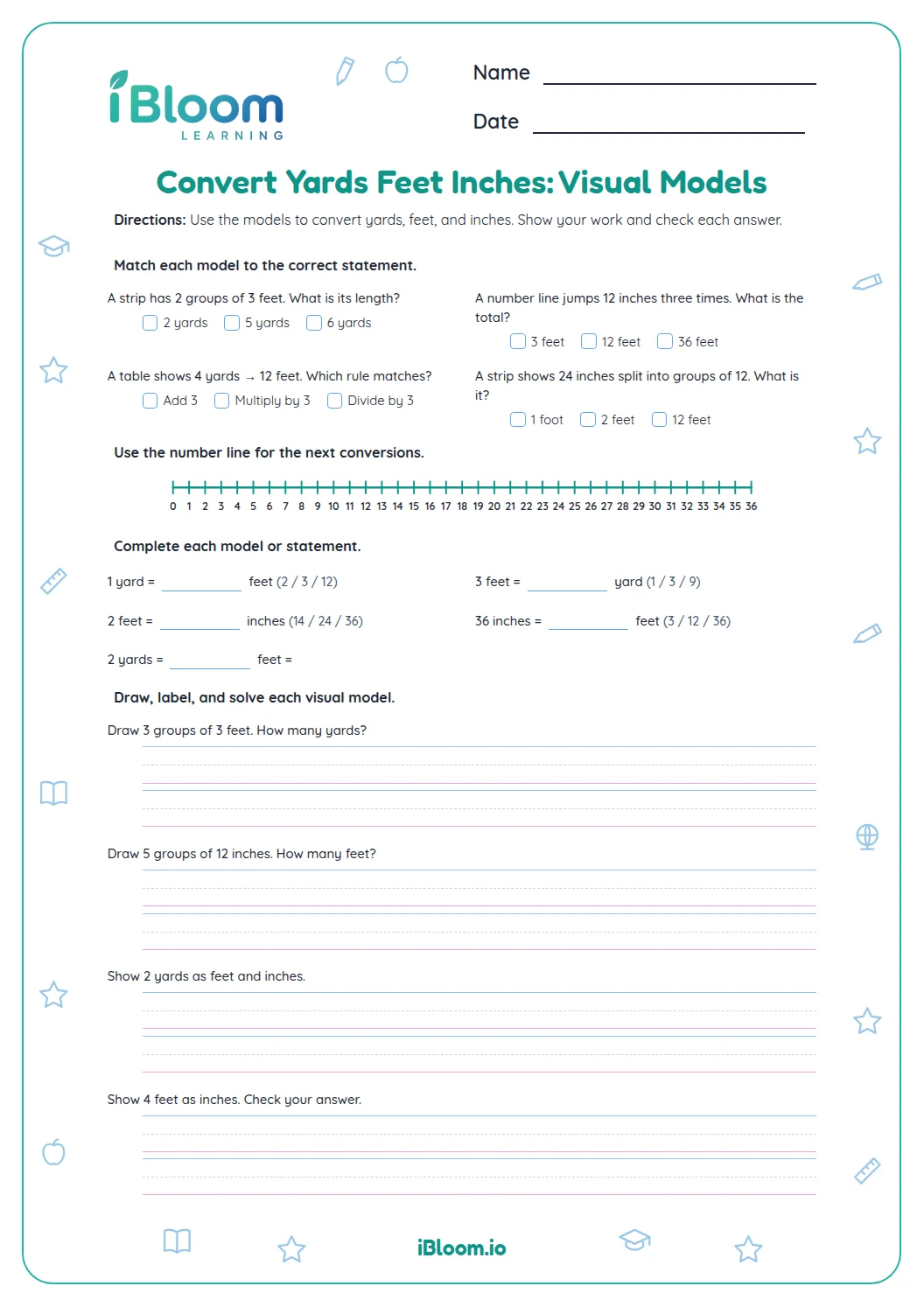
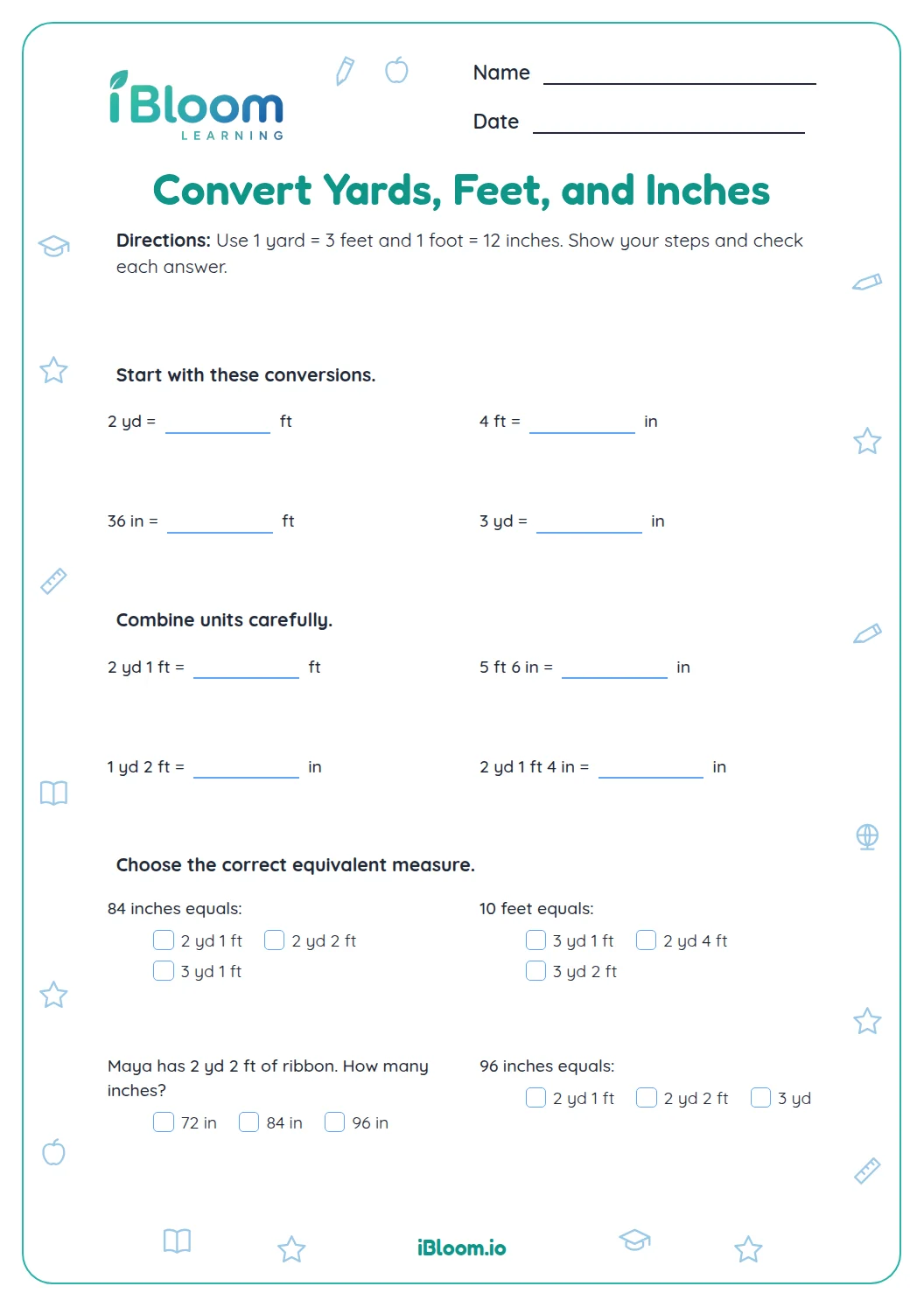
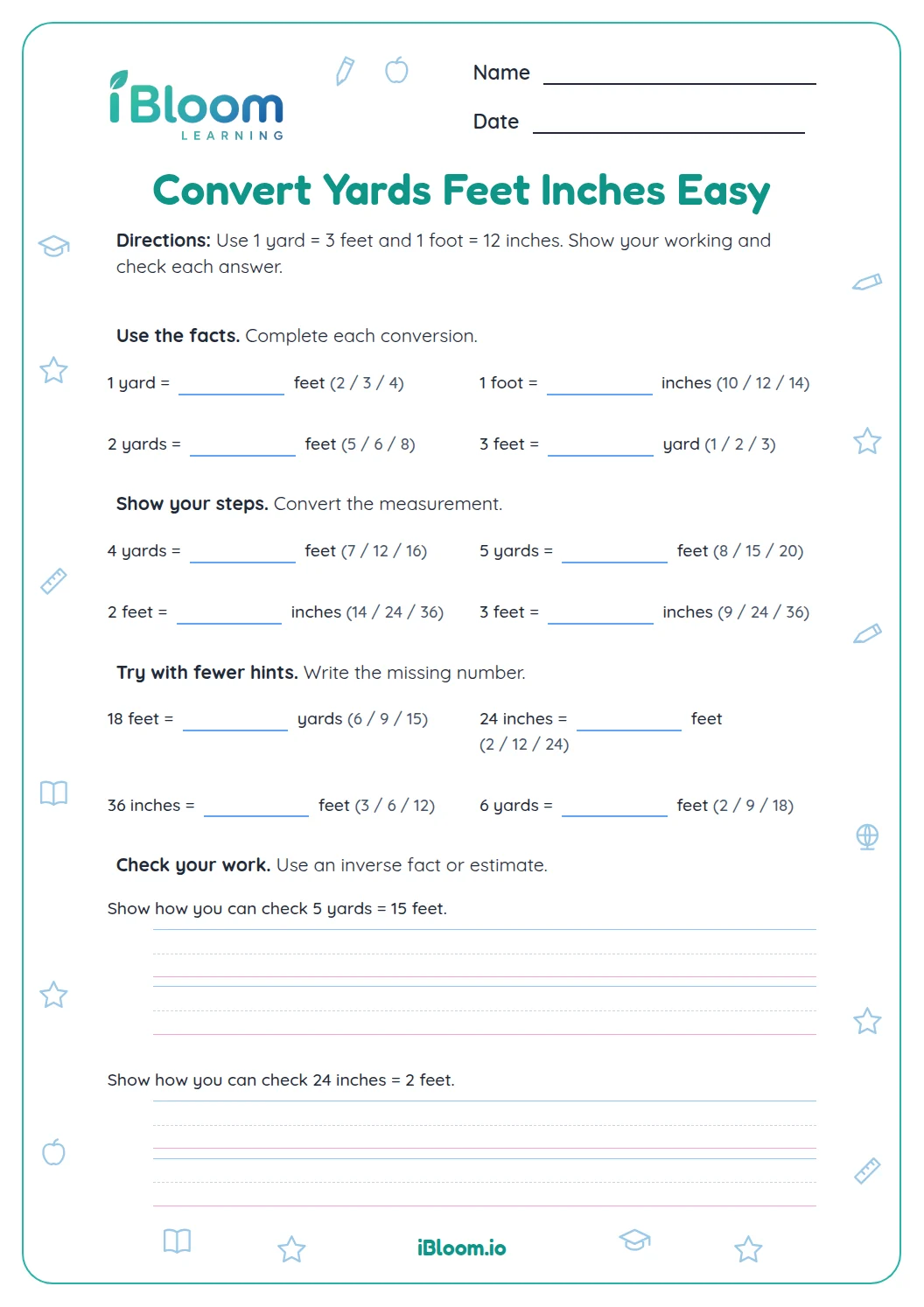
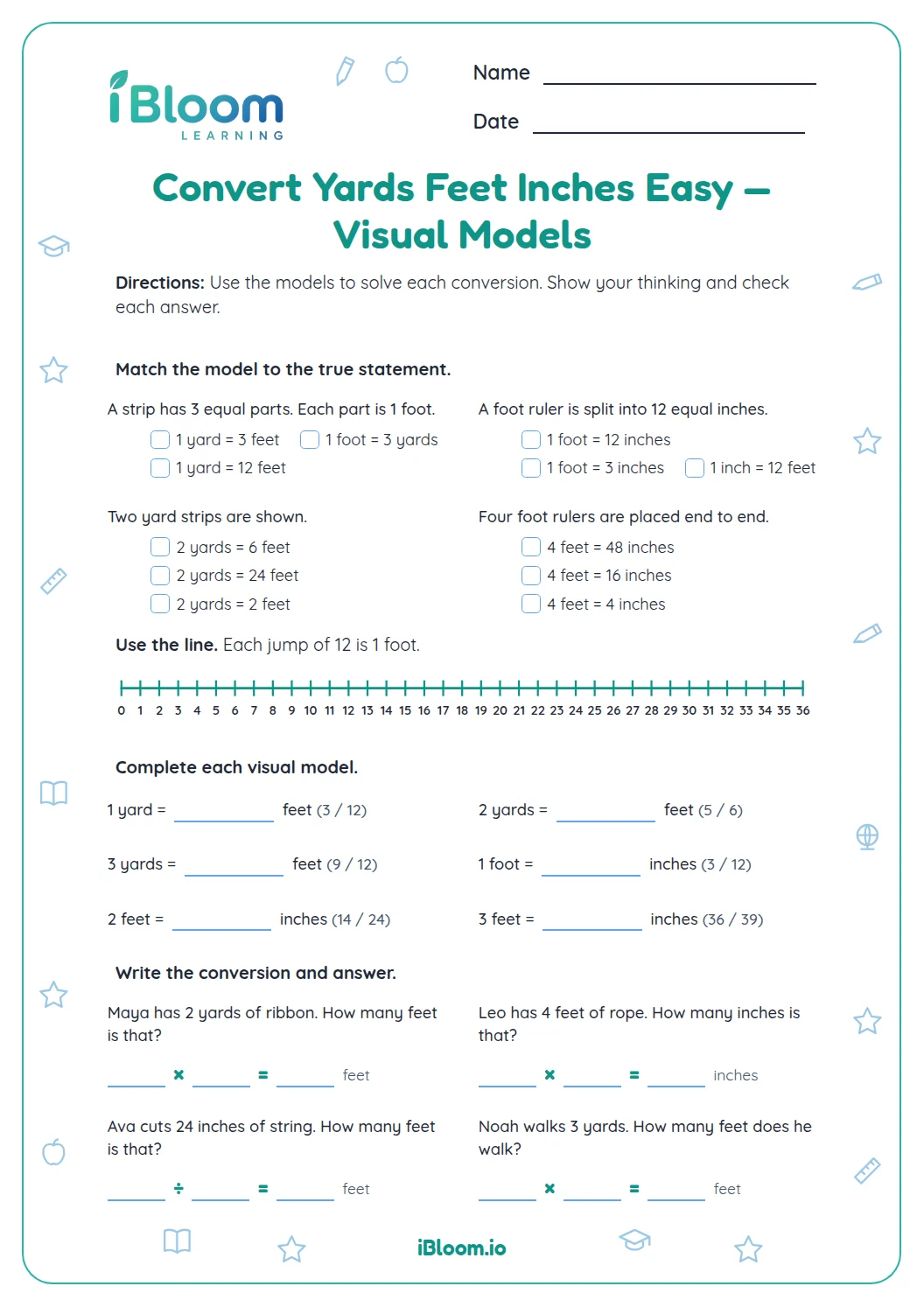
Seventeen short items use the two unit facts named in the directions: 3 feet make 1 yard, and 12 inches make 1 foot. Students find totals by counting equal groups, then apply the same facts to simple length situations.
- Part A: use equal groups to convert yards to feet
- Part B: use equal groups to convert feet to inches
How can equal groups show a conversion?
One yard is a group of 3 feet. Two yards make two groups of 3 feet, so 2 yards equal 6 feet. For inches, count groups of 12.
- 12 yards = 2 groups of 3 feet
- 22 yards = 6 feet
How to use this worksheet
- 1Choose the unit fact that matches the question.
- 2For yards to feet, count groups of 3.
- 3For feet to inches, count groups of 12.
- 4Use repeated addition or a multiplication fact.
- 5Label the answer with the requested unit.
Common mistakes and quick fixes
The mistake
Using 12 feet in a yard.
The fix
Remember 1 yard = 3 feet; 12 is the number of inches in one foot.
The mistake
Converting yards straight to inches using only 3.
The fix
Each yard has 3 feet and each foot has 12 inches, so multiply by 36.
The mistake
Writing 50 inches as 5 feet.
The fix
Five feet is 60 inches; 50 inches is 4 feet and 2 inches.
Common Core alignment
This page uses equal groups to express equivalent customary length measures.
Express larger length measures in smaller units and record equivalent measures.
On this sheet: Students use the unit relationships 1 yard = 3 feet and 1 foot = 12 inches to find equivalent lengths.
Show the official wordingHide the official wording
Know relative sizes of measurement units within one system of units including km, m, cm; kg, g; lb, oz; l, ml; hr, min, sec. Within a single system of measurement, express measurements in a larger unit in terms of a smaller unit. Record measurement equivalents in a two-column table.
What to practice next
Make more practice
Further reading
Questions parents and teachers ask
How many feet are in a yard?
There are 3 feet in 1 yard. To change yards to feet, multiply the number of yards by 3. For example, 4 yards is 4 × 3, or 12 feet. Students can keep the three-to-one relationship in mind, then multiply for each yard in the measurement.
How many inches are in a foot?
There are 12 inches in 1 foot. Multiply feet by 12 to find inches; divide inches by 12 to find feet. If the inches do not divide evenly, write the quotient in feet and the remainder in inches. A small table or repeated addition can help students see the groups of twelve before multiplying.
How many inches are in a yard?
A yard has 3 feet, and each foot has 12 inches. So 1 yard equals 3 × 12, or 36 inches. You can convert yards to inches by multiplying the number of yards by 36. If there is a remainder, keep it with the smaller unit rather than dropping it.
What is a mixed-unit length?
A mixed-unit length uses a larger unit and a smaller unit together, such as 4 feet 2 inches. To write 50 inches that way, group 48 inches into 4 feet, leaving 2 inches. Use the conversion facts in reverse to check whether a mixed-unit answer has the same total length.
What does the challenge include?
It includes 17 questions in two parts: direct equal-group conversions and short length situations. A separate answer key gives each result. The questions use the two facts 3 feet = 1 yard and 12 inches = 1 foot, with small whole-number groups to support repeated addition.