




About this worksheet
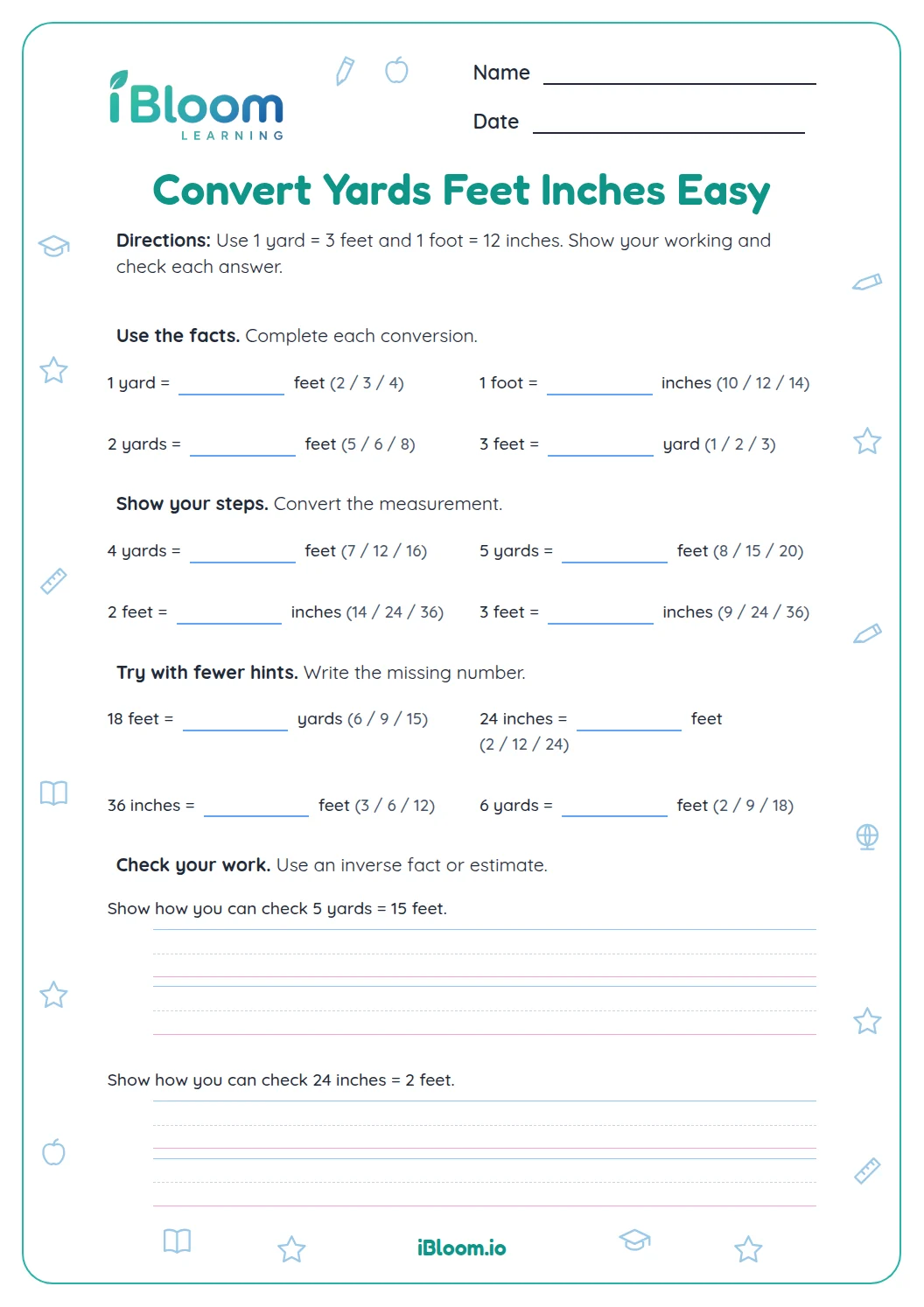
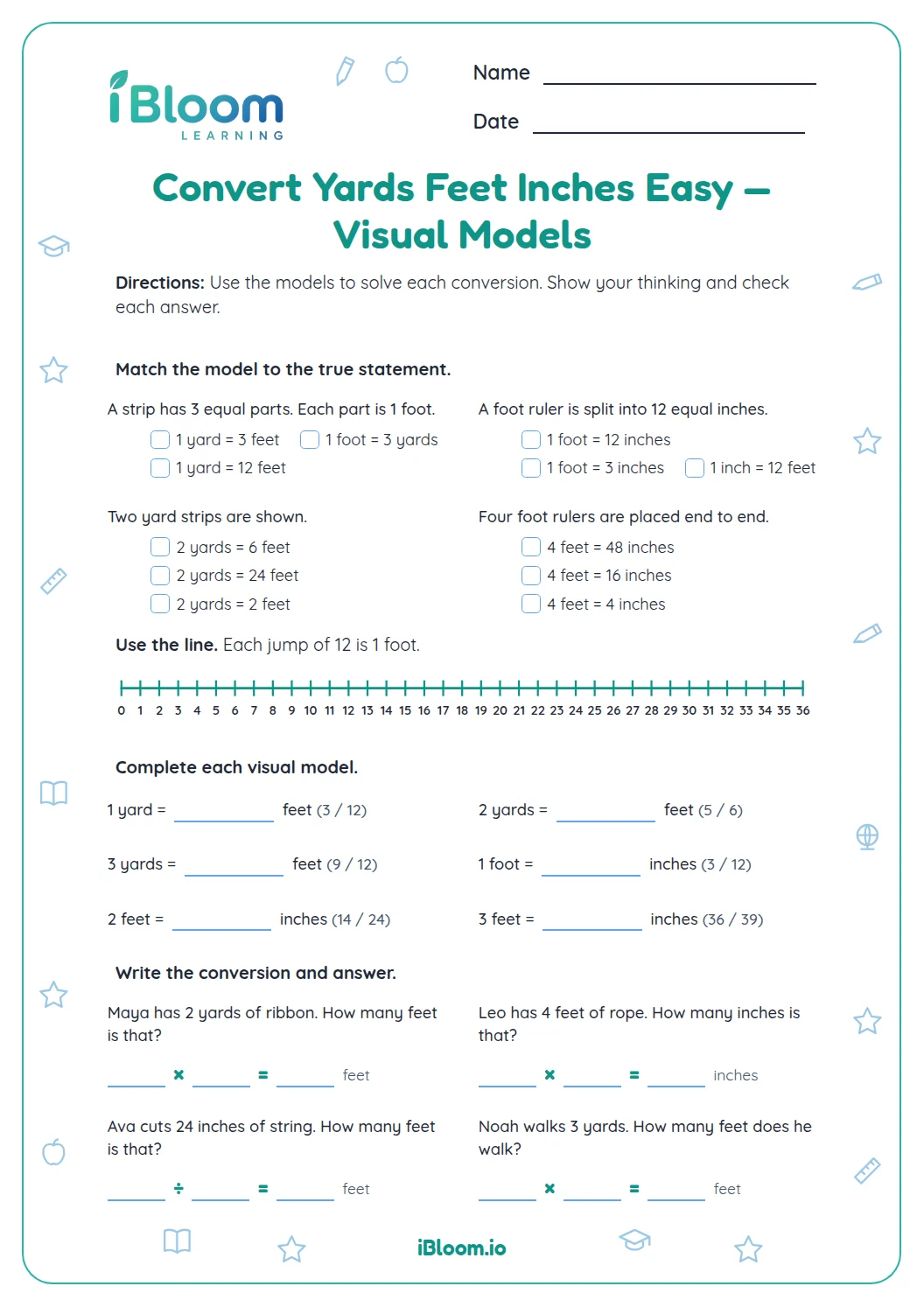
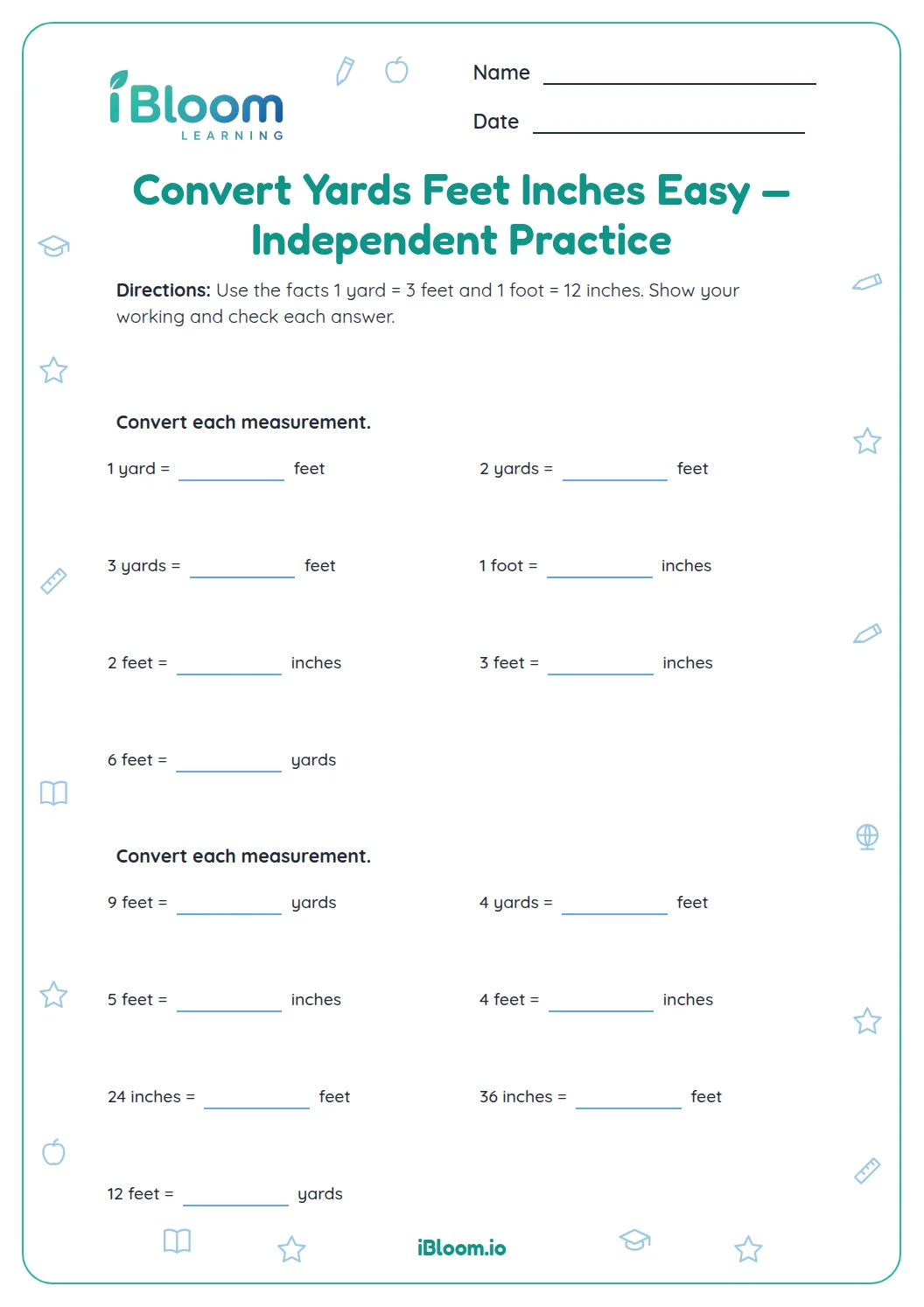
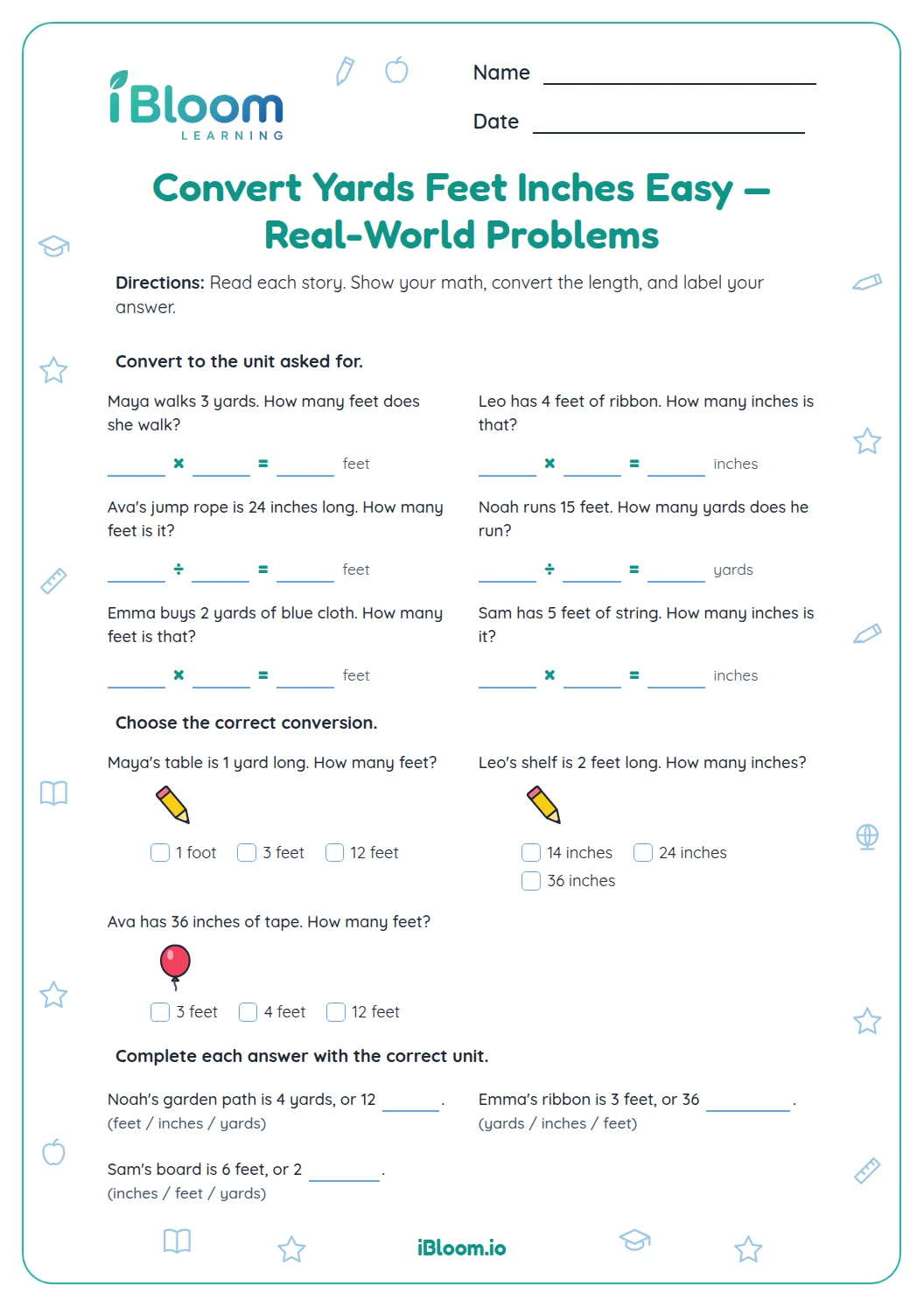
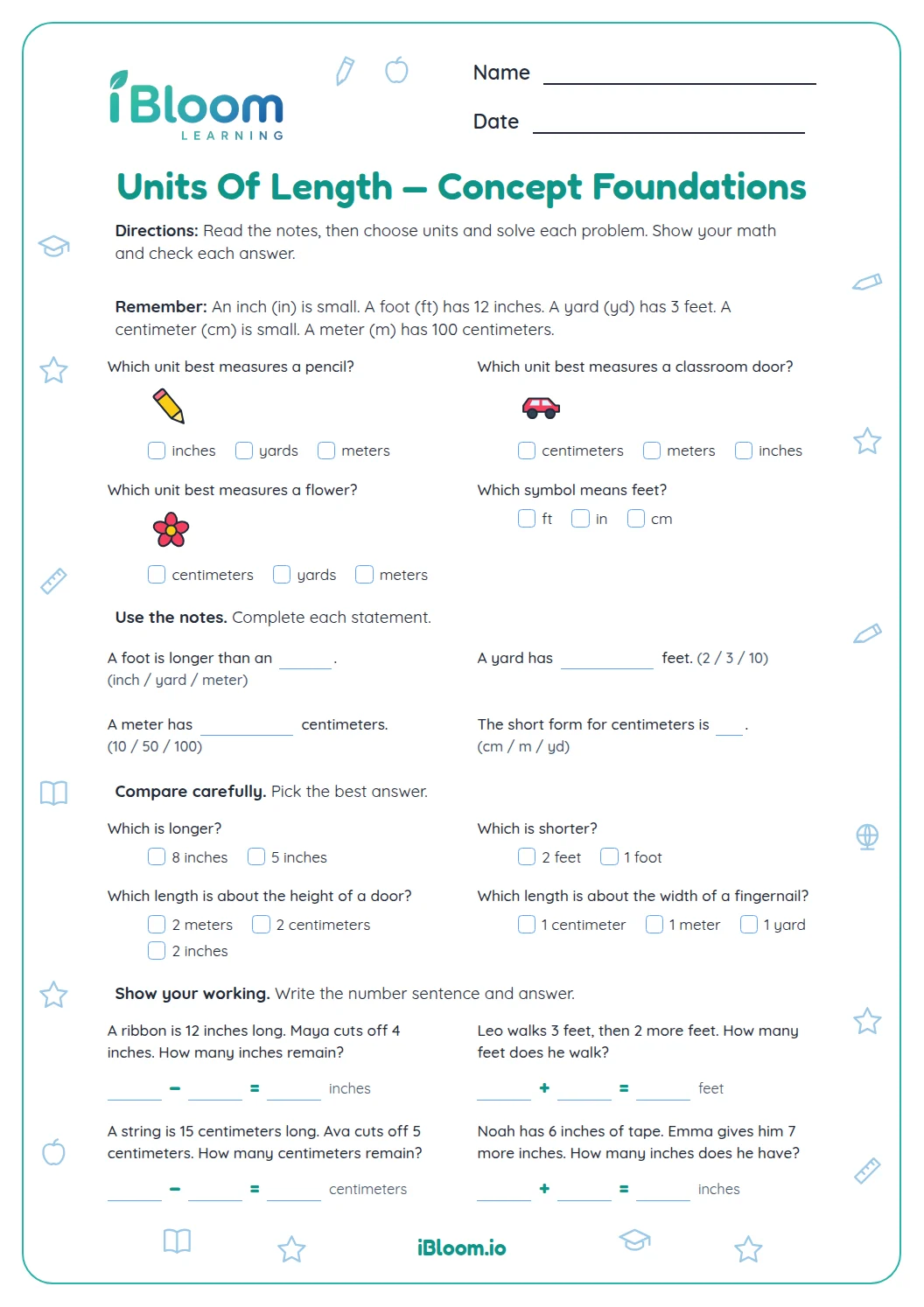
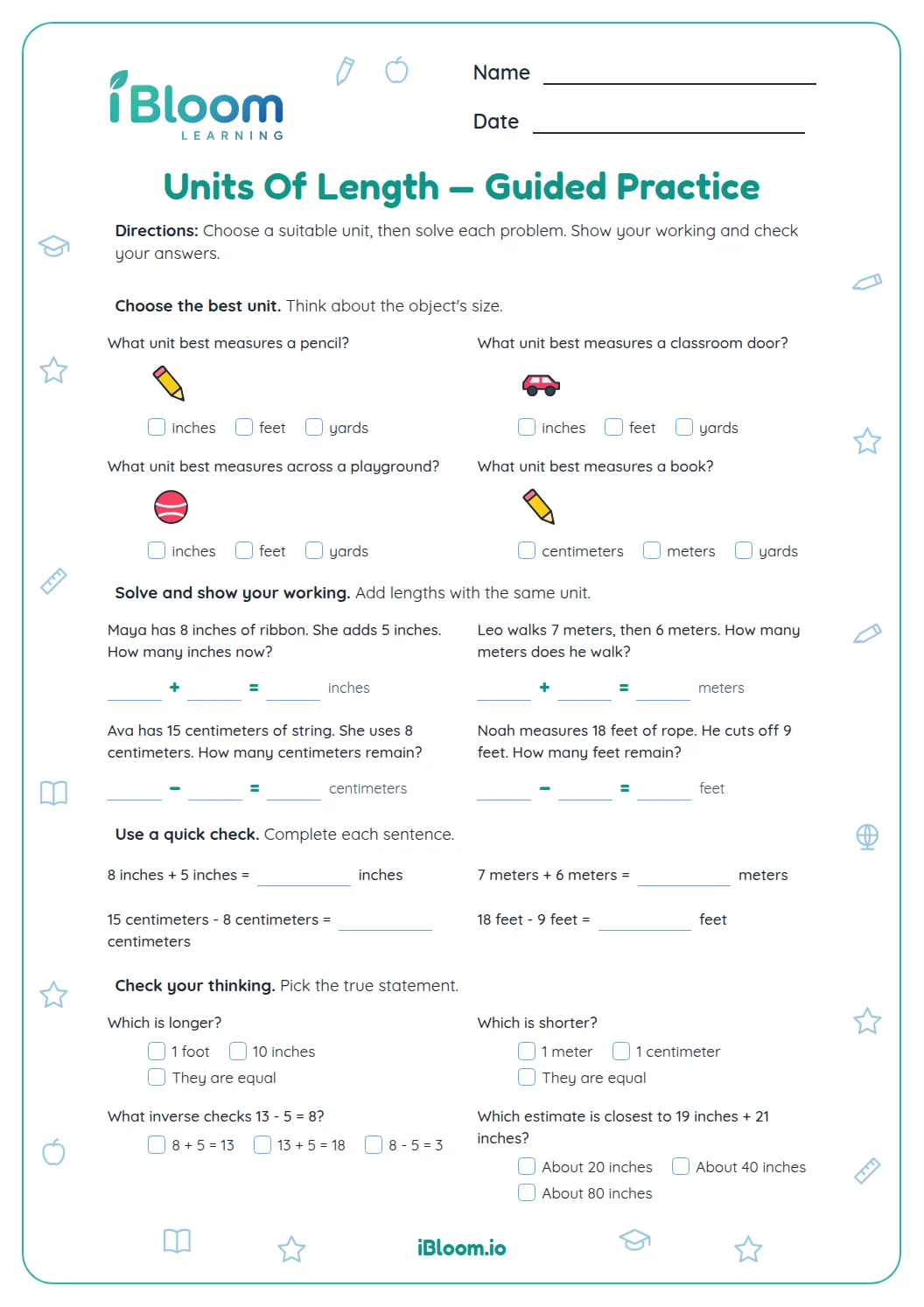
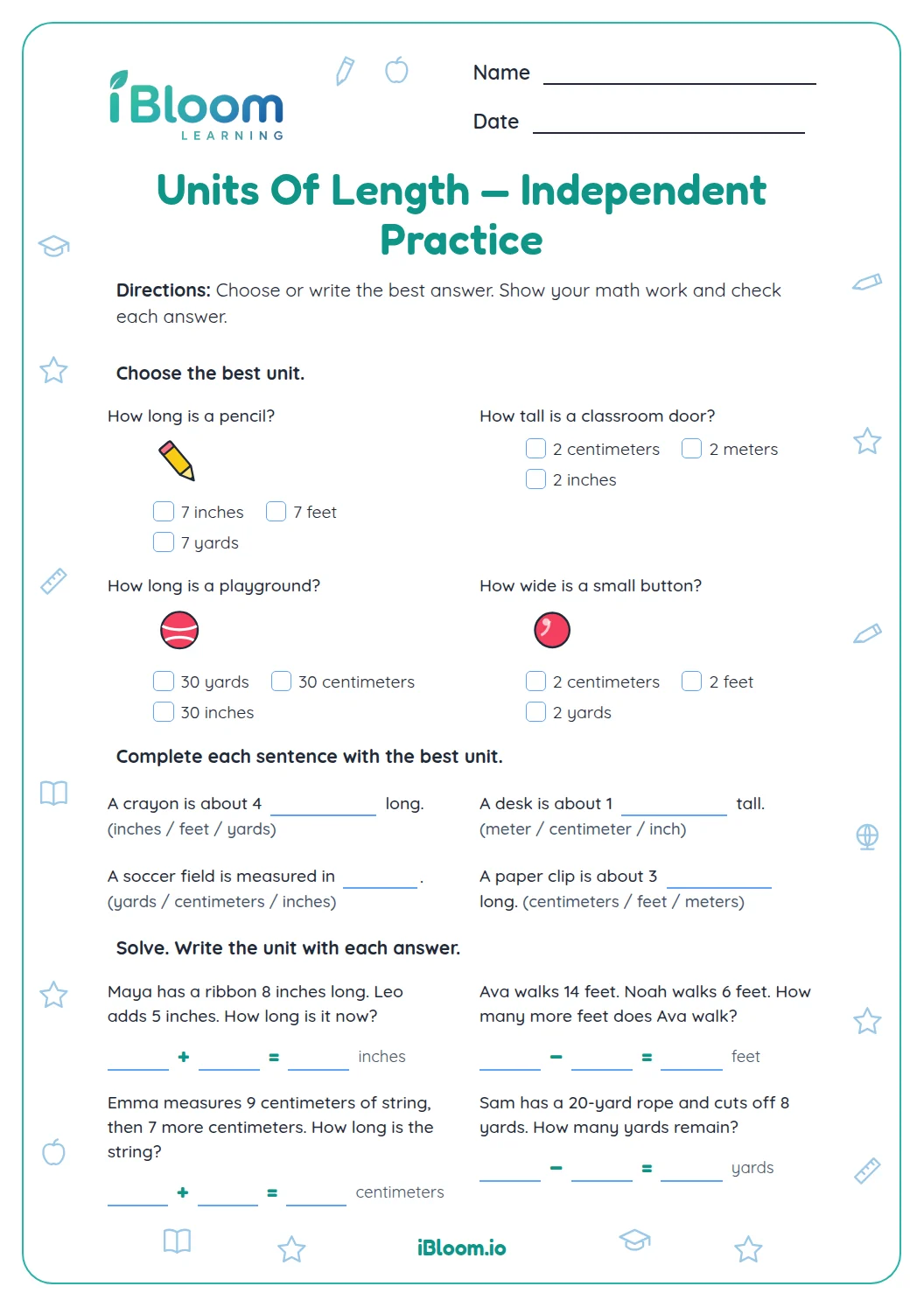
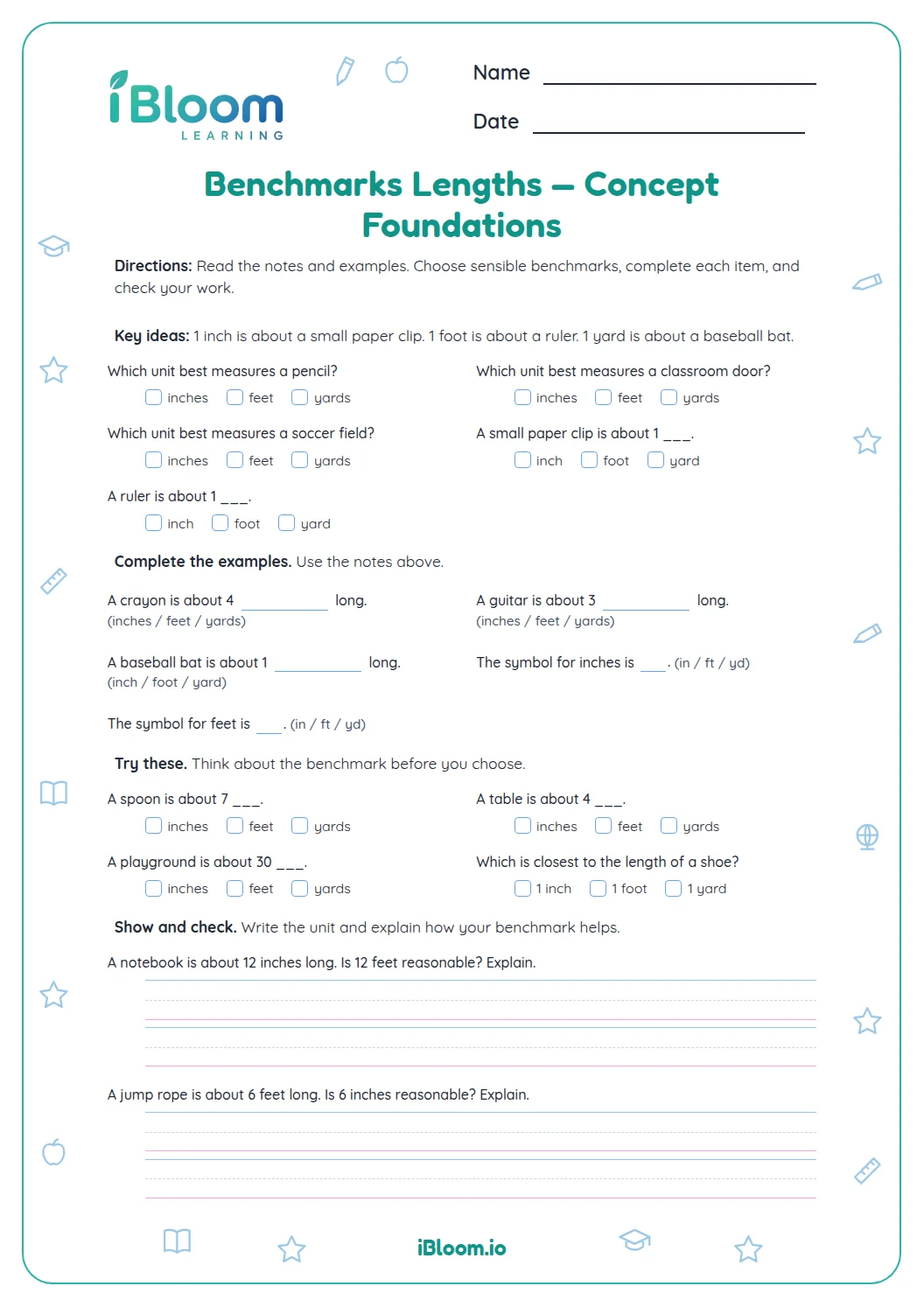
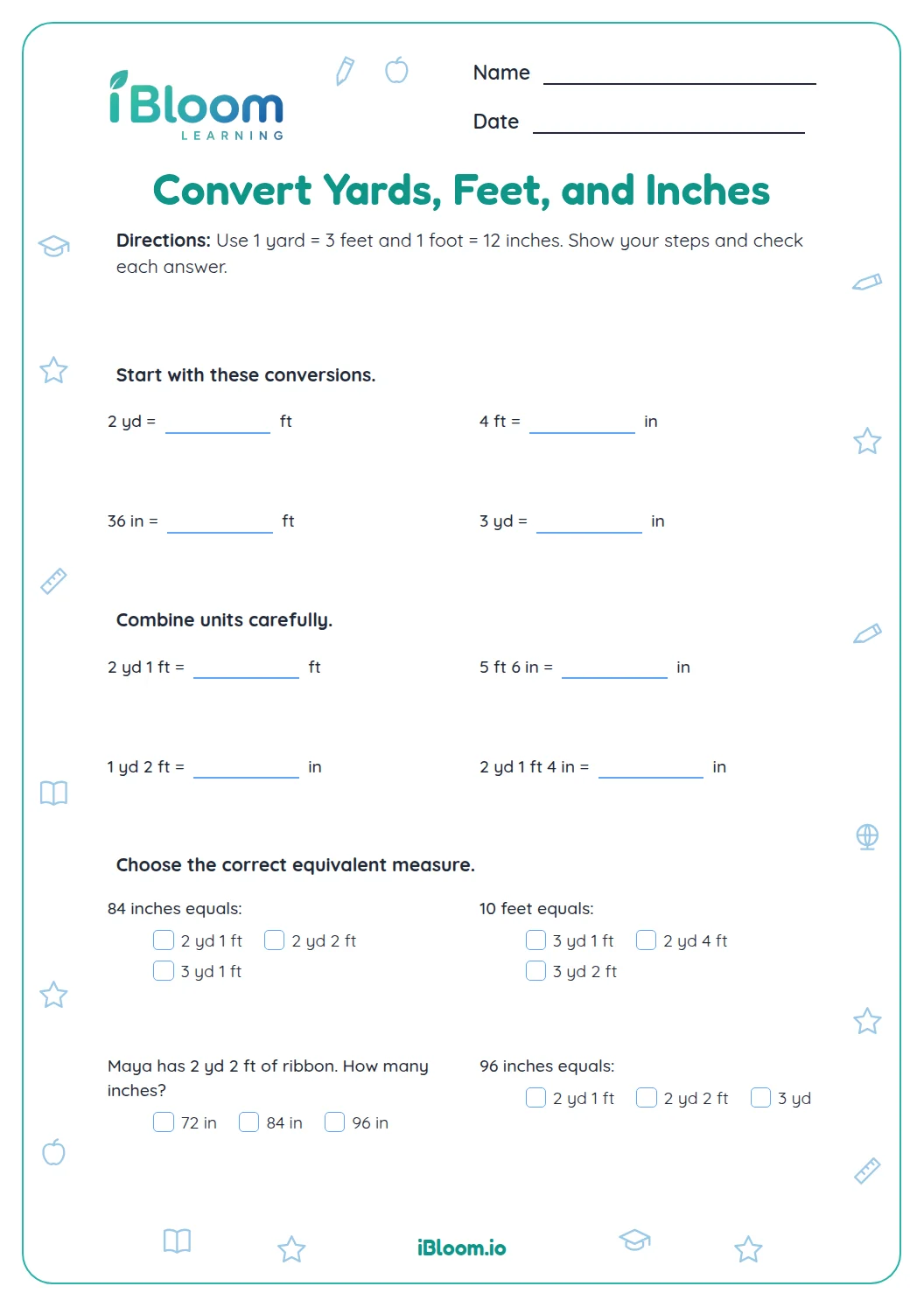
This free printable Grade 2 worksheet introduces yards, feet and inches as three units for the same length. Children fill in the key facts (1 yard = 3 feet, 1 foot = 12 inches), change yards to feet and feet to inches, decide which length is longer, and solve two word problems about ribbon and rope. It practices Common Core 2.MD.A.2 and 4.MD.A.1 and suits children who can add equal groups, such as 3 + 3 + 3. There are 15 questions on two pages, with a separate answer key.
Aligned to 2.MD.A.2 and 4.MD.A.1
Why does the same length have different numbers?
A yard is a long unit and a foot is shorter, so it takes more feet than yards to measure the same rope. A rope that is 2 yards long is also 6 feet long. The rope did not change; only the size of the unit did.
Measuring one length with two units and comparing the numbers is the idea behind 2.MD.A.2. Question 13 asks it directly: when a rope is measured in yards and in feet, which number is bigger?
- 12 yards = ___ feet
- 21 yard = 3 feet
- 32 yards = 3 + 3
- 42 yards = 6 feet
How do you change feet to inches?
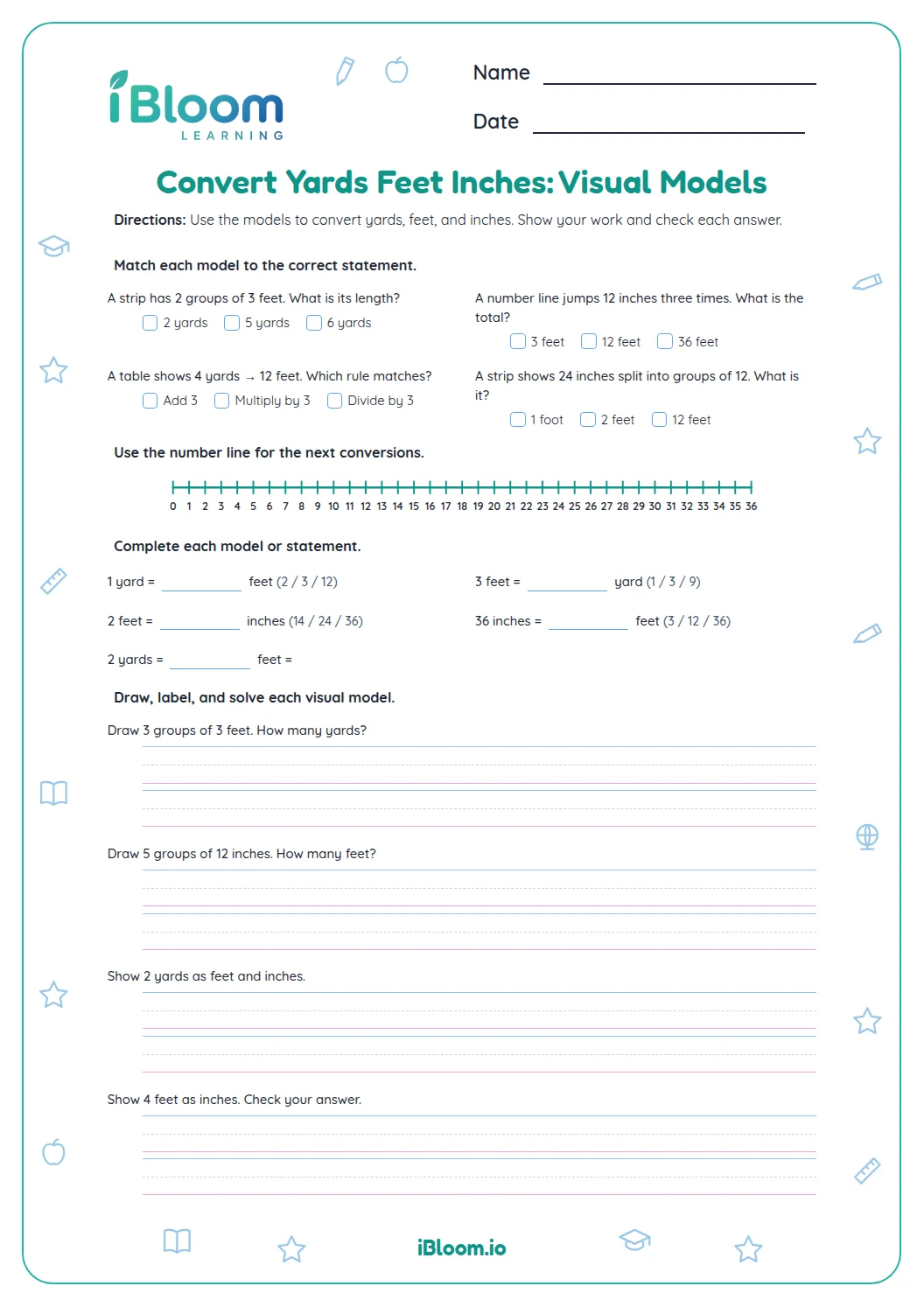
One foot is 12 inches, so every foot adds another 12. Two feet is 12 + 12 = 24 inches, and 3 feet is 12 + 12 + 12 = 36 inches. That 36 is also the number of inches in one yard, which links all three units: 1 yard = 3 feet = 36 inches.
Children can keep a running total by counting 12, 24, 36, 48, 60, or use a 12-inch ruler and place it down once for each foot.
How can children see the units for themselves?
Lay three 12-inch rulers end to end beside a yardstick. They line up exactly, which shows 3 feet = 1 yard better than any rule can. Then count the inch marks on the yardstick together to reach 36.
A tape measure works too. Let your child pick a ribbon or a piece of string, measure it in feet, then in yards, and say which number came out bigger.
What is on this worksheet?
Fifteen questions in four parts, from the key facts to short word problems.
- Part A, Key facts: four missing numbers, including 3 feet = ___ yard
- Part B, Change the unit: three yards-to-feet and three feet-to-inches conversions
- Part C, Which is true: three multiple-choice questions comparing lengths
- Part D, Word problems: ribbon in yards and rope in feet, with space to write a number sentence
- Answer key on separate pages
How to use this worksheet at home or in class
- 1Find three 12-inch rulers and a yardstick. Lay the rulers along the yardstick and count them together.
- 2Do Part A as a conversation. Ask your child to say each fact in a full sentence: “One yard is three feet.”
- 3In Part B, have your child write the count by 3s under each yards-to-feet question (3, 6, 9...) and circle the last number.
- 4For feet to inches, add 12 for each foot. Check any total by laying rulers down one at a time.
- 5In Part C, ask “Which is bigger, a foot or a yard?” before reading the choices.
- 6For the word problems, write the number sentence first, then solve it and write the unit. Check with the answer key.
Common mistakes and quick fixes
The mistake
Writing only the key fact number: 2 yards = 3 feet.
The fix
There are 3 feet in every yard. Draw two groups of 3 or write 3 + 3 to get 6 feet.
The mistake
Thinking 12 inches is longer than 3 feet because 12 is a bigger number than 3.
The fix
Compare in the same unit. 3 feet is 36 inches, so 3 feet is longer. A bigger number of a smaller unit is not always longer.
The mistake
Writing 1 yard = 12 inches, mixing up the foot fact with the yard.
The fix
12 inches is 1 foot. A yard has 3 feet, so it has three 12s: 36 inches.
Common Core alignment
Most US states use the Common Core standards or a close state version. This sheet practices the two standards below.
Measure one length with two units and say how the numbers compare.
On this sheet: Yards and feet, and feet and inches, give two numbers for one length, and question 13 asks which is bigger.
Show the official wordingHide the official wording
Measure the length of an object twice, using length units of different lengths for the two measurements; describe how the two measurements relate to the size of the unit chosen.
Express a larger unit in smaller units, like 4 ft = 48 in.
On this sheet: Questions 5 to 10, 14 and 15 change yards to feet and feet to inches, such as 4 feet = 48 inches.
Show the official wordingHide the official wording
Know relative sizes of measurement units within one system of units including km, m, cm; kg, g; lb, oz.; l, ml; hr, min, sec. Within a single system of measurement, express measurements in a larger unit in terms of a smaller unit. Record measurement equivalents in a two-column table. For example, know that 1 ft is 12 times as long as 1 in. Express the length of a 4 ft snake as 48 in. Generate a conversion table for feet and inches listing the number pairs (1, 12), (2, 24), (3, 36), ...
What to practice next
Make more practice
Further reading
Questions parents and teachers ask
What does “convert” mean on this worksheet?
Convert means to write the same length with a different unit. A ribbon that is 2 yards long is also 6 feet long. The ribbon stays the same; only the unit changes. On this sheet children change yards to feet and feet to inches by using the key facts in Part A.
How many inches are in a yard?
There are 36 inches in a yard. One yard is 3 feet, and each foot is 12 inches, so 12 + 12 + 12 = 36. Question 3 on the worksheet asks for this fact, and question 4 turns it around: 3 feet equals 1 yard.
Why is the number of feet bigger than the number of yards?
A foot is a shorter unit than a yard, so you need more of them to cover the same length. Three feet fit in one yard. That is why 2 yards becomes 6 feet. Question 13 asks children to say which number is bigger when one rope is measured both ways.
What if my child cannot multiply yet?
That is fine. Every question can be solved with repeated addition. For 4 yards, write 3 + 3 + 3 + 3 and add to get 12 feet. For 3 feet, write 12 + 12 + 12 to get 36 inches. A 12-inch ruler placed down once for each foot gives the same answer.
What is the answer to Maya’s ribbon problem?
Maya has 9 feet of ribbon. She has 3 yards, and each yard is 3 feet, so 3 + 3 + 3 = 9 feet. The number sentence is 3 × 3 = 9, or three groups of three. The second problem, Leo’s 4 feet of rope, comes to 48 inches.
Is there an answer key for this worksheet?
Yes. A separate answer key shows every missing number, the correct bubbles in Part C and both word problem answers with their units. Print the worksheet by itself and keep the key for checking, or download the worksheet and key together as a free PDF from this page.