


About this worksheet
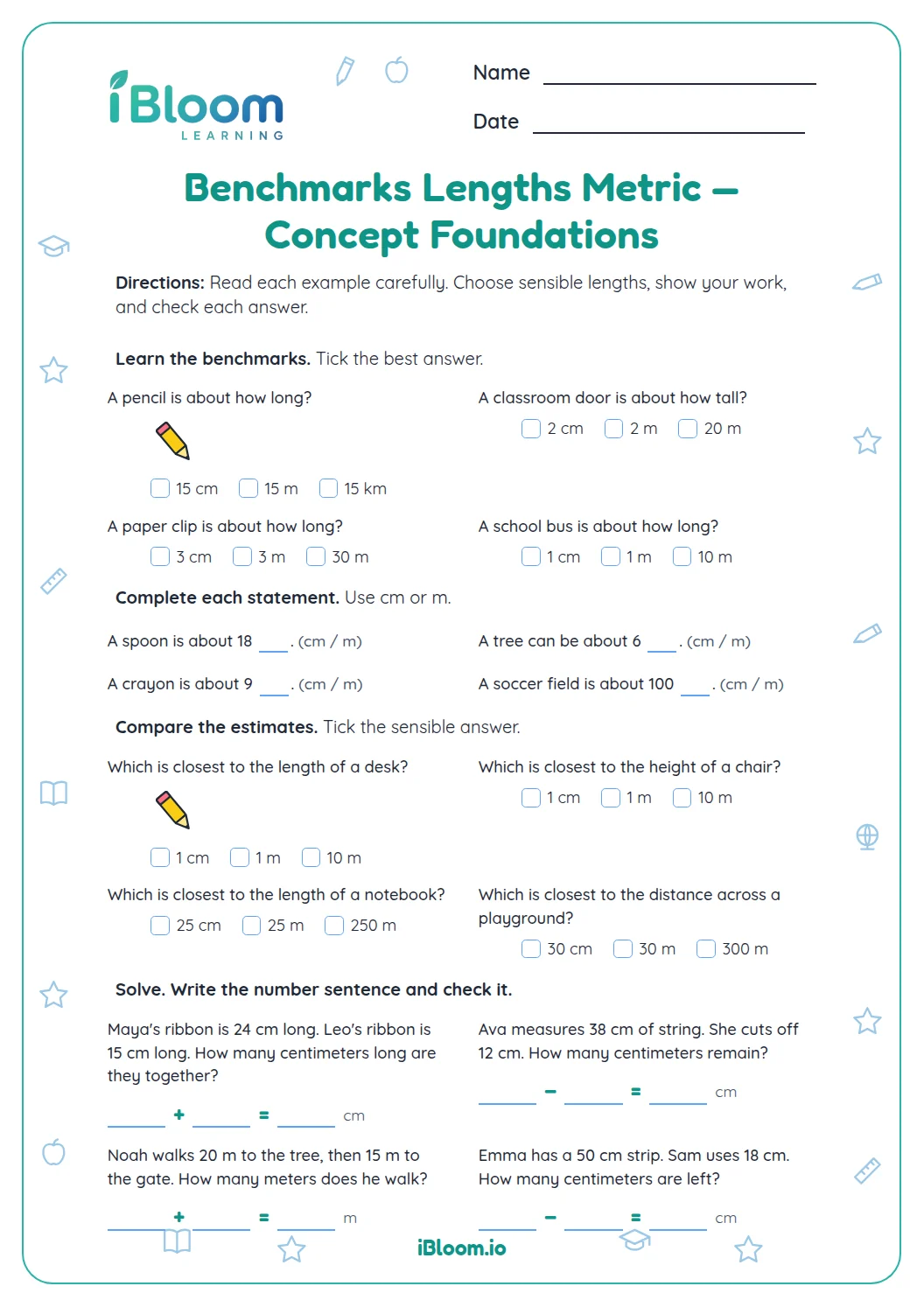
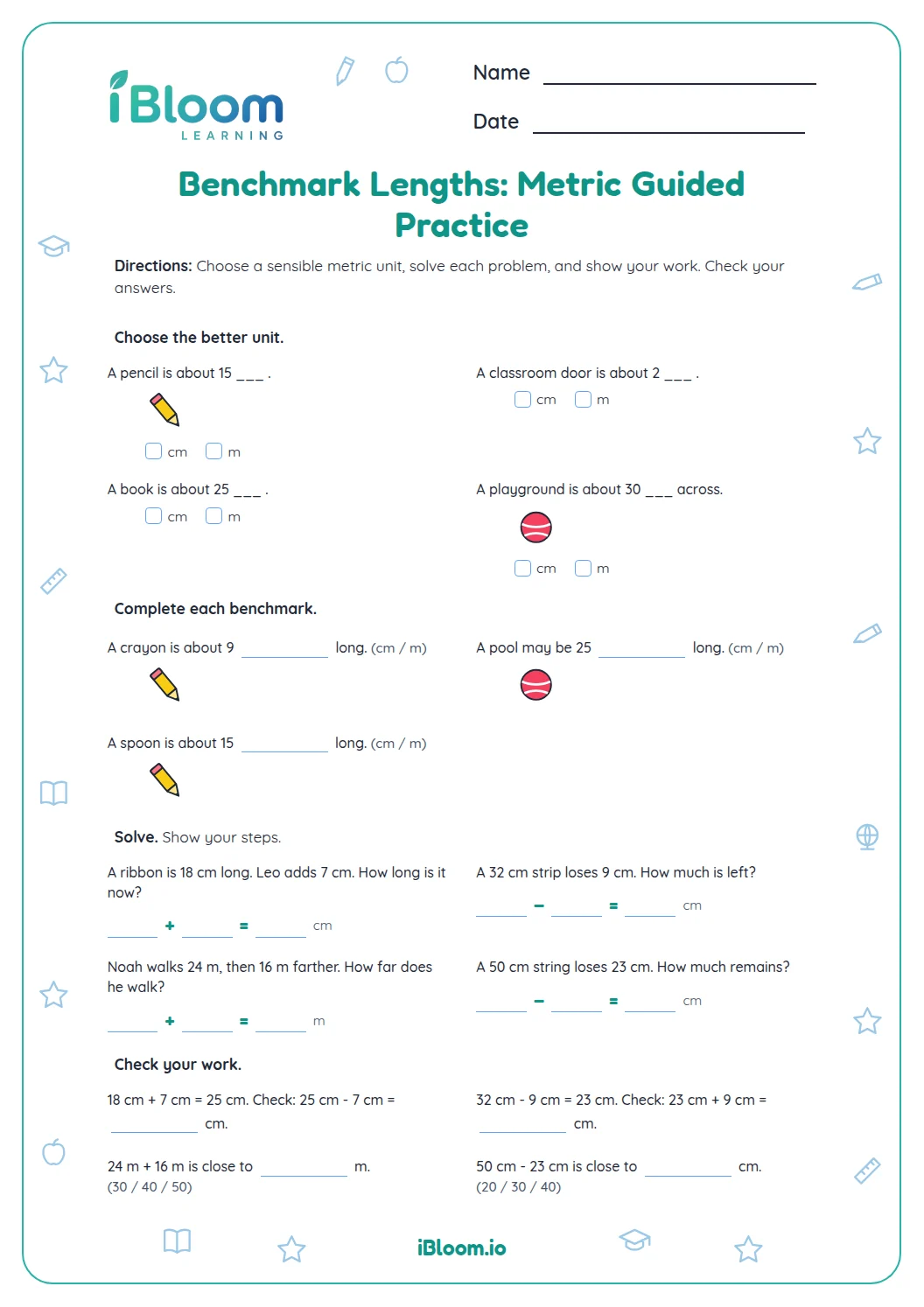
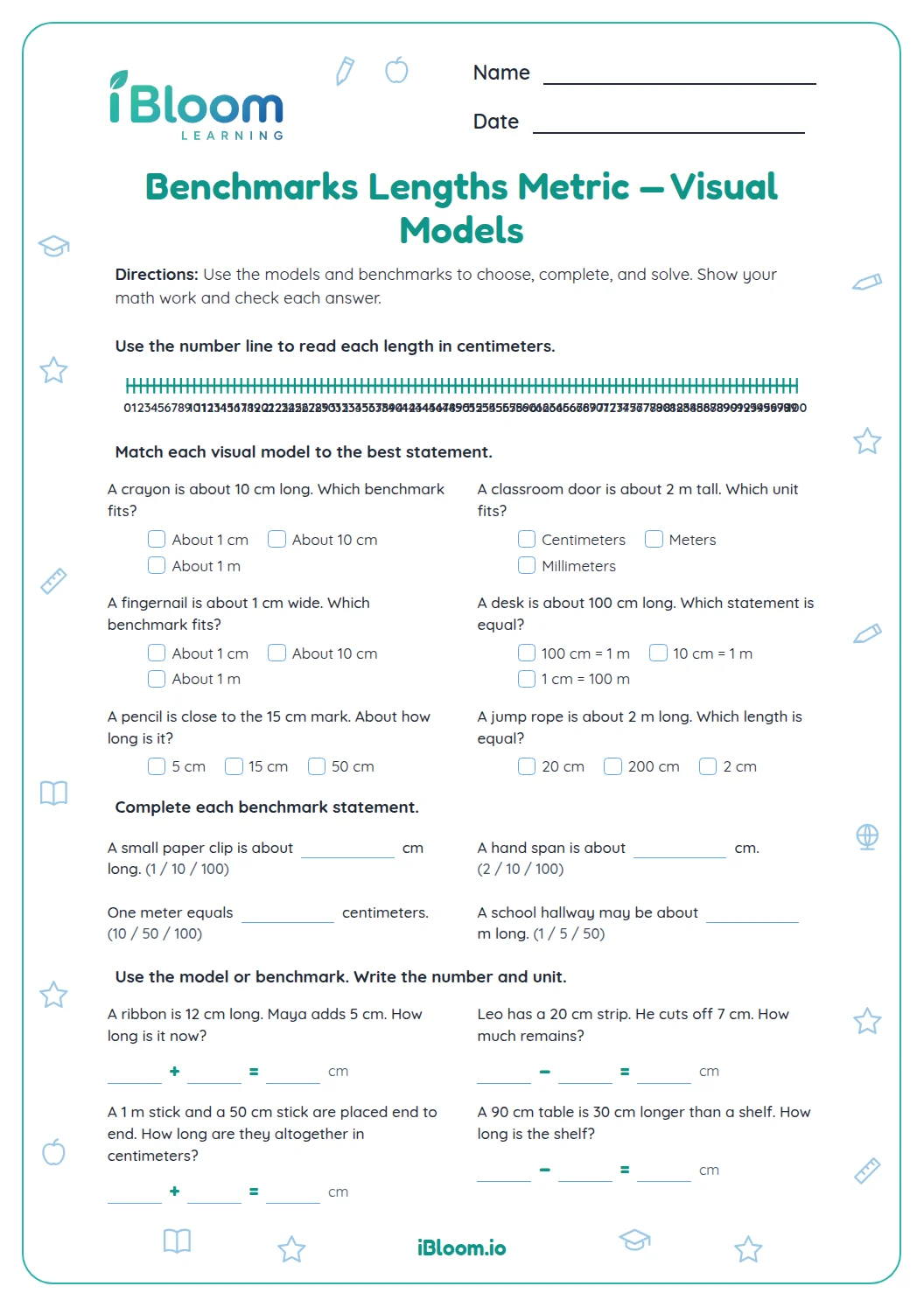
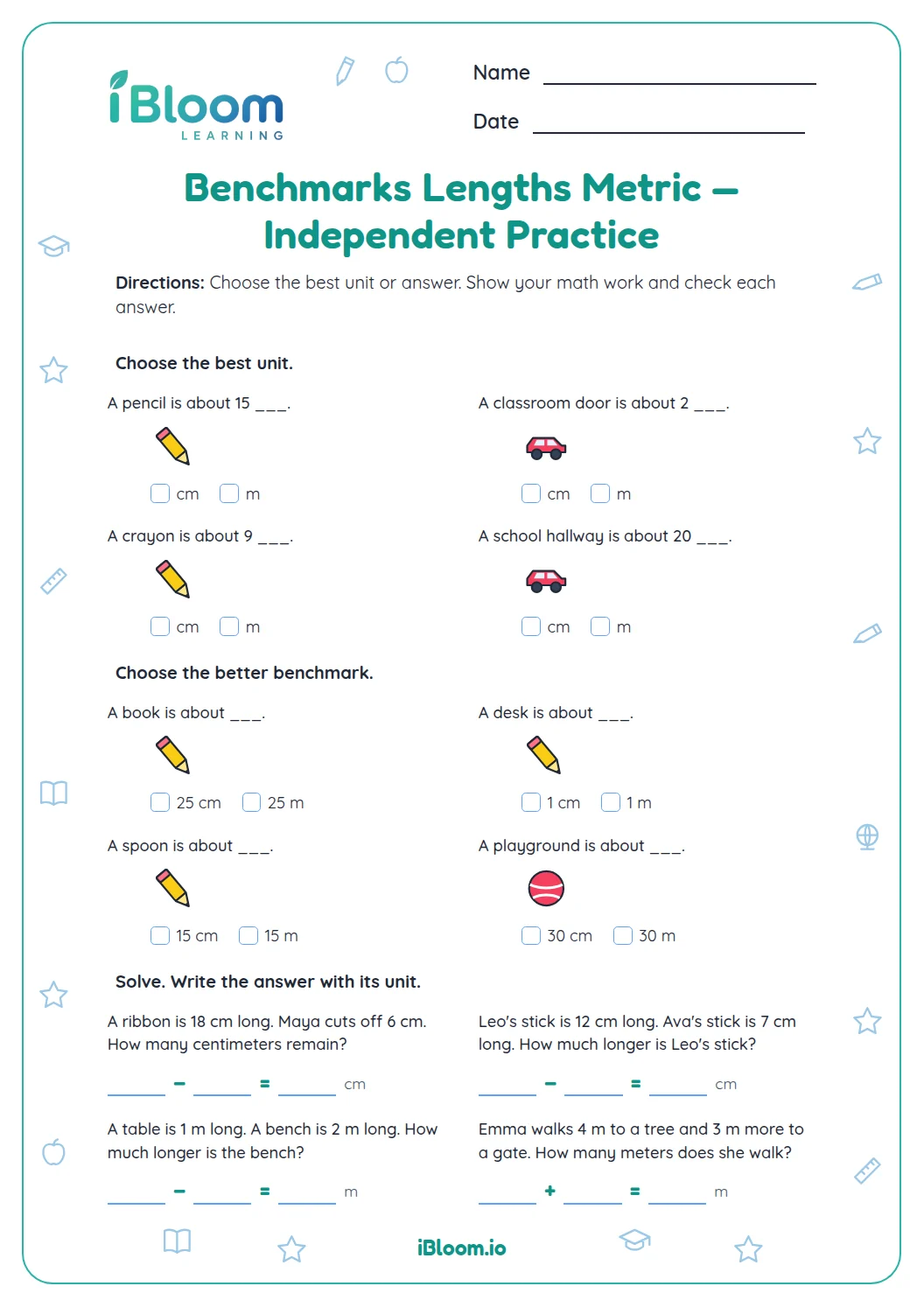
This Grade 2 measurement worksheet uses ruler drawings to show an object’s length and pairs it with a second stated length. Students compare the two lengths, subtract to find how much longer the first is, and record the difference with its unit. The 14 questions alternate inches and centimeters, and the answer key includes each difference. The ruler models support the comparison while students practice writing a subtraction equation.
Aligned to 2.MD.B.5
How do you use a ruler model to compare lengths?
Question 1 shows a 5-inch crayon and gives a second object length of 2 inches. Subtract 2 from 5: 5 − 2 = 3, so the crayon is 3 inches longer. Keep the unit in the answer because both measurements are in inches.
Why must the two lengths use the same unit?
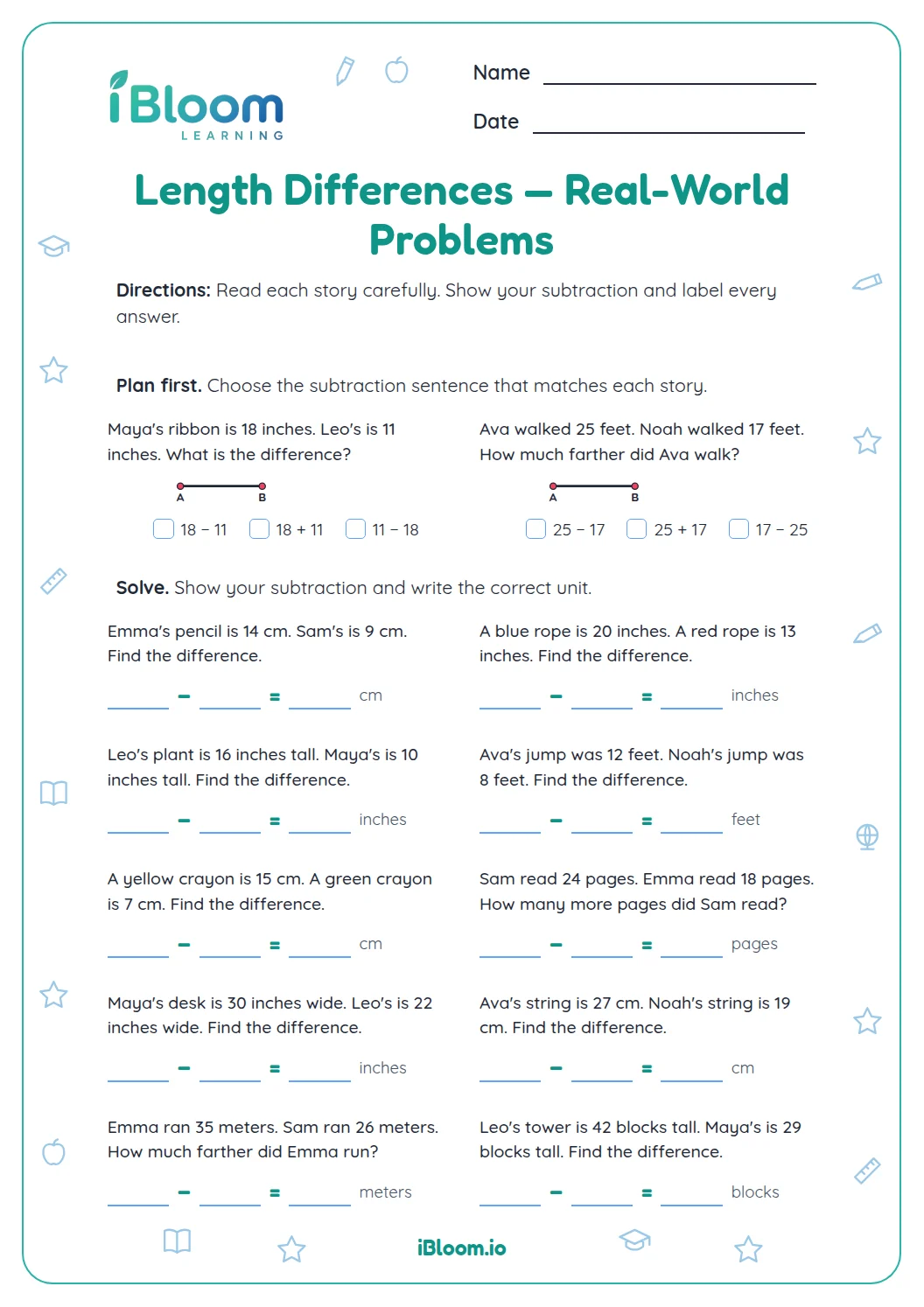
A difference is meaningful when both lengths use the same unit. The worksheet keeps each pair in inches or each pair in centimeters. Do not convert one length; subtract the stated measurements directly and label the result with that unit.
How can you check a difference?
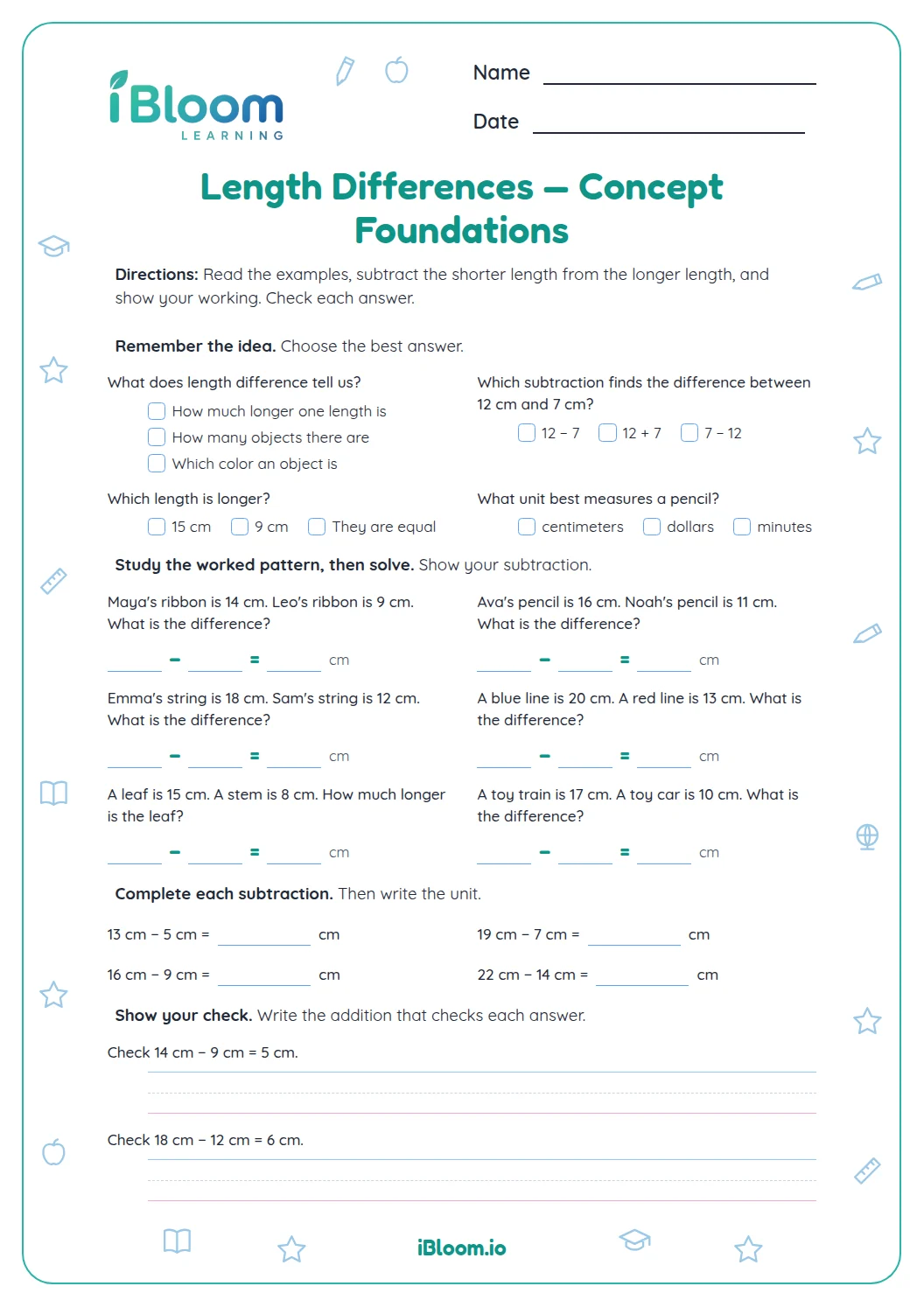
Add the difference to the shorter length. For question 2, 7 cm − 4 cm = 3 cm; then 4 cm + 3 cm returns to 7 cm. This confirms the difference shown by the two measurements.
How to use this worksheet
- 1Read the longer length from the ruler drawing.
- 2Find the second length and check that the units match.
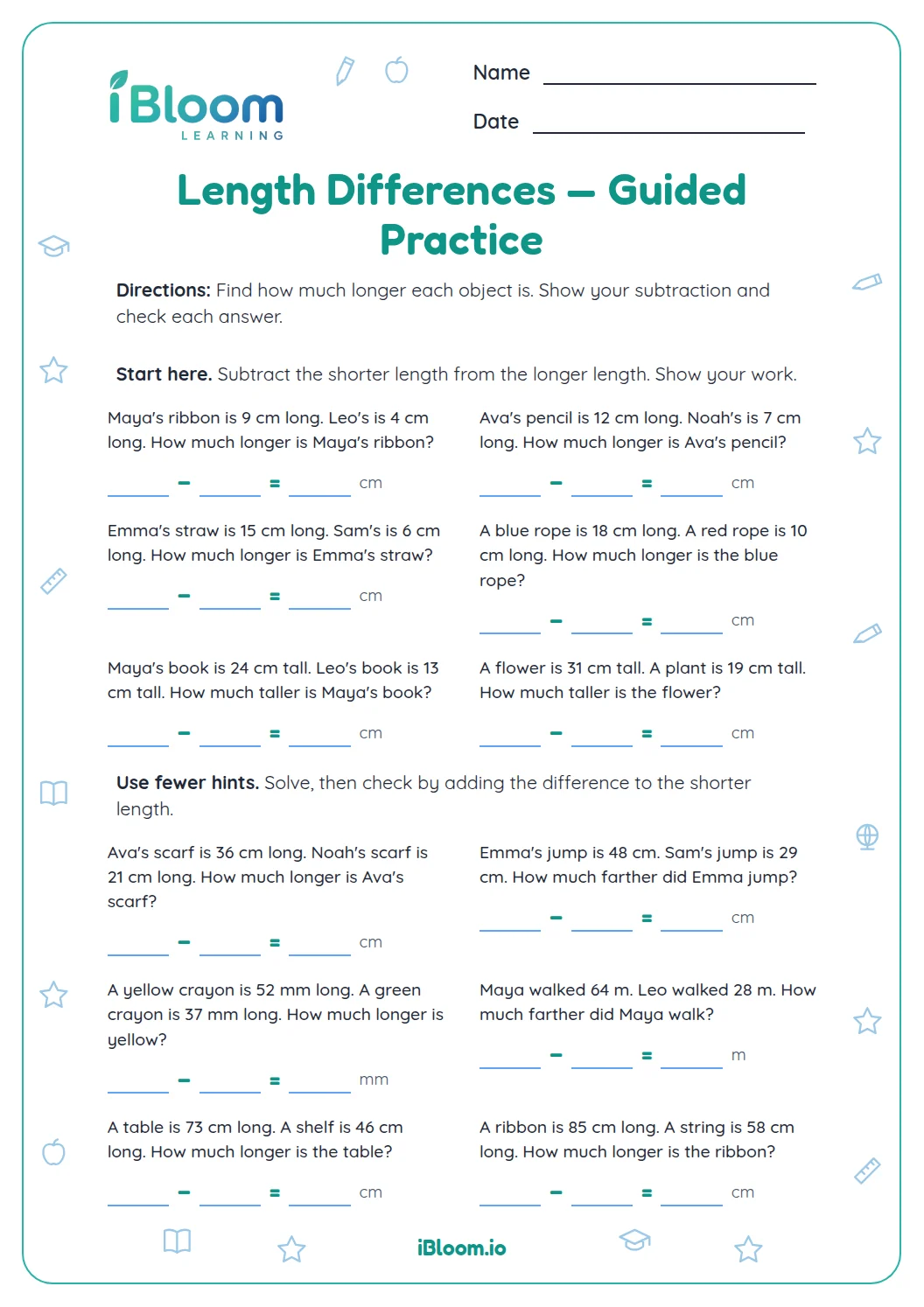
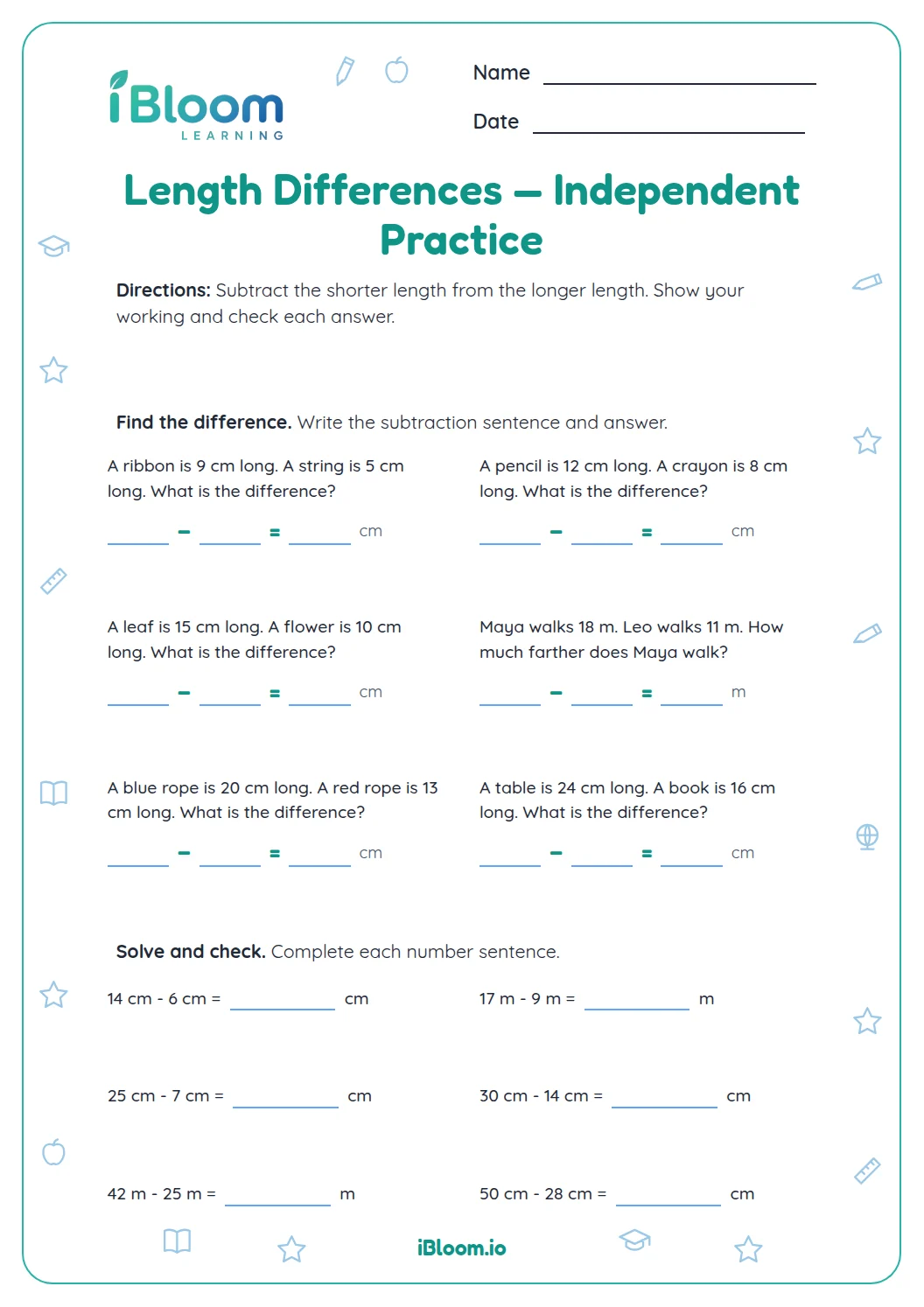
- 3Subtract the shorter length from the longer length.
- 4Write the difference and include inches or centimeters.
- 5Add the difference to the shorter length to check.
Common slips and fixes
The mistake
Subtracting the longer measurement from the shorter one.
The fix
Start with the longer length so the difference is positive.
The mistake
Dropping the unit in the answer.
The fix
Copy the shared unit, inches or centimeters, into the answer.
The mistake
Mixing inches and centimeters in one subtraction.
The fix
Use only the two measurements given in that question; their units match.
Common Core alignment
Students measure to determine how much longer one object is than another.
Subtract same-unit lengths to find how much longer one object is.
On this sheet: Students compare same-unit lengths and express each subtraction difference in that unit.
Show the official wordingHide the official wording
Use addition and subtraction within 100 to solve word problems involving lengths that are given in the same units, e.g., by using drawings (such as drawings of rulers) and equations with a symbol for the unknown number to represent the problem.
What to practice next
Make more practice
Questions parents and teachers ask
What do the ruler drawings show?
Each drawing shows the longer object’s length on a ruler. The question gives the second object’s length in the same unit. Students compare the two measurements, subtract the shorter from the longer, and write the difference with its unit. The key uses matching units throughout.
How many comparisons are on the worksheet?
There are 14 length-difference questions. The examples alternate between inches and centimeters, and each has a ruler drawing for the longer object. The answer key lists the difference for every pair, with the unit included. The drawings and prompts use matching units.
What is the answer to the first ruler question?
The crayon measures 5 inches and the second object measures 2 inches. Subtract 5 − 2 to find a difference of 3 inches. Adding 3 inches to 2 inches checks that the longer length is 5 inches. The key gives this result as 3 inches.
Do students need to convert inches to centimeters?
No conversion is needed for these comparisons. Each pair uses the same unit, so students can subtract the two inch measurements or the two centimeter measurements as written. The answer should keep that shared unit. The key also keeps the unit in each answer.
How can I help a child who subtracts in the wrong order?
Ask which object is longer and have the child name that measurement first. Then subtract the shorter length from it. A quick addition check, shorter length plus difference equals longer length, can show whether the answer makes sense. This check applies to every comparison.