


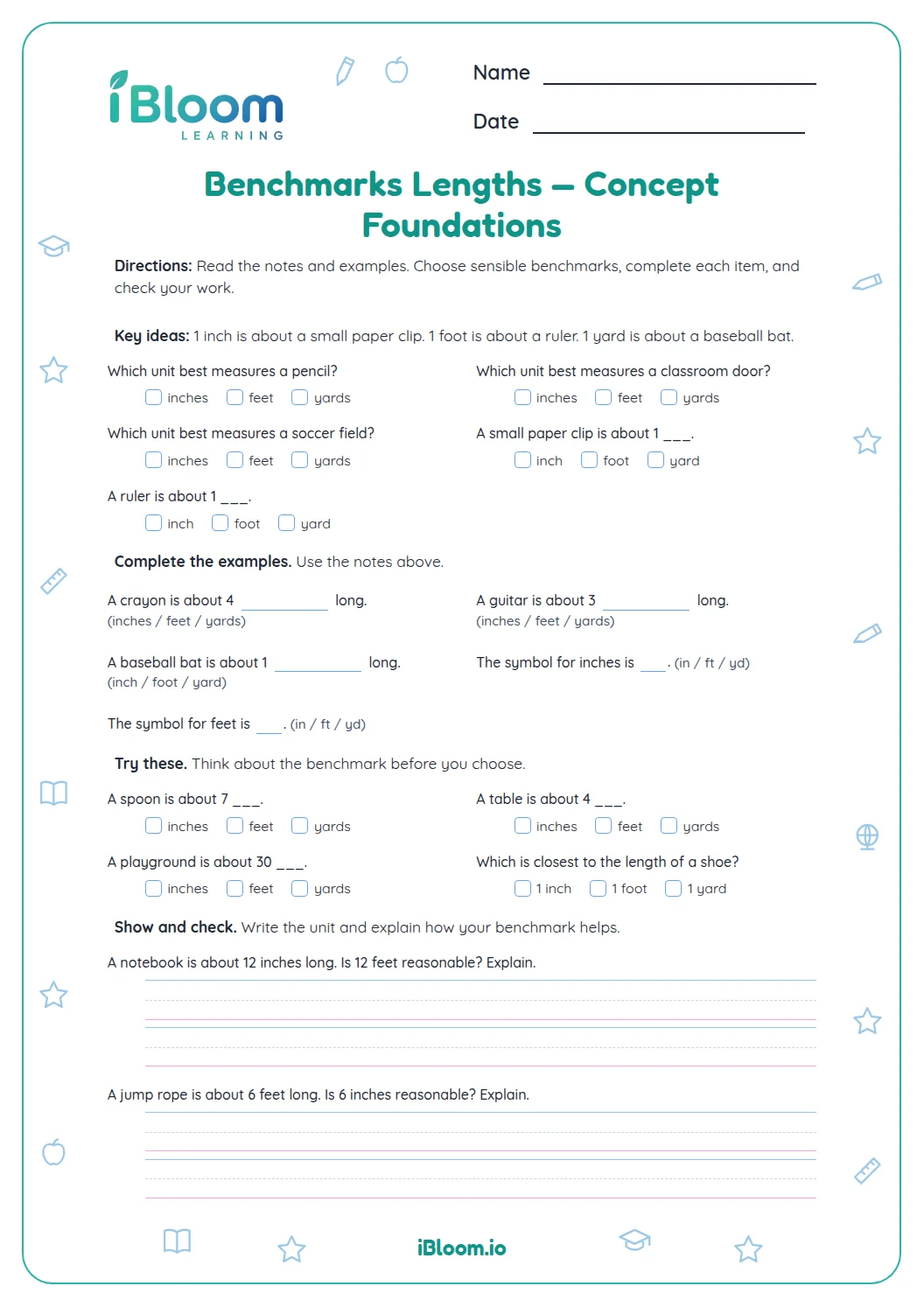
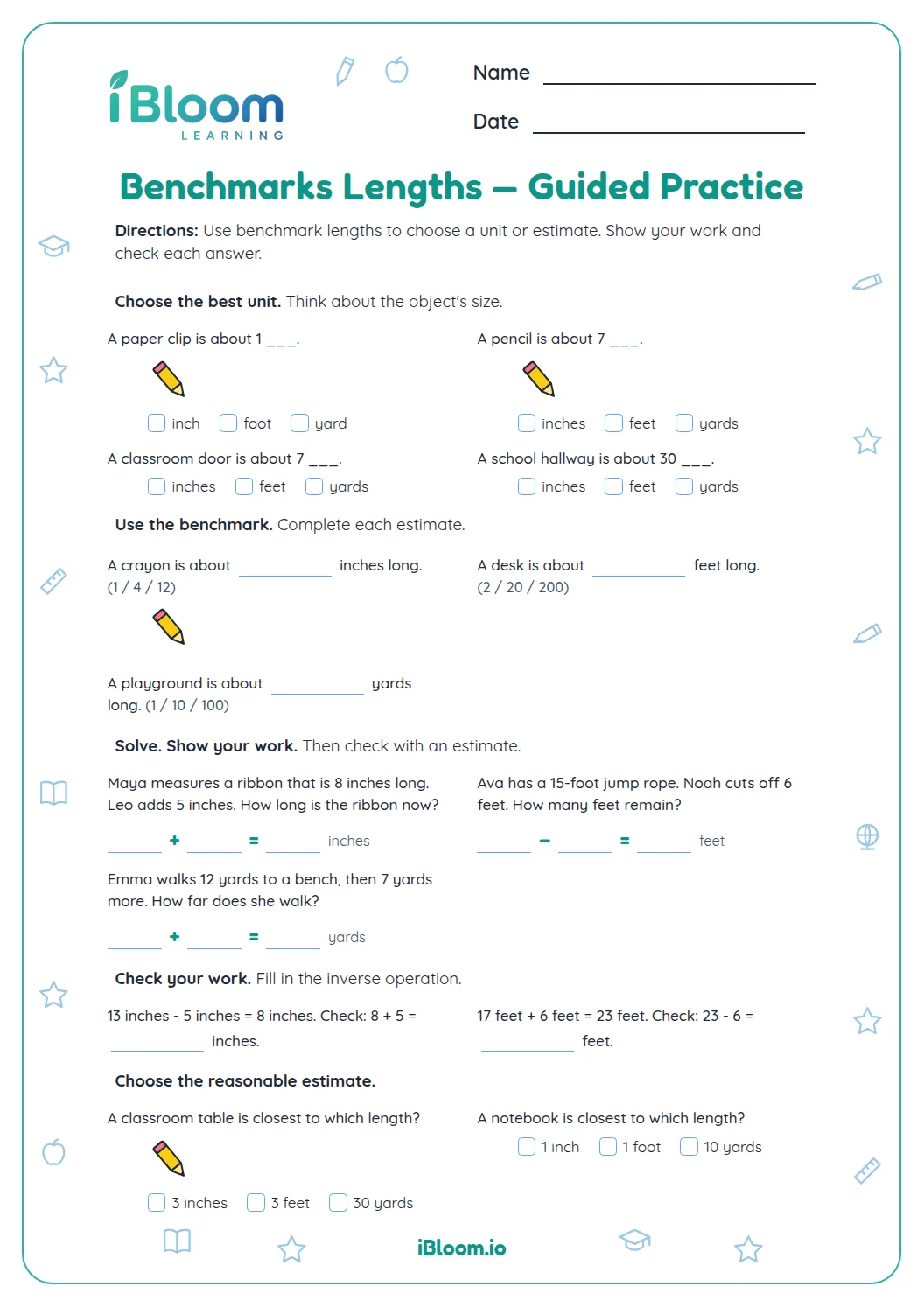
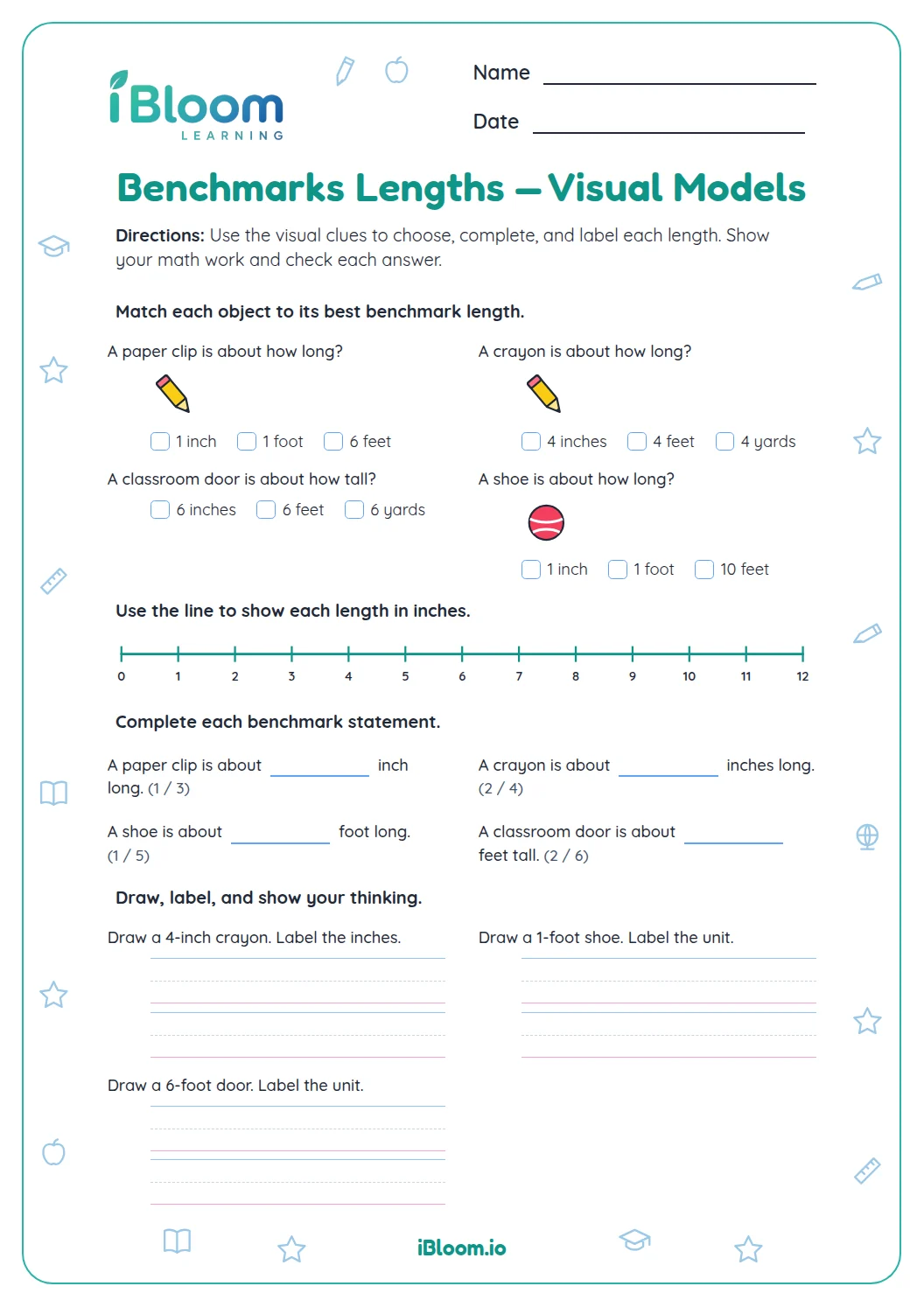
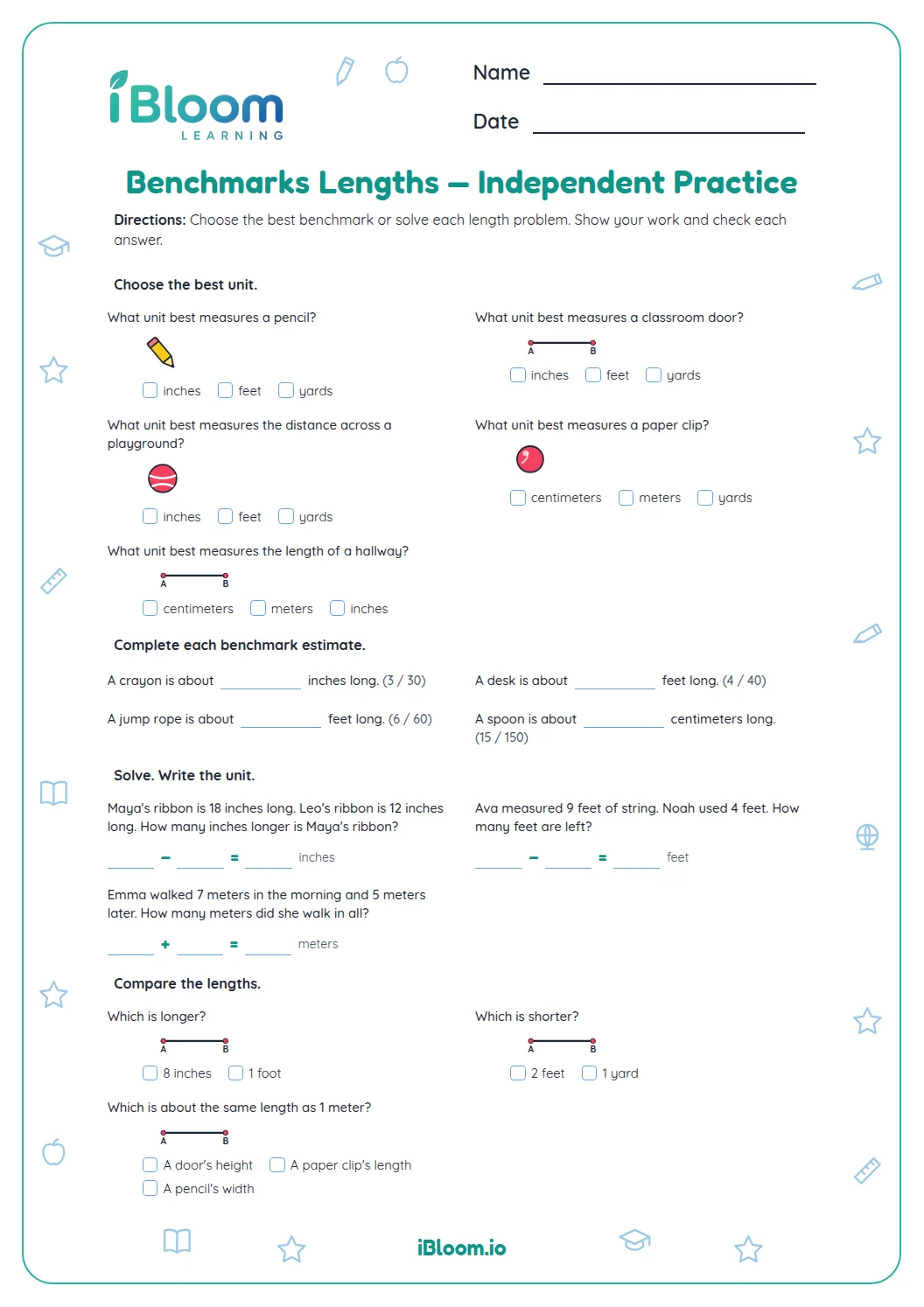


About this worksheet
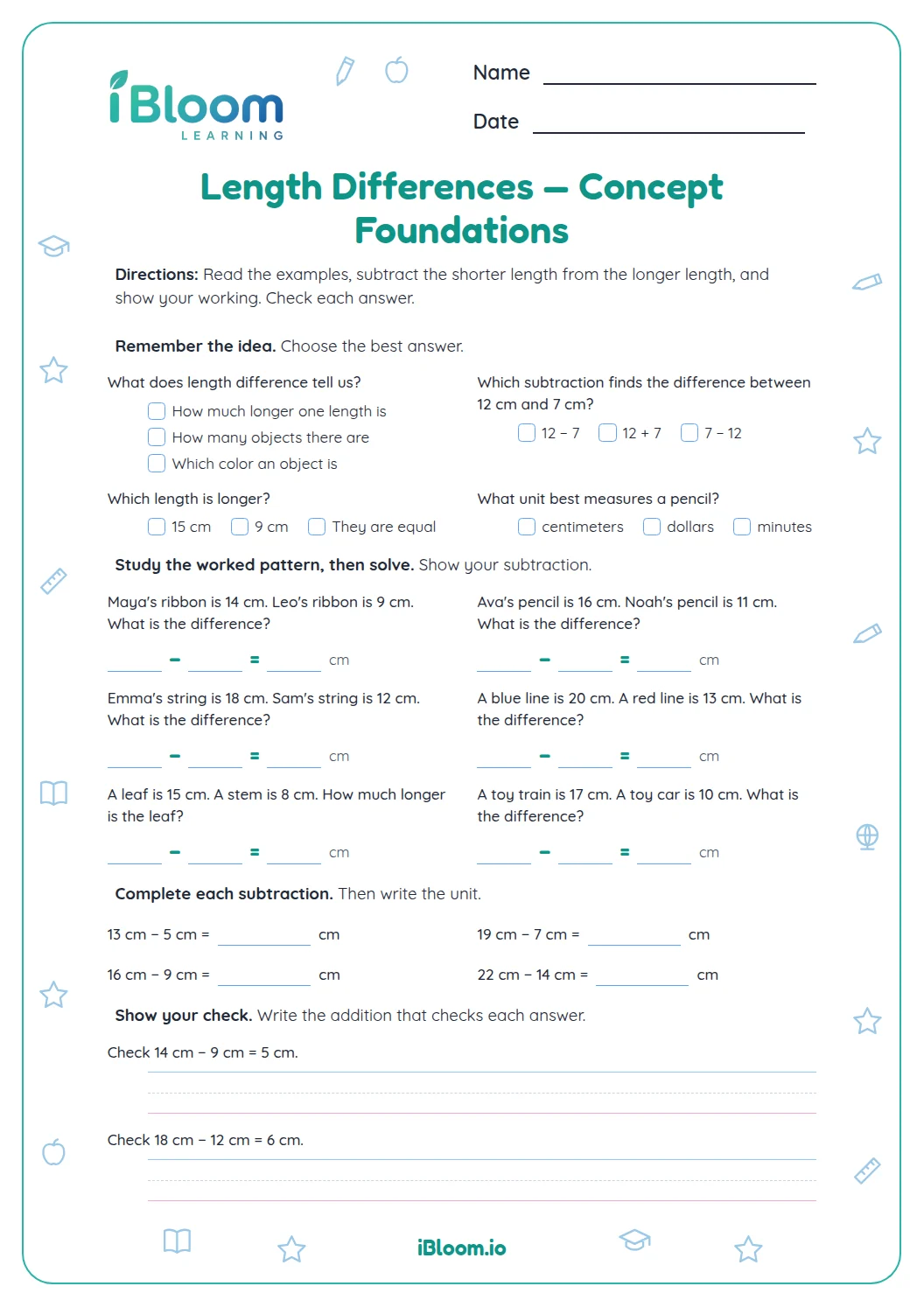
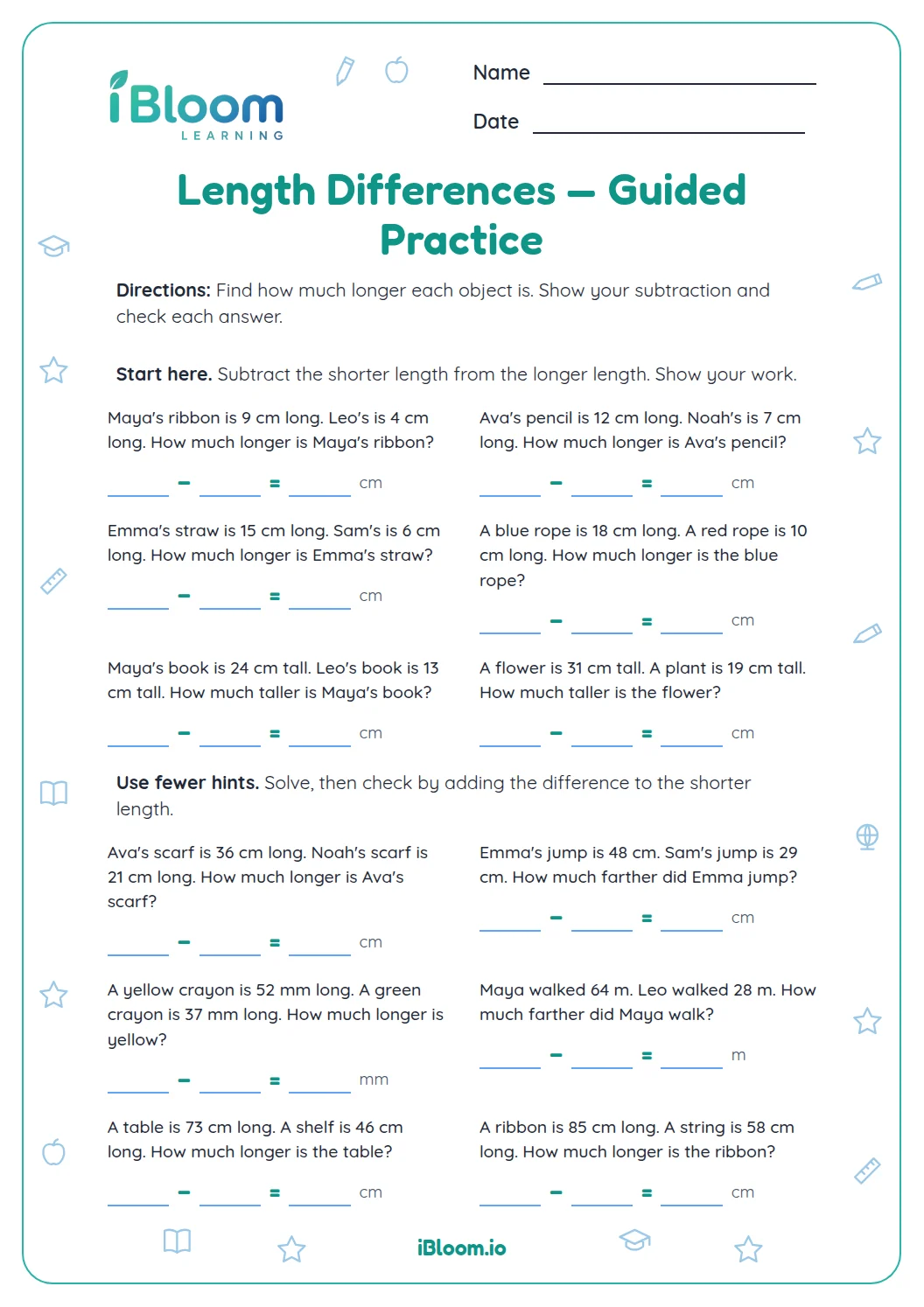
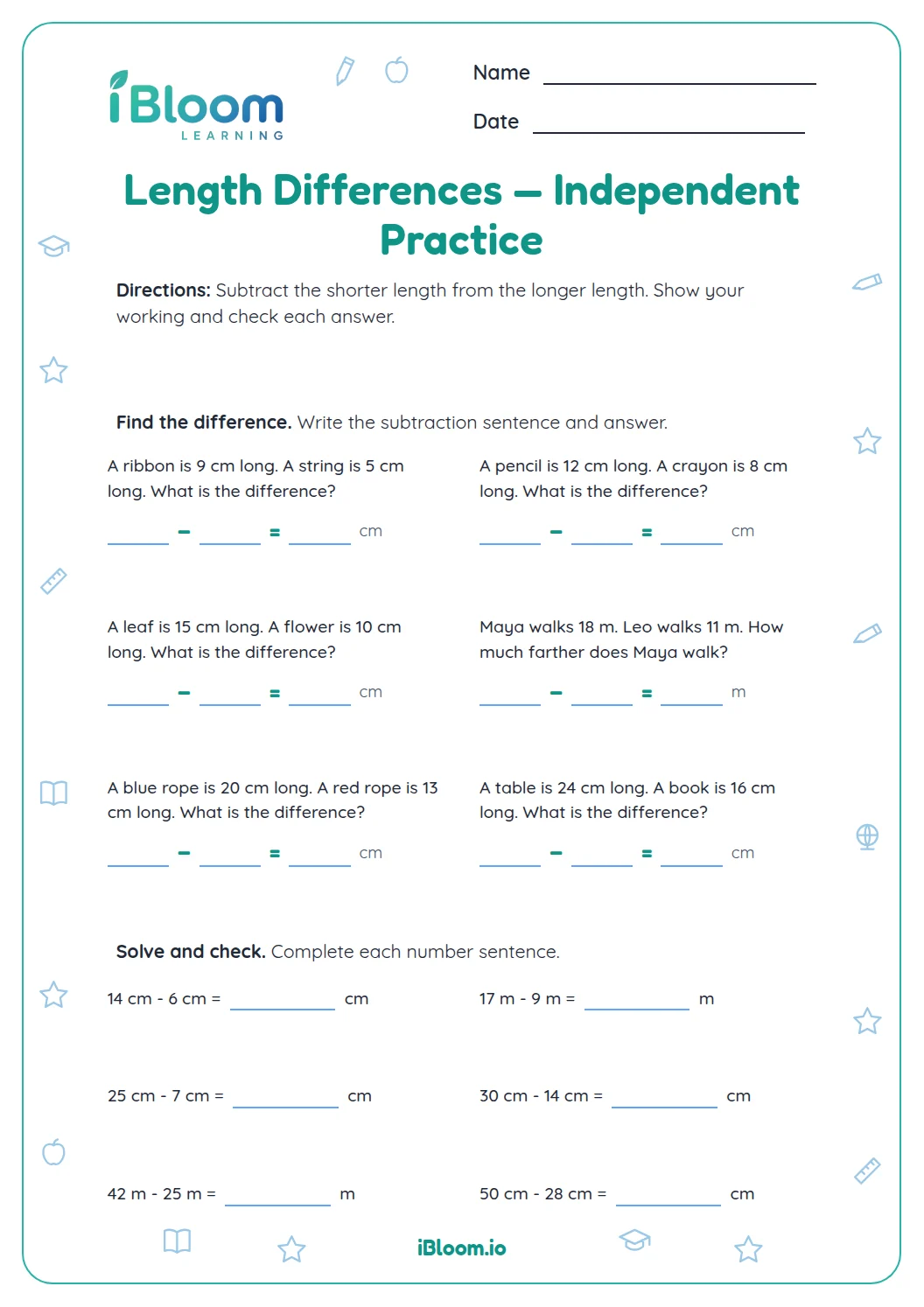
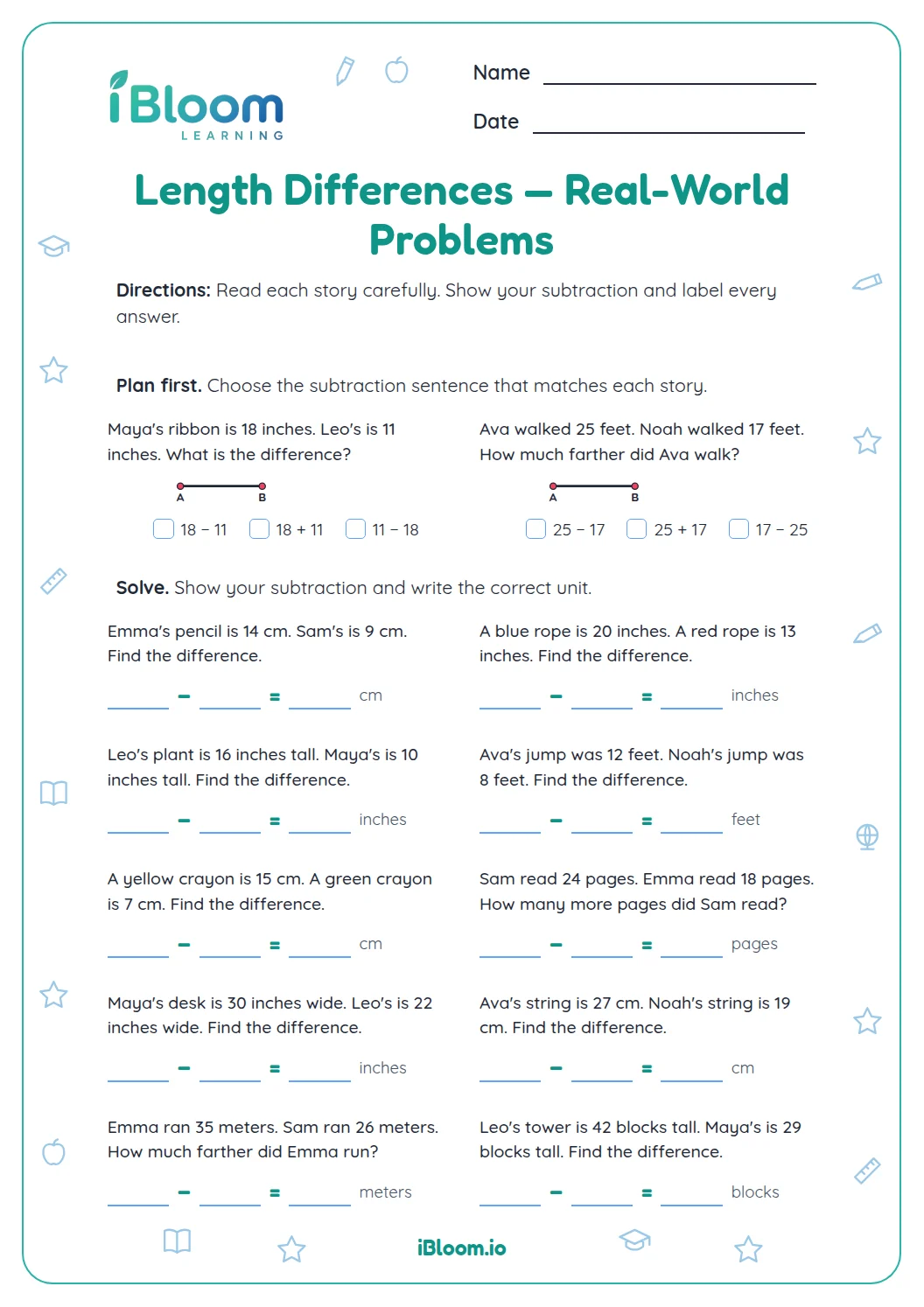
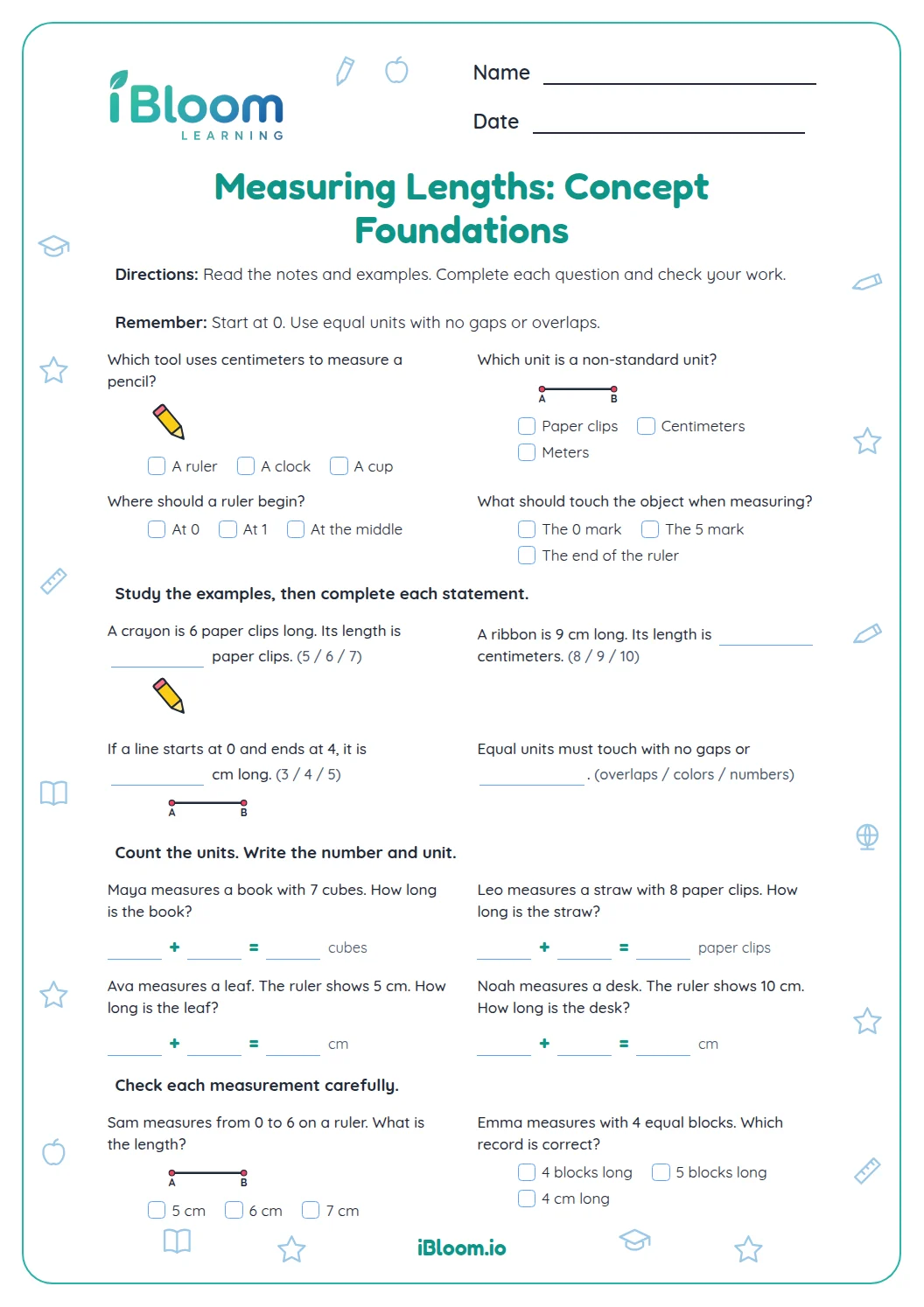
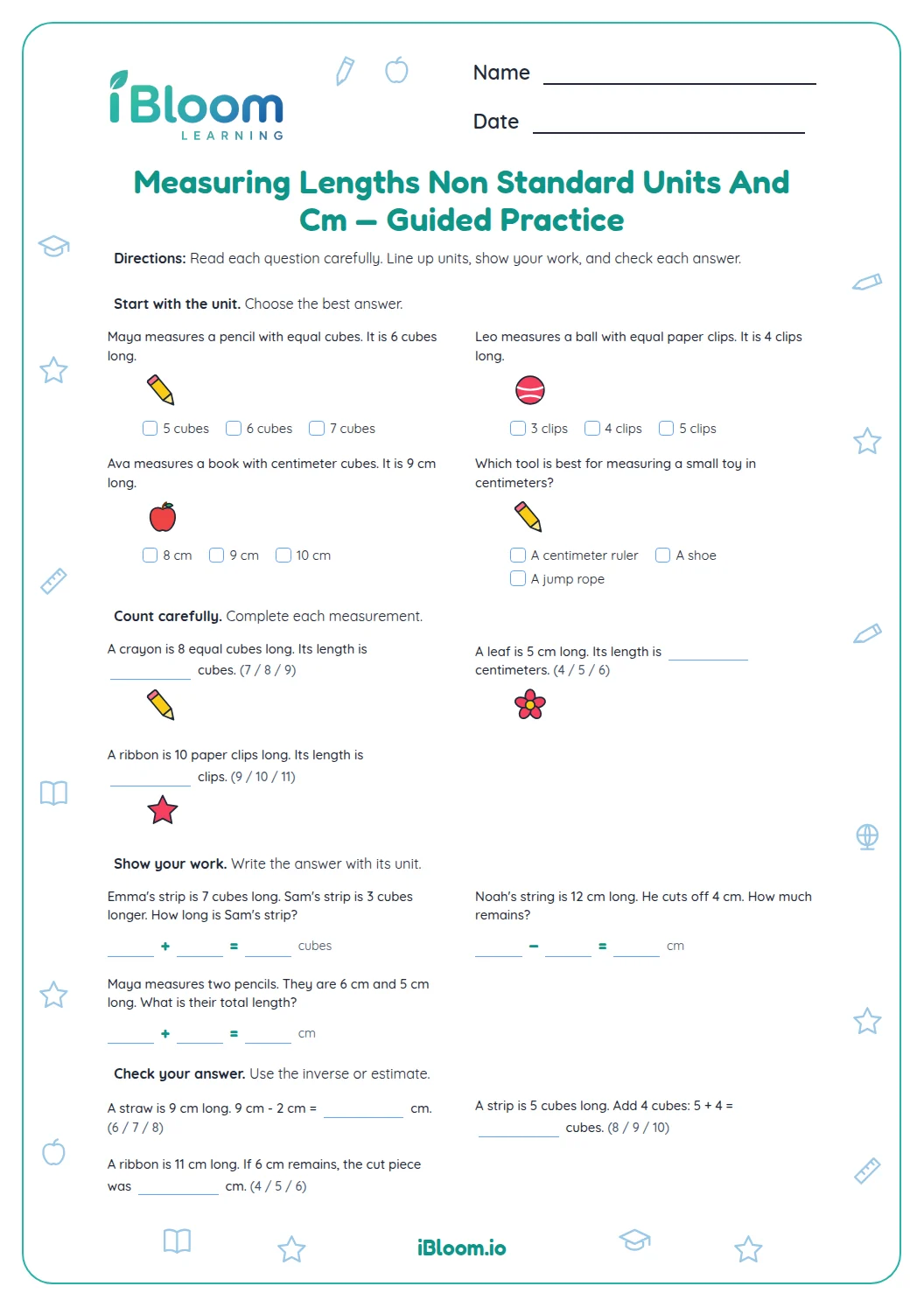
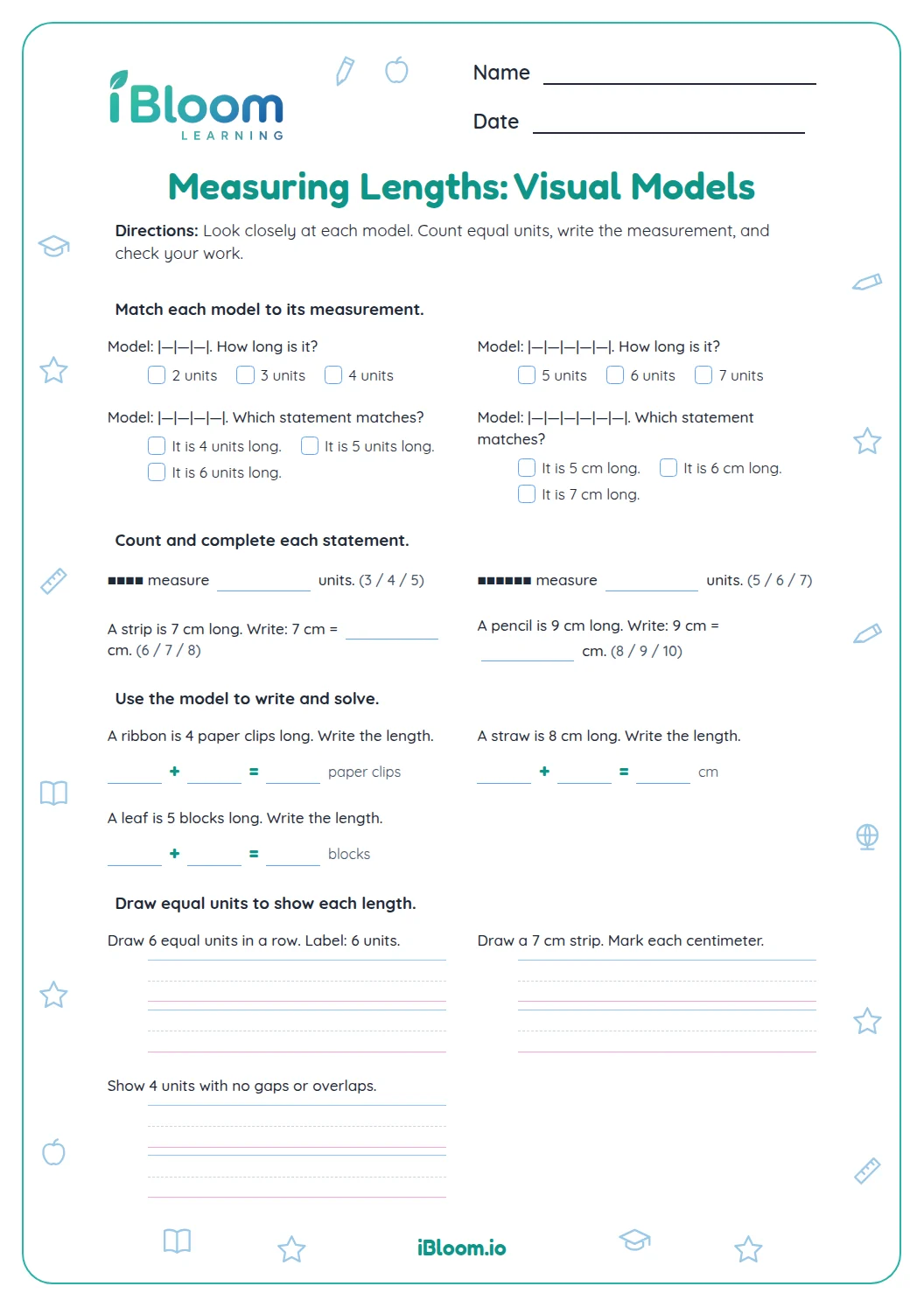
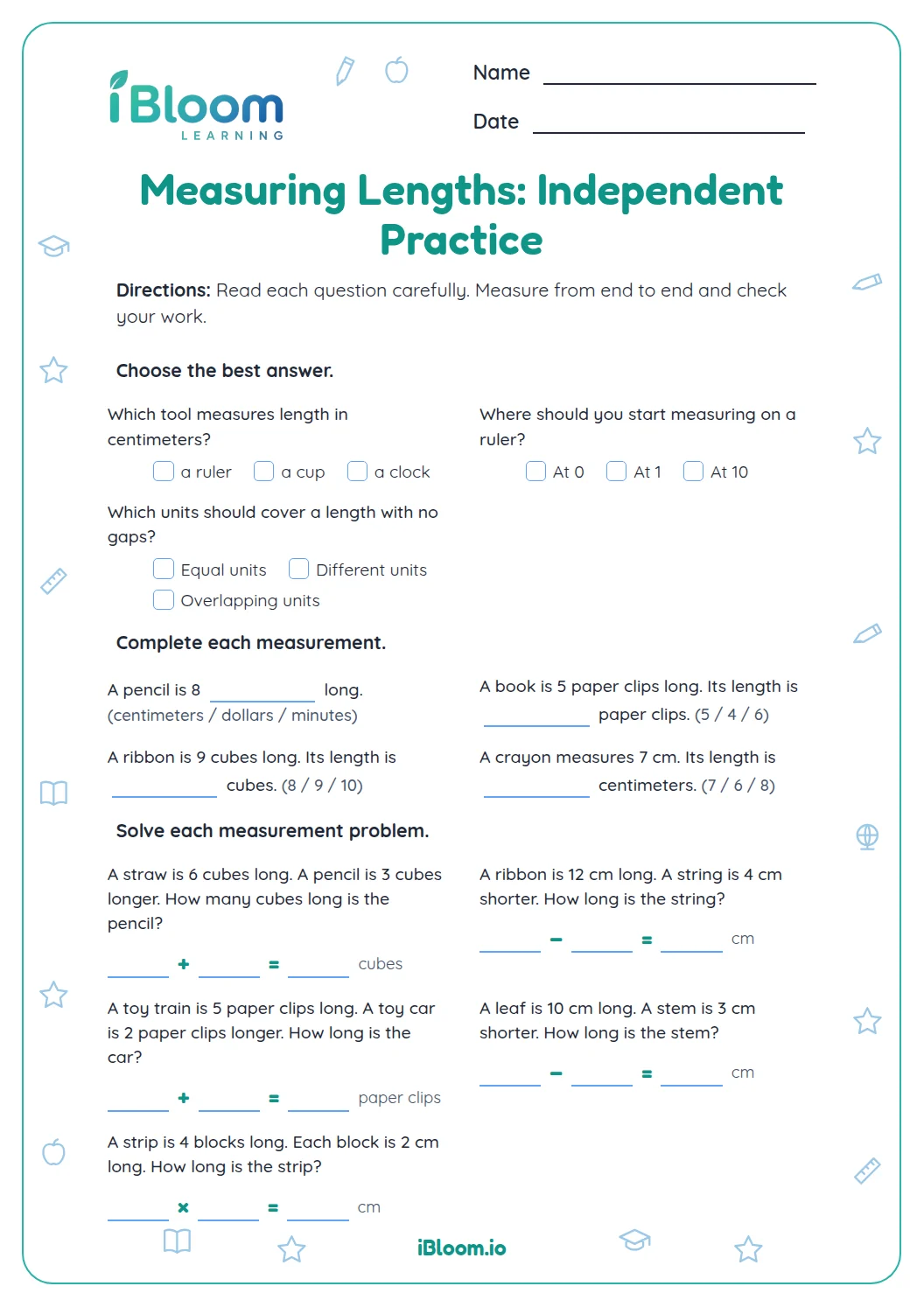
This Grade 2 printable practices finding how much longer one measured length is than another. Students check subtraction reasoning, complete compact centimeter and meter difference sentences, and explain two answers. A separate key gives each difference and sample reasoning. The questions use consistent units within each comparison.
Aligned to 2.MD.A.4
How do you find how much longer?
Put the two lengths in the same unit, then subtract the shorter length from the longer one. If a pencil is 5 inches and a crayon is 2 inches, the difference is 3 inches.
- 1Maya says 18 cm − 11 cm = 29 cm.
- 2She added instead of subtracting.
- 318 cm − 11 cm = 7 cm.
How can a ruler model help?
For 32 cm − 18 cm, subtract 10 first: 32 − 10 = 22. Then subtract 8: 22 − 8 = 14 cm.
How can you check a difference?
Add the difference to the shorter length. If the sum equals the longer length, the difference is consistent.
How to use this worksheet
- 1Read the units in both lengths.
- 2Identify the longer and shorter length.
- 3Subtract the shorter length from the longer one.
- 4Include the unit in your answer.
- 5Check by adding the difference to the shorter length.
Common mistakes and quick fixes
The mistake
Subtracting the longer length from the shorter.
The fix
The difference is the amount from the smaller measurement up to the larger one.
The mistake
Dropping the unit in the answer.
The fix
Copy “inches” into the answer so the measurement is clear.
The mistake
Adding the two lengths.
The fix
Ask how much longer one is; find the gap by subtracting.
Common Core alignment
The sheet practices comparing measured lengths in a standard unit.
Compare lengths by finding how much longer one object is.
On this sheet: Each item asks for a difference between lengths in the same unit.
Show the official wordingHide the official wording
Measure to determine how much longer one object is than another, expressing the length difference in terms of a standard length unit.
What to practice next
Make more practice
Further reading
Questions parents and teachers ask
What does length difference mean?
It tells how much longer one object is than another. Subtract the shorter measurement from the longer measurement when both use the same unit. The difference is a length itself, so include the same unit used for both objects. The number sentence can make that comparison easier to see.
How many problems are on the sheet?
There are 14 questions in three parts: four reasoning choices, eight missing-number difference sentences, and two short explanations. Each comparison uses measurements in the same unit. The compact formats leave room for students to show two examples of their reasoning, and a separate answer key gives the results.
Why do the questions use inches?
The sheet uses centimeters and meters, with each comparison keeping to one unit. That lets learners focus on finding the gap without converting measurements. Include the printed unit when it appears after a blank, and check that the larger measurement comes first in a subtraction sentence.
How can a child check an answer?
Add the difference to the shorter length. For example, if the difference is 3 inches and the shorter length is 2 inches, the total should be 5 inches. A subtraction equation records the gap between the measurements and helps keep their order straight.
Does it include an answer key?
Yes. The answer key gives the difference for each item, including the unit, so a parent or teacher can check the response. Review a missed problem by measuring from the shorter length up to the longer one. This check works even when the lengths are not drawn.