



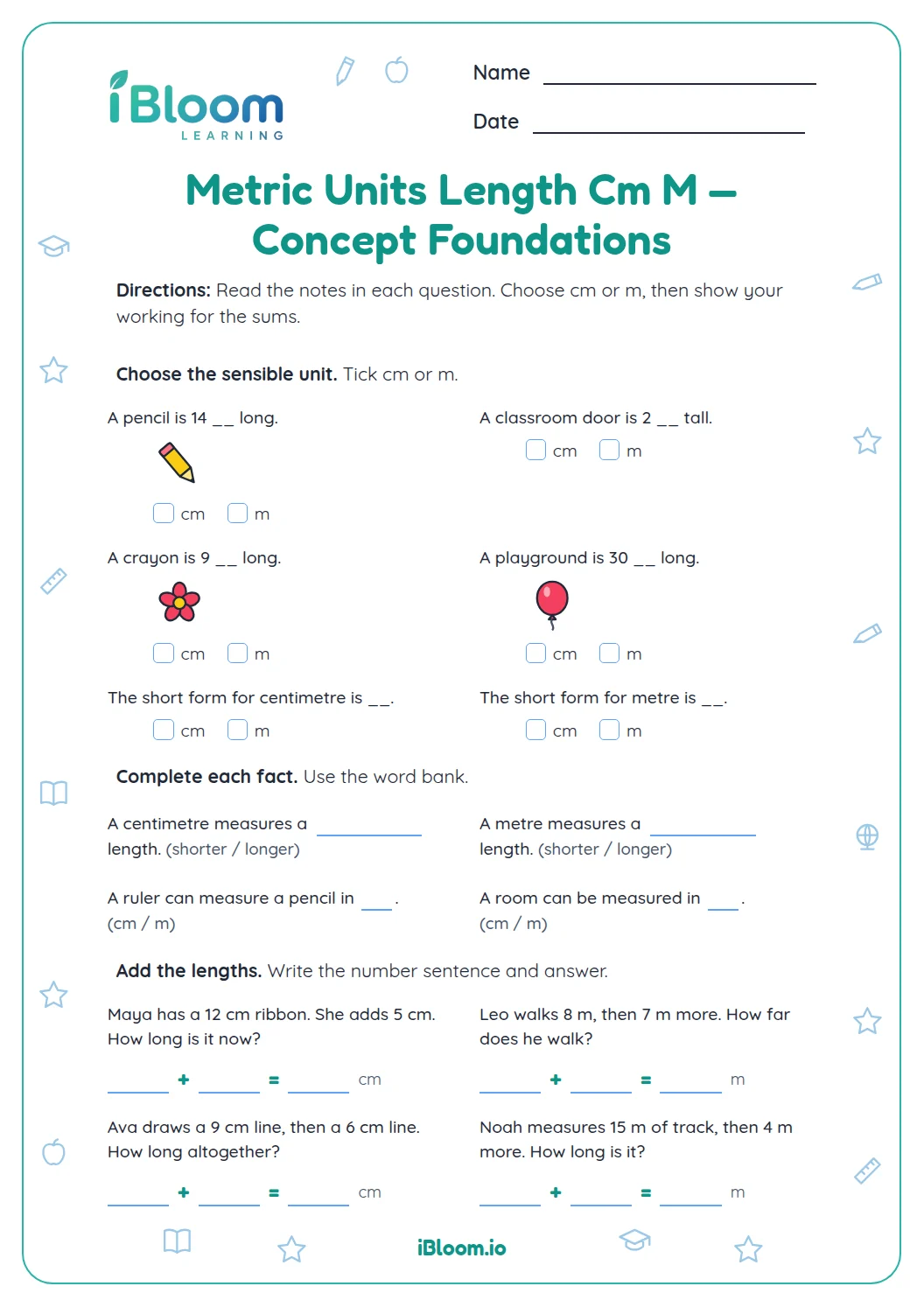


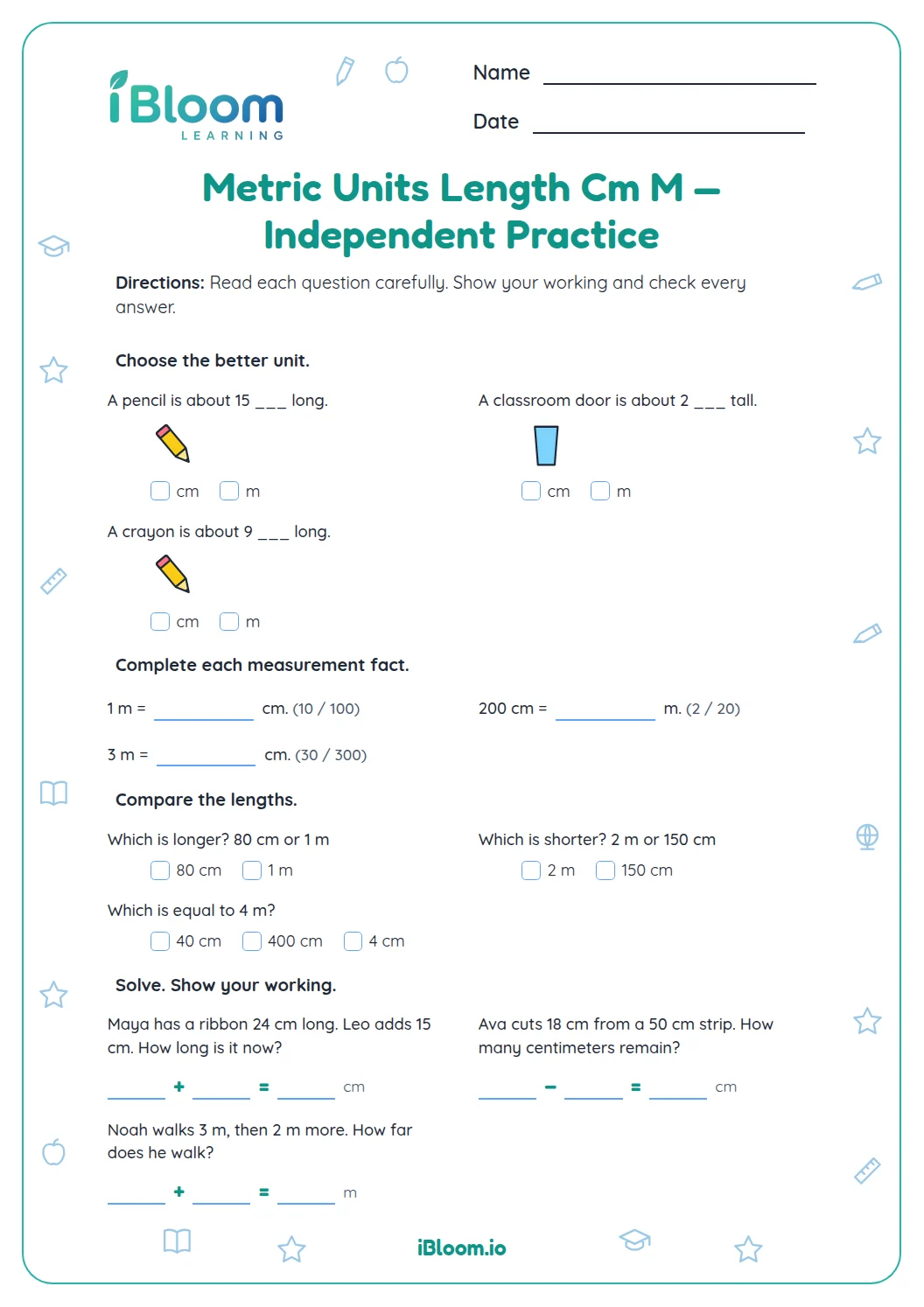
About this worksheet
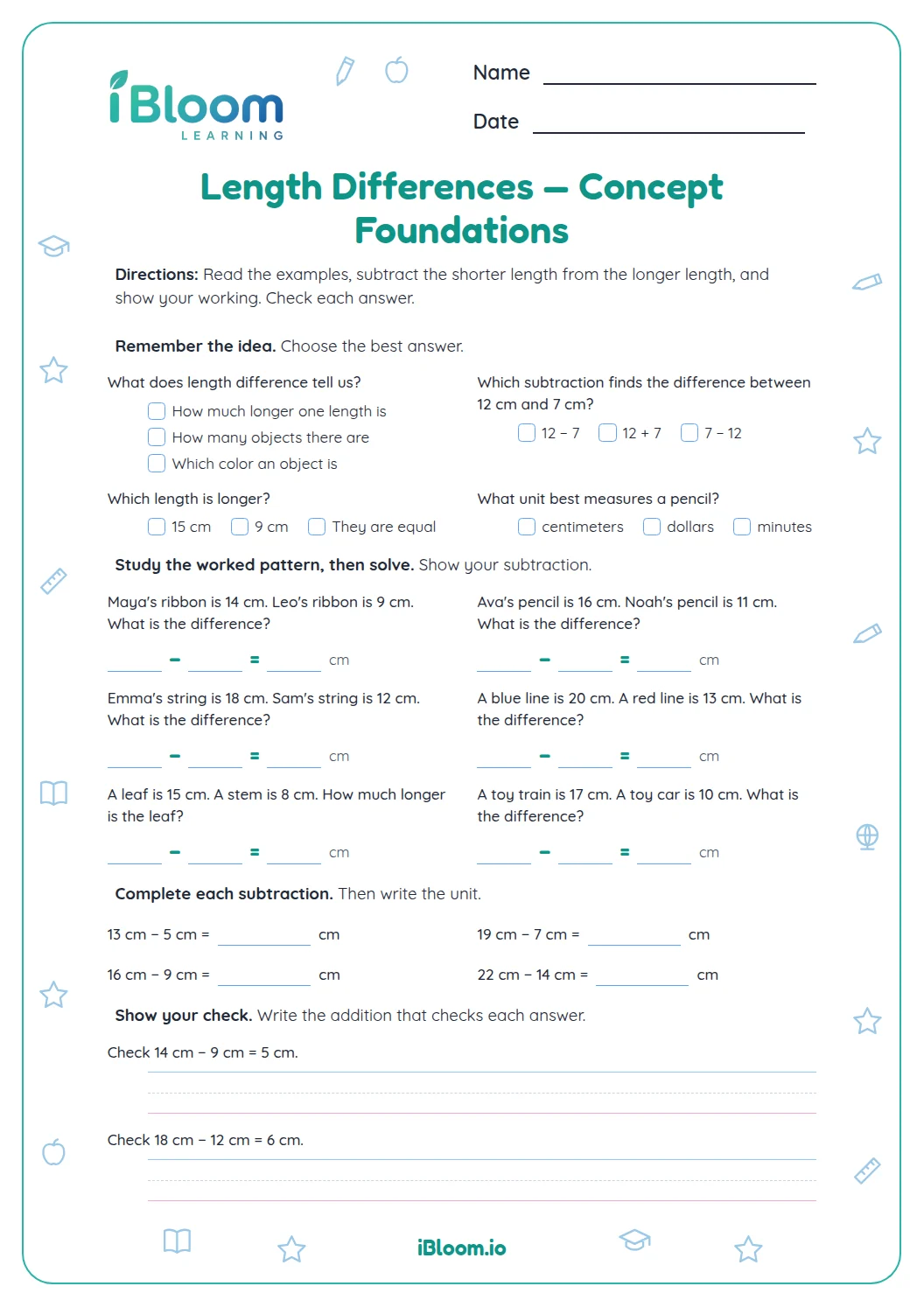
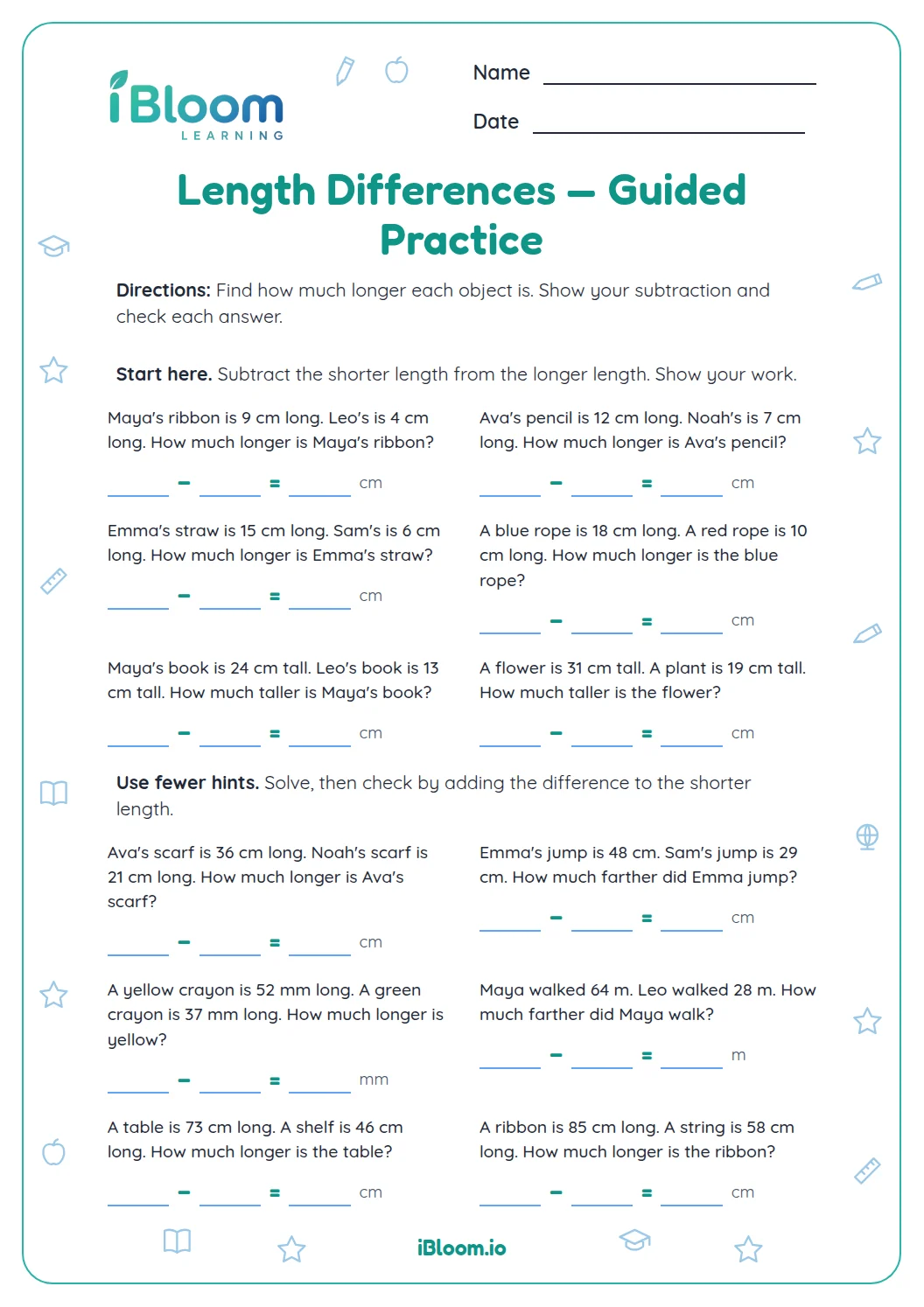
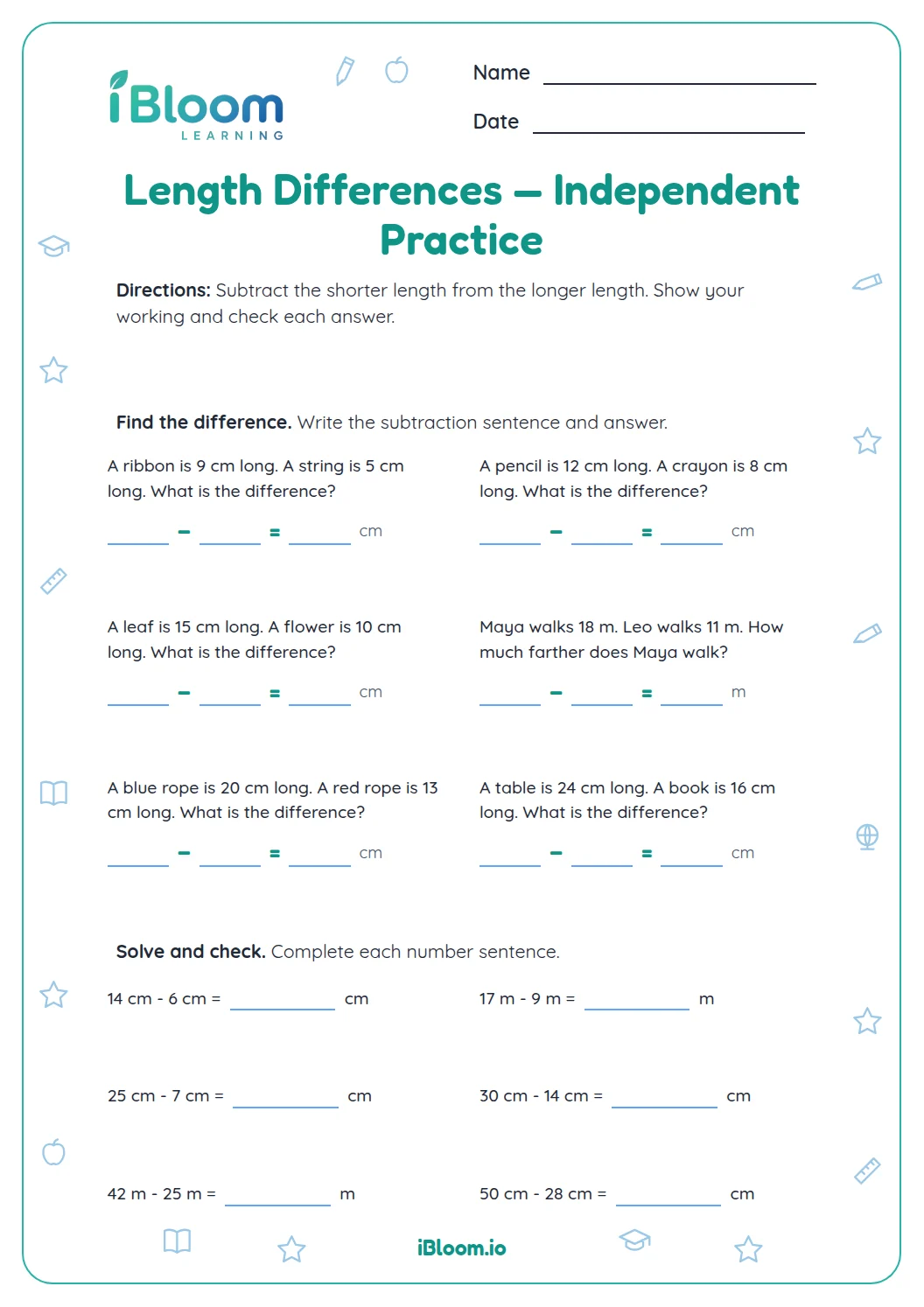
This Grade 2 worksheet practices finding how much longer one measured length is than another. Students compare centimeter lengths in short situations, then solve missing-length subtraction sentences. Part A writes the difference directly; Part B reverses the subtraction sentence to find the length taken away. Addition offers a way to check an unknown subtrahend. The skill aligns with CCSS 2.MD.A.4. A separate answer key is included.
Aligned to 2.MD.A.4
How do you compare two lengths?
Use the same unit for both lengths, then subtract the shorter from the longer. Question 1 compares 12 cm with 8 cm, so 12 − 8 = 4 cm.
- 1Longer length: 12 cm
- 2Shorter length: 8 cm
- 312 cm − 8 cm = 4 cm
How can a missing length be found?
In 13 cm − ___ cm = 5 cm, find the amount taken from 13 to leave 5. The missing amount is 8 cm.
What is on the worksheet?
Part A uses comparison situations. Part B practices the same idea in equations with one missing measurement.
How to use this worksheet
- 1Circle both measurements.
- 2Check that both use centimeters.
- 3Subtract the smaller measure from the larger.
- 4Use addition to check a missing value.
- 5Write cm with each comparison answer.
Common mistakes and quick fixes
The mistake
Subtracting longer from shorter.
The fix
Start with the greater measurement and count down.
The mistake
Adding both lengths.
The fix
Find the gap between the two measures.
The mistake
Leaving off centimeters.
The fix
Carry the unit into the answer.
Common Core alignment
This worksheet practices the Common Core skill named below.
Students compare measured lengths and state how much longer one is in centimeters.
On this sheet: Questions ask students to compare two centimeter lengths or find the missing length in a subtraction sentence.
Show the official wordingHide the official wording
Measure to determine how much longer one object is than another, expressing the length difference in terms of a standard length unit.
What to practice next
Make more practice
Further reading
Questions parents and teachers ask
What does “how much longer” ask students to find?
It asks for the difference between two lengths. Subtract the shorter measurement from the longer one, then state the difference in the same unit. For example, 12 cm − 8 cm = 4 cm, so the first length is 4 centimeters longer.
Why are the measurements all in centimeters?
Using one unit keeps the practice focused on comparing lengths and finding their difference. Students do not need to convert between units. All measurements and subtraction sentences on this page use centimeters, so learners can focus on the meaning of the difference and missing value.
How can a missing length be checked?
Substitute the missing measurement into the subtraction sentence. For 13 cm − ___ cm = 5 cm, the blank is 8 cm because 13 cm − 8 cm leaves 5 cm. Another check is to add 8 cm and 5 cm to recover 13 cm.
What is the difference between 12 cm and 8 cm?
The difference is 4 cm. Subtract the shorter length from the longer one: 12 − 8 = 4. The question asks for how much longer the first item is, so the answer is a length difference rather than the combined length of both items.
Does the answer key come with the worksheet?
Yes. A separate answer key gives the eight comparison differences and the missing values in Part B. For the story questions, students should include centimeters with their numerical answers. They can also show the subtraction or substitute a missing value to confirm it.