




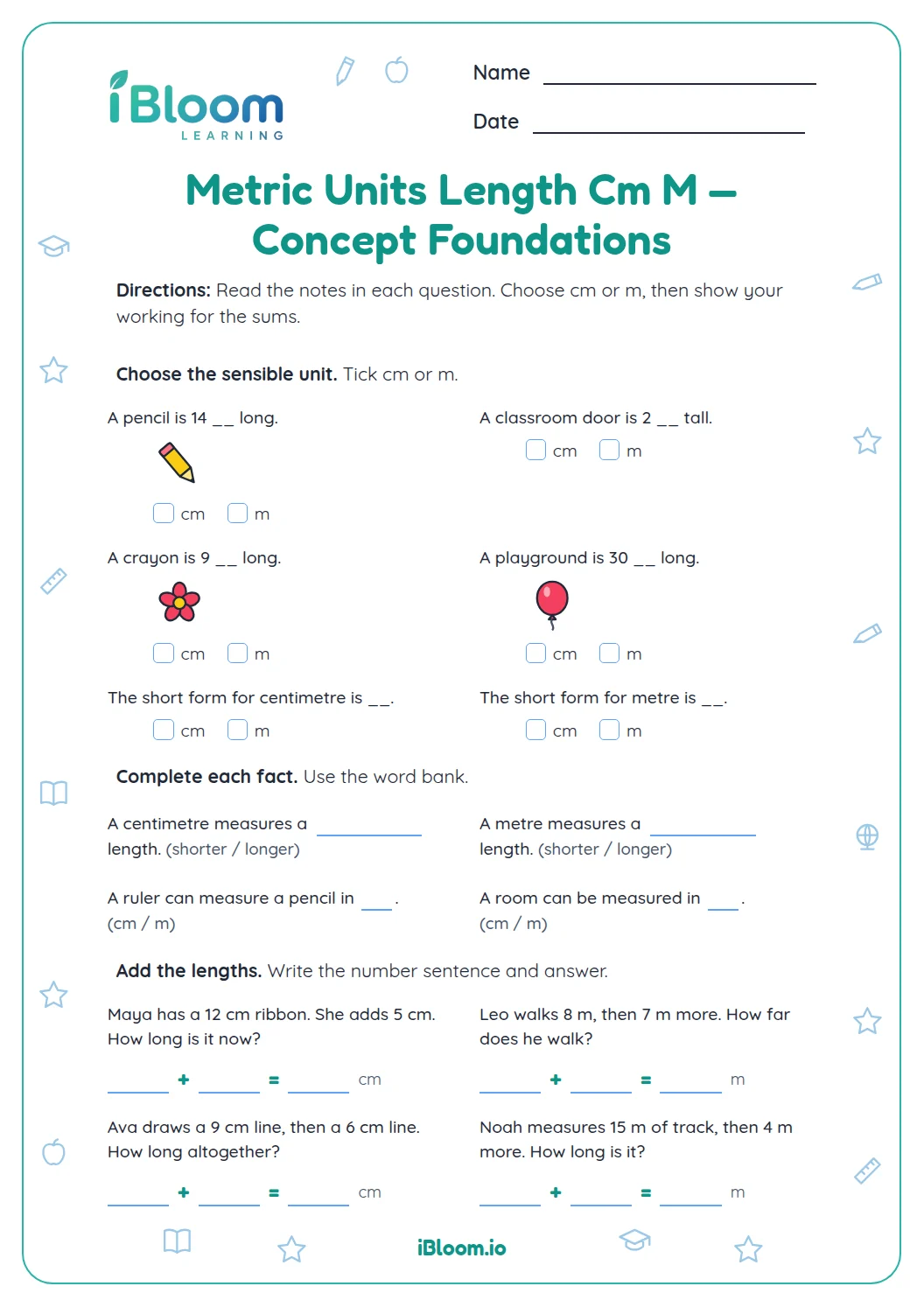


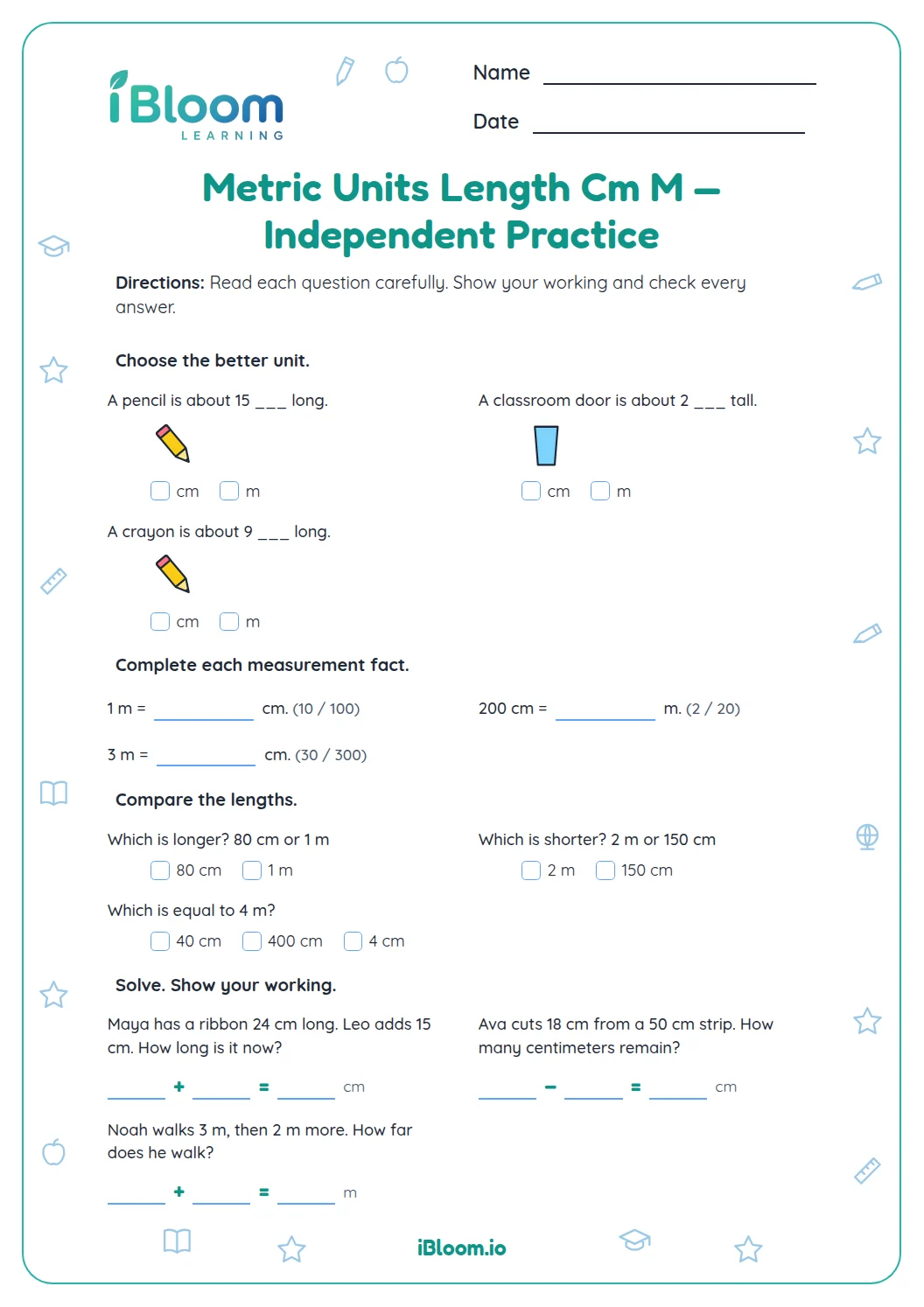
About this worksheet
This free printable worksheet gives Grade 2 students ten reasoning questions about how much longer or shorter one length is than another, with every length in centimeters and every number within 100. Part A asks for the missing length in number sentences such as 35 cm − ___ = 12 cm. Part B has four quick checks, including two true-or-false claims to test. Part C has two word problems where the wording points the wrong way. It practices Common Core 2.MD.B.5 and the comparing idea in 2.MD.A.4. A separate answer key shows every answer.
Aligned to 2.MD.B.5 and 2.MD.A.4
What is on this worksheet?
The page has three parts that get harder as they go. Part A has four number sentences with one length missing, such as ___ − 18 cm = 9 cm and 46 cm + ___ = 80 cm. Children write the missing length with its unit.
Part B has four choose-the-answer items. Two ask for a length that is a set amount longer or shorter (15 cm longer than 48 cm), and two give a claim to check, such as 31 cm + 25 cm is less than 58 cm. Part C has two word problems with working space and an answer box.
- All lengths in centimeters, all numbers within 100
- Some questions need regrouping, such as 75 − 46 and 61 − 25
- Two true-or-false claims, one true and one false, so children must check rather than guess
- Two word problems where the clue word (longer, shorter) points the opposite way
Why are the word problems tricky?
In question 9 a rope is 30 cm, and it is 8 cm longer than a string. Many children see the word longer and add, getting 38 cm. But the rope is the longer one, so the string must be shorter: 30 − 8 = 22 cm.
Question 10 flips it the other way. A pen is 15 cm and is 6 cm shorter than a ruler. The ruler is the longer one, so add: 15 + 6 = 21 cm. Asking which object is longer before doing any math is the habit this page builds.
- 1Rope: 30 cm. The rope is 8 cm longer than the string.
- 2So the string is the shorter one.
- 330 cm − 8 cm = 22 cm
- 4Check: 22 cm + 8 cm = 30 cm. The string is 22 cm.
How do you find a missing length in a number sentence?
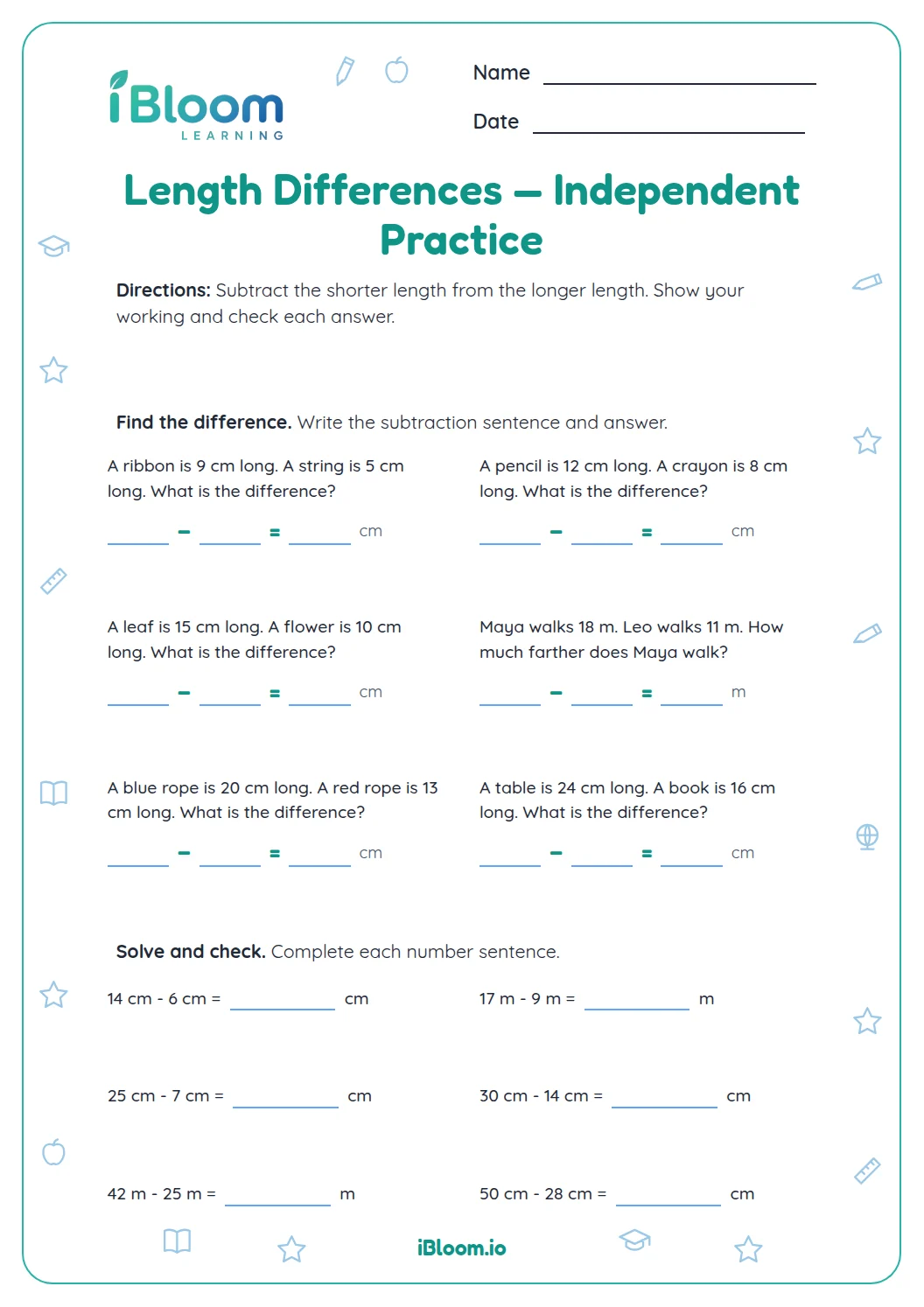
Think of the sentence as a story about two lengths and the difference between them. In 35 cm − ___ = 12 cm, you start at 35 cm and end at 12 cm, so the missing part is the jump from 12 to 35: 35 − 12 = 23 cm.
When the blank comes first, as in ___ − 18 cm = 9 cm, the missing length is the longest one. Put the two parts back together: 18 + 9 = 27 cm. A quick check by putting 27 cm back into the sentence catches most slips.
How to use this worksheet at home or in class
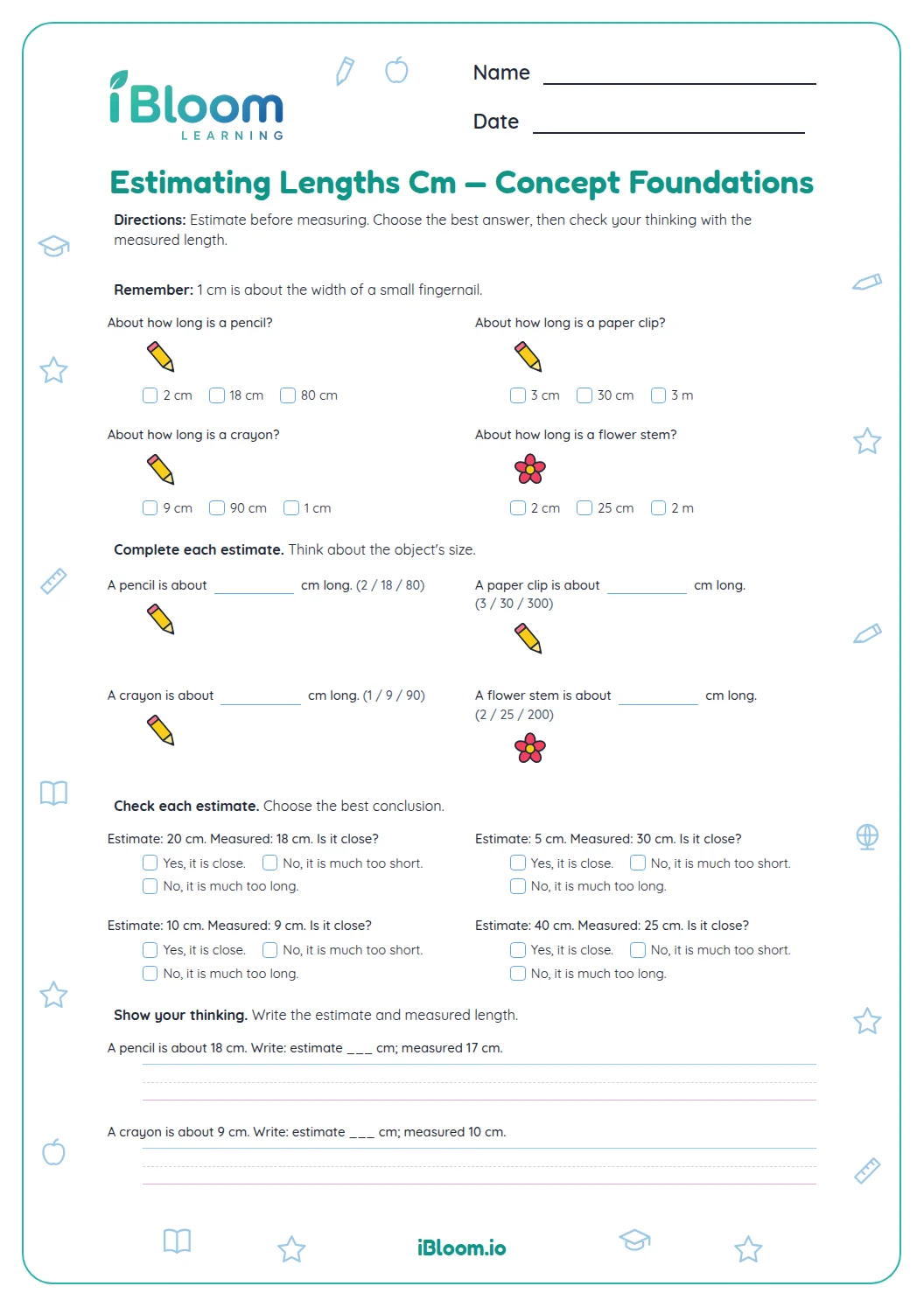
- 1Warm up with a real ruler: measure a pencil and a crayon in centimeters and ask how much longer the pencil is.
- 2Before Part A, read one sentence aloud as a story: “Something was 35 cm, part was cut off, and 12 cm was left.”
- 3For Part B, ask your child to check each claim with a quick subtraction before coloring True or False.
- 4For Part C, have your child draw two bars, label the longer one first, then decide whether to add or subtract.
- 5Check with the answer key, and for any miss ask: “Which one is longer? Does your answer make it longer?”
Common mistakes and quick fixes
The mistake
Adding whenever the problem says longer. In question 9, a child adds 30 + 8 and says the string is 38 cm.
The fix
Draw two bars and label the rope as the longer bar. If the string came out at 38 cm, it would be longer than the rope, which the problem says is not true.
The mistake
Subtracting the smaller digit from the bigger digit in each place, so 75 − 46 becomes 31 instead of 29.
The fix
Count up instead: from 46 to 50 is 4, from 50 to 75 is 25, and 4 + 25 = 29. Or regroup a ten before subtracting the ones.
The mistake
Writing only a number, or the wrong unit, as in 22 instead of 22 cm.
The fix
Have your child say the full answer aloud as a sentence (“The string is 22 cm long”) and then copy it into the answer box.
Common Core alignment
Most US states teach measurement with the Common Core standards or a close state version, so this page fits Grade 2 classrooms in most of the country.
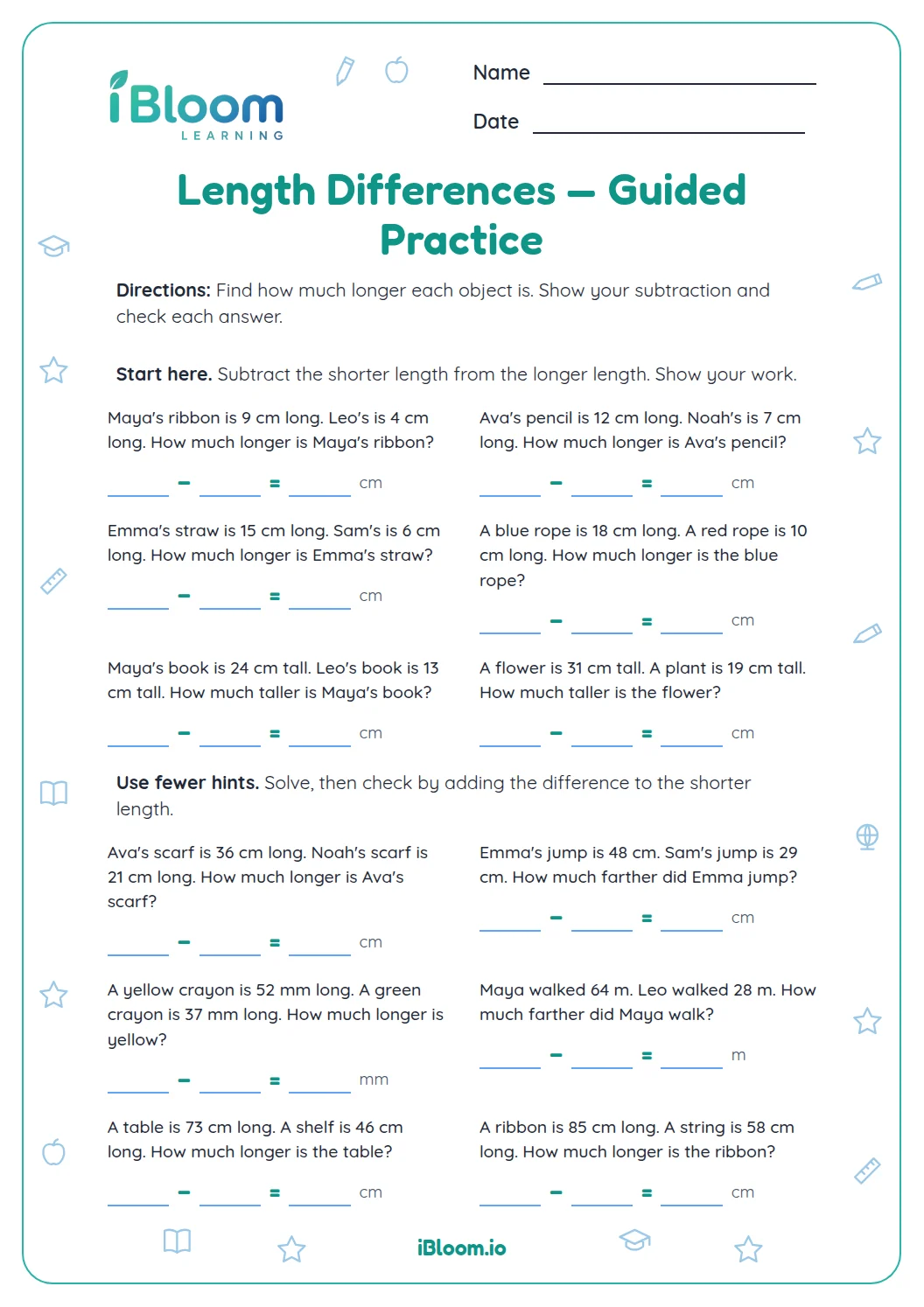
Solve length word problems by adding and subtracting within 100.
On this sheet: Every question adds or subtracts lengths in centimeters, including sentences with a missing length.
Show the official wordingHide the official wording
Use addition and subtraction within 100 to solve word problems involving lengths that are given in the same units, e.g., by using drawings (such as drawings of rulers) and equations with a symbol for the unknown number to represent the problem.
Find how much longer one object is than another, in standard units.
On this sheet: Part B and the word problems compare two lengths and give the difference in centimeters.
Show the official wordingHide the official wording
Measure to determine how much longer one object is than another, expressing the length difference in terms of a standard length unit.
What to practice next
Make more practice
Further reading
Questions parents and teachers ask
What is a length difference?
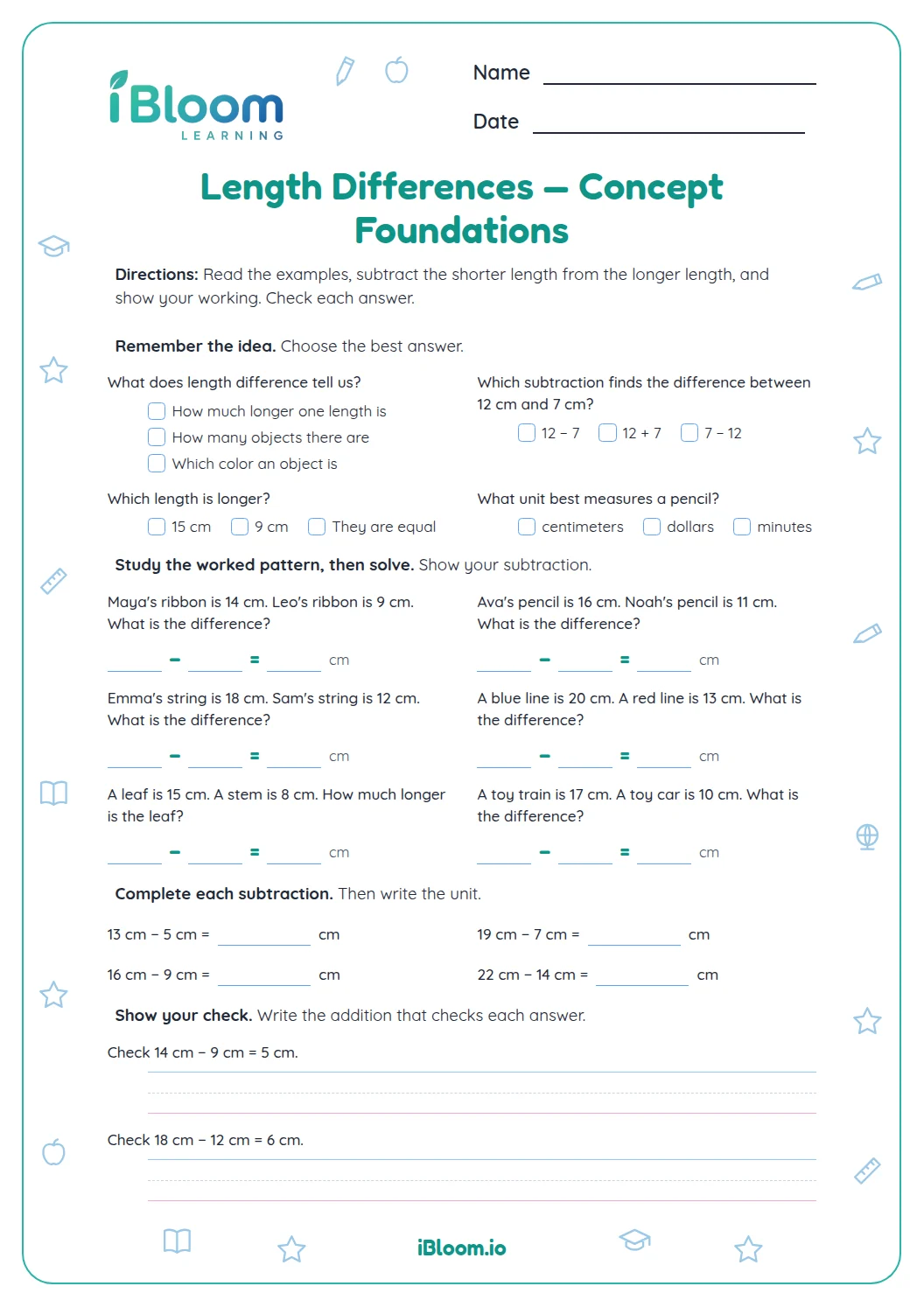
A length difference is how much longer one thing is than another. You find it by subtracting the shorter length from the longer one. On this worksheet, a 75 cm shelf and a 46 cm box have a difference of 29 cm, because 75 − 46 = 29. The answer always keeps its unit, centimeters.
What grade is this worksheet for?
This worksheet is written for Grade 2, where Common Core 2.MD.B.5 asks children to solve length word problems with addition and subtraction within 100. It works as a challenge late in the measurement unit, and as a quick review at the start of Grade 3 for children who still mix up longer and shorter.
Why is it called a reasoning challenge?
Most questions cannot be solved by grabbing the two numbers and subtracting. Children must decide which length is longer, check whether a claim is true, or notice that the word longer means they should subtract. Questions 7 and 8 are claims to test, and questions 9 and 10 reverse the usual clue words.
My child added in question 9. How do I help?
Draw two bars: a long one for the 30 cm rope and a shorter one for the string. Ask which bar is longer. Since the rope is longer by 8 cm, the string is 30 − 8 = 22 cm. Then ask whether 38 cm would make sense, since it would make the string longer than the rope.
Does my child need a ruler for this worksheet?
No, every length is printed as a number, so children only add and subtract. A centimeter ruler still helps as a number line: children can find 46 and count up to 75 to check question 7. Measuring real objects first, as 2.MD.A.4 asks, makes the numbers easier to picture.
Is there an answer key?
Yes. The answer key is a separate page that shows every missing length, the correct choice for each Part B item, and both word problem answers with centimeters. You can print the worksheet on its own and keep the key for checking, or download both as free PDFs from this page.