






About this worksheet
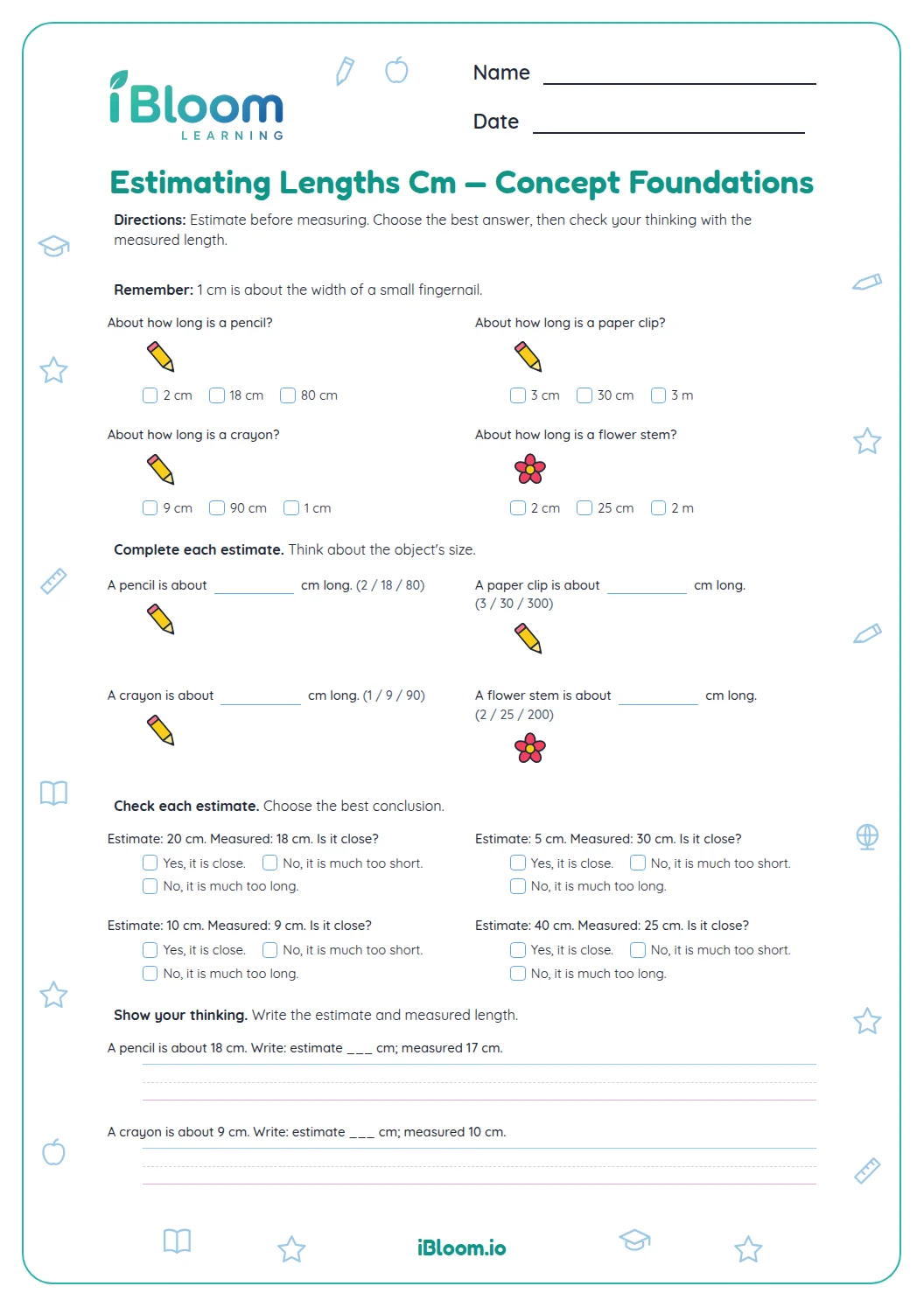
This Grade 2 worksheet practices estimating lengths in centimeters, the unit named in the title. Children judge familiar objects from a paper clip and crayon to a room and school bus, then compare their estimates with reasonable examples in the separate answer key. The aim is a sensible estimate rather than an exact measurement.
Aligned to 2.MD.A.3
What lengths will children estimate?
Part A estimates familiar objects, including a crayon, paper clip, door, and pencil. Part B continues with objects of different sizes, all estimated in centimeters.
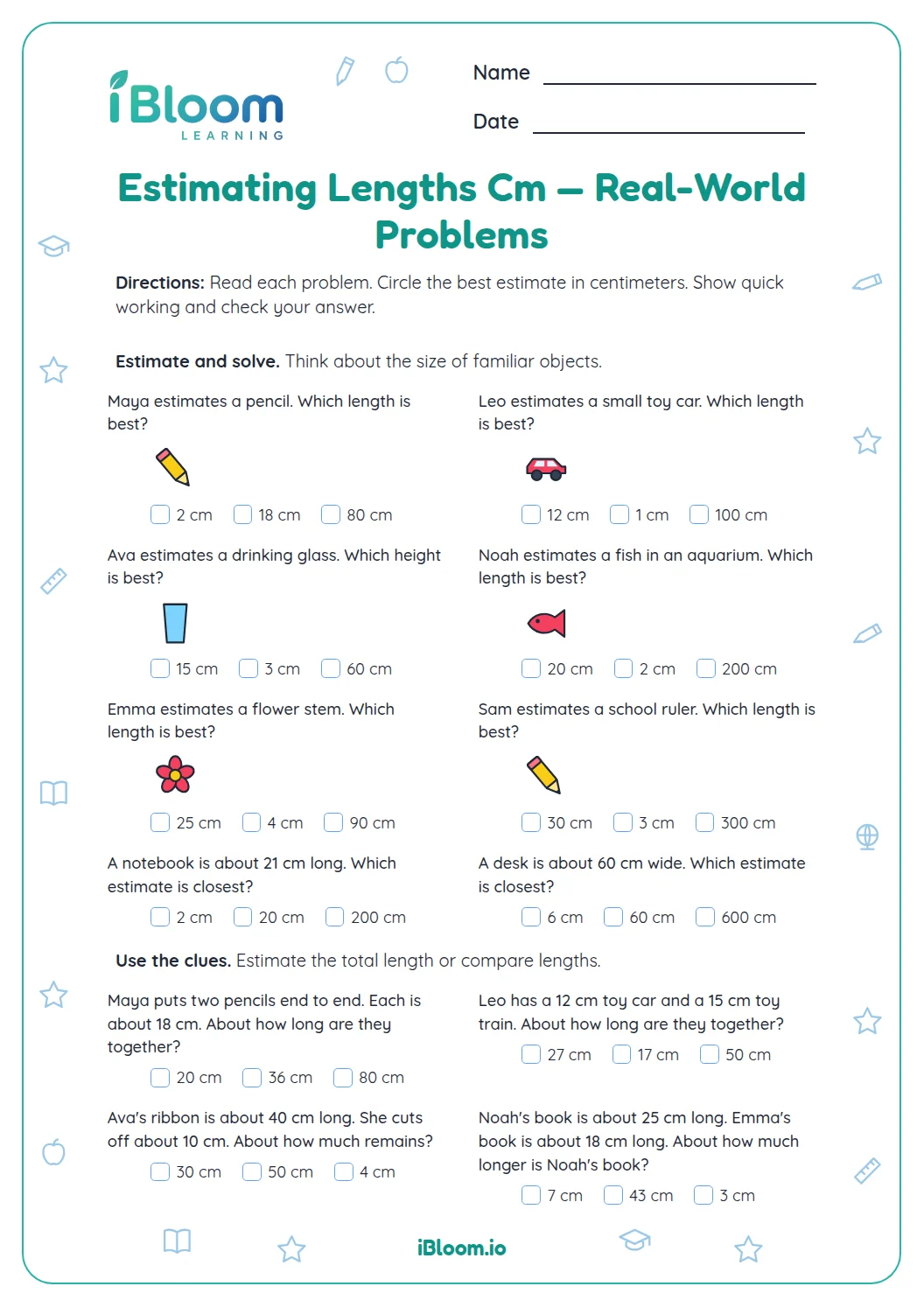
Part B continues with a wider range of objects, all estimated in centimeters. The answer key gives reasonable examples, not exact measurements for every real object.
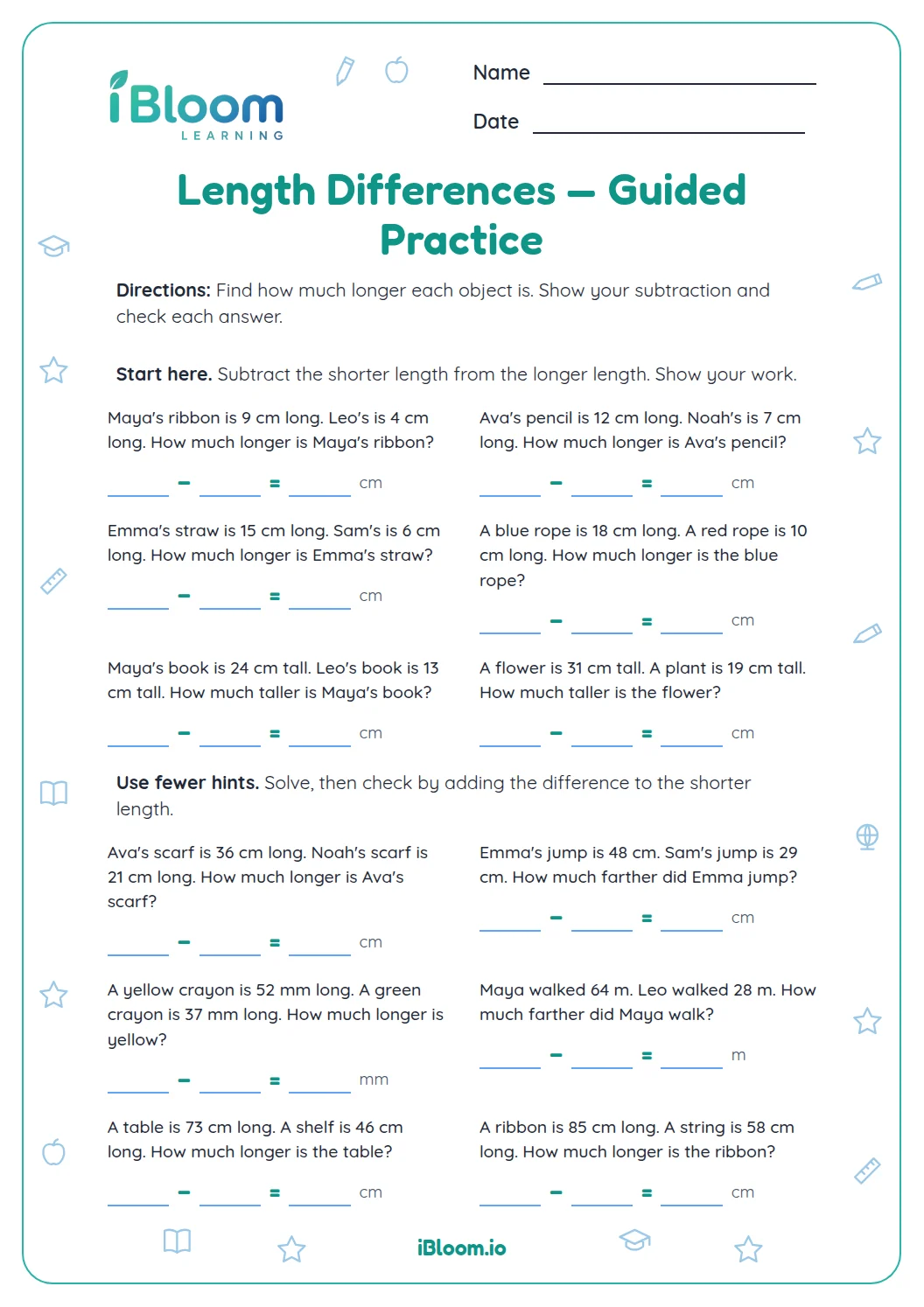
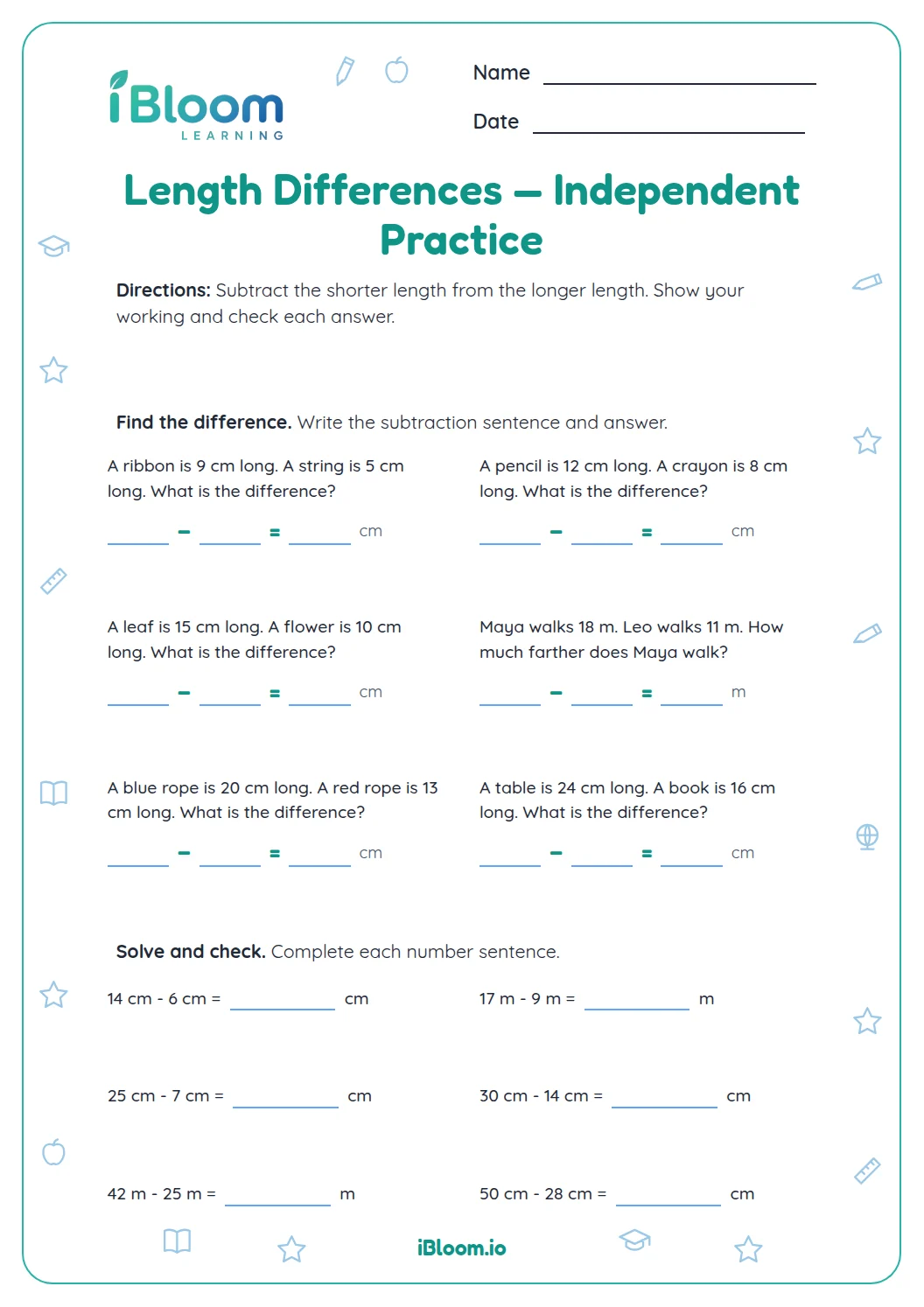
- All 16 items ask for a length in centimeters
- Small and large objects give practice judging scale
- The answer key offers reasonable sample estimates
How can a child choose a reasonable estimate?
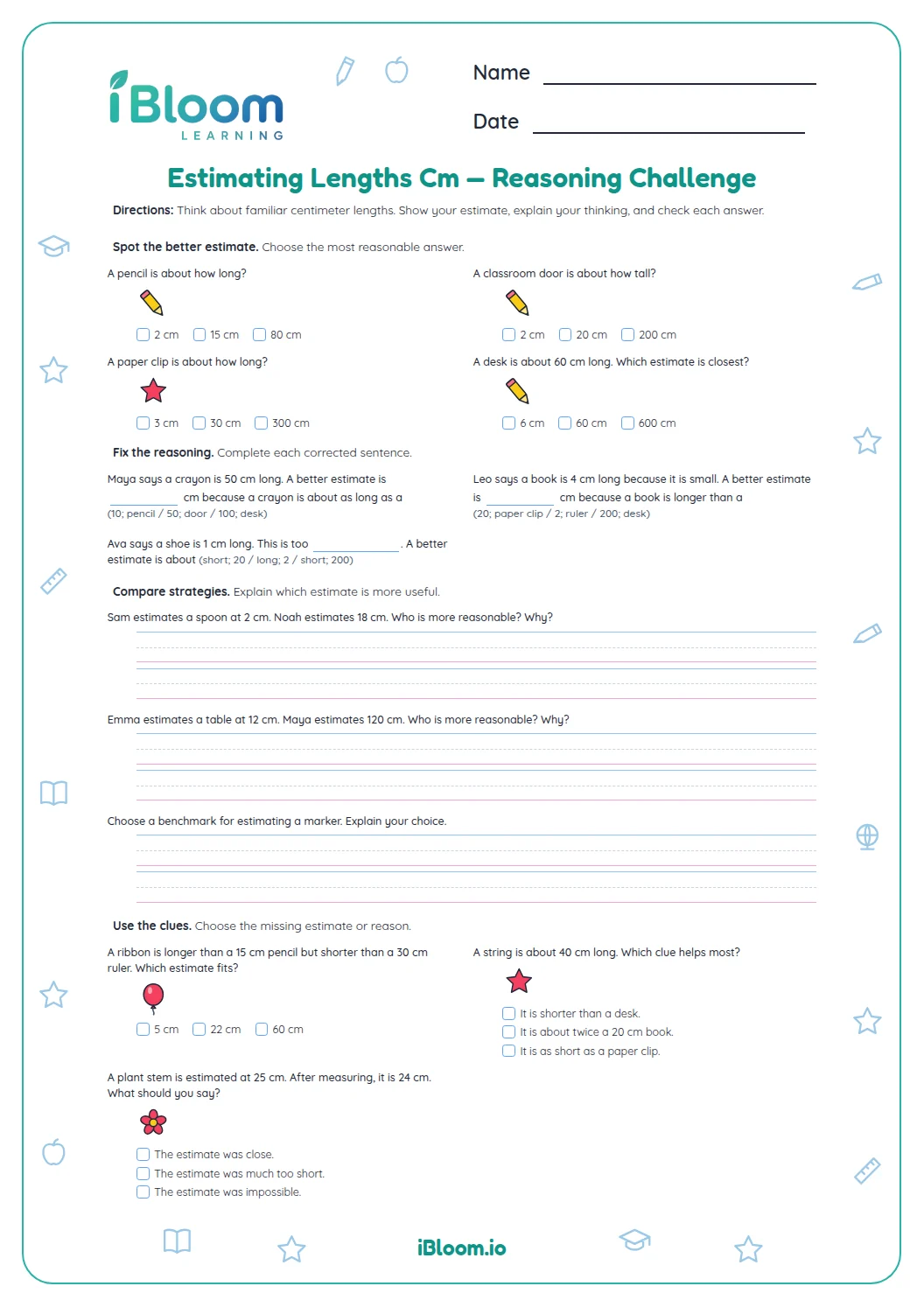
A pencil is roughly 18 centimeters long, and a doorway is roughly 2 meters tall. These are memory anchors, not exact measurements; real objects vary. Compare a new object with one of these familiar lengths before choosing.
For example, a paper clip is much shorter than a pencil, so 3 centimeters is sensible while 30 centimeters is not. A school bus is much longer than a room, so a few meters makes sense.
How to use the worksheet
- 1Read the object first and imagine holding or standing beside it.
- 2Decide whether centimeters or meters are the more useful unit.
- 3Compare the answer choices with a familiar benchmark such as a pencil or doorway.
- 4Use the key to discuss why a tempting estimate is too short or too long.
Common estimating slips
The mistake
Choosing a large number in centimeters for a very long object.
The fix
Ask whether the object is room-sized or larger; meters are usually easier for those lengths.
The mistake
Choosing meters for a small hand-held object.
The fix
Compare it with a pencil. Most small objects are only a few centimeters long.
Common Core alignment
Children estimate lengths using centimeters and compare their estimates with familiar benchmarks.
Estimate lengths using familiar objects and centimeters.
On this sheet: Children estimate familiar objects using centimeters.
Show the official wordingHide the official wording
Estimate lengths using units of inches, feet, centimeters, and meters.
What to practice next
Make more practice
Questions parents and teachers ask
How can a child estimate an object’s length?
Start with a familiar object whose length you can picture, such as a pencil. Compare the target with that benchmark, then choose an amount that is plausible in centimeters. This worksheet includes both small objects and much larger ones so children practice keeping the unit fixed while judging different scales.
When should a child choose centimeters instead of meters?
Every estimate on this page is requested in centimeters, including the room, bus, slide, and flagpole. Large objects will need many centimeters. The key gives sample amounts to discuss scale; an estimate does not have to match a particular real object exactly.
Does this worksheet ask children to measure anything?
No. The questions ask for sensible estimates, so children can complete the page without a ruler. Measuring a few real objects afterward is a helpful way to discuss whether an estimate was close. Invite the child to explain which benchmark helped them choose, even when their answer differs from an exact measurement.
What Grade 2 skill does this page practice?
It practices estimating length with standard units, including centimeters and meters. CCSS 2.MD.A.3 names this skill. The familiar objects help children connect written units and numbers to lengths they can picture, while the answer choices show how an incorrect unit can make an estimate far too small or large.