

About this worksheet
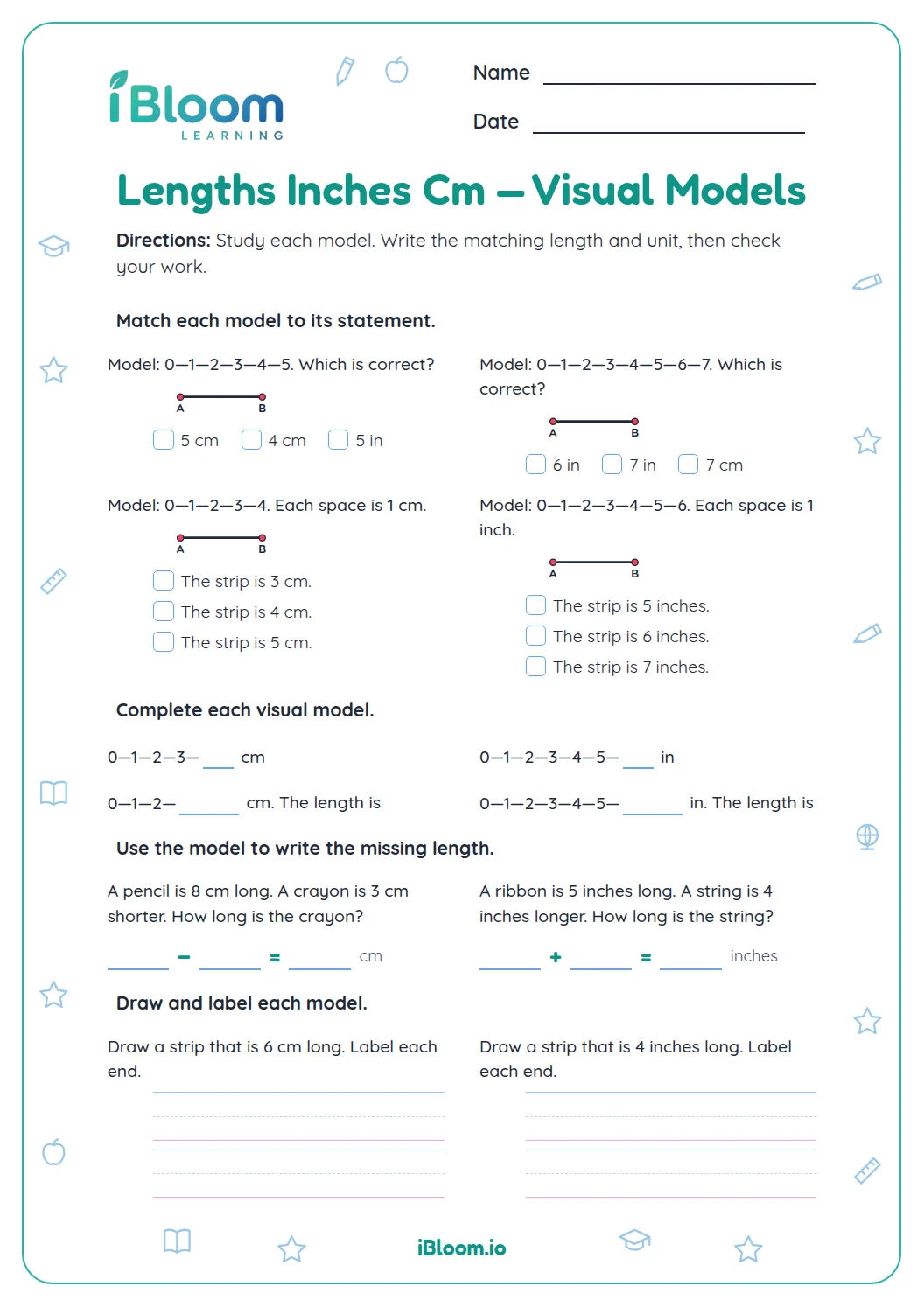
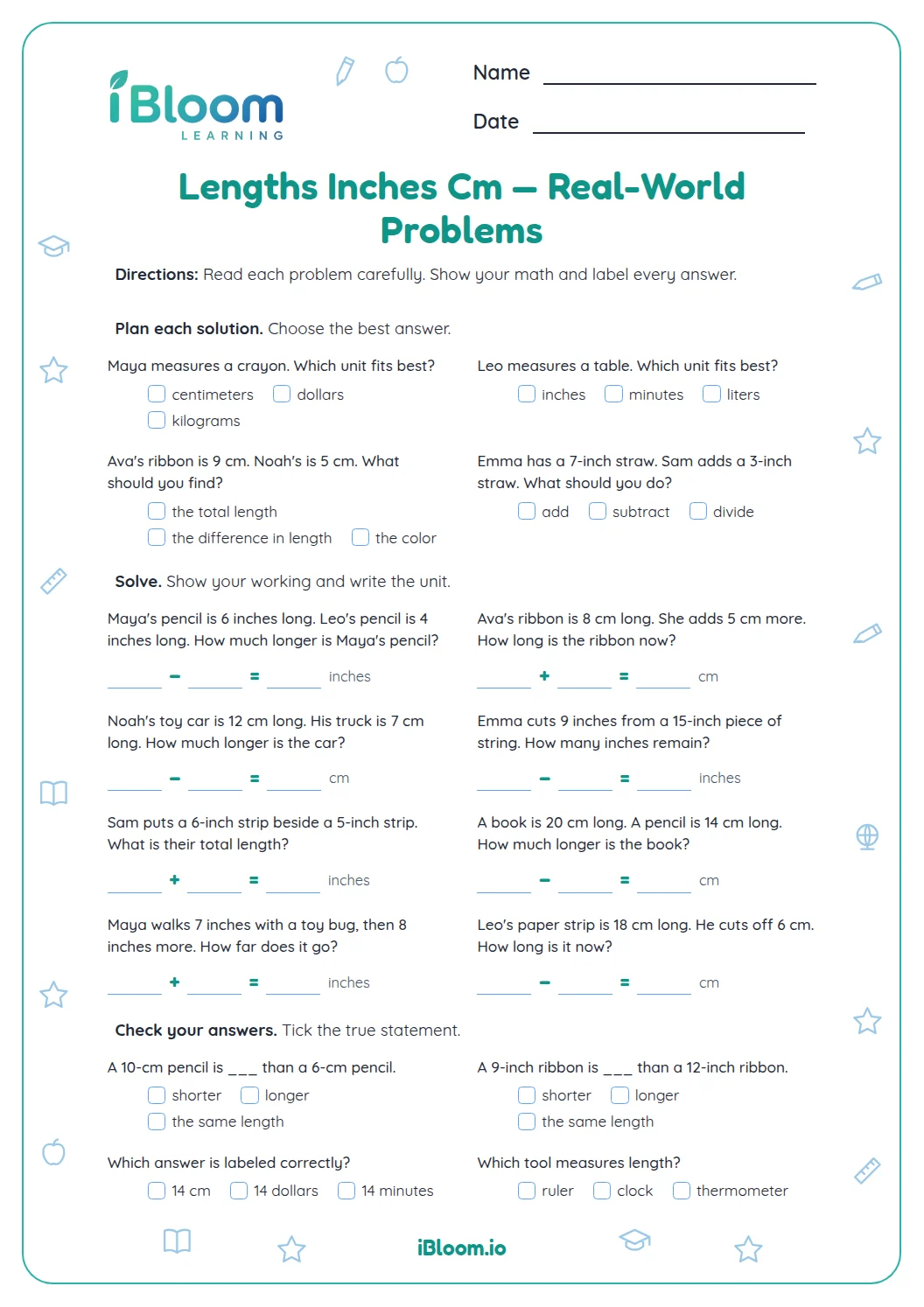
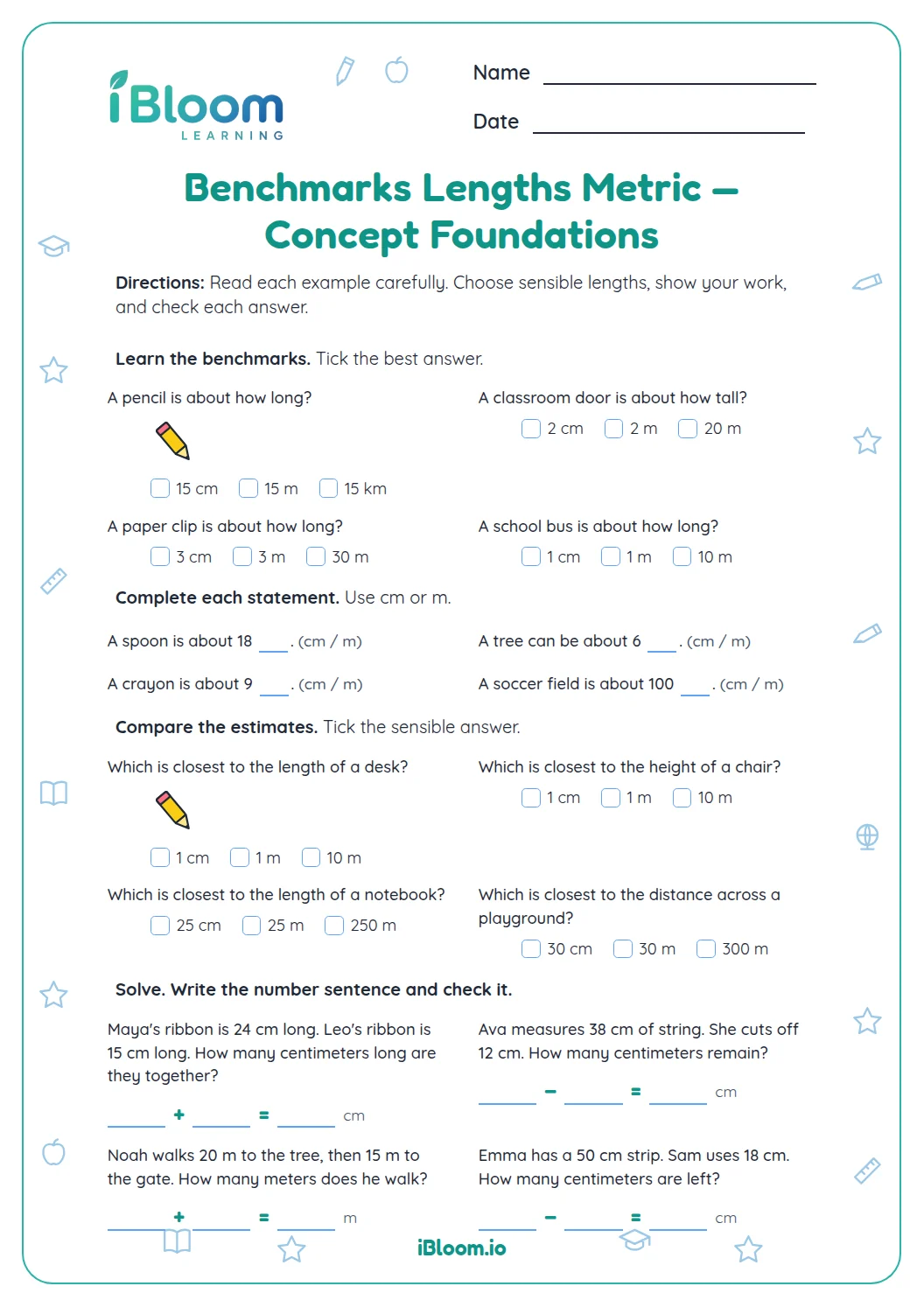
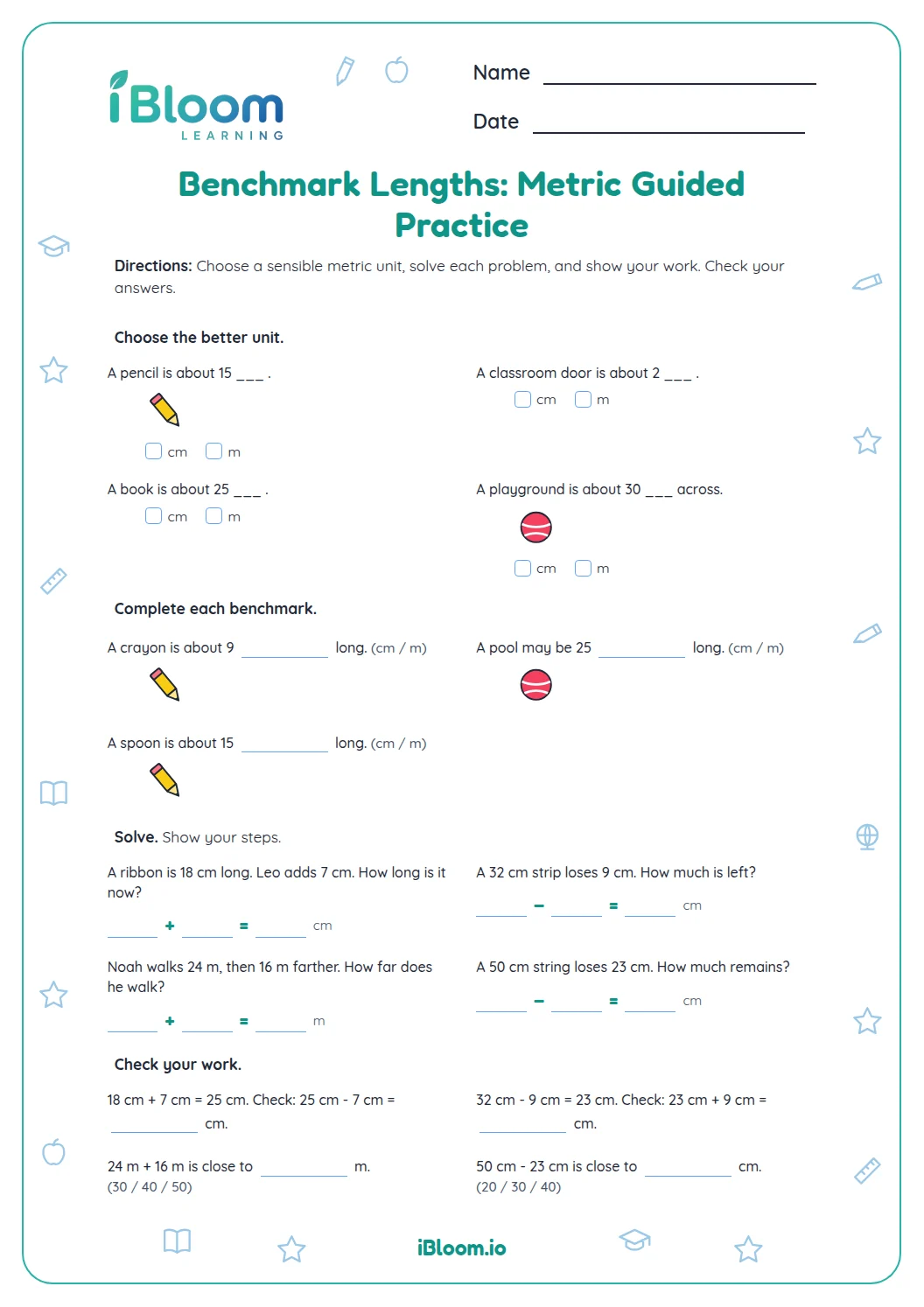
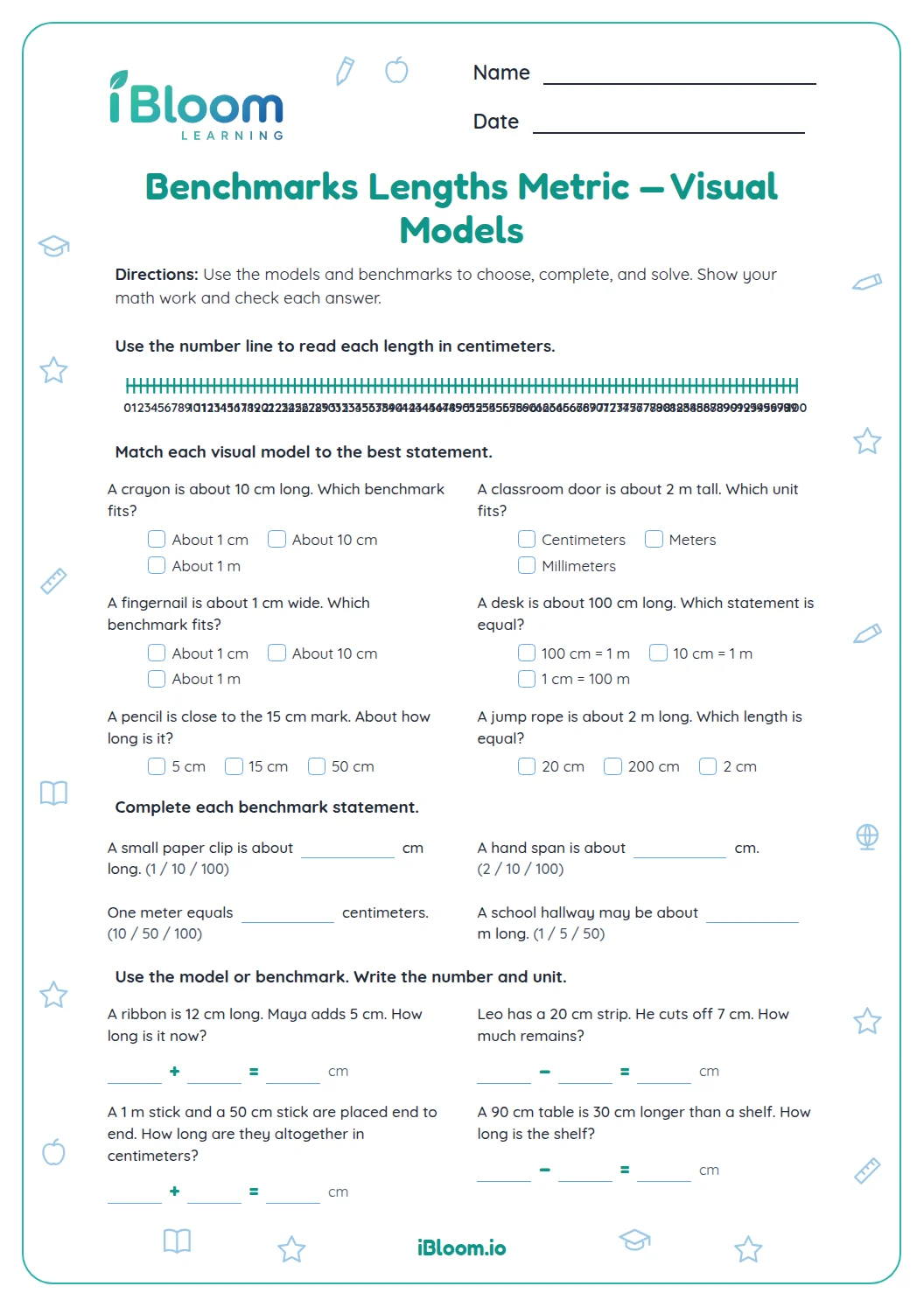
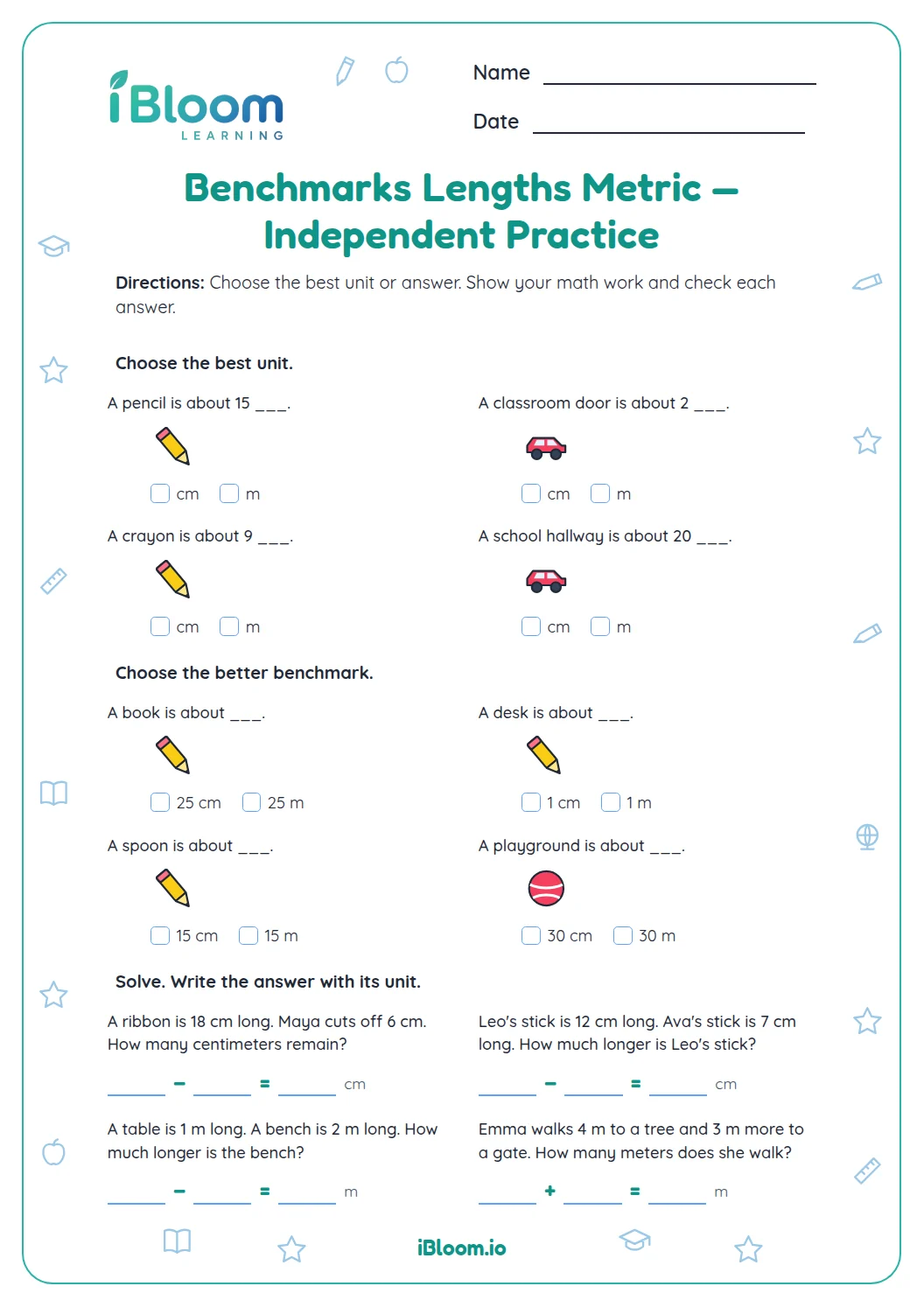
This free printable gives Grade 2 students 14 guided questions about inches and centimeters. Children identify unit labels, record stated measurements, compare lengths in the same unit, and solve short joining or difference stories. The page keeps measurements supplied, so students focus on reading and using the units rather than measuring a picture. The answer key shows each response.
Aligned to 2.MD.B.5
How do students read inch and centimeter labels?
Part A connects abbreviations and familiar objects with units, then records supplied lengths. A label of 6 in means six inches; students do not need to measure an image.
How do students solve length stories?
Part B adds or subtracts measurements stated in the same unit. In question 7, 8 cm − 5 cm = 3 cm, so Emma’s ribbon is 3 cm longer.
How should students compare two lengths?
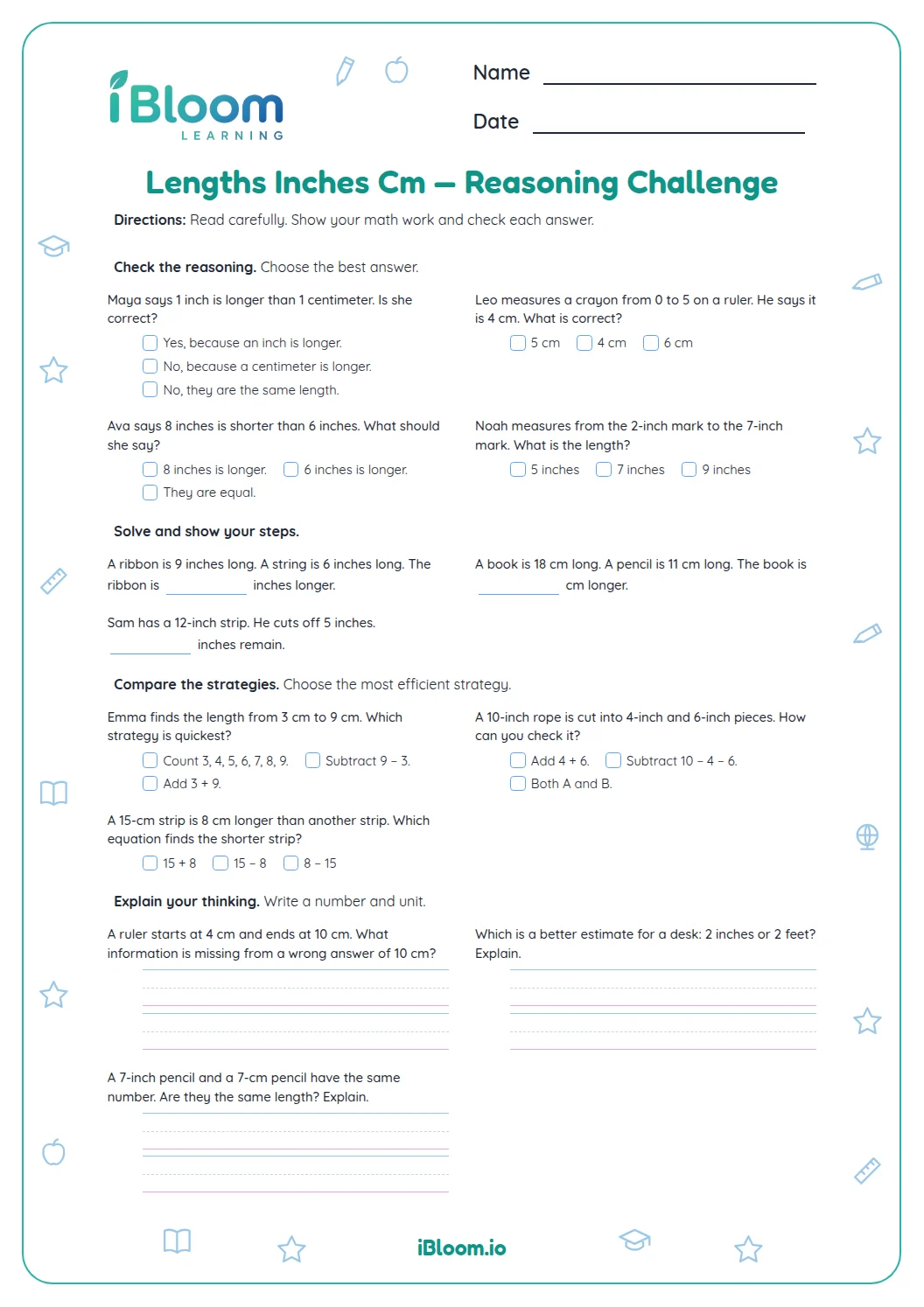
Part C uses >, <, and = with matching units. For 8 cm and 5 cm, choose > because 8 is greater than 5. Check the units before comparing the numbers.
How to work through the page
- 1Read the unit abbreviation before using the number.
- 2For comparisons, check that both lengths use inches or both use centimeters.
- 3Add when lengths are joined; subtract to find a difference.
- 4Write or select the answer with the unit attached.
Common mistakes and quick fixes
The mistake
Comparing 8 cm and 6 in by number alone.
The fix
Compare measurements only when they share a unit.
The mistake
Adding lengths when asked how much longer one is.
The fix
Subtract the shorter length from the longer length.
The mistake
Writing a unit that differs from the story.
The fix
Carry inches or centimeters through the equation and answer.
Common Core alignment
This practice connects inch and centimeter length stories to the listed Grade-level standard.
Solve same-unit length word problems with addition and subtraction within 100.
On this sheet:
Show the official wordingHide the official wording
Use addition and subtraction within 100 to solve word problems involving lengths that are given in the same units, e.g., by using drawings (such as drawings of rulers) and equations with a symbol for the unknown number to represent the problem.
What to practice next
Make more practice
Further reading
Questions parents and teachers ask
Does the worksheet ask students to measure a picture?
No. Each length used in a calculation is supplied in the question, and the instructions focus on reading units, comparing lengths, and solving short stories. Students identify inches and centimeters without measuring an image or bringing a ruler.
How many questions are included?
The worksheet has 14 questions in three compact parts. It includes unit choices, stated lengths, same unit addition and subtraction stories, and comparisons. The separate answer key lists an answer for every question, including the comparison symbols and units where needed.
Can children compare inches directly with centimeters?
The comparison questions pair measurements in the same unit, such as 8 cm and 5 cm or 3 in and 6 in. A number of inches should not be compared with a number of centimeters by looking only at the numerals; convert only if a question asks for it.
What does the abbreviation “in” mean?
The abbreviation “in” stands for inches, and “cm” stands for centimeters. The worksheet asks students to identify these labels and keep the correct unit with each supplied length. For example, a 6 in ribbon is six inches long.
How should students decide whether to add or subtract?
Join two lengths by adding them. Find how much longer one measurement is by subtracting the shorter length from the longer one. For example, Emma’s 8 cm ribbon is 3 cm longer than Sam’s 5 cm ribbon because 8 − 5 = 3.