




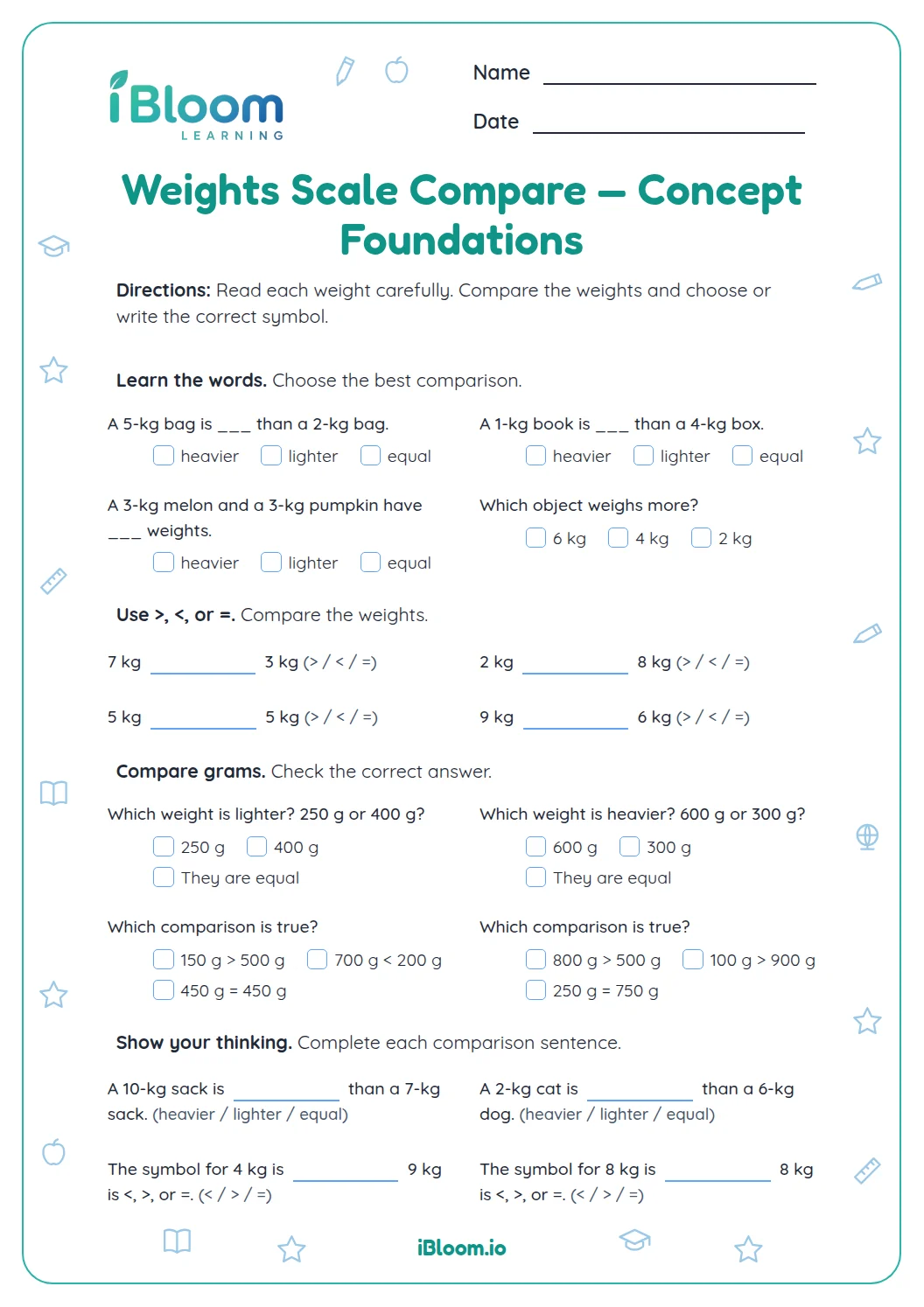

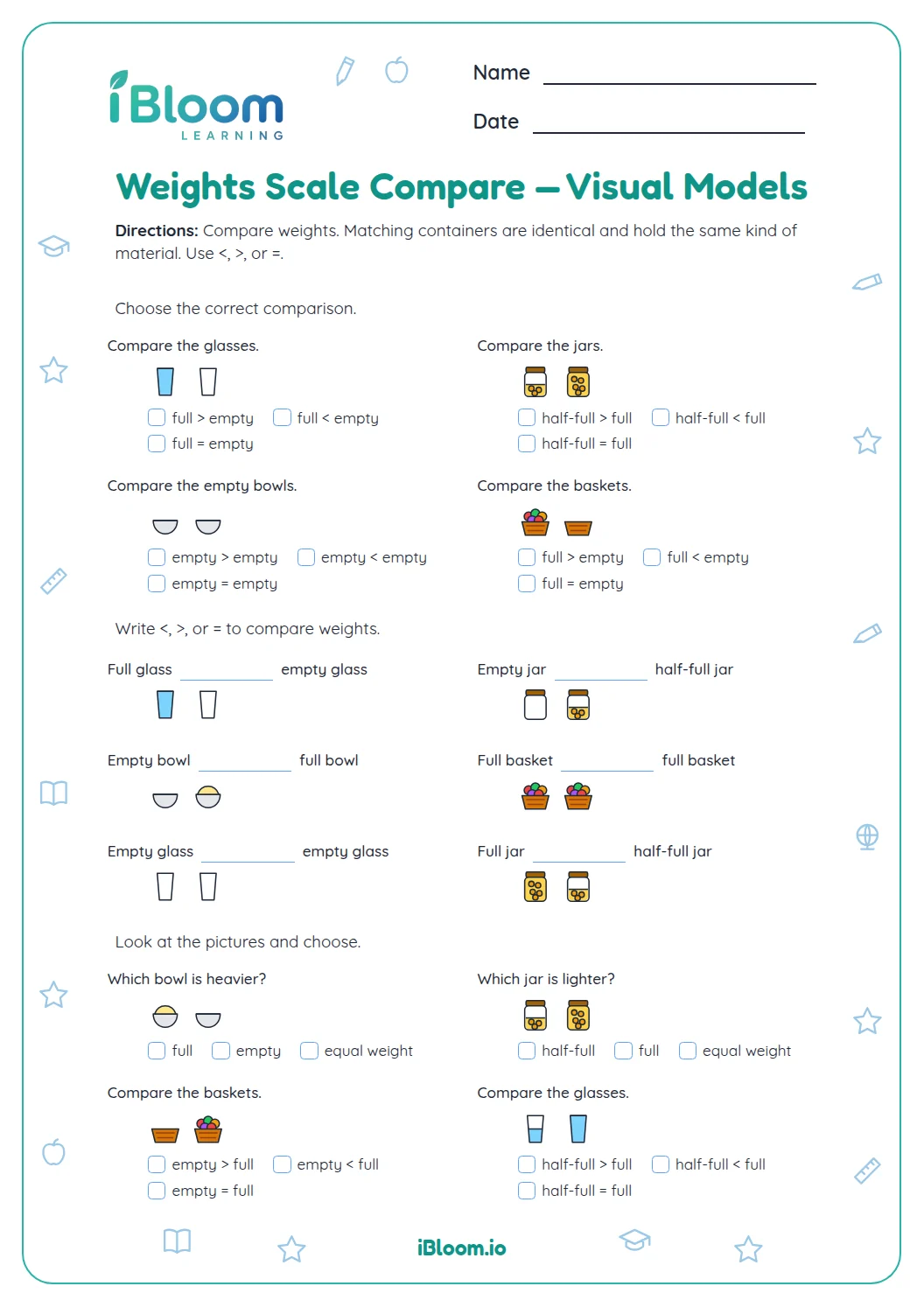
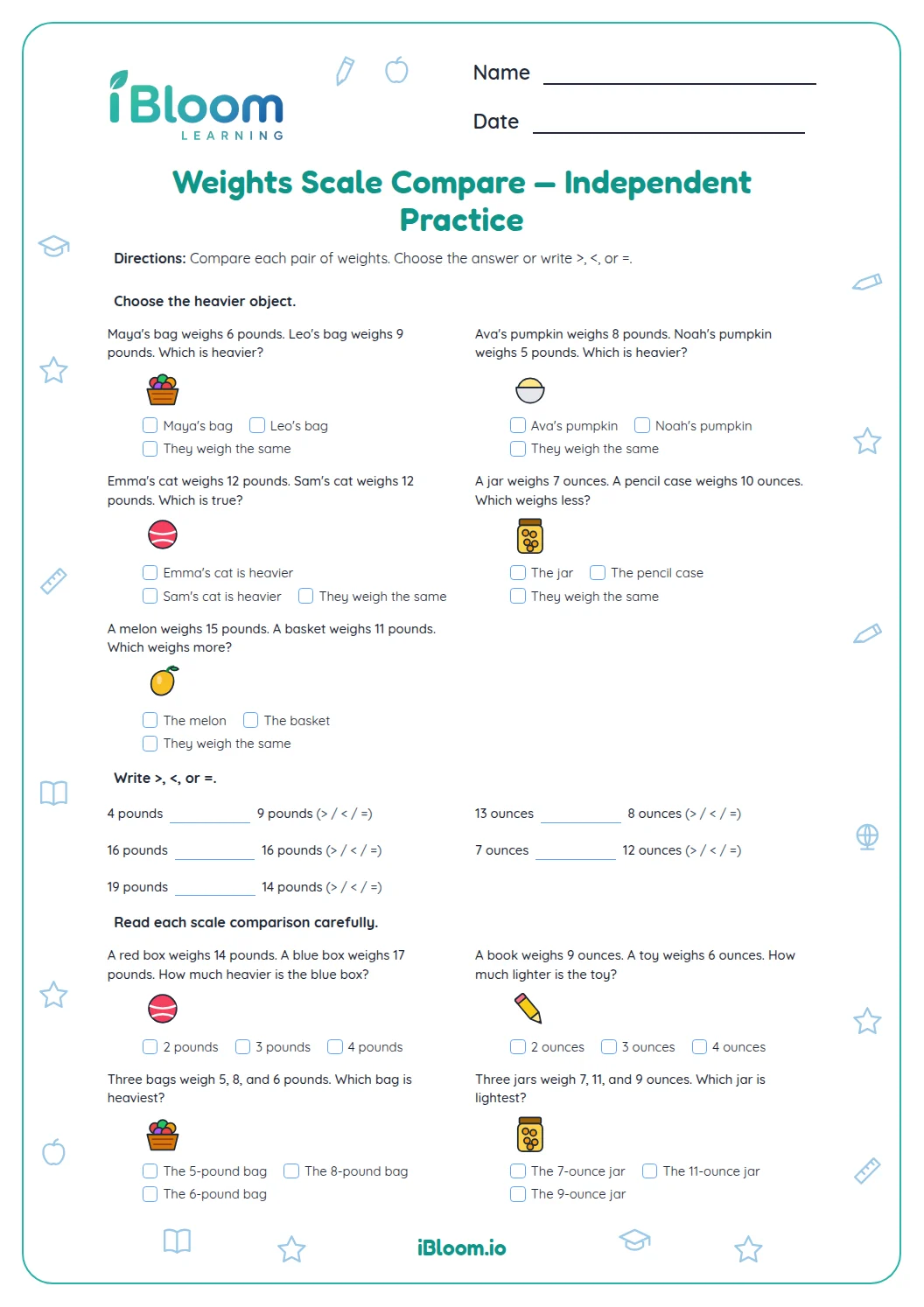
About this worksheet
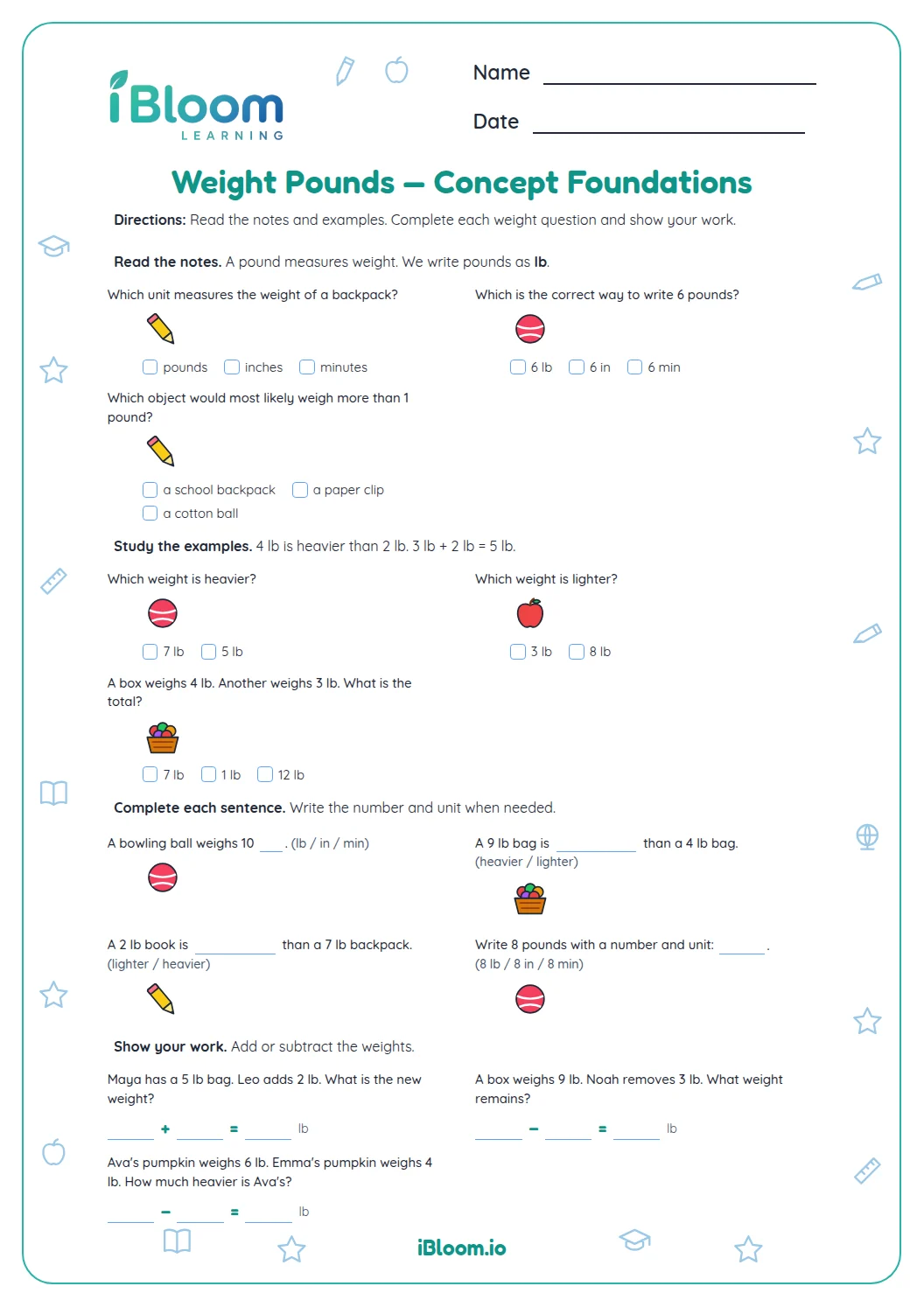
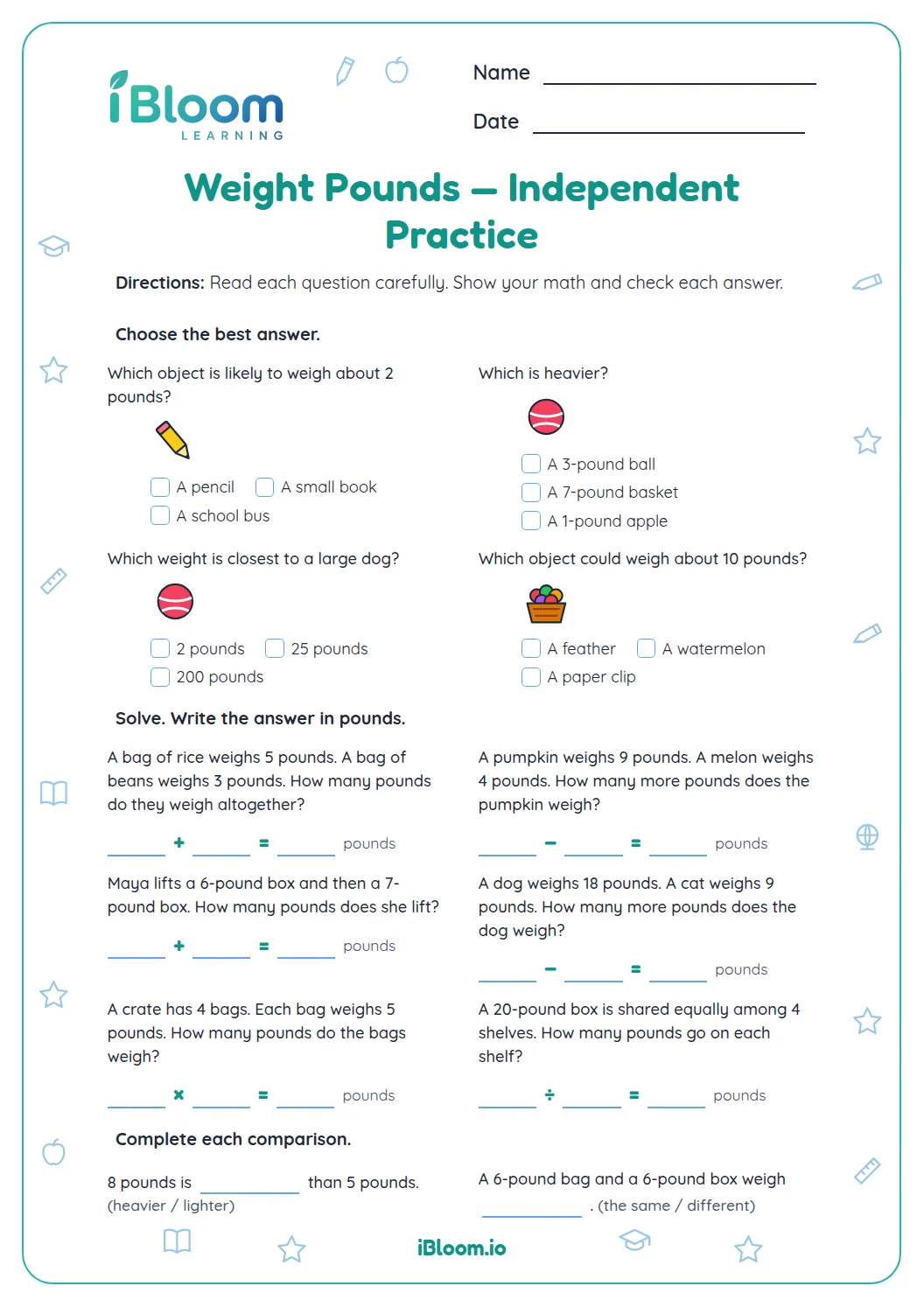
This free Grade 2 worksheet uses pounds in 14 short weight problems. Children compare heavier and lighter amounts, find missing weights, and check totals using addition and subtraction within 100. The situations keep one unit throughout, so students can focus on choosing an operation and explaining the relationship. A two-page worksheet and separate answer key are included.
Aligned to 2.OA.A.1
How do the weight clues work?
Each item gives a weight in pounds and a relationship such as heavier, lighter, or together. Keep the unit in mind, then decide whether the unknown is a part, a whole, or a difference.
For example, a 38 lb box is 14 lb heavier than a bag. Subtract 14 from 38 to find the bag weighs 24 lb.
What kinds of problems are included?
The 14 questions move from short weight relationships to missing-number sentences and checks of totals. All amounts stay within 100 pounds, with no unit conversion.
How can a child check an answer?
Put the answer back into the clue. If the bag is 24 lb, then 24 + 14 equals the 38 lb box. For a total, add the two weights and compare the sum with the claim.
How to use this worksheet
- 1Read the whole clue before choosing an operation.
- 2Name the known weights and the unknown weight.
- 3Check whether the answer makes the heavier or lighter relationship true.
- 4Use the answer key after finishing both parts.
Common mistakes and quick fixes
The mistake
Adding when the unknown is the lighter weight.
The fix
Sketch the heavier weight as the whole; subtract the difference to find the lighter amount.
The mistake
Reporting the difference as the combined weight.
The fix
Ask whether the clue says “how much more” or “together,” then choose subtraction or addition.
The mistake
Forgetting to test a true-or-false total.
The fix
Calculate the sum first and compare it with the stated total.
Common Core alignment
Solve one- and two-step addition and subtraction word problems within 100.
On this sheet: Students add and subtract pounds in comparison and total situations with unknown weights.
Show the official wordingHide the official wording
Use addition and subtraction within 100 to solve one- and two-step word problems involving situations of adding to, taking from, putting together, taking apart, and comparing, with unknowns in all positions, e.g., by using drawings and equations with a symbol for the unknown number to represent the problem.
What to practice next
Make more practice
Further reading
Questions parents and teachers ask
What does this pounds worksheet practice?
It practices addition and subtraction in weight situations. Across 14 questions, children compare amounts, find missing weights, and check totals, using pounds in every problem. The numbers stay within 100, so the main task is interpreting words such as heavier, lighter, and together.
Does the worksheet ask children to convert pounds?
No. Every weight is already given in pounds, and answers stay in pounds. That lets children focus on the relationship in each problem, such as finding a lighter weight or adding two loads, without changing units. After solving, they can check by putting the answer back into the original clue.
How can I explain “14 pounds heavier”?
Say that the heavier object has 14 pounds more than the lighter one. If the heavier object weighs 38 pounds, subtract 14 to find the other weight: 38 − 14 = 24 pounds. Then check by adding 14 back to 24.
How many questions and pages are included?
There are 14 questions on two worksheet pages, followed by a separate two-page answer key. The practice includes word problems, missing-weight number sentences, comparisons, and true-or-false checks about totals. This gives an adult room to review each answer.
What should a child do when checking a weight claim?
Work out the amount described, then compare it with the claim. For a statement about two bags together, add their weights. For a statement about how much heavier one is, subtract the lighter weight from the heavier weight.