
About this worksheet
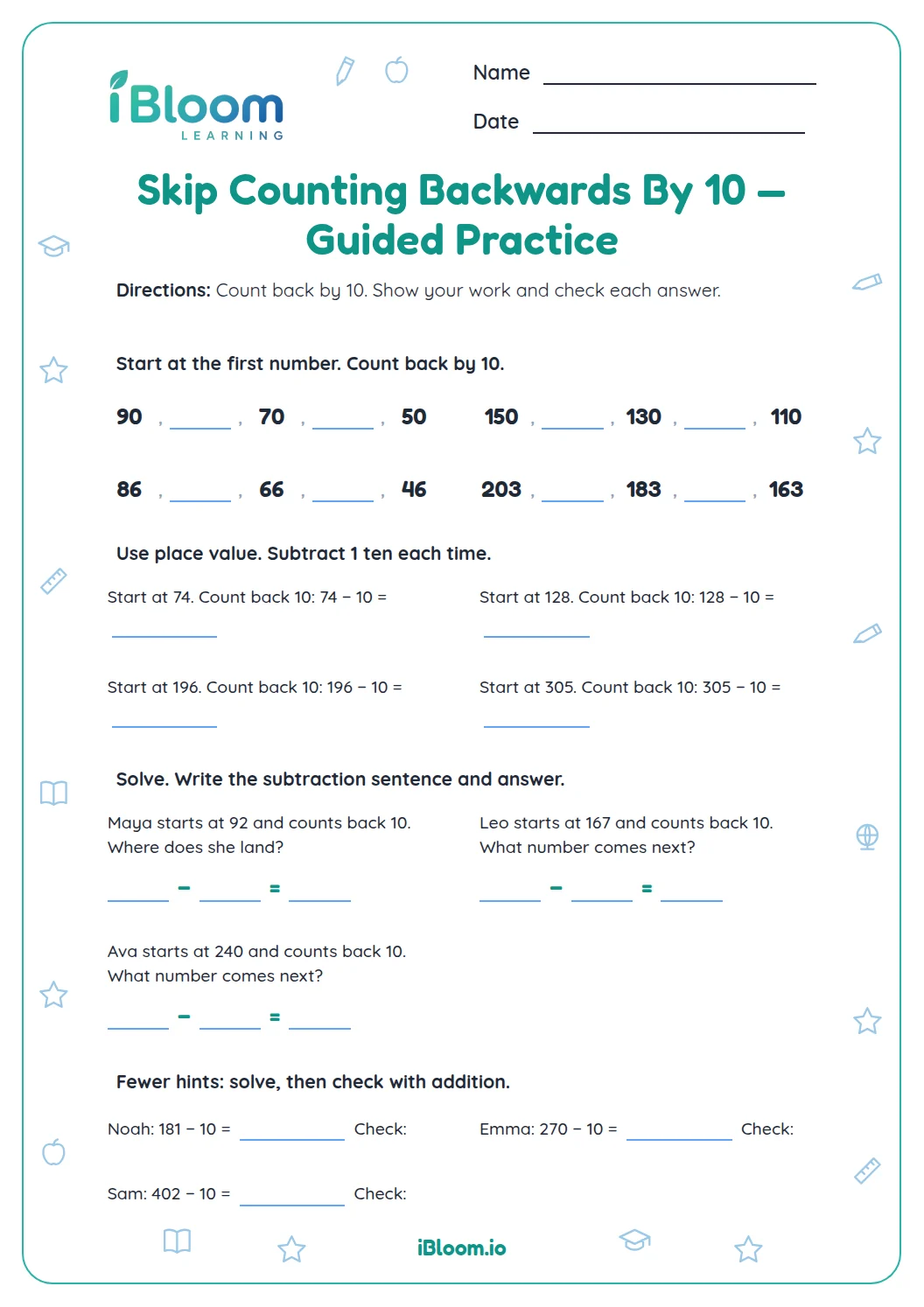
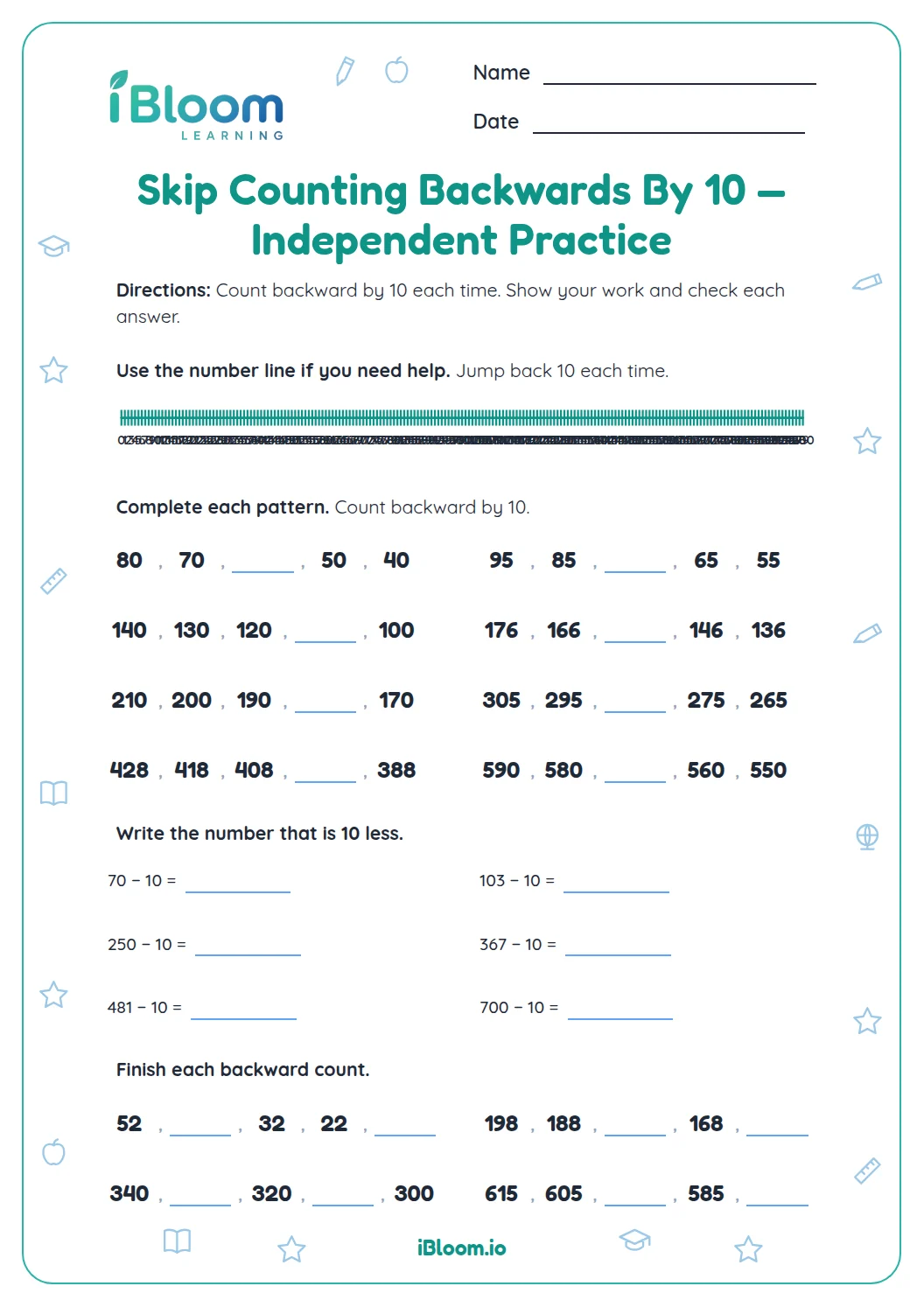
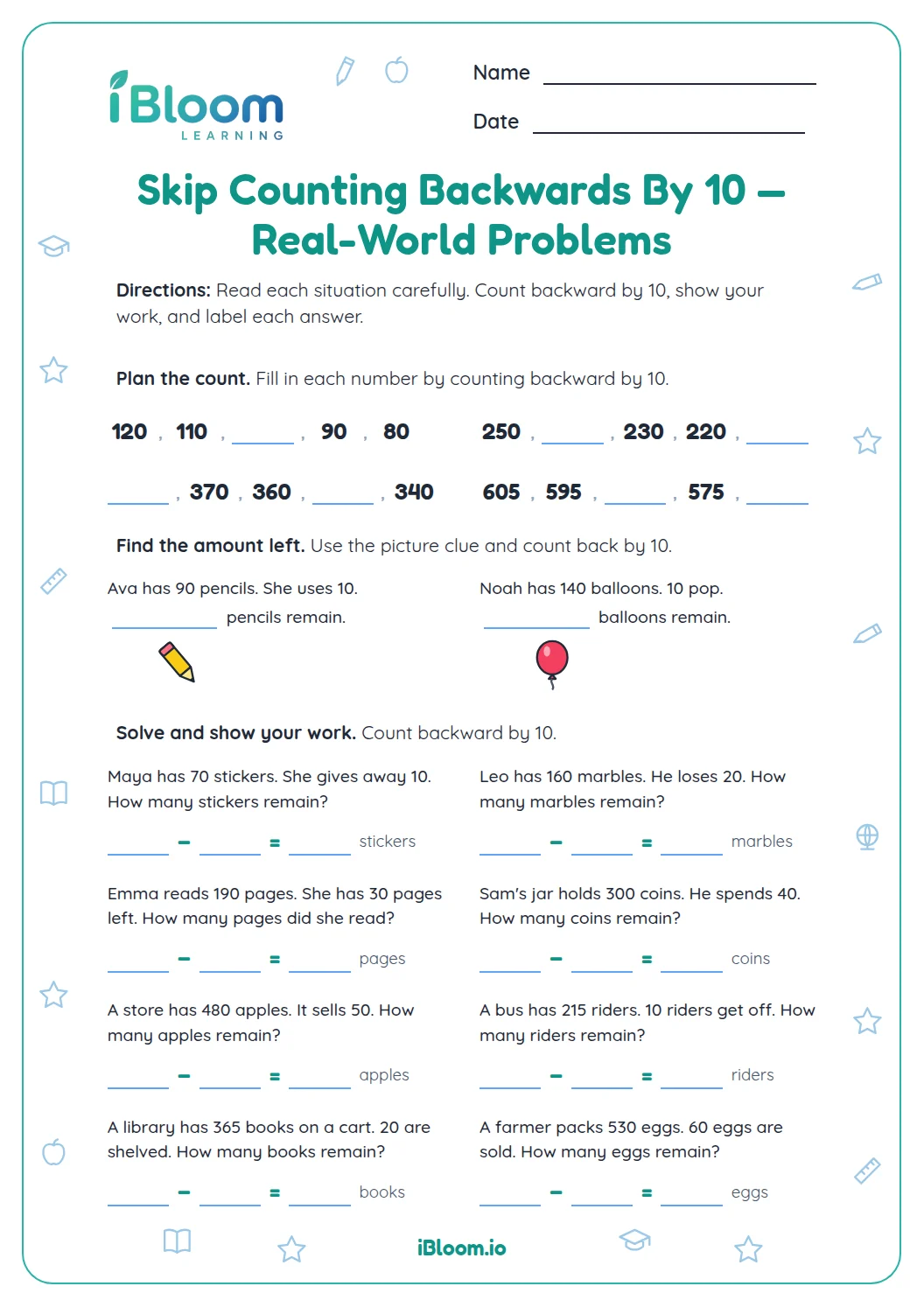
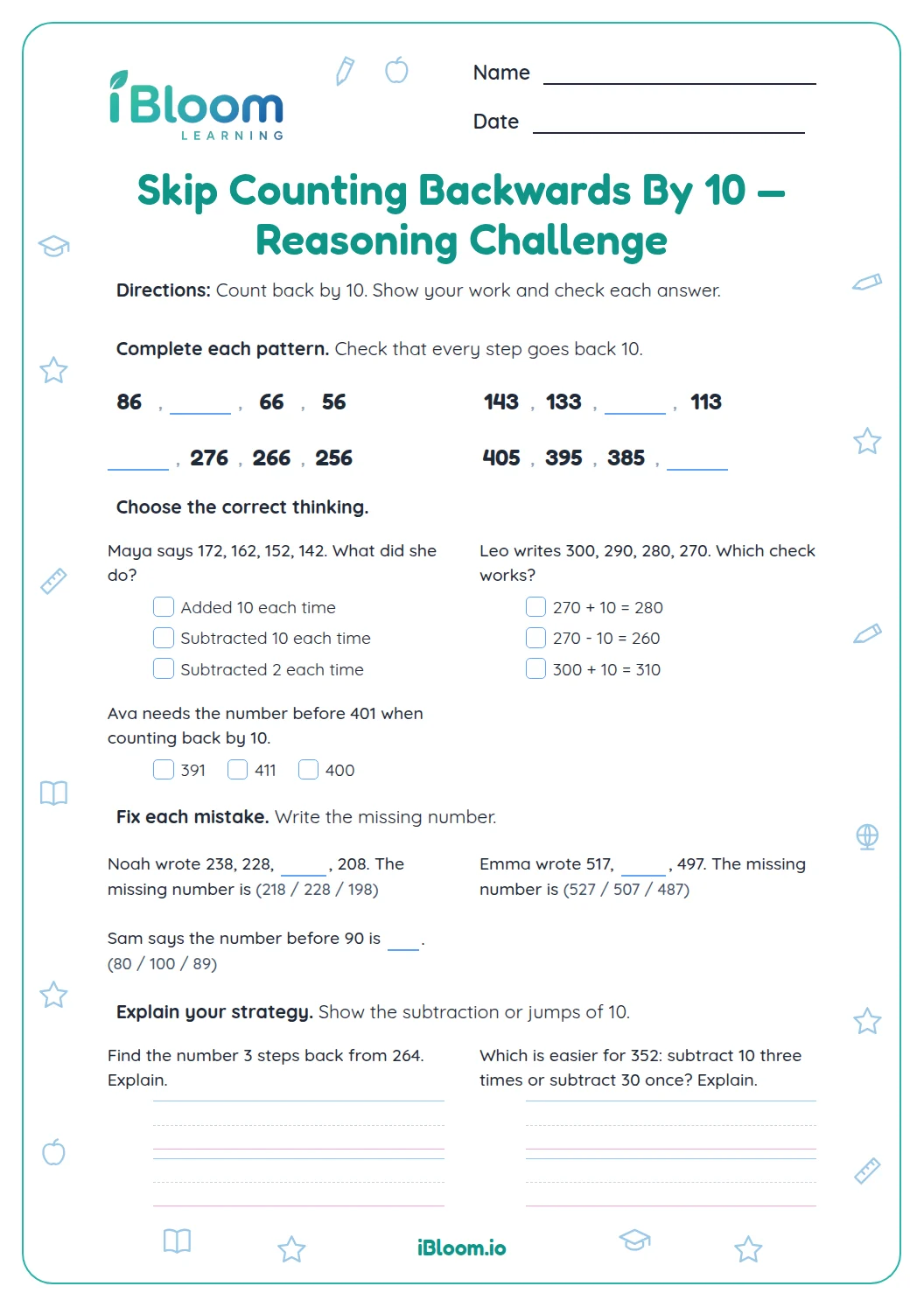
This free printable worksheet is for Grade 2 learners practicing skip counting backward by 10. It moves from reading a visual model to solving a short application, with 15 questions across three parts and a separate answer key. The page explains how to notice the key features, record an answer, and check it. It aligns with 2.NBT.A.2, which calls for learners to count within 1,000; skip-count by 5s, 10s, and 100s..
Aligned to 2.NBT.A.2
How does counting backward by 10 work?
Each backward jump of 10 changes the tens digit by one group of ten. The ones digit stays the same when there is no regrouping across a hundred.
- 1Start at 684.
- 2Jump back 10: 674.
- 3Jump back 20: 664.
- 4Subtract three tens: 684 − 30 = 654.
What will children practice?
The sheet moves from number-line jumps to subtraction sentences. The number range stays within 1,000.
How to use this worksheet
- 1Say each number aloud as you move one tick left.
- 2Keep the ones digit in view.
- 3For several jumps, count the tens rather than subtracting one at a time.
- 4Check the final number by adding the tens back.
Common mistakes and quick fixes
The mistake
Changing the ones digit during a simple jump of 10.
The fix
Read the directions again, mark the important information, and check the answer against the model or operation.
The mistake
Moving forward instead of backward.
The fix
Read the directions again, mark the important information, and check the answer against the model or operation.
The mistake
Counting 20 back as two hundred instead of two tens.
The fix
Read the directions again, mark the important information, and check the answer against the model or operation.
Common Core alignment
This worksheet practices the following Common Core skill.
Count within 1,000; skip-count by 5s, 10s, and 100s.
On this sheet: The questions ask learners to count within 1,000; skip-count by 5s, 10s, and 100s..
Show the official wordingHide the official wording
Count within 1000; skip-count by 5s, 10s, and 100s.
What to practice next
Make more practice
Further reading
Questions parents and teachers ask
Why does the ones digit stay the same?
Adding or subtracting one ten changes the tens place by 10, so the ones place stays fixed. For example, 684 becomes 674 after one backward jump. When a number crosses a hundred, regrouping changes the hundreds and tens digits, so track each jump carefully.
How can a number line help?
A number line makes each group of ten visible as one equal jump. Start at the given number and move left for backward counting. Count the jumps, then read the endpoint. This helps children avoid treating each jump as one unit.
What does “20 less” mean?
Add the amount taken away to the answer. If a problem starts at 684 and subtracts 30, check that 654 + 30 returns to 684. This confirms the direction and size of the change. Children can also count forward by tens from the result to the starting number.
Should children count backward by ones?
The goal is to notice groups of ten, so each jump represents ten. Counting each individual number is possible but hides the skip-counting pattern. Encourage children to say the sequence by tens and point to each model tick. Ask the learner to explain the clue they used so the answer connects back to the skill.
How can I check an answer?
Add the amount taken away to the answer. If a problem starts at 684 and subtracts 30, check that 654 + 30 returns to 684. This inverse check confirms both the direction and the size of the change. Ask the learner to explain the clue they used so the answer connects back to the skill.