




About this worksheet
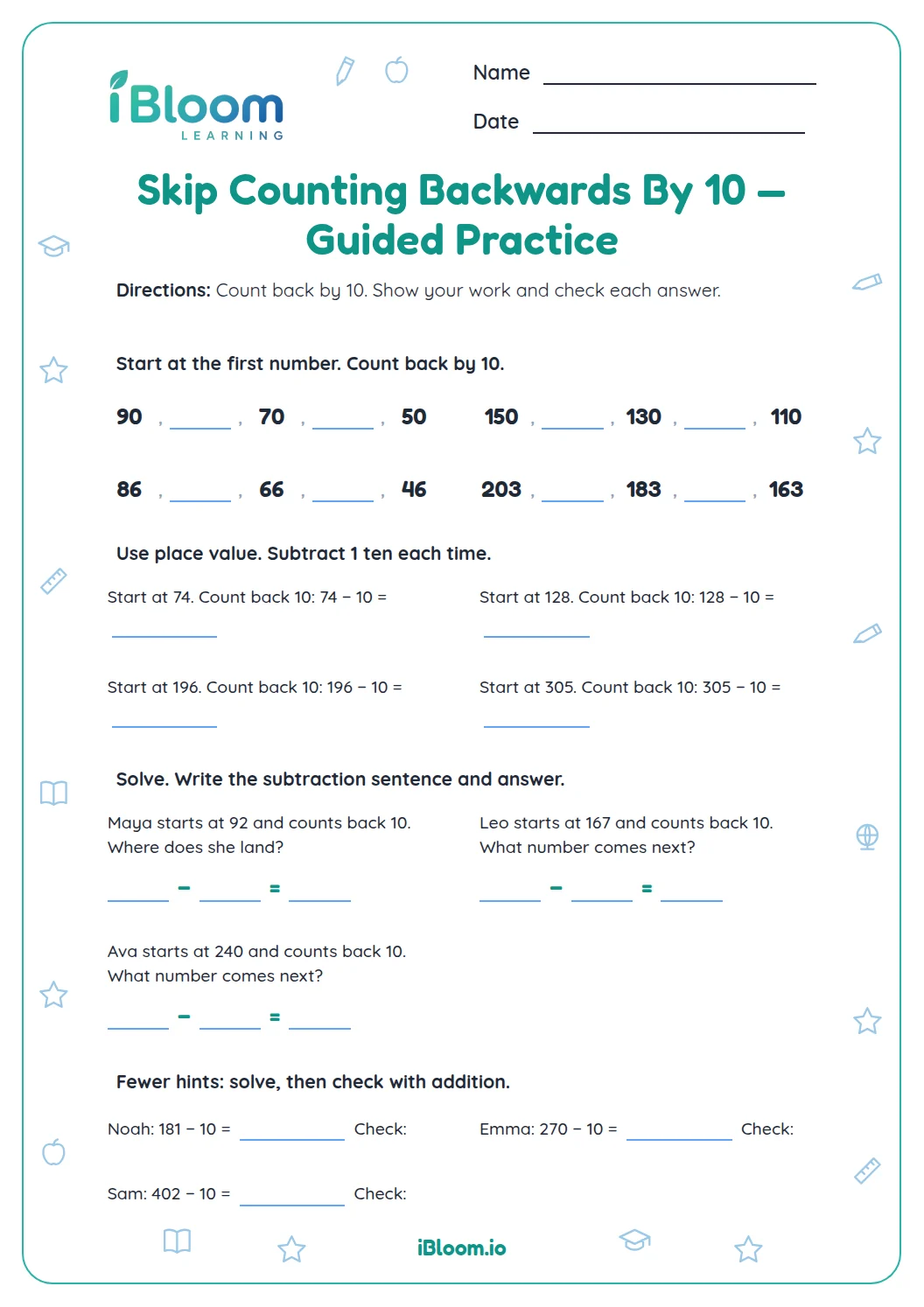
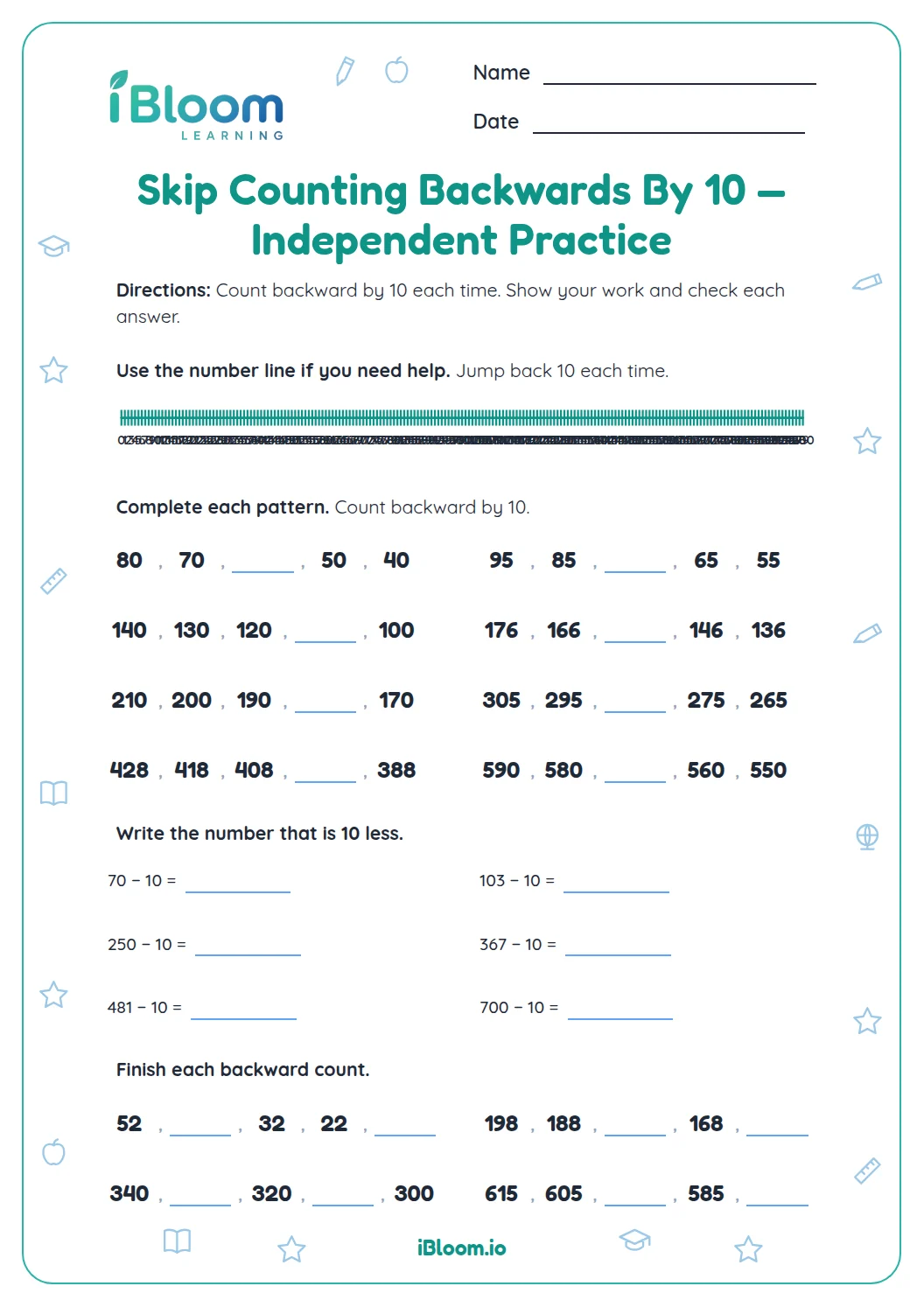
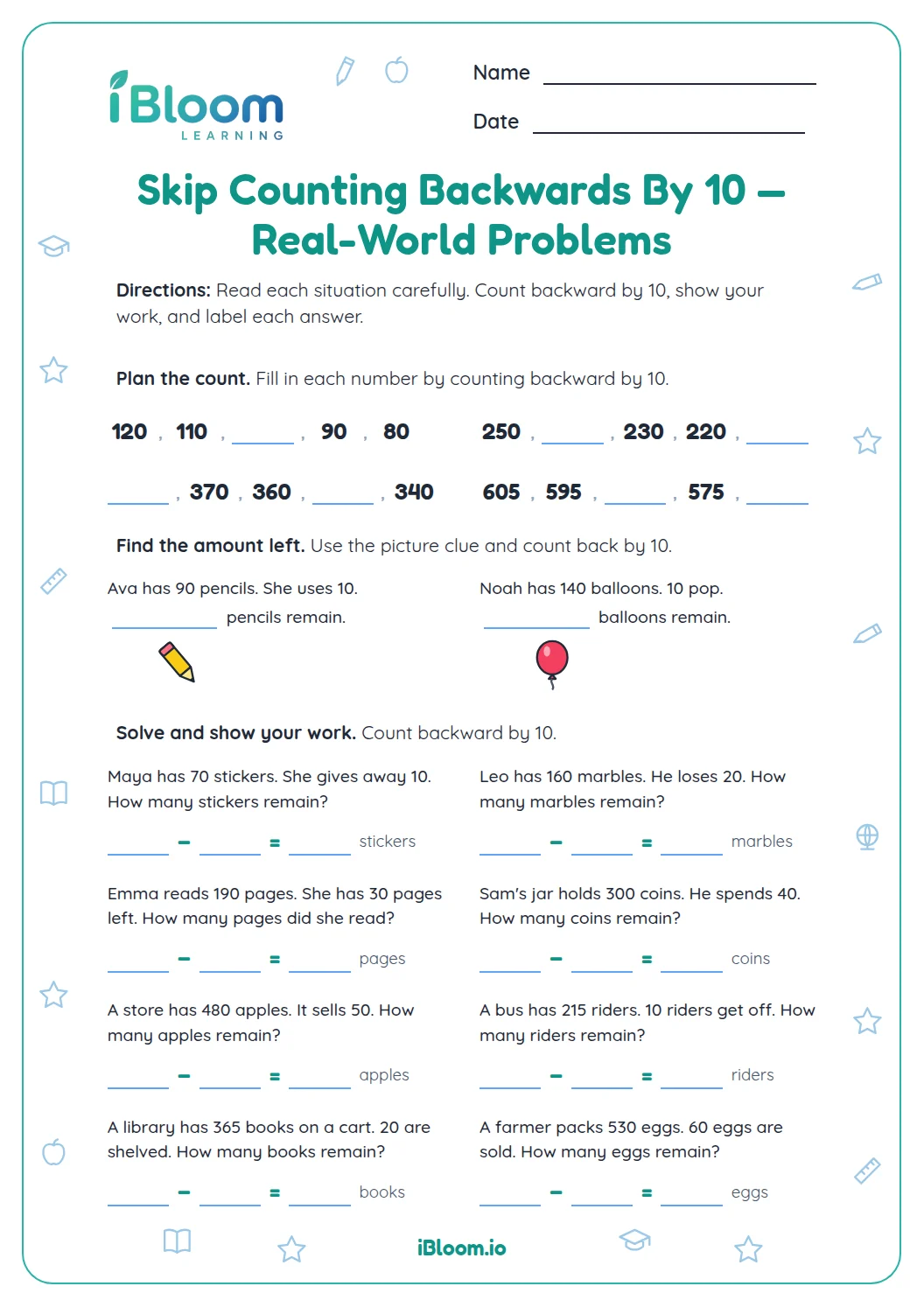
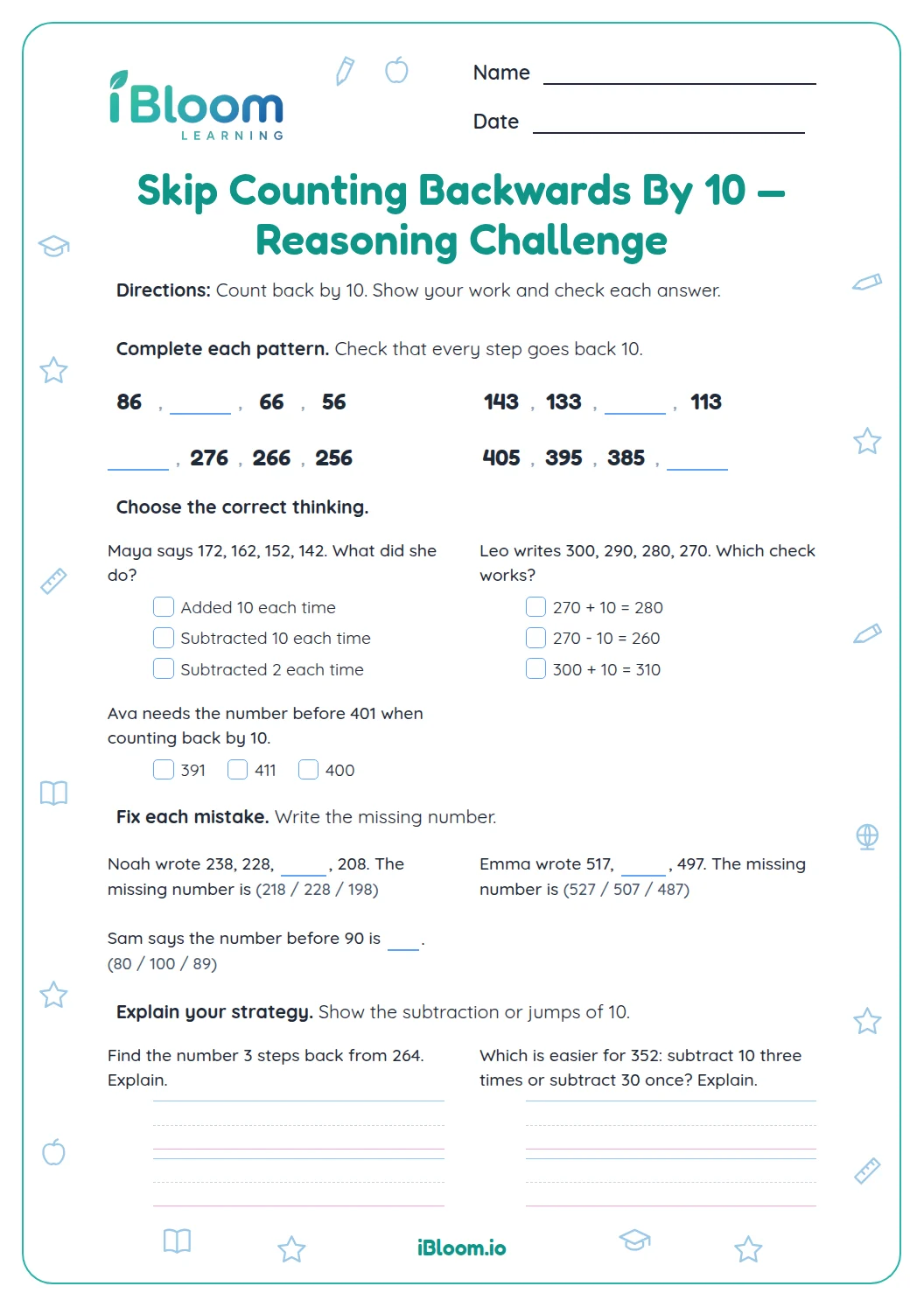
This Grade 2 printable practices counting backward by 10 within 1,000. Children make two jumps back from 80 on a number line, then complete 17 sequences, including counts that cross hundreds and start above 900. The worksheet spans two pages, with a separate two-page answer key. It practices the skip-counting skill in CCSS 2.NBT.A.2.
Aligned to 2.NBT.A.2
What does one jump back mean?
Each jump to the left on a number line subtracts 10. In question 1, two jumps from 80 land on 60.
- 1Start at 80
- 280 − 10 = 70
- 370 − 10 = 60
How do you cross a hundred?
After the number-line question, the sequences include missing numbers before, between, and after known values. Several cross a hundred, where the hundreds digit changes as the tens decrease.
- Part A: count back through nearby tens.
- Part B: cross hundreds while subtracting ten.
- Part C: find missing starts and multiple gaps.
What should you check around each blank?
Check both neighbors of a blank. The number before the blank must be 10 greater than the missing number, and the number after it must be 10 less.
How to use this worksheet at home or in class
- 1Find the starting number.
- 2Subtract 10 for each step.
- 3Keep moving backward across hundreds.
- 4Check each blank against the number before and after it.
Common mistakes and quick fixes
The mistake
Subtracting 1 instead of 10.
The fix
Check that the tens place changes at each step.
The mistake
Counting forward after a blank.
The fix
Say “ten less” each time before writing the next number.
The mistake
Changing the hundreds digit too early.
The fix
Count through all the tens in the current hundred before crossing to the previous hundred.
Common Core alignment
This worksheet practices the following Common Core skill.
Count within 1,000 and skip-count by 10s.
On this sheet: Children count backward by tens within 1,000 and identify the missing number in each sequence.
Show the official wordingHide the official wording
Count within 1000; skip-count by 5s, 10s, and 100s.
What to practice next
Make more practice
Further reading
Questions parents and teachers ask
What does counting backward by 10 mean?
Subtract 10 at every step. In question 1, two jumps from 80 land on 60: the first jump reaches 70 and the next reaches 60. Each jump represents one group of ten. The jumps make the size of each counting step visible.
How does a count cross a hundred?
Keep subtracting 10 as the count moves through the tens. For example, 400, 390, 380, 370 crosses below 400 without changing the size of the step. The hundreds digit changes as the sequence continues. Each listed number is ten less than the one before it.
Can a sequence start above 900?
Yes. The worksheet includes sequences near 1,000 as well as smaller starting numbers. Continue subtracting 10 at every step, including when the count moves from 1,000 to 990. The same ten-less rule works for every starting point in the sequence.
How can children check a missing number?
Subtract 10 from the number before the blank and add 10 to the number after it. Both checks should give the same missing value. This works for a blank at the start, middle, or end of a sequence.
How many problems are included?
There are 18 problems: one number-line question and 17 missing-number sequences. The sequences include counts that cross hundreds, a count near 1,000, and one sequence with two missing values. The worksheet includes both a number line and written sequences.