

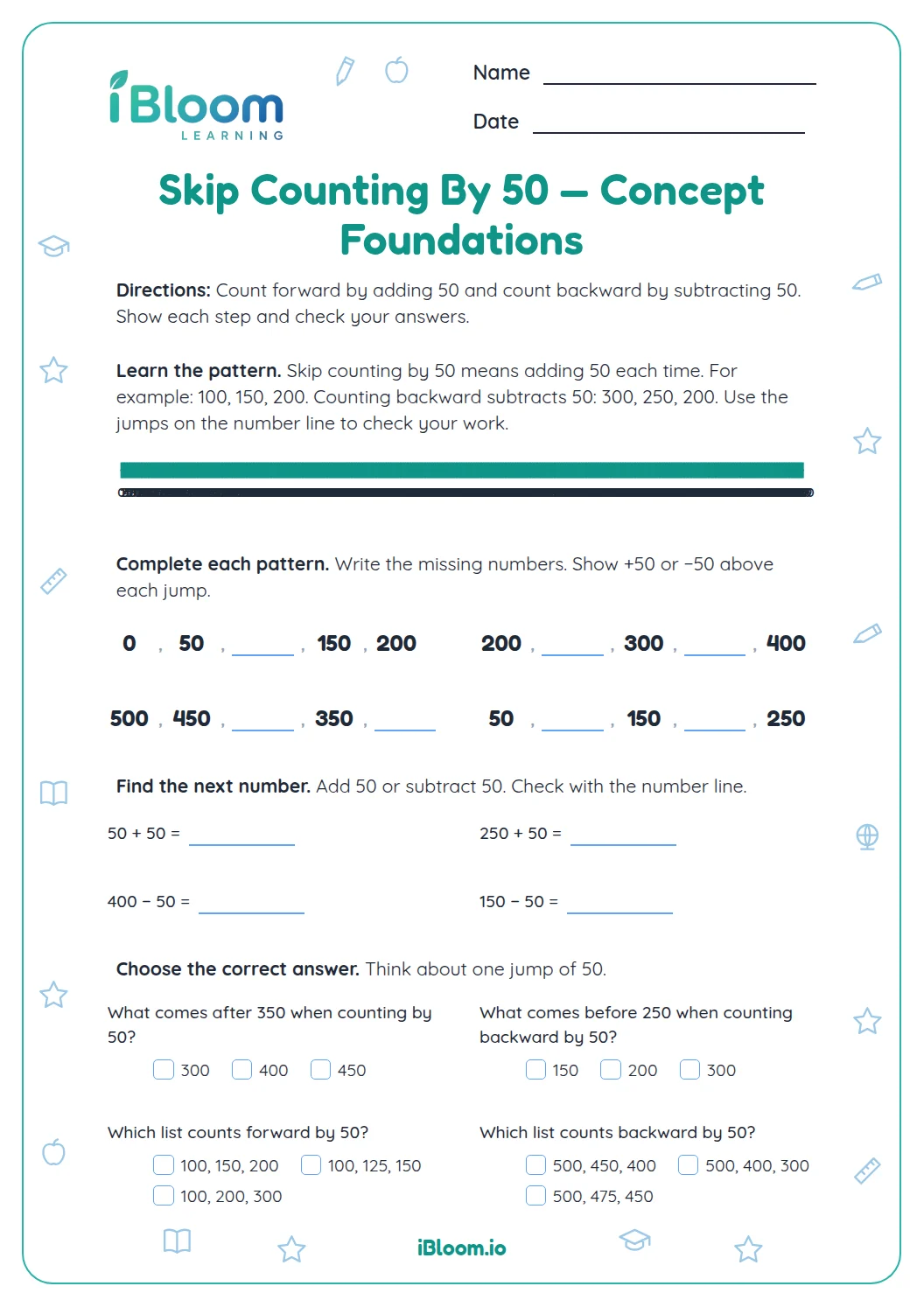
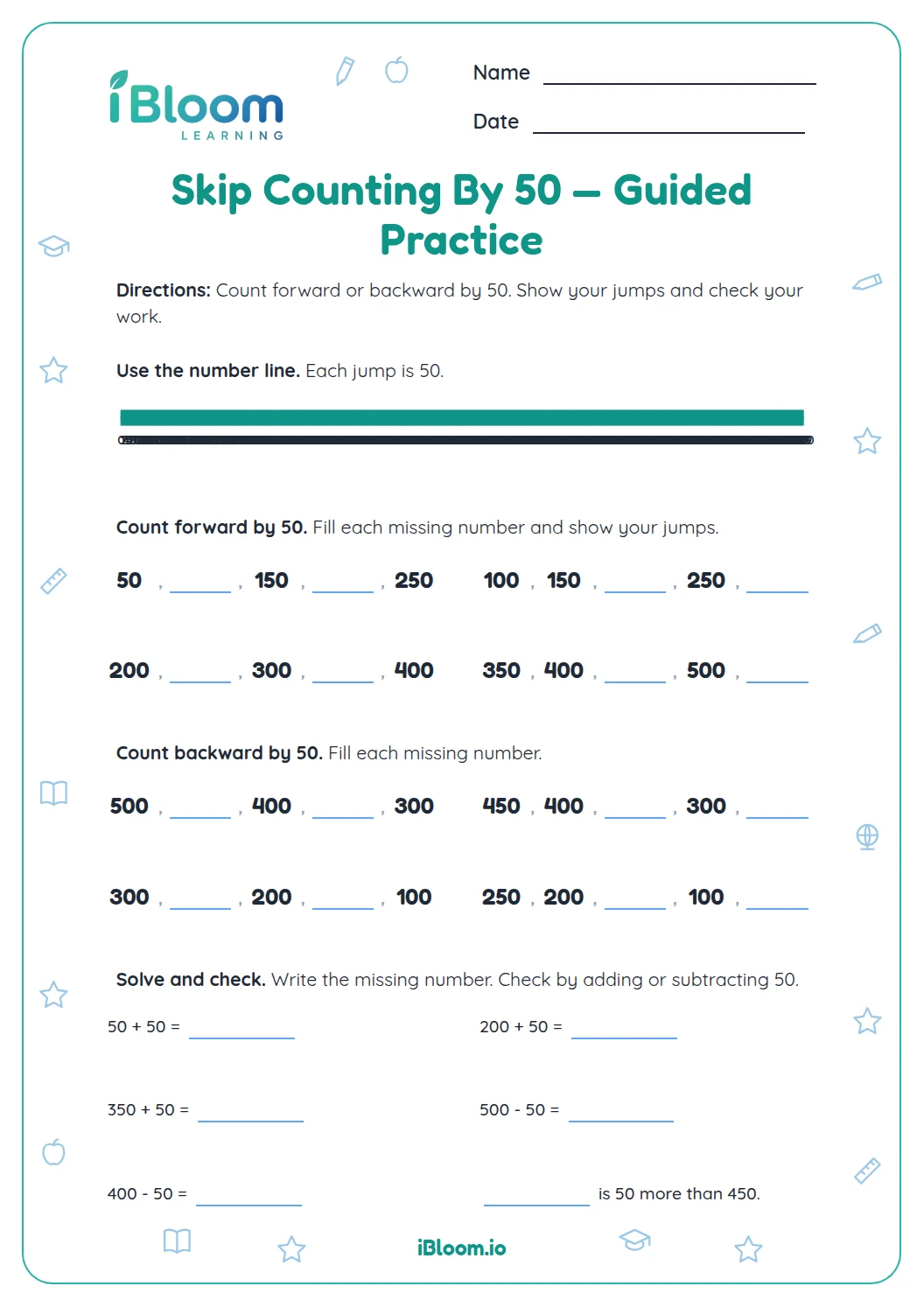
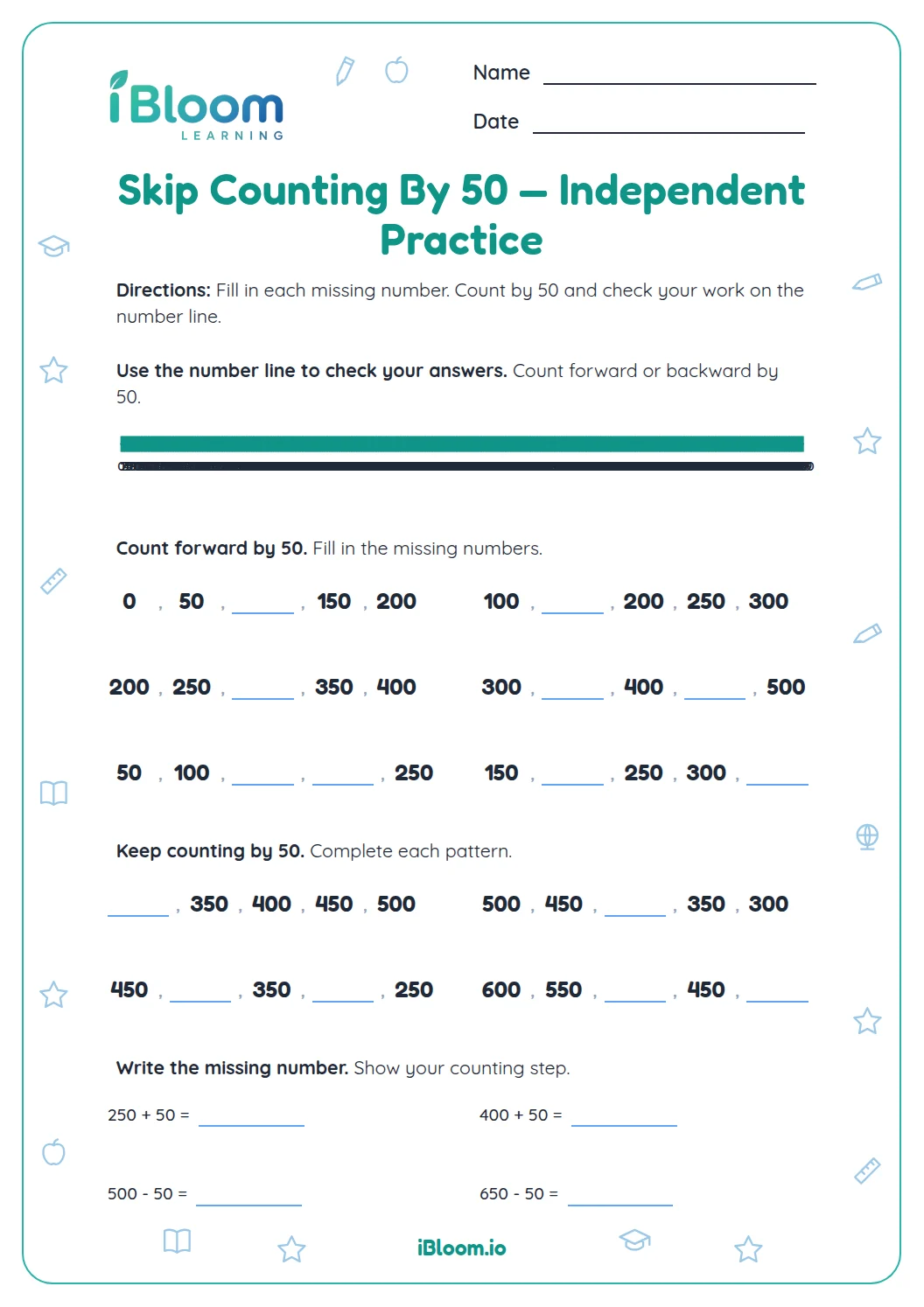
About this worksheet
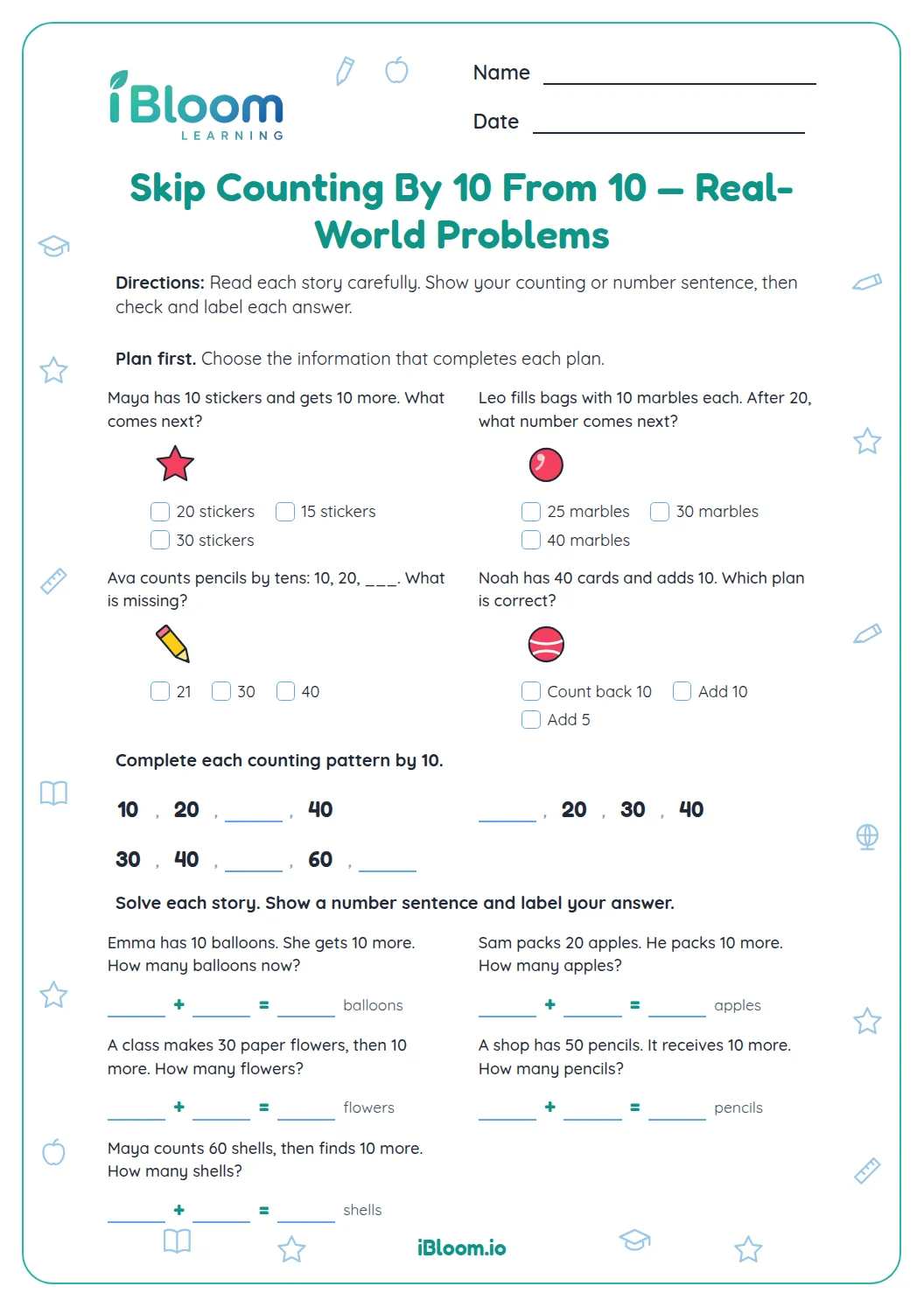
This Grade 2 printable practices skip counting by 10 starting at 10, a counting sequence named in CCSS 2.NBT.A.2. Children follow number-line models, fill missing values in sequences, choose correct ten-step patterns, and connect each jump to adding 10. The worksheet includes 14 questions and a separate answer key. The visual models make each equal jump clear before students work with number sentences.
Aligned to 2.NBT.A.2
How does each jump show ten more?
Each interval on a number line is one jump of 10. Starting at 10, the second jump lands on 30 because 10, 20, 30.
How can a missing number be found?
Read the numbers in order and check that every step increases by 10. In Part A, 40, ___, 60 continues with 50.
How does addition connect to skip counting?
Adding 10 once gives the next number in the sequence. Part C practices that same jump as a number sentence.
How to use this worksheet
- 1Say the starting number, 10, aloud.
- 2Use one tick interval as one jump of 10.
- 3Fill the two missing values in Part A by checking the numbers before and after each blank.
- 4In Part B, choose the list or number that follows the ten-step rule.
- 5Complete Part C by adding 10 once.
- 6Check the answer key and read any missed pattern aloud.
Common mistakes and quick fixes
The mistake
Counting by ones after the starting number.
The fix
Compare neighboring values; each step must add 10.
The mistake
Starting at 0 instead of 10.
The fix
Use the first value printed in the pattern or number line.
The mistake
Skipping a blank without checking both neighbors.
The fix
Count forward from the left and backward from the right.
Common Core alignment
This worksheet practices counting within 1,000 with skip-counting by tens.
Count within 1,000 and skip-count by tens.
On this sheet: All six patterns and four sequence choices count forward by tens.
Show the official wordingHide the official wording
Count within 1000; skip-count by 5s, 10s, and 100s.
What to practice next
Make more practice
Further reading
Questions parents and teachers ask
How do I teach skip counting by tens?
Begin at 10 and say each next number after adding another 10. Use the number lines in Part A to point from one tick to the next, then ask the child to name the same pattern without the model. The repeated jump links counting and addition. Check the pattern by counting from the start again.
What does this worksheet practice?
The questions start at 10 and continue by tens. Children fill missing terms, recognize a list that follows the rule, and complete addition sentences such as 30 + 10. The visual models support the sequence before students solve the number sentences. This matches the ten-step idea in every problem.
How can I check a missed number?
Look at both neighbors of the blank. Each number should be 10 more than the one before it and 10 less than the one after it. For example, between 40 and 60, the missing number is 50. This check works for each pattern printed on the page.
Is there an answer key?
Yes. The printable includes a separate key with the missing values and multiple-choice answers. Have the learner read a corrected sequence aloud and explain the size of each jump to reinforce the ten-step pattern. The key helps identify which jump to practice again.
What is the answer between 40 and 60?
The missing number is 50 because the sequence increases by 10 each time: 40, 50, 60. On this worksheet, that pattern appears in Part A. Point to each term and say the amount added before moving to the next number.