

About this worksheet
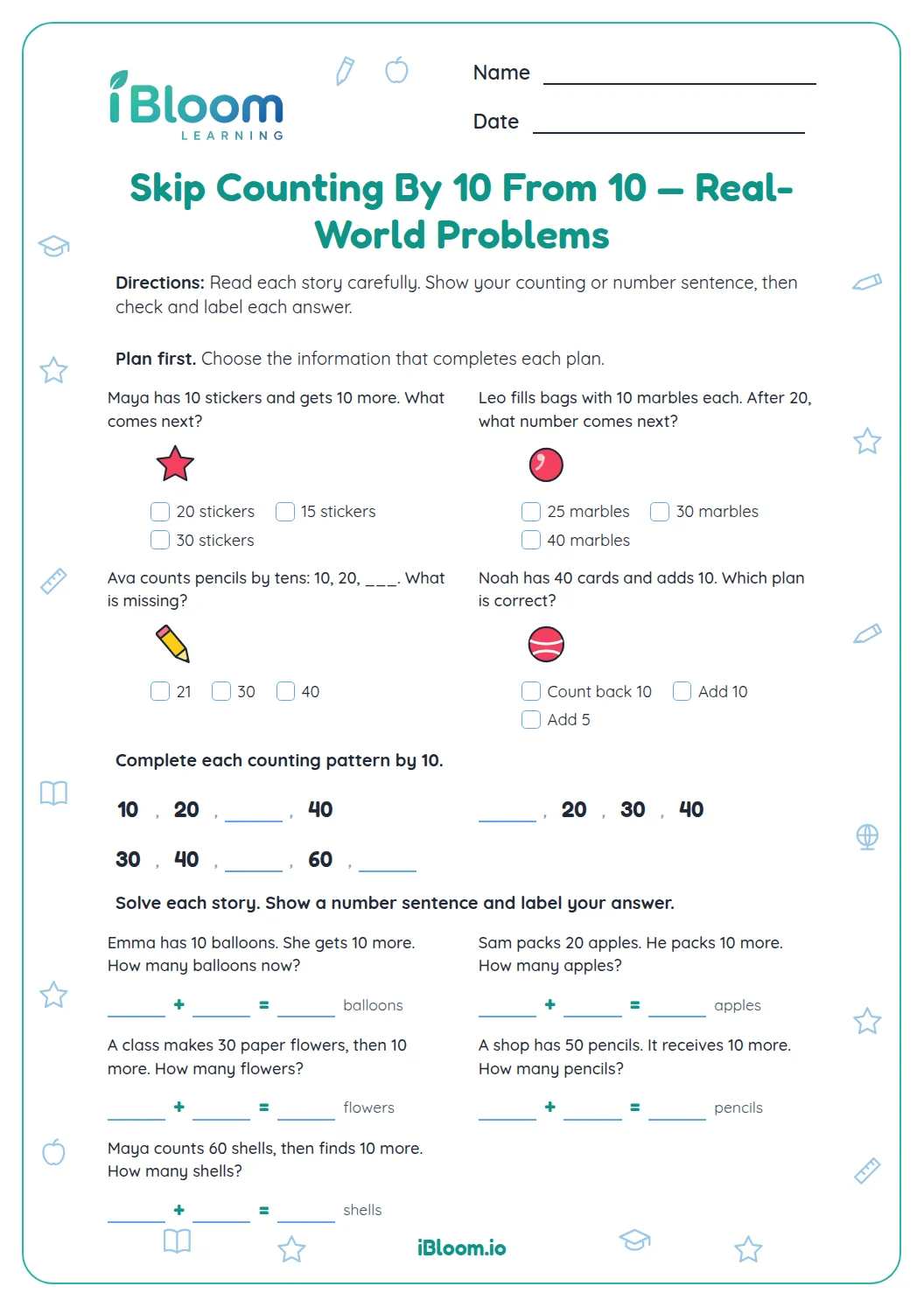
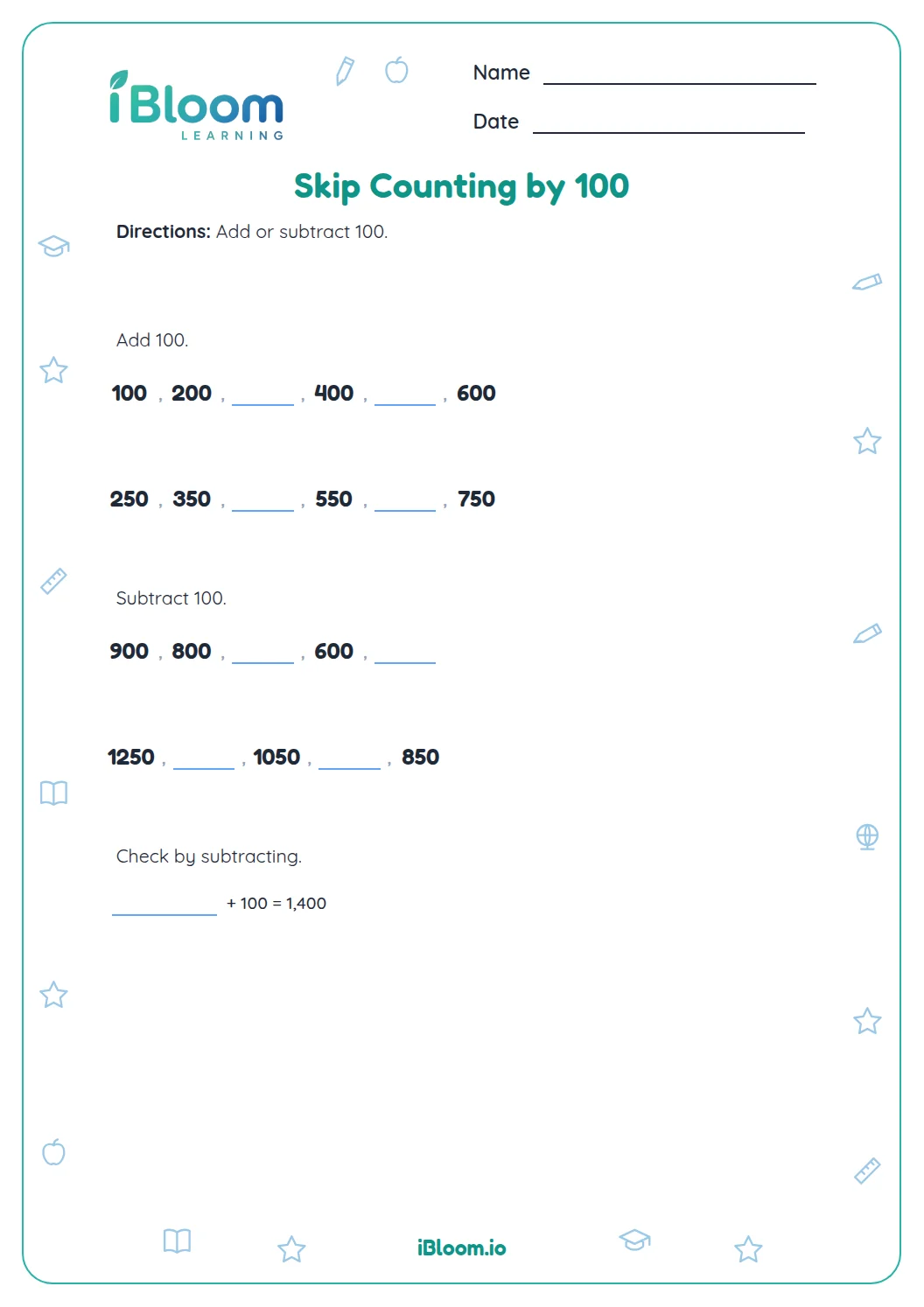
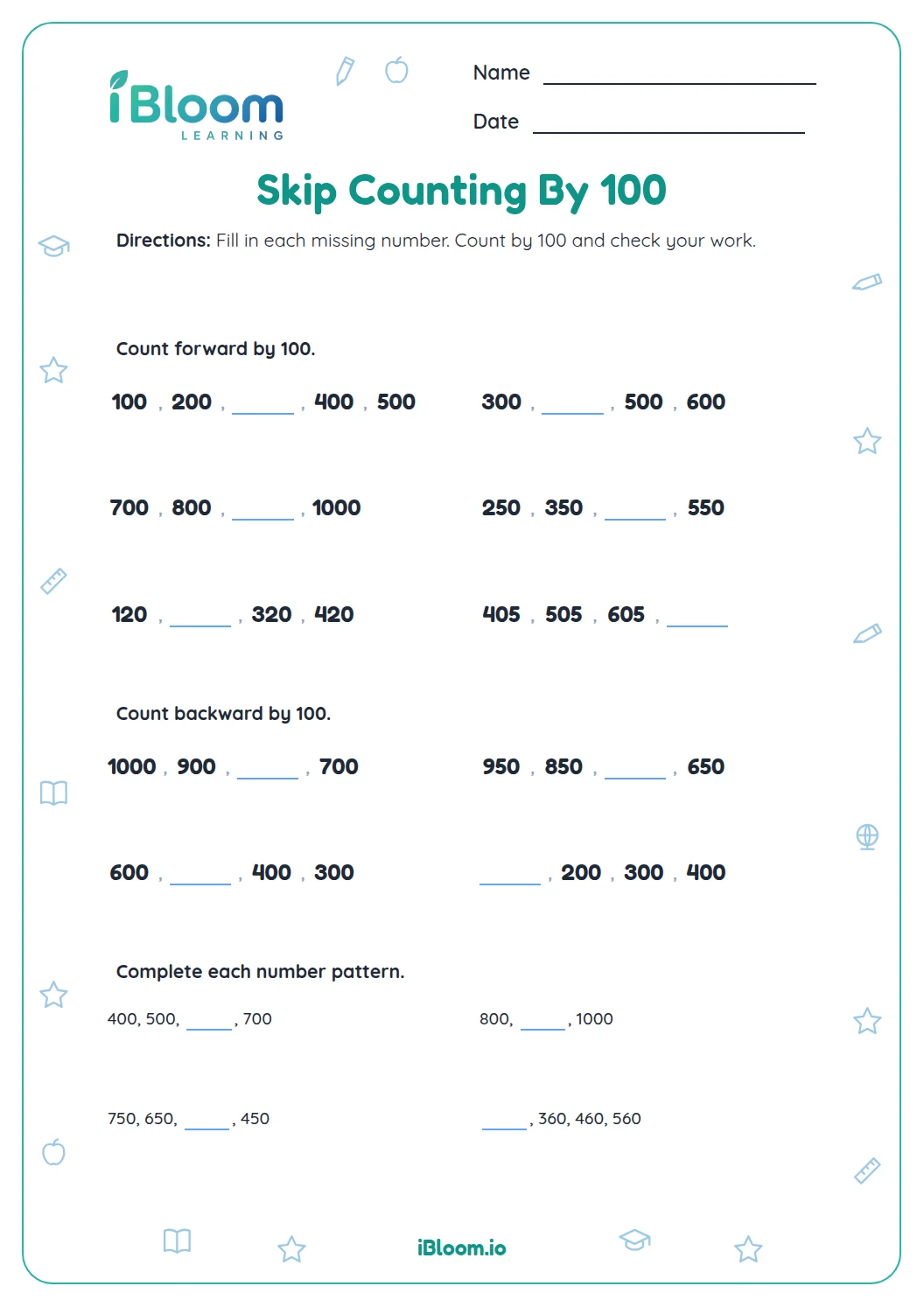
This guided worksheet begins with familiar patterns starting at 10, then shifts to less familiar starting points such as 260 and 520. Students continue sequences, add or subtract one ten, and apply groups of ten in short situations. All values stay within 1,000. A separate key gives the missing values and sample sequences.
Aligned to 2.NBT.A.2
How does skip counting by 10 work?
Skip counting by 10 means adding ten at each step. Starting at 10 gives 10, 20, 30, and so on. Starting at 260 gives 260, 270, 280; the starting number can change, but each jump is still ten.
Students can track each jump on a number line or say the sequence aloud. Looking at place value helps check that the number grows by one ten each time.
What is in the guided practice?
Part A warms up with sequences from 10. Part B starts at other values and asks students to continue the pattern. Part C connects ten more and ten less to number patterns; Part D applies equal jumps of ten to short situations.
How do equal jumps find a total?
Question 15 starts at 340 and makes six jumps of ten. Six tens equal 60, and 340 + 60 = 400. The last value is also the sixth step forward from the starting number.
How to solve each pattern
- 1Read the first number and say “plus ten” for every jump.
- 2Write each term in order, checking the ones digit as you go.
- 3For ten-more and ten-less questions, change the value by one ten.
- 4For word problems, identify how many groups or jumps of ten are described.
Common skip-counting slips
The mistake
Adding one instead of ten at each jump.
The fix
Say the difference between two neighboring terms; it should always be ten.
The mistake
Changing the ones digit when counting from a number such as 263.
The fix
Add one ten: the tens place changes, while the ones place remains 3.
The mistake
Stopping one jump too soon in a sequence.
The fix
Count the blanks and make one ten-unit jump for each blank.
The mistake
Treating ten less than 1,000 as 1,000 minus one.
The fix
Subtract one ten, or 10, to get 990.
Common Core alignment
This practice aligns with Grade 2 place-value counting.
Count within 1,000 by ones, tens, and hundreds.
On this sheet: Students count forward by tens and use those jumps within 1,000.
Show the official wordingHide the official wording
Count within 1,000; skip-count by 5s, 10s, and 100s.
What to practice next
Make more practice
Further reading
Questions parents and teachers ask
What does skip counting by ten mean?
It means adding ten at each step. Starting at 10 gives 10, 20, 30, and continuing from 260 gives 260, 270, 280. Each pair of neighboring numbers differs by ten, even when the starting number is not a multiple of one hundred.
Why does this page start with 10?
Starting at 10 makes the pattern easy to see before students try other starting points. They first recognize the familiar sequence, then practice the same equal jump from values such as 260 or 520. The rule stays the same even when the sequence begins somewhere new.
How can a child check a missing number?
Compare it with the number immediately before and after it. Each jump should be ten. A subtraction check also works: subtract ten from the next number to recover the missing number, or subtract ten from the missing number to find the previous term.
Are any answers greater than 1,000?
No. The sequences, starting values, and word problems stay at or below 1,000. The questions practice Grade 2 skip counting and place value within the grade range. Children can also say each count aloud to hear the steady pattern, then explain how they know every jump is ten.
How does skip counting help with equal groups?
Counting by tens keeps track of groups that each have ten. Seven groups of ten reach 70, and saving ten cents for eight weeks reaches 80 cents. Students can count the groups aloud or add ten repeatedly to check the total.