


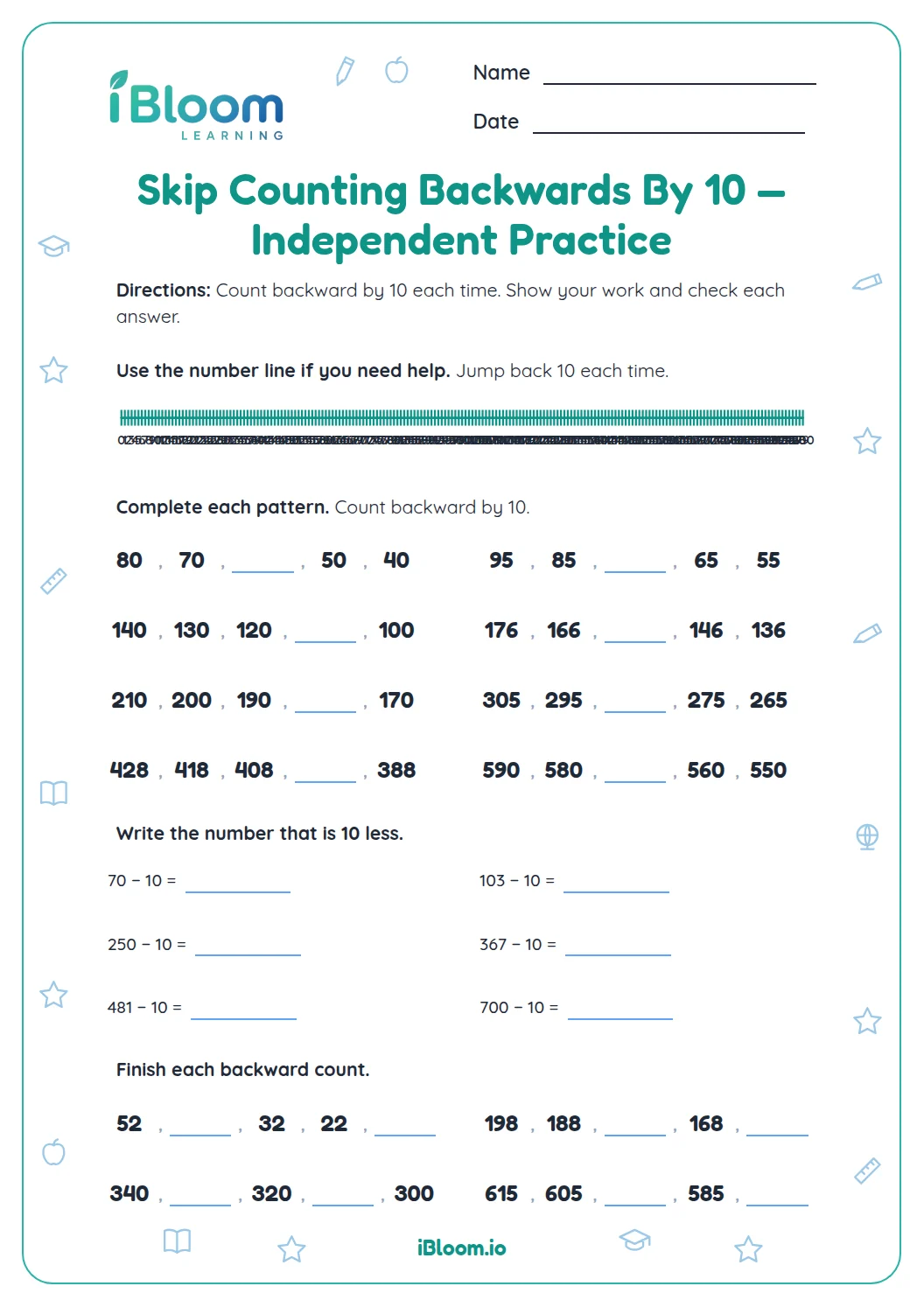
About this worksheet
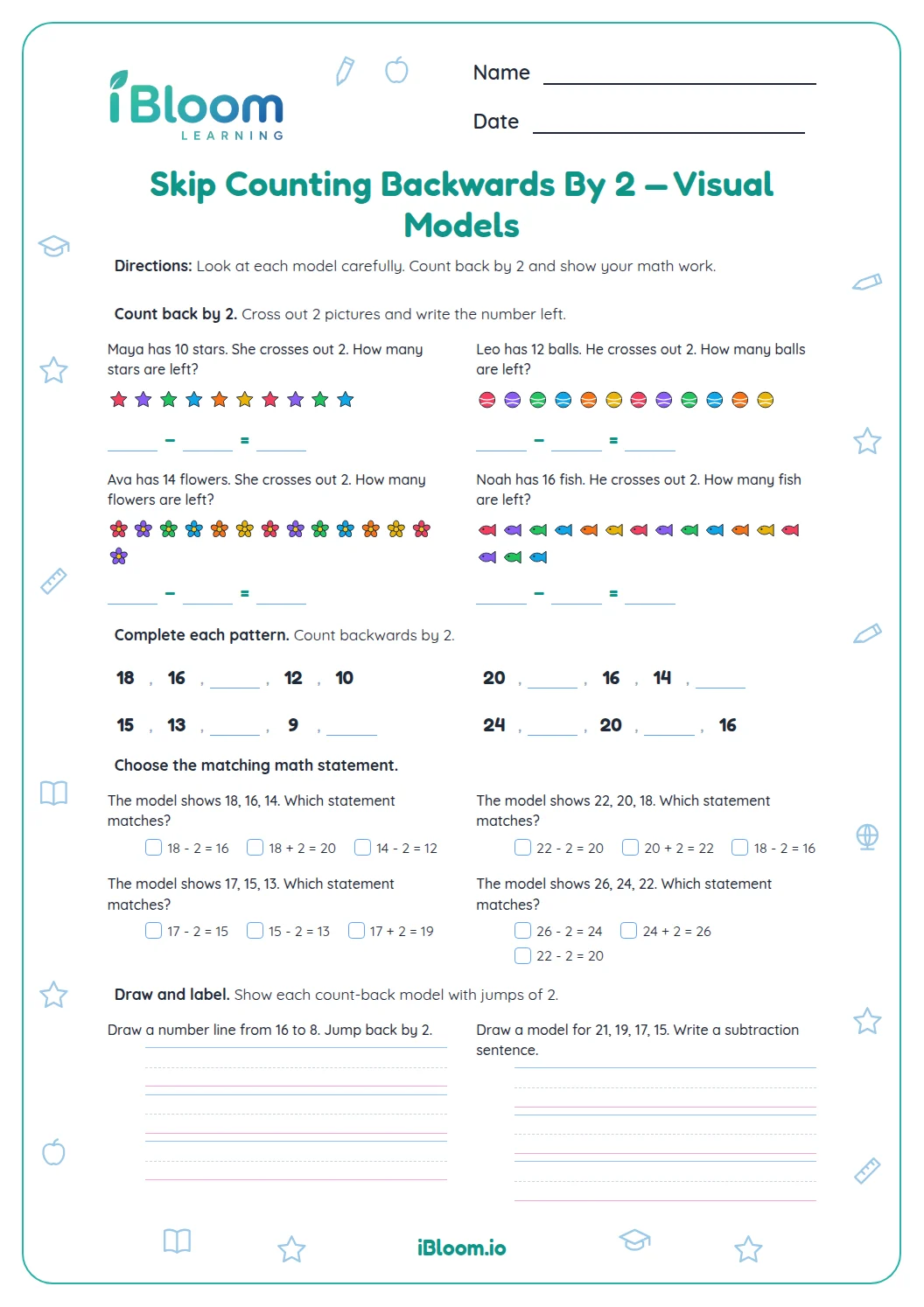
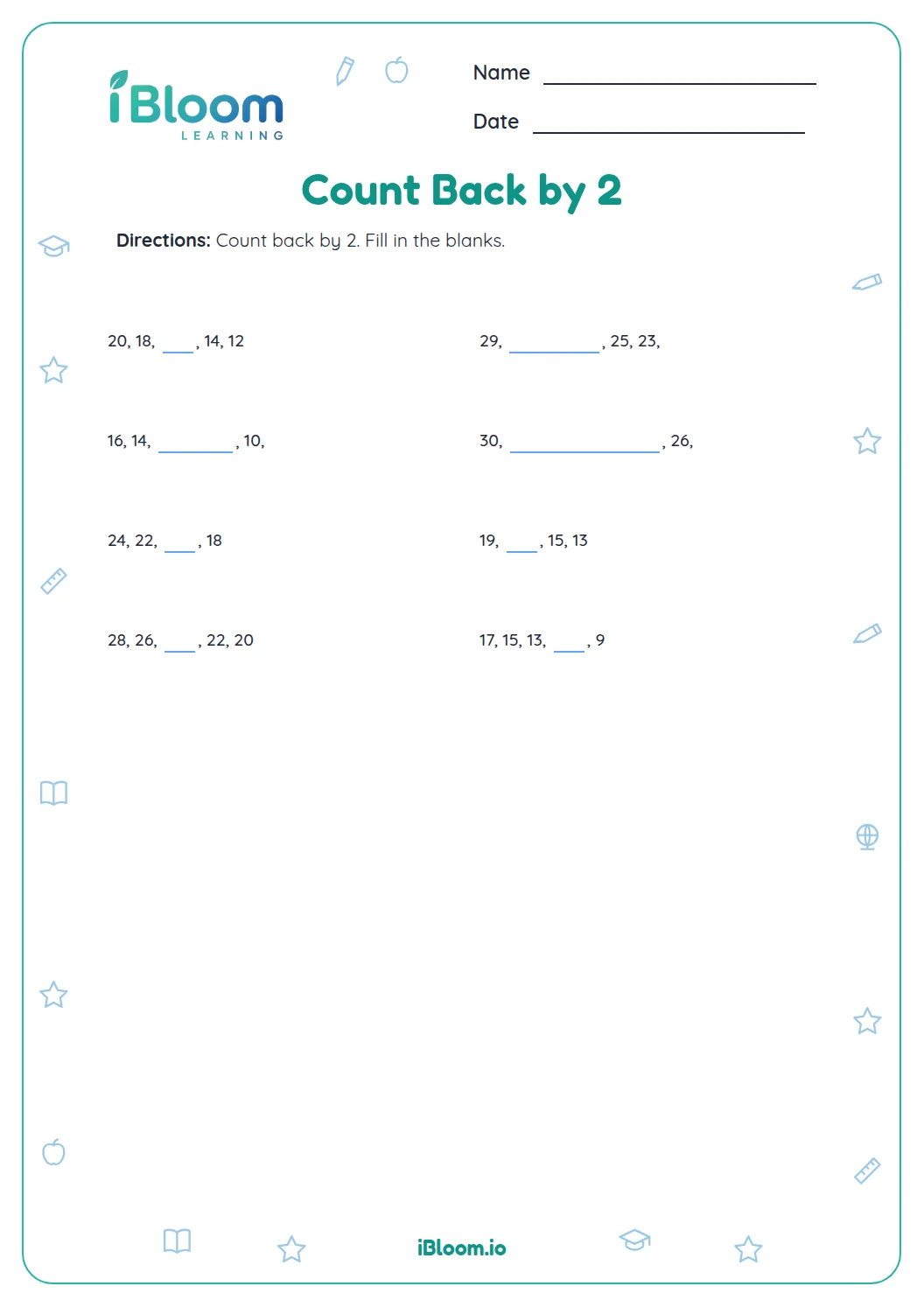
This Grade 2 printable gives children guided practice counting backward by 2 from even and odd starting numbers. It moves from missing terms in short sequences to longer runs, count-from-a-start questions, and a check for a mistaken step. All 16 items ask children to keep subtracting 2, with a separate key listing each answer.
What changes each time you count backward by 2?
Each number is 2 less than the one before it. In question 1, 20 becomes 18, then 16; subtract 2 once more to find 14. The sequence keeps its even-number pattern.
- 120, 18, 16, ___, 12
- 216 − 2 = 14
- 314 − 2 = 12
- 4The missing number is 14.
What if the starting number is odd?
The step remains −2, so an odd start stays odd. In question 7, 35 is followed by 33, 31, 29, and 27. The digits do not need to alternate between odd and even.
How can a child check a counting run?
Compare each pair of neighbors. Subtract the later number from the earlier one; each difference should be 2. The last questions ask children to continue a run or replace a term that breaks the step.
How to use this worksheet
- 1Read the start and say “minus 2” before writing.
- 2Finish one blank at a time; subtract 2 from the nearest known term.
- 3For a written run, include exactly the requested number of terms.
- 4Keep odd starts odd and even starts even.
- 5Check each adjacent pair by subtracting the smaller from the larger.
- 6Use the key to revisit any place where the difference is not 2.
Common mistakes and quick fixes
The mistake
Subtracting 1 instead of 2.
The fix
Say the two numbers aloud and check their difference.
The mistake
Switching from odd to even in the middle of a run.
The fix
Subtracting 2 preserves whether a number is odd or even.
The mistake
Changing the step size for one term, as in 52, 50, 48, 47.
The fix
Subtract 2 again: 48 − 2 = 46.
What to practice next
Make more practice
Further reading
Questions parents and teachers ask
Does the pattern change for an odd starting number?
No. Subtracting 2 preserves whether a number is odd or even. Starting at 35 gives 33, 31, and 29. Have the child say each number while counting down, then check that each neighboring pair differs by exactly 2.
How many numbers should a child write after the start?
Follow the wording in each item. When the start is already printed and it asks for the next four numbers, write four new terms after it. In a sequence with one blank, use the nearest printed number and subtract 2 or add 2 to find the missing term.
What is an easy way to check the sequence?
Subtract each later term from the term just before it. Every difference should equal 2. The pattern also stays entirely odd or entirely even, so noticing a change in parity can help catch an arithmetic slip before checking the key.
Is an answer key included?
Yes. The separate key lists missing terms, the numbers in the counting runs, and answers to the reasoning questions. For any written run, check both the number of requested terms and the repeated step of 2, rather than only checking the last answer.
Does the sheet use both even and odd starting numbers?
Yes. Several sequences start with even numbers, and others start with odd numbers such as 35 and 101. In either case, subtract 2 at each step. The numbers remain in the same odd or even pattern throughout the run.