




About this worksheet
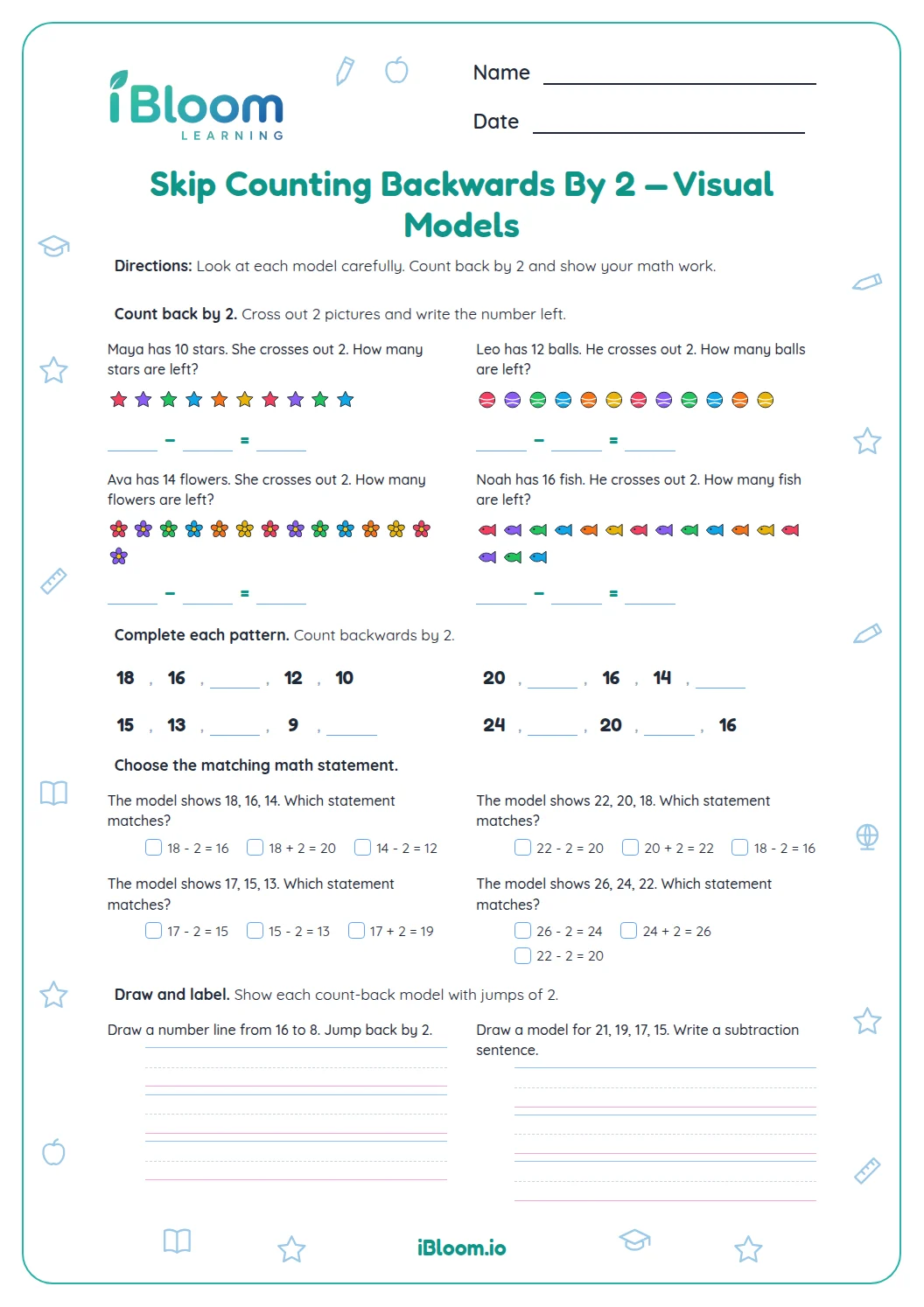
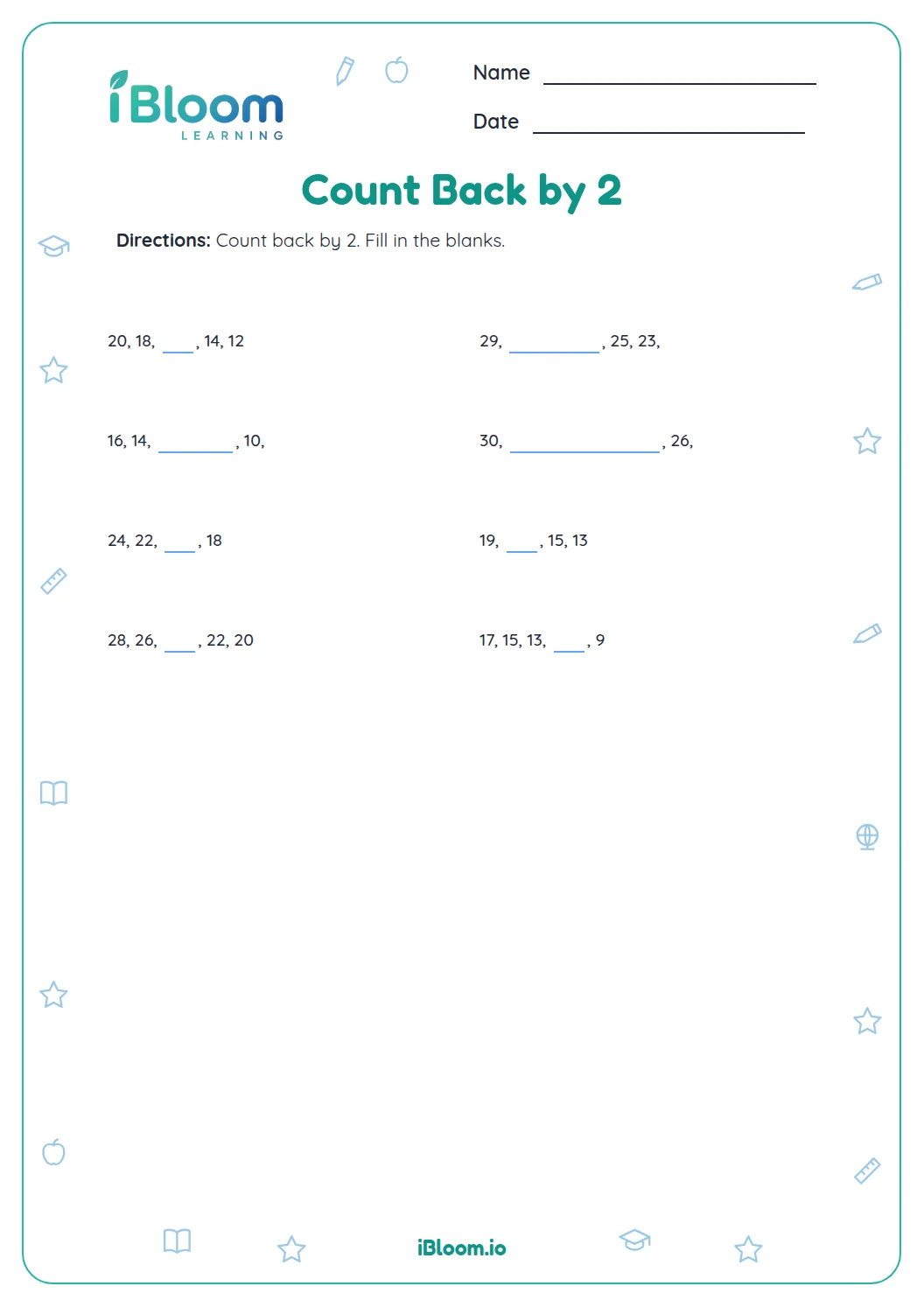
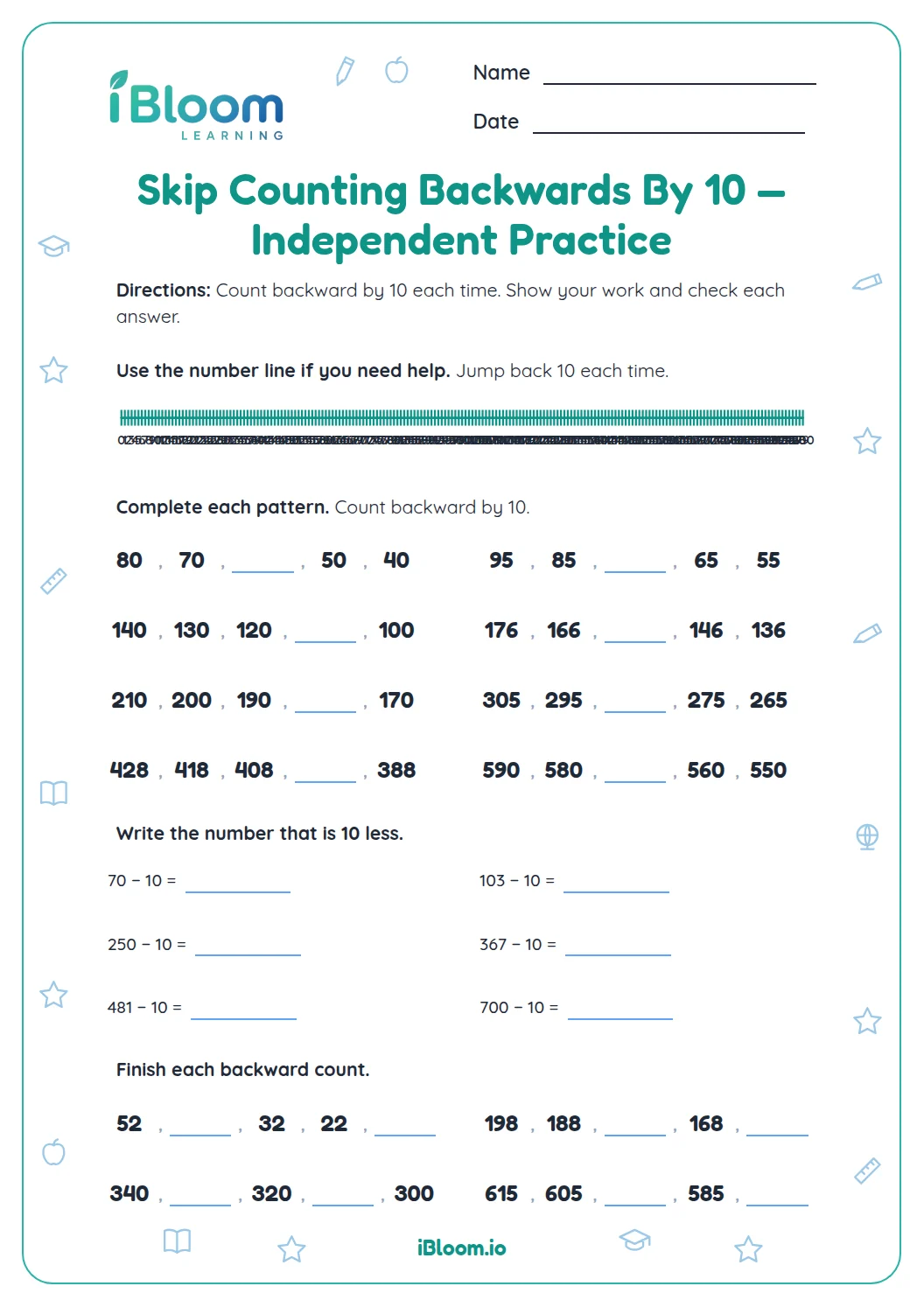
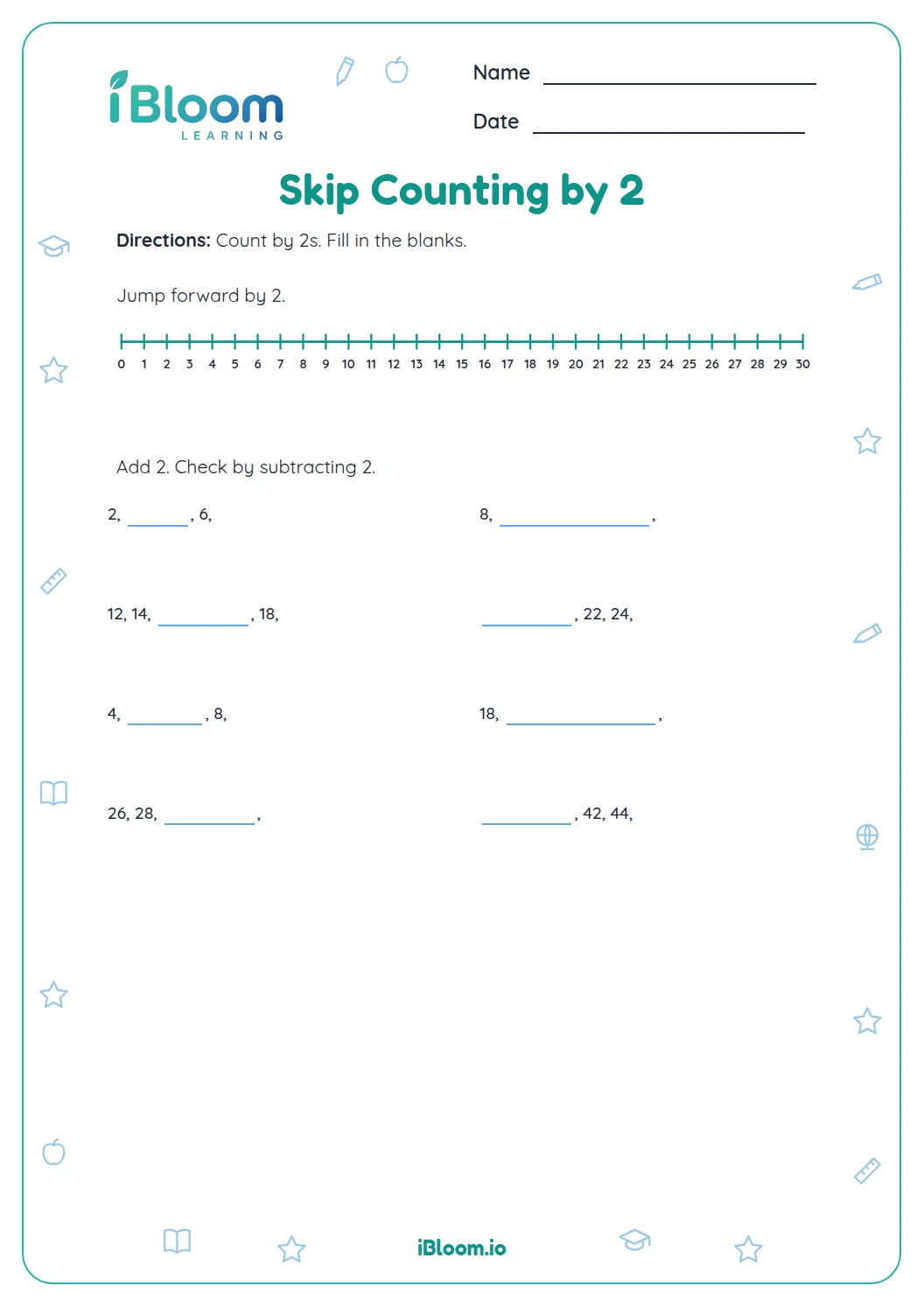
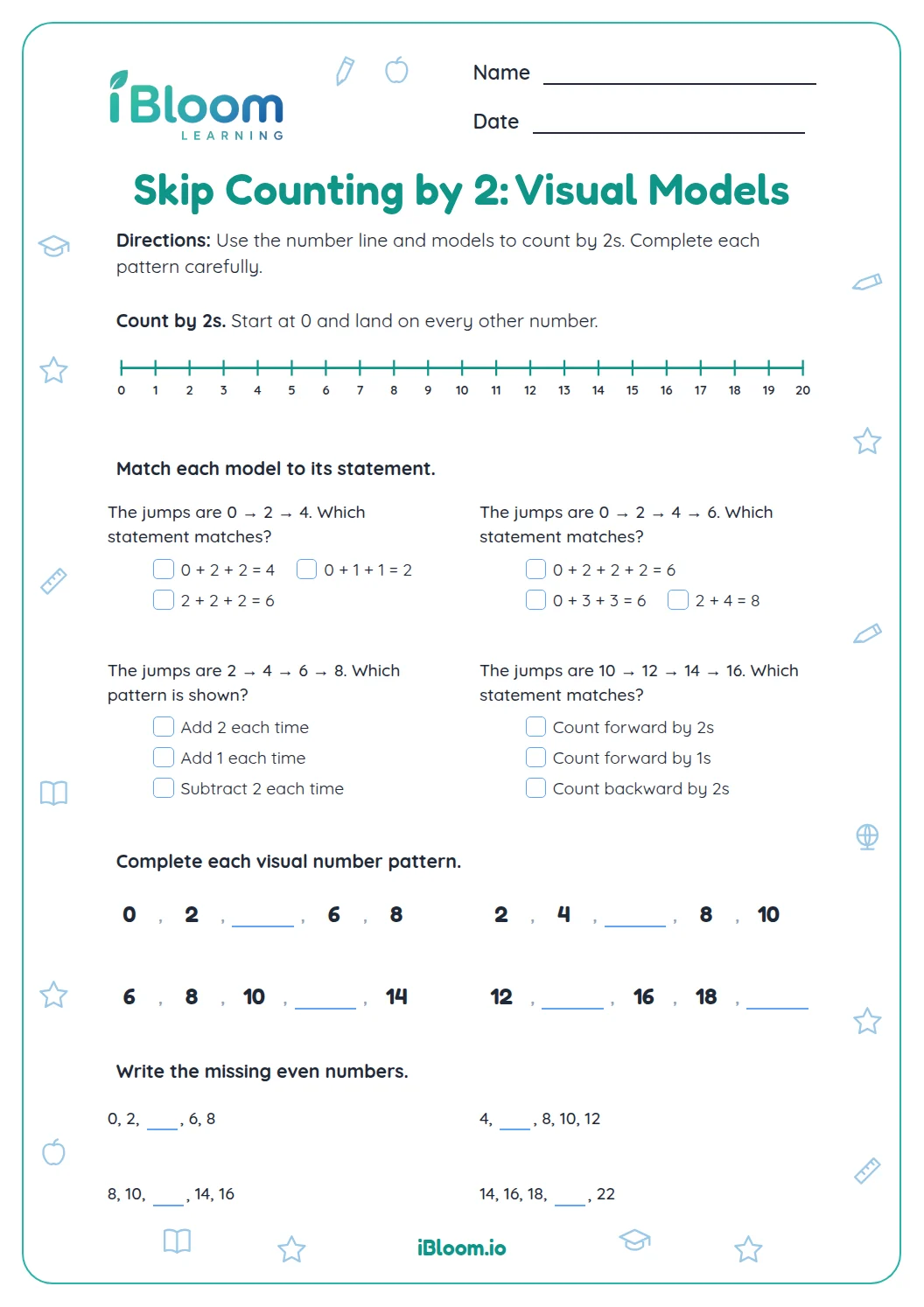
This printable Grade 2 math worksheet gives children repeated practice counting backward by 2. Sixteen number sequences ask for a missing term, followed by four short situations that use the same step size. The separate answer key lists each missing number and ending value. All numbers stay within 1,000, so children can focus on the pattern: subtract 2 at every step.
What changes at each step?
A backward count by 2 gets 2 smaller each time. In question 1, 30 drops to 28, then 26 and 24. The blank is the number reached after the first step.
How can I fill a missing term?
Track the step size from one term to the next. If a sequence begins 42, 40, ___, 36, subtract 2 from 40 to get 38. Check that subtracting 2 again gives 36.
How do count-back stories work?
Count the number of steps, then subtract 2 for each step. Ava starts at 46 and takes five steps: 44, 42, 40, 38, 36, so she lands on 36.
What does this worksheet include?
There are 16 missing-number sequences followed by 4 short count-back questions. The answer key includes one result for every item.
How can I use this page?
- 1Say the start number aloud.
- 2Move down by 2 once to find the blank.
- 3Check the next number to confirm the sequence continues by 2.
- 4For a story, count the steps before calculating the ending number.
Common slips and quick fixes
The mistake
Subtracting 1 instead of 2.
The fix
Say the next two numbers aloud to hear the size of each jump.
The mistake
Counting the start as one of the jumps.
The fix
Keep the start number separate, then make the stated number of steps.
The mistake
Changing from backward to forward counting mid-sequence.
The fix
Check that each new number is 2 less than the one before it.
What to practice next
Make more practice
Questions parents and teachers ask
What does counting backward by 2 mean?
Counting backward by 2 means subtracting 2 each time. A count from 30 goes 30, 28, 26, 24, with each number two less than the one before it. This worksheet practices that same pattern with both even and odd starting values.
How can my child check a missing number?
Find the number before the blank and subtract 2. Then subtract 2 from the answer to see whether it matches the next given number. Matching both neighboring steps confirms the missing term. This check also catches a one-step slip: the answer must be two less than the number before it and two more than the number after it.
How do I count the steps in a story problem?
Keep the starting value separate from the steps. For five steps back from 46, count 44 as step one and continue until you have made five changes. The final value is 36. For the four story questions, write down each landing number if keeping track of several steps mentally feels tricky.
Does every sequence start with an even number?
No. A backward count by 2 can begin with an odd or even number. Odd starts stay odd and even starts stay even, because subtracting 2 does not change whether the number is odd or even. For instance, 19, 17, 15, 13 stays odd, while 20, 18, 16, 14 stays even; both patterns move backward by two.
How many questions are on the printable?
There are 20 questions: 16 sequences with a missing term and four short situations. A separate answer key shows every missing number and each count-back result. The first section uses number patterns, and the final section puts the same two-at-a-time rule into short situations.