


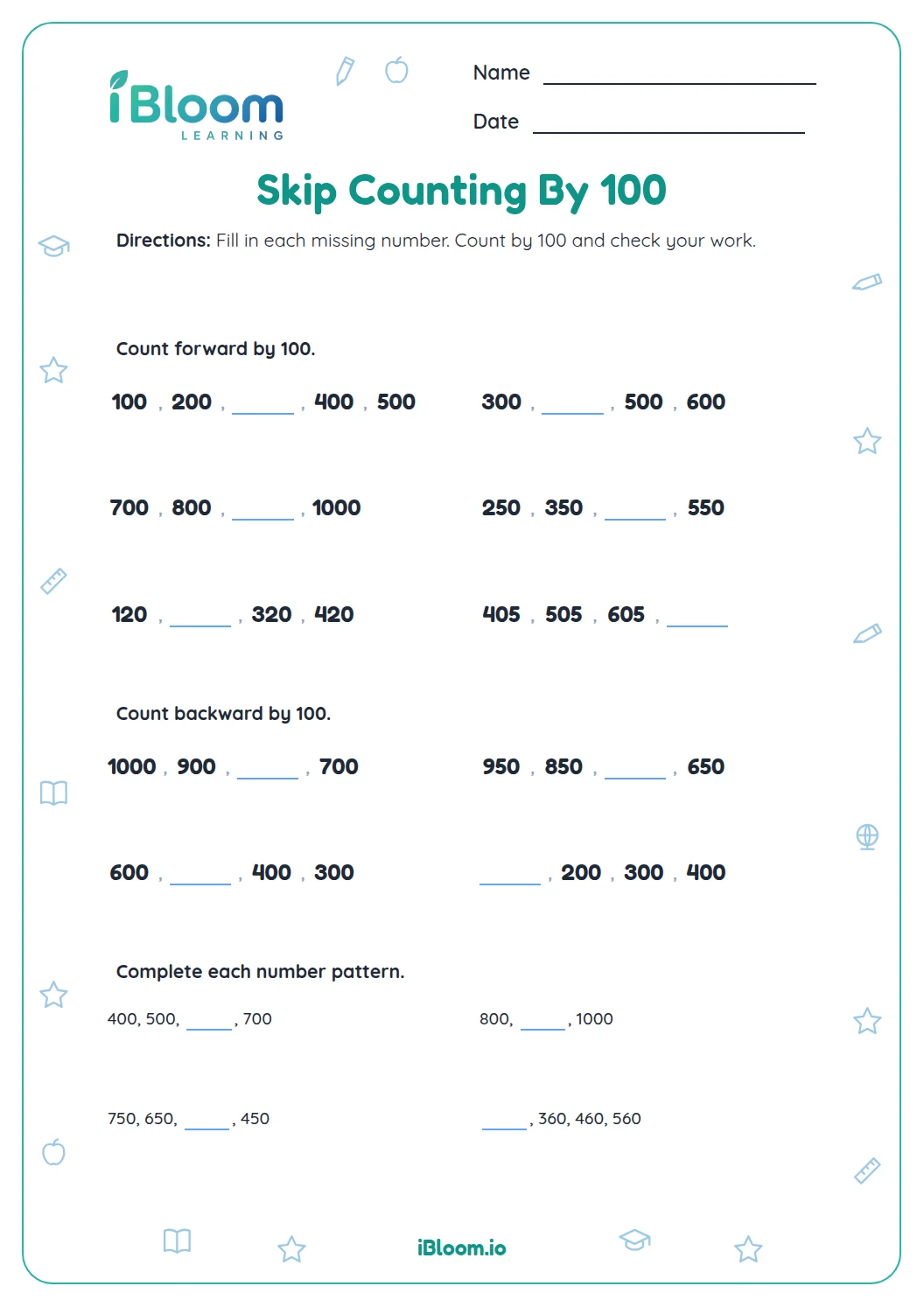
About this worksheet
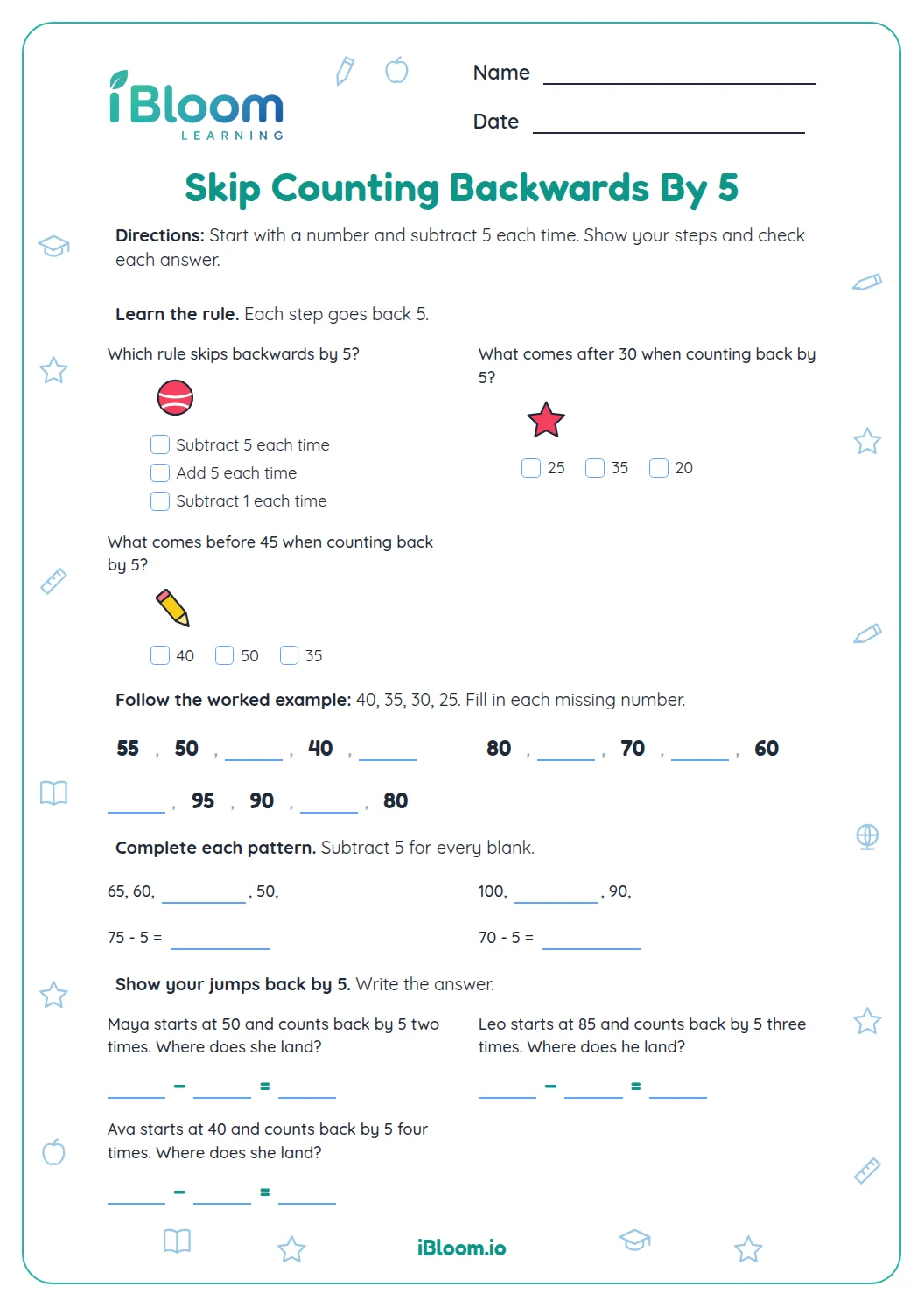
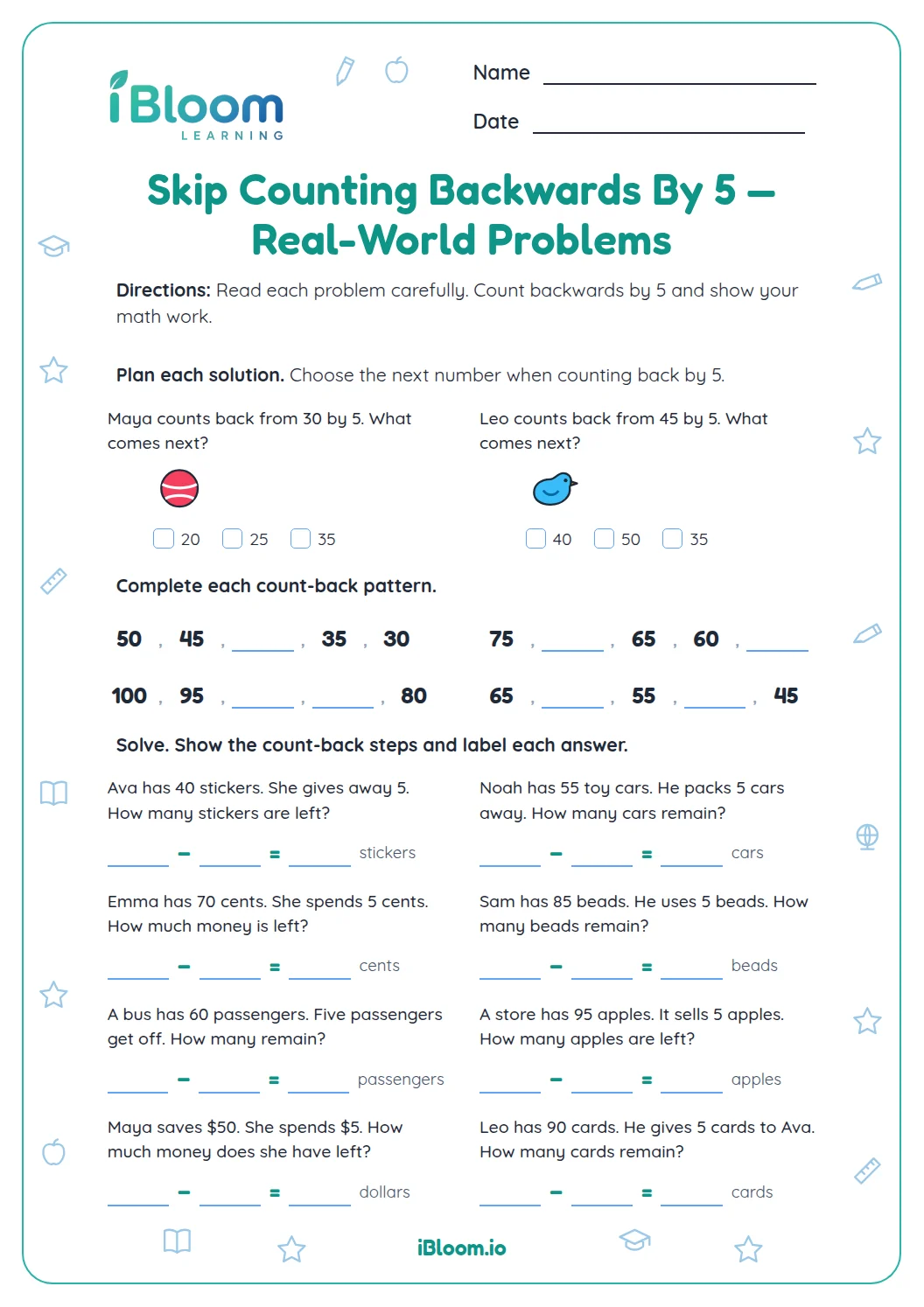
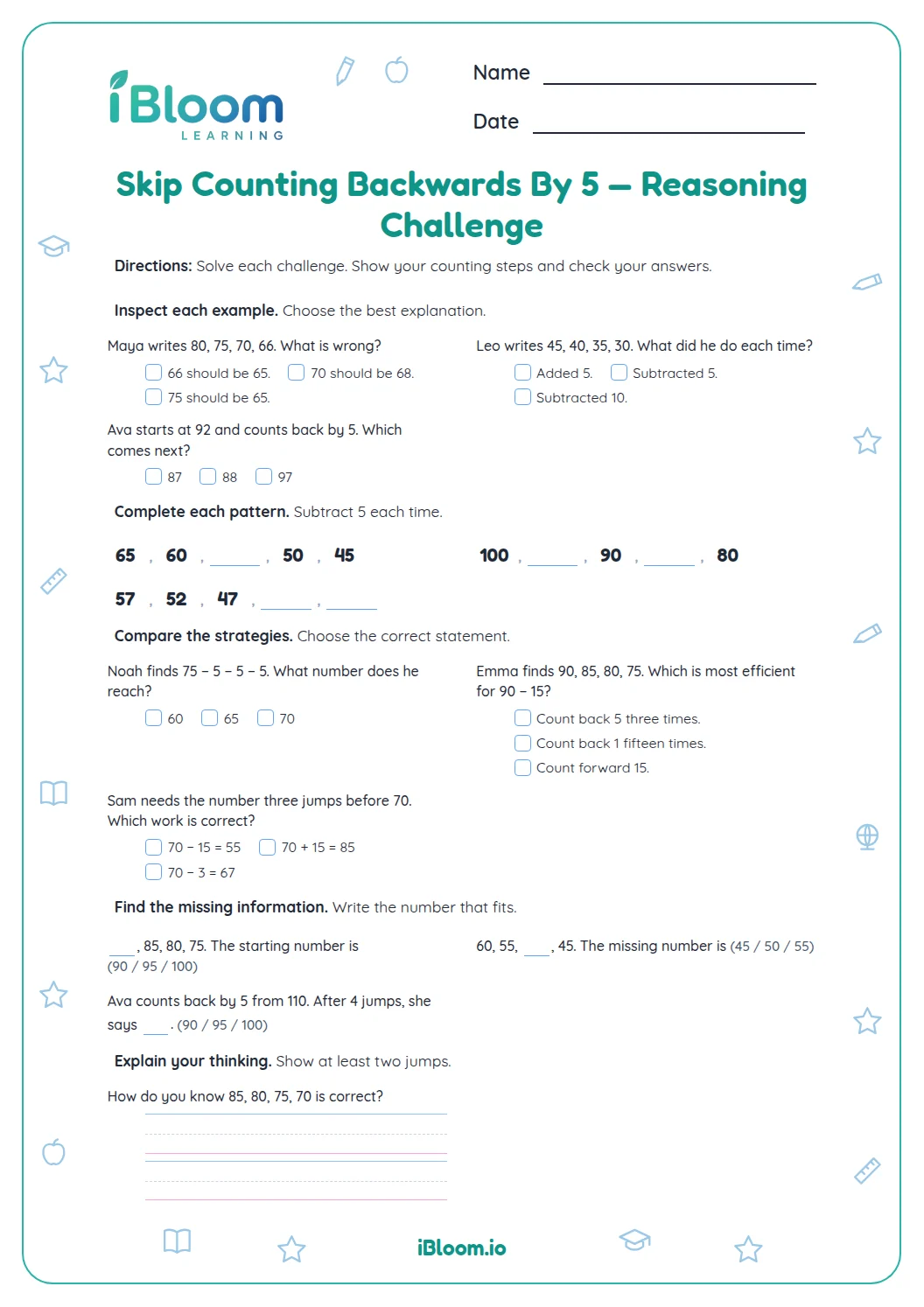
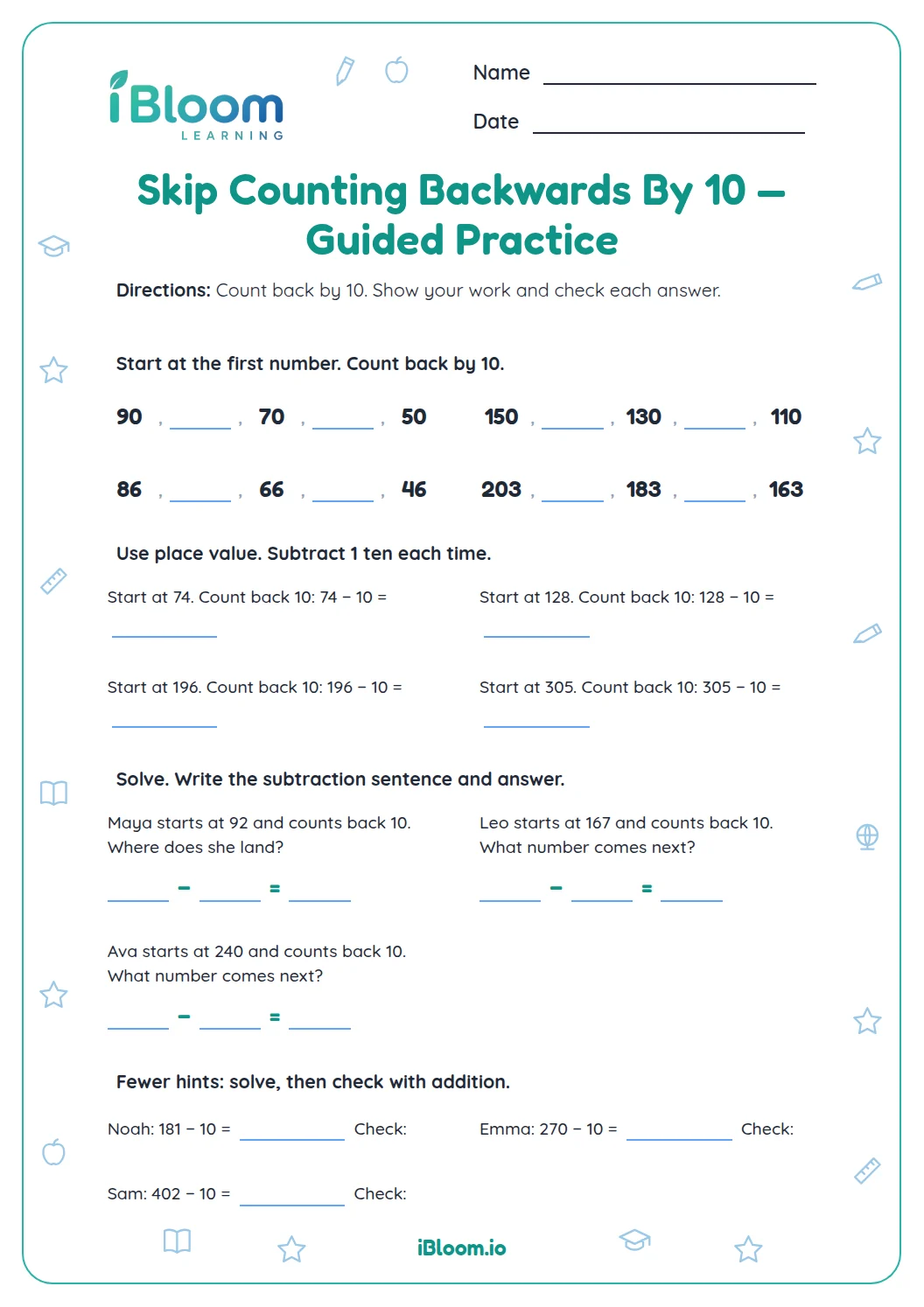
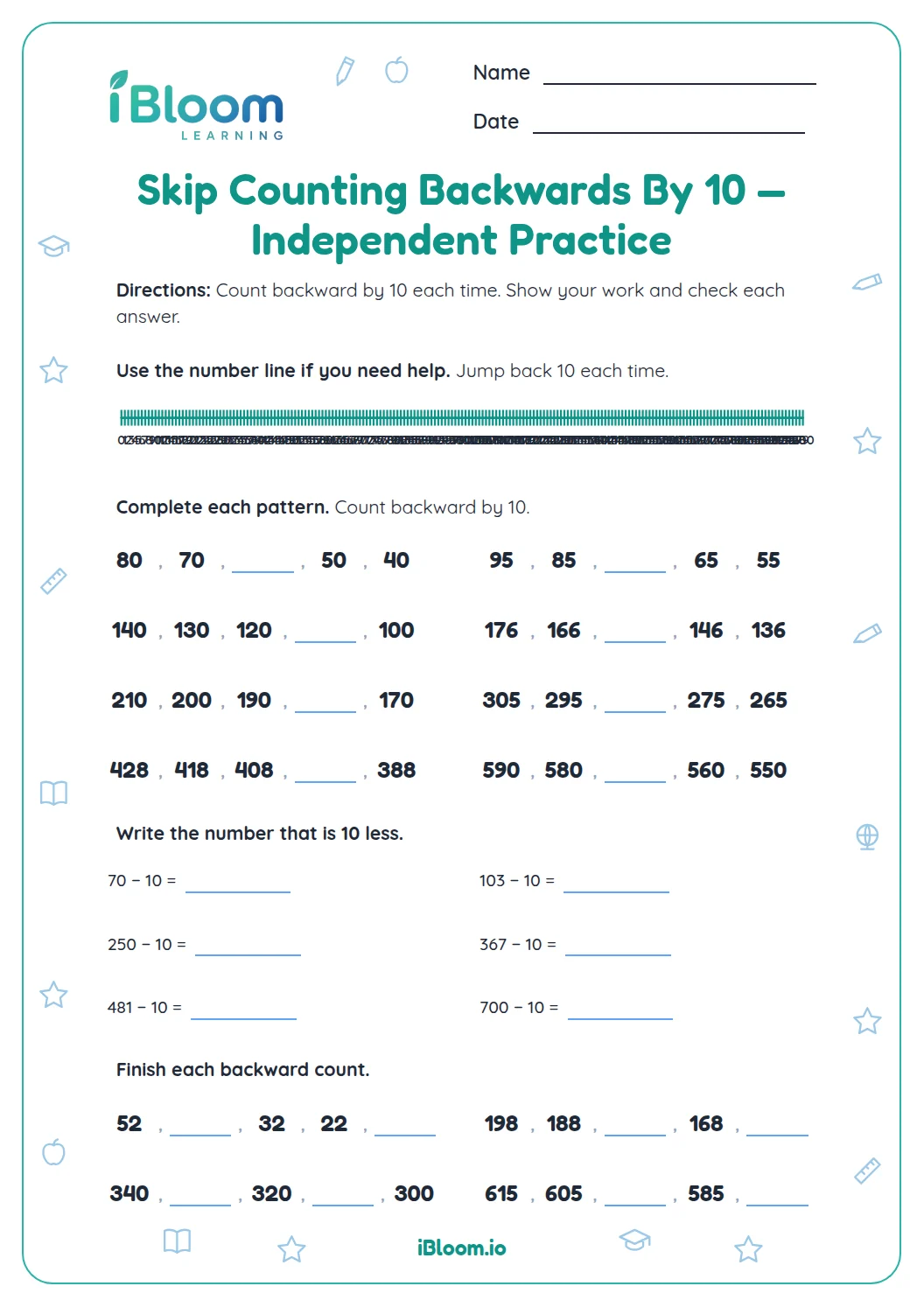
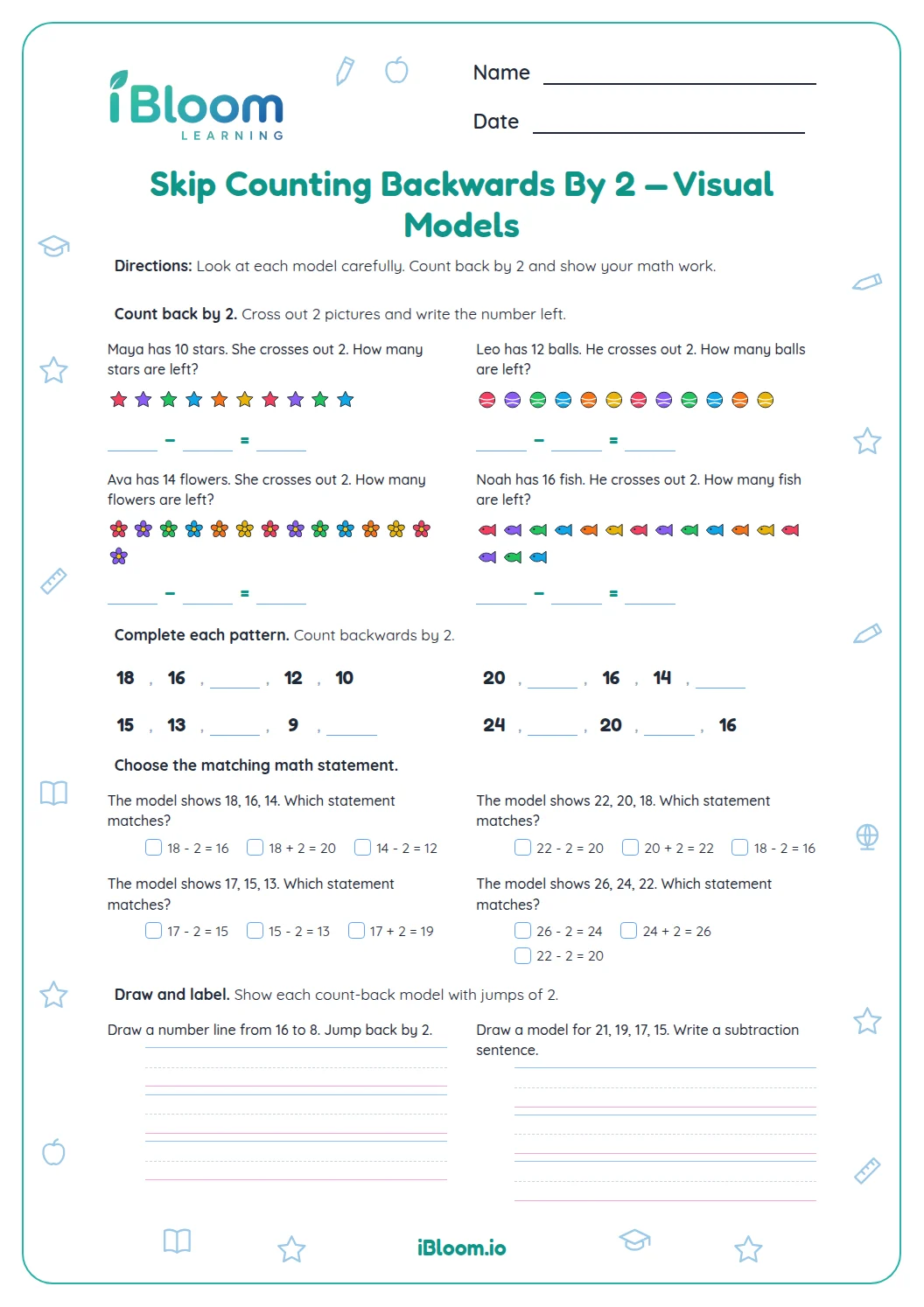
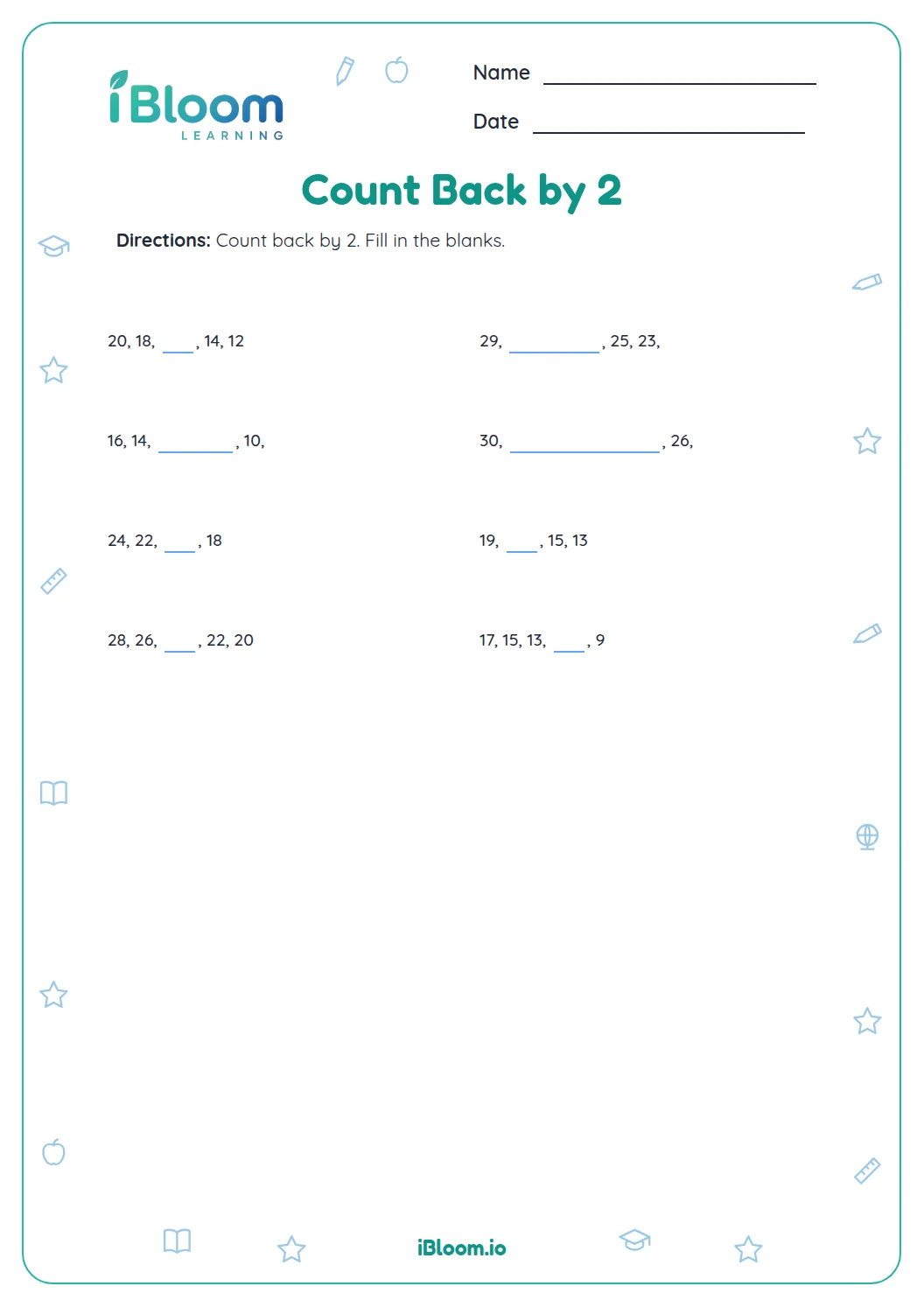
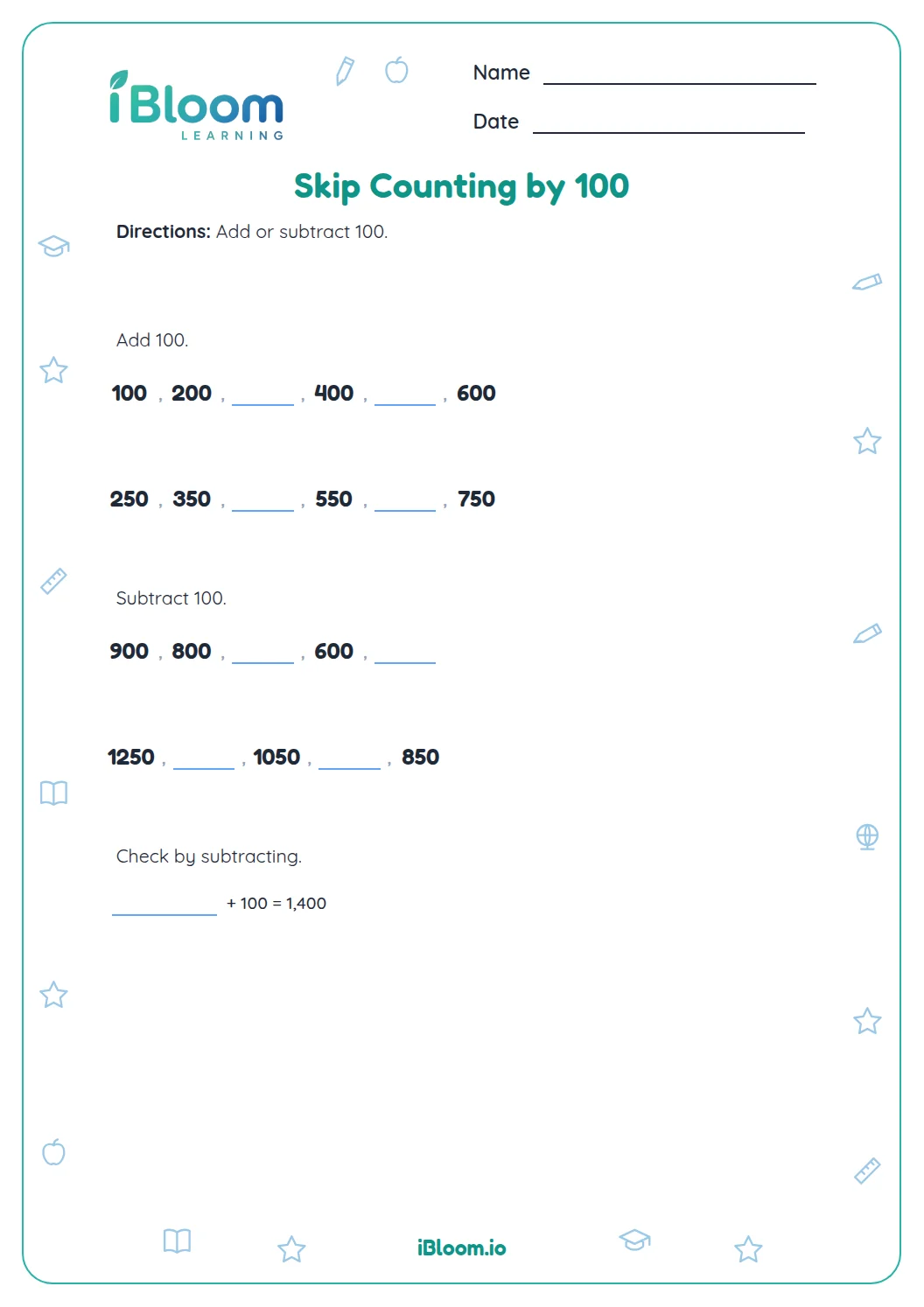
This Grade 2 printable gives children 16 missing-term sequences that count backward by fives. Each move to the right subtracts 5, and the blank shifts position so learners use the nearby terms to check their count. The sequences stay within 1,000. A matching answer key lists each missing number. This practices skip-counting within 1,000, including by fives (CCSS 2.NBT.A.2).
Aligned to 2.NBT.A.2
What stays the same in each sequence?
Every term is five less than the one before it. Read left to right, keep the direction clear, and use the neighboring terms to check the missing value.
How do you find a missing term?
Subtract five repeatedly from the starting number. If the blank is between two terms, check both directions: the earlier value is five more, and the later value is five less.
- 195, 90, ___, 80, 75
- 290 − 5 = 85
- 3Check: 85 − 5 = 80
- 4Answer: 85
How can you check the direction of a pattern?
Compare the first two printed terms. If the second is five less, keep subtracting as you move right. For a blank between known terms, check from each side: one step backward adds five, and one step forward subtracts five.
How to use this worksheet
- 1Start at the first number and move left to right.
- 2Subtract 5 once for each step.
- 3When a number is missing, use the closest known term.
- 4Check that the term before and after the blank differ by 5.
Common mistakes and quick fixes
The mistake
Counting upward by 5 instead of backward.
The fix
Say “five less” as you move right, and check that each number decreases.
The mistake
Subtracting 5 twice when the blank is only one step away.
The fix
Count one move at a time; the blank is one step from its neighbor unless another blank is printed.
The mistake
Dropping a zero or changing a digit while subtracting.
The fix
Subtract carefully across a hundred or ten boundary, then check the difference is still 5.
Common Core alignment
Skip-count by fives within 1,000 using backward sequences.
On this sheet: Count within 1,000; skip-count by 5s, 10s, and 100s.
Show the official wordingHide the official wording
Count within 1000; skip-count by 5s, 10s, and 100s.
What to practice next
Make more practice
Further reading
Questions parents and teachers ask
What does counting backward by five mean?
Each next number is 5 less than the number before it. In a sequence that begins 95, 90, the next number is 85, followed by 80. The worksheet uses this same step size throughout. Each step is one move to the next term, so subtract five once for each move.
How many questions are included?
There are 16 missing-term questions. Each presents a sequence that decreases by fives, with the missing value placed at different points. Children can read left to right and check the terms on both sides of a blank. Start with the closest printed number rather than restarting from the first term in the sequence.
How can a child check a missing term?
Subtract 5 from the number immediately before the blank and see whether the result fits. Then subtract 5 again and compare with the next printed term. For example, after 90 comes 85, and after 85 comes 80. Checking the next term is a useful way to catch a one-step counting slip.
Are the numbers within 1,000?
Yes. The sequences use numbers from 145 through 995, so each value is within 1,000. Learners focus on maintaining the backward-by-five pattern while keeping track of hundreds, tens, and ones. No sequence goes above 1,000, and the numbers remain whole numbers throughout.
What is in the answer key?
The answer key supplies the missing number for each of the 16 sequences. Children can check a response by confirming that both neighboring steps change by five. Check both the number before and after the blank to confirm the step in each direction.
What should I do if a child counts up instead?
Have the child point from one printed number to the next while saying “five less.” They can compare the first two terms to establish the direction, then continue one step at a time. A number line or spoken count can help keep the direction clear before writing the missing value.