



About this worksheet
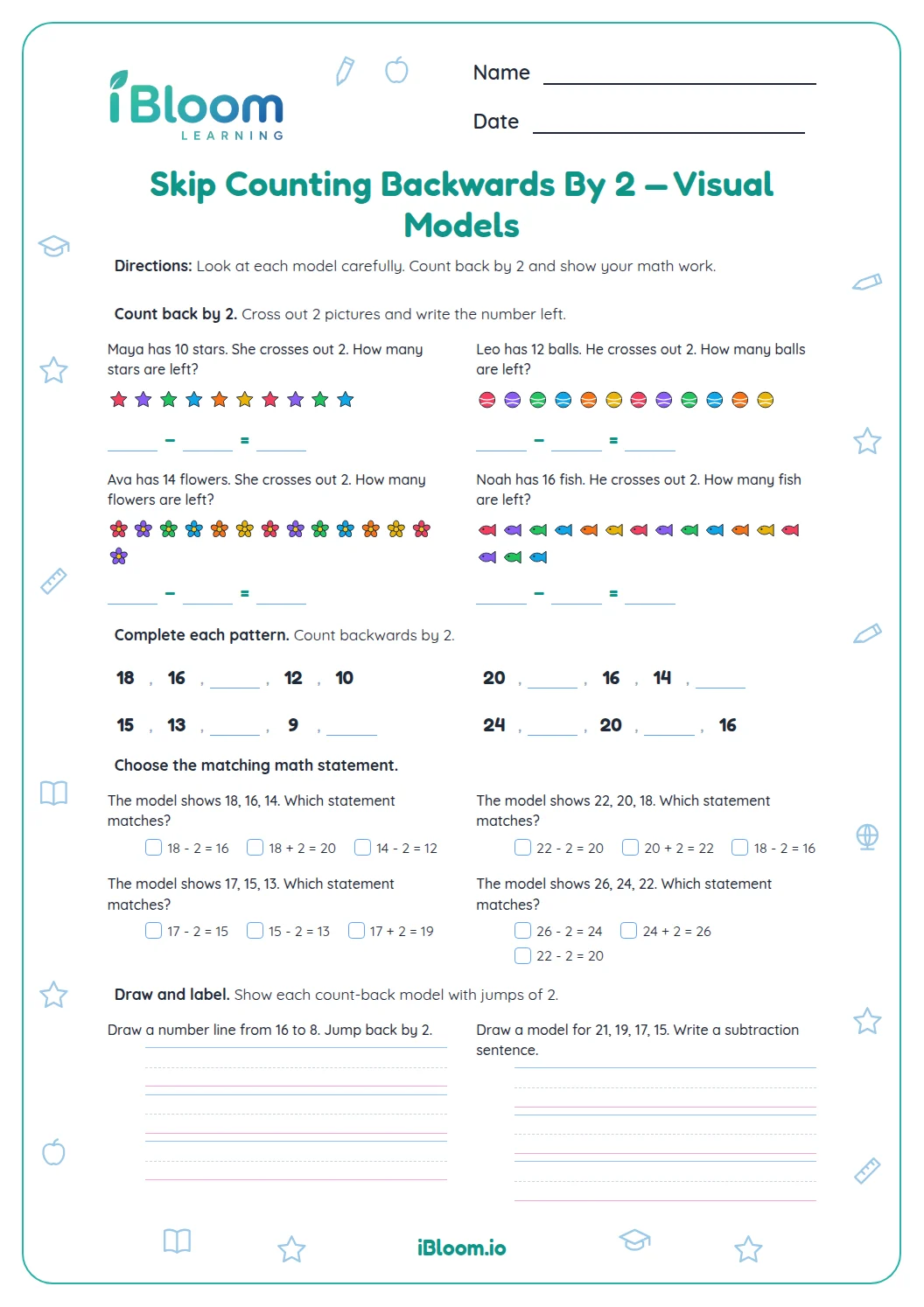
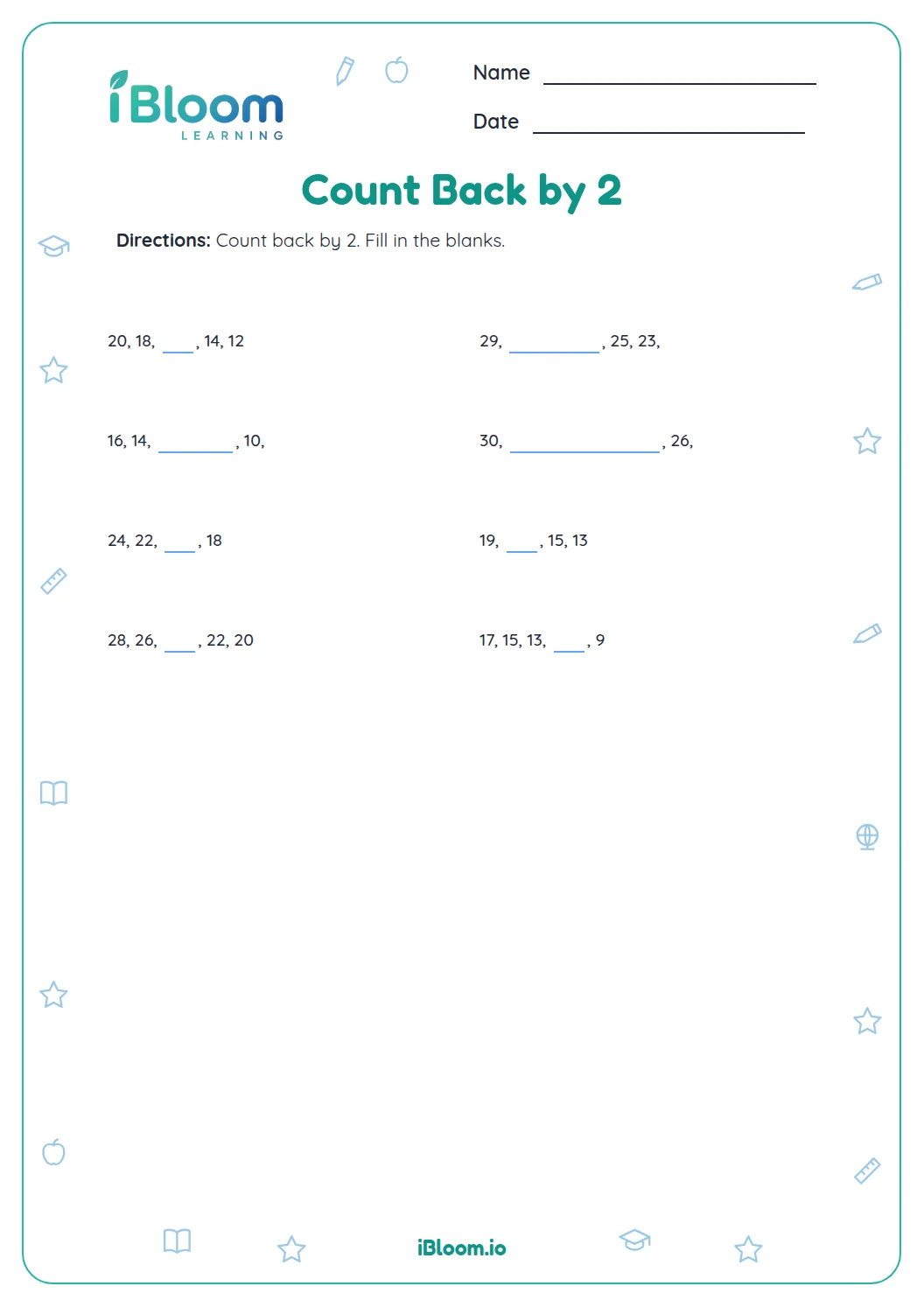
This Grade 2 worksheet turns skip counting backward by 2 into familiar situations: seats, blocks, fruit, riders, and game points. Part A fills gaps in descending sequences, and Part B uses short stories about turns, stops, and rounds to track groups shrinking by two. The values are chosen so students can track the repeated subtraction without losing the starting amount. The answer key shows each missing count and remaining quantity.
How do I complete a count backward by 2?
Part A gives a starting amount and a sequence with missing terms. Each next number is two less than the one before it, so compare neighboring terms before filling the gaps.
- 118, ___, 14, ___, 10
- 218 → 16 → 14 → 12 → 10
How do I turn each story into a count?
Part B tells how many items leave on each turn. Subtract two repeatedly for the stated number of turns, or multiply the number of turns by two and subtract that total once.
- 124 riders; 2 get off at each of 4 stops
- 224 − 2 − 2 − 2 − 2 = 16 riders
How can I check the remaining amount?
Count the number of changes, not the number of numbers you say. Four stops create four subtractions; then check that the result is two less for each stop.
How to use this worksheet
- 1In Part A, point to the first number and say the next number two less.
- 2Fill each blank, then read the full count aloud to check the rhythm.
- 3For each story, mark the starting amount and how many times two is removed.
- 4Subtract 2 once per turn, stop, or round.
- 5Write the remaining amount with the item named in the story.
Common mistakes and quick fixes
The mistake
Subtracting 2 only once even when there are several turns.
The fix
Make one subtraction for each stop or round in the story.
The mistake
Counting down by 1 instead of 2.
The fix
Say the next even number below the current number.
The mistake
Using the number of stops as the amount removed.
The fix
Each stop removes two, so multiply stops by 2 or subtract 2 repeatedly.
What to practice next
Make more practice
Questions parents and teachers ask
How many problems are on the worksheet?
There are 16 problems in two parts. Eight have students complete a backward count by two, and eight use real-world situations where two items leave on each turn, stop, or round. Each problem has a clear starting amount and answer.
Do students need to subtract repeatedly or multiply first?
Either method works when it is clear. A child can count back two once per turn, or find the total removed by multiplying two by the number of turns and subtracting that amount from the start. The key shows the final quantity.
Why do many starting numbers look even?
Removing two repeatedly from an even number keeps the count on even numbers. That makes the pattern easier to follow and helps students check whether a missing term fits. For instance, 18, 16, 14, 12, 10 uses the same step each time.
What is a good way to avoid missing a turn?
Make one mark for every turn or stop named in the story. Then subtract two for each mark. This keeps the number of changes separate from the starting quantity, and helps prevent counting the start as an extra stop.
How should the answer include units?
Write the remaining number and name what remains, such as “16 riders” or “12 muffins.” Naming the item makes it clear what the number describes. Check the result by counting back two once for each turn in the situation.