



About this worksheet
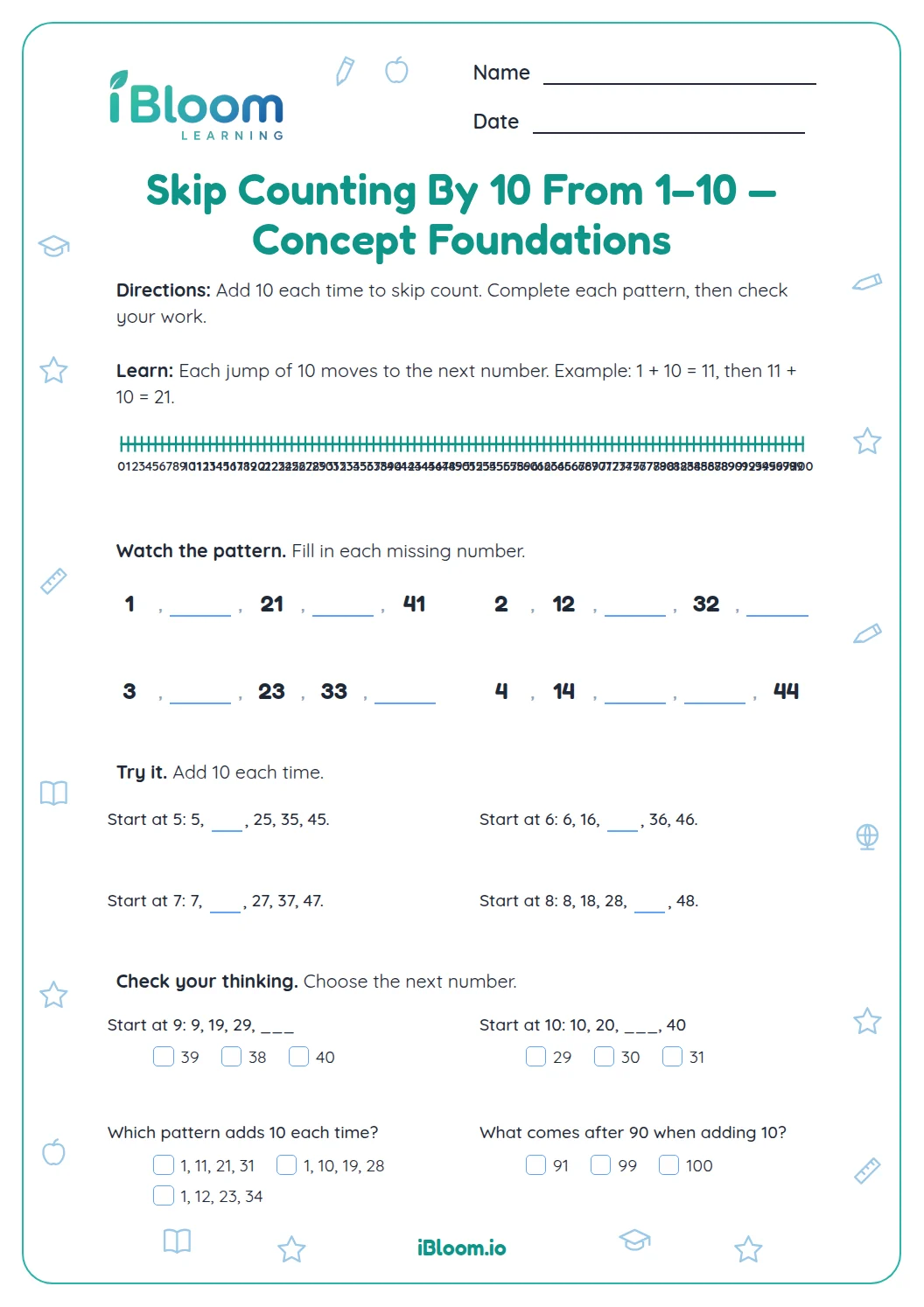
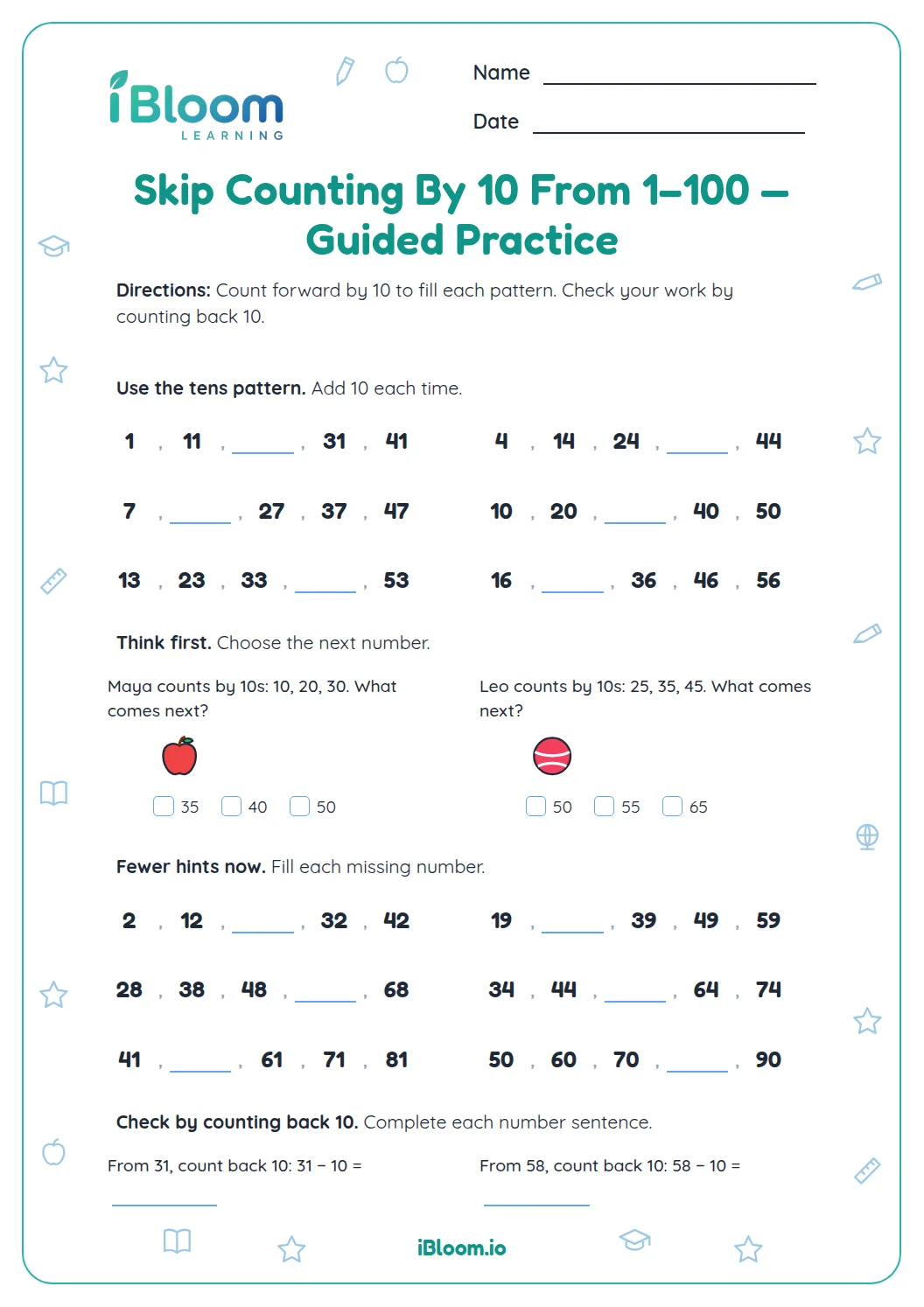
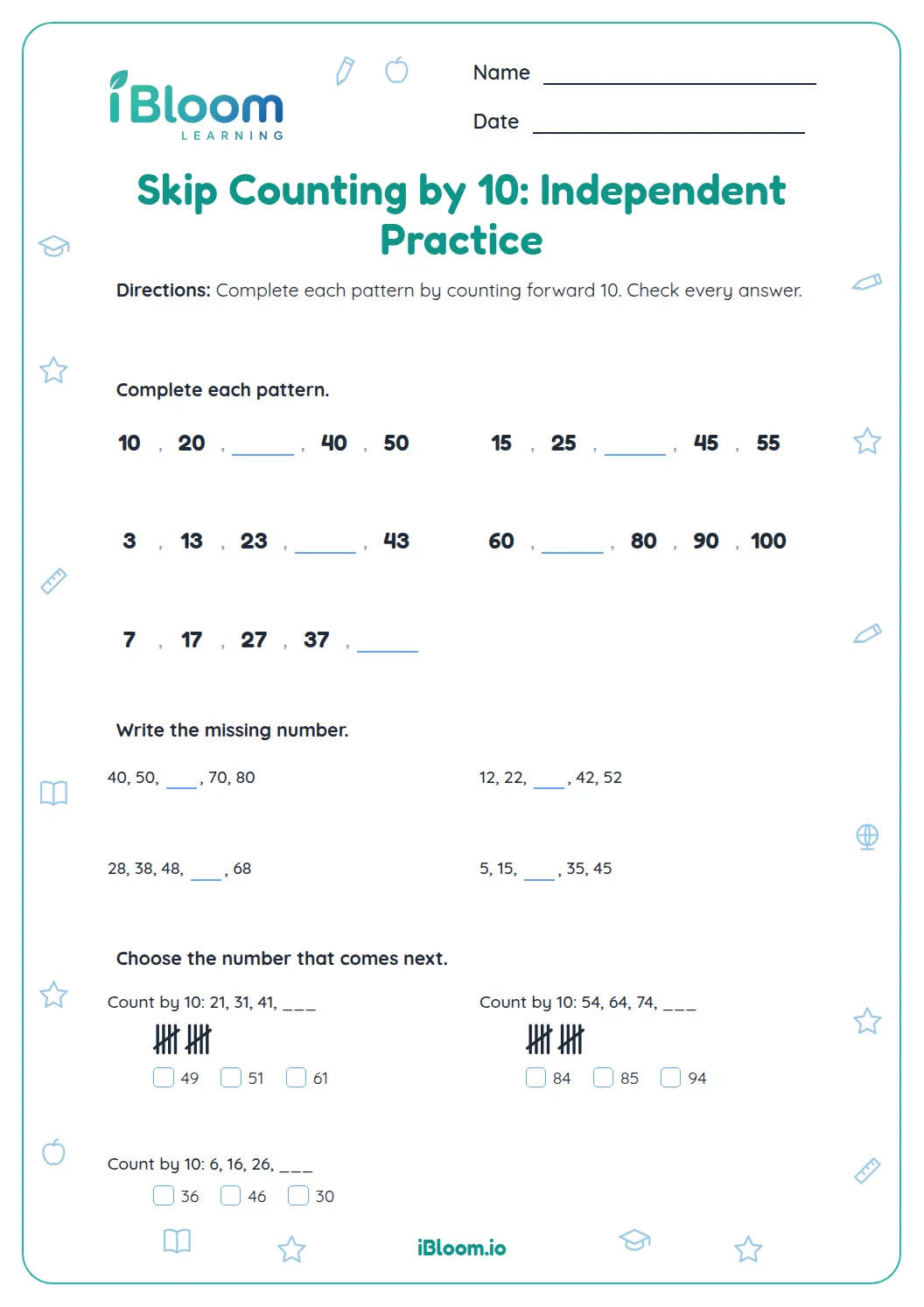
This free Grade 2 worksheet gives independent practice skip counting by 10 from starting numbers 1 through 10. The first ten questions provide one missing-number sequence for each start; the final four apply the same ten-step pattern to other numbers and a short comparison. The answer key lists each missing value so a learner can check that every jump is 10.
Aligned to 2.NBT.A.2
What changes in a count by tens?
Each number is 10 greater than the one before it. The first ten questions give a missing term in a sequence beginning at each whole number from 1 through 10. For example, 1, 11, 21, 31 increases by one ten each time.
How does the pattern work from another start?
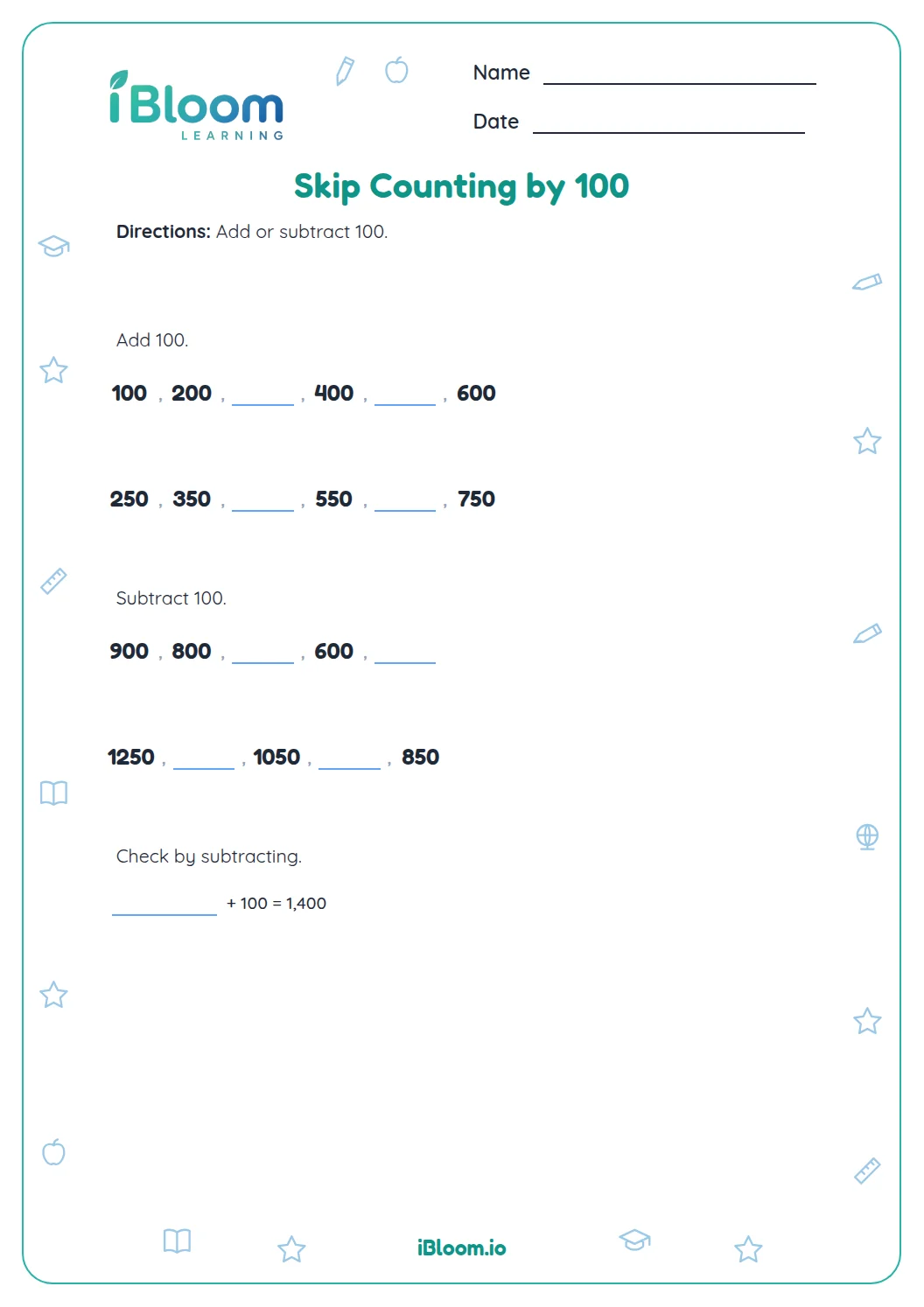
The final four questions apply the same +10 rule to other starting values and numbers in the hundreds. The starting number can change while the size of each jump stays 10.
How can you check a missing number?
Add 10 to the term before the blank, or subtract 10 from the term after it. Check both neighboring jumps. For a comparison such as 651 to 661, subtract to see that the difference is 10.
How to use this worksheet at home or in class
- 1Read the first two terms and find their difference.
- 2Keep adding 10 to move forward one term.
- 3For a missing middle number, add 10 to the number before the blank.
- 4For “next number” questions, begin from the stated number.
- 5Check that every pair of neighboring terms differs by 10.
Common mistakes and quick fixes
The mistake
Adding 1 instead of 10.
The fix
Compare the ones digits: counting by tens keeps the ones digit the same.
The mistake
Starting at 10 when the pattern begins at 1.
The fix
Write the first term exactly as given, then add 10.
The mistake
Skipping two terms after a blank.
The fix
Find the missing value from its immediate neighbor, then verify the term after it.
Common Core alignment
The worksheet gives practice counting forward by tens within 1,000, starting at each number from 1 through 10.
Count forward by 10s within 1,000 and describe the number pattern.
On this sheet: The worksheet questions directly practice the action named in this standard.
Show the official wordingHide the official wording
Count within 1000; skip-count by 5s, 10s, and 100s.
What to practice next
Make more practice
Further reading
Questions parents and teachers ask
How many questions does this worksheet have?
There are 14 questions across four parts. The first ten are missing-number sequences that begin at each whole number from 1 through 10. Four more questions apply counting by tens to later numbers and a simple difference. Each missing value continues the sequence by one group of ten.
Does every sequence start at 1?
The first sequence starts at 1, and the next nine start at 2 through 10. This covers every starting number named in the worksheet title. The final four questions extend the same +10 pattern to other numbers. Each sequence contains one blank, and the key lists its missing value.
How can a child check a missing number?
Add 10 to the number immediately before the blank, or subtract 10 from the number after it. Then check both neighboring jumps to make sure the sequence increases by exactly 10. This works for the sequences and later applications. The key provides the value for every blank.
How high do the numbers go?
The values reach the hundreds and stay within 1,000. This lets children see that adding 10 changes the tens place while the ones digit stays the same. The starting sequence questions stay below 50. In each early sequence, the ones digit stays the same from one term to the next.
What should the last question show?
The last question asks how much greater 661 is than 651. Subtract 651 from 661 to get 10. This difference matches the size of every skip-counting jump on the worksheet. This final comparison also lets learners check that a ten-count is the same as a difference of 10.