


About this worksheet
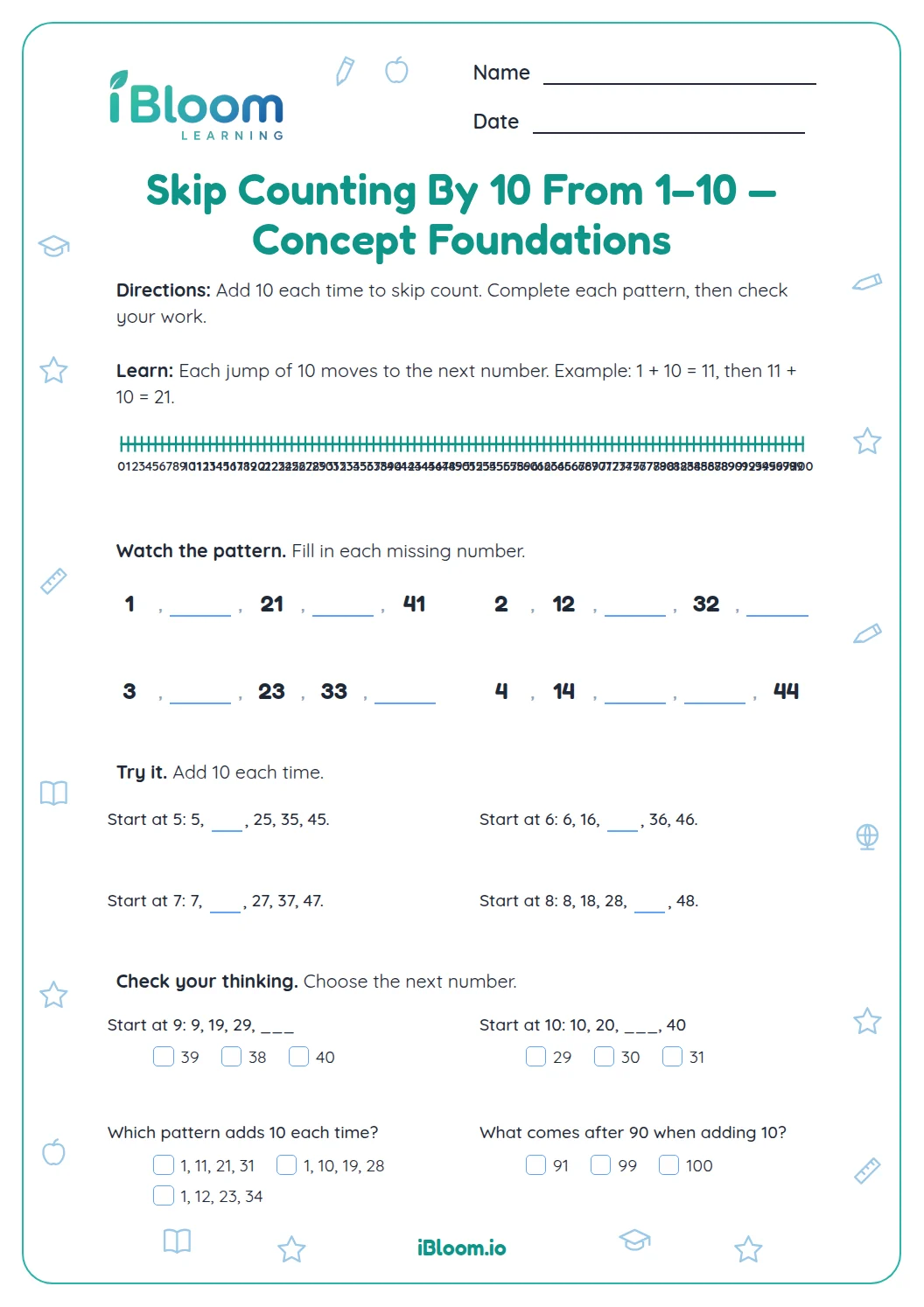
This Grade 2 worksheet practices skip counting by 10 from 10 through 100. Students choose correct sequences, identify a missing term, connect groups of ten with their totals, and spot a skipped number. All 14 items are multiple choice, and the answer key identifies the correct list, number, or explanation.
Aligned to 2.NBT.A.2
What stays the same in a skip-counting pattern?
The jump stays the same each time. In a pattern by tens, every new number is 10 more than the one before it. Students use this steady change to choose a correct list and find a missing term.
- 1Which list counts by 10 from 10 to 50? → 10, 20, 30, 40, 50
- 2Each term is 10 more than the last.
How do equal groups connect to counting by tens?
One group of ten represents one jump in the sequence. Eight groups give 10, 20, 30, 40, 50, 60, 70, 80, for a total of 80. Students connect that relationship to a sequence and to equal groups.
- 18 groups of 10 → 80
- 2The number of groups tells how many tens.
How can students explain a pattern error?
Compare each number with the one before it. In Noah’s list, 50 belongs between 40 and 60. The final question asks why 100 follows 90; each step adds 10.
How to use this worksheet
- 1Read the whole sequence or situation.
- 2Check that each step adds 10.
- 3Compare choices term by term to find a correct pattern.
- 4Connect the number of groups with the number of tens.
- 5For an error question, identify the missing multiple of ten.
Common mistakes and quick fixes
The mistake
Choosing a list that skips one multiple of ten.
The fix
Compare each term with the number before it; the difference should be 10.
The mistake
Counting the starting number as one jump.
The fix
Count the terms and the jumps separately; the first term is not a jump.
The mistake
Naming a missing number without checking the pattern rule.
The fix
Check that the number before and after it are each 10 away.
Curriculum alignment
This practice connects the page activities with the listed learning standard.
Count by tens and use equal jumps to extend a number pattern.
On this sheet: The worksheet counts by tens from 10 through 100 and explains patterns made by equal jumps of 10.
Show the official wordingHide the official wording
Count within 1000; skip-count by 5s, 10s, and 100s.
What to practice next
Make more practice
Further reading
Questions parents and teachers ask
What does counting by 10 mean?
Each number is 10 more than the number before it. Starting at 10 gives 10, 20, 30, and so on. The worksheet asks students to choose matching sequences and spot a list that skips 50. The answer key marks the correct pattern.
How do you find a missing number in a pattern?
Compare the numbers before and after the gap. If the sequence increases by 10 each time, the missing term is 10 more than the previous number and 10 less than the next. Questions 1 through 3 ask students to choose a sequence or missing term that follows this rule.
What is the 9th number when counting by tens from 10?
The ninth number is 90: 10 is first, 20 second, and each new term adds another ten. Question 10 asks students to select that value from two choices. Counting each term in order shows why the ninth term is 90.
How many questions are included?
There are 14 multiple-choice questions in one part. They ask students to recognize sequences, choose missing terms, connect equal groups with totals, and identify an error. The questions count by tens from 10 through 100, and the answer key gives the correct choice for every item.
How does a group of ten relate to skip counting?
Each group represents one jump of ten. Eight groups of ten make 80, and six groups make 60. Questions 8 and 9 connect groups with totals, while other items ask students to recognize the same tens pattern in a sequence.
What should students do after this page?
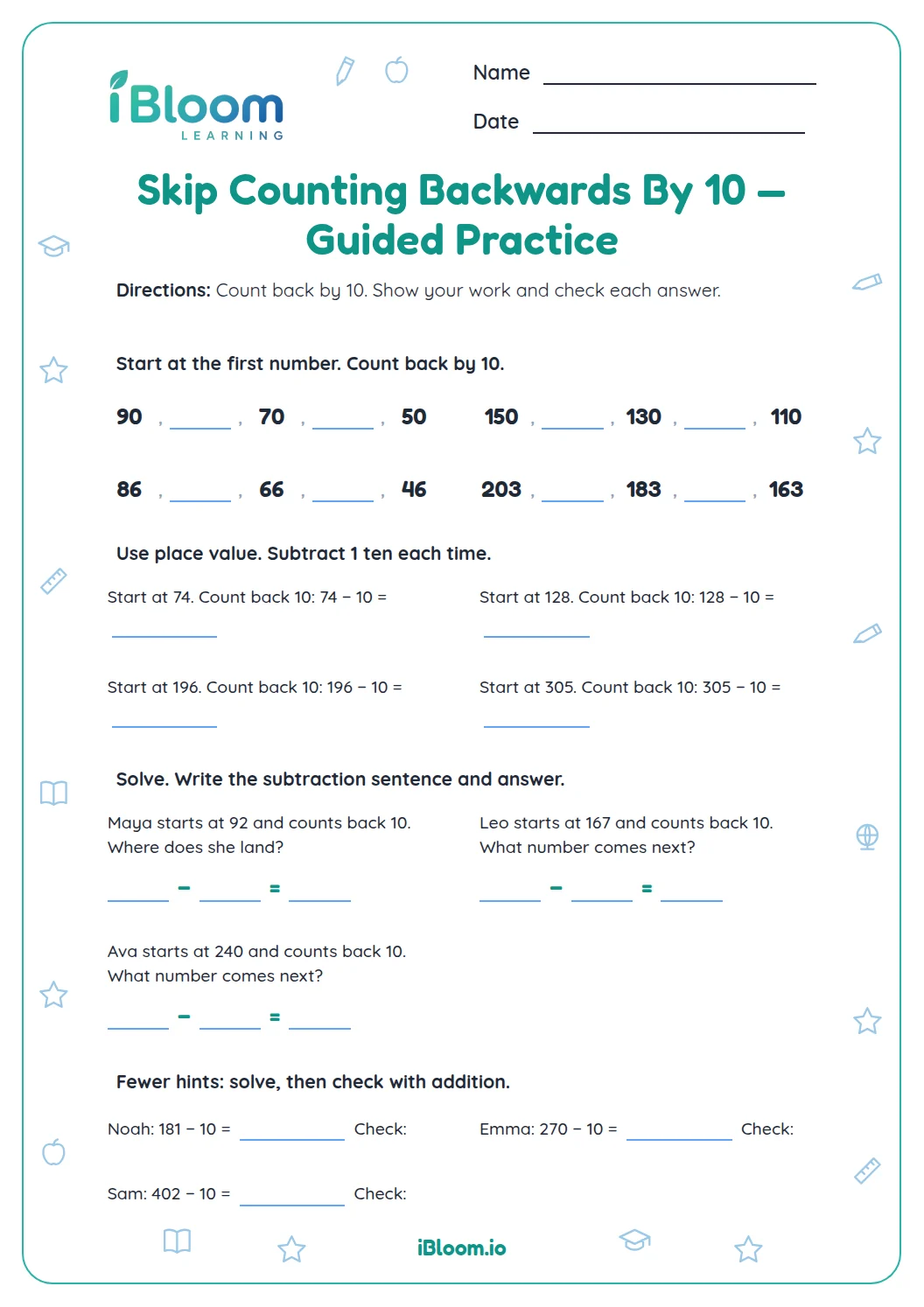
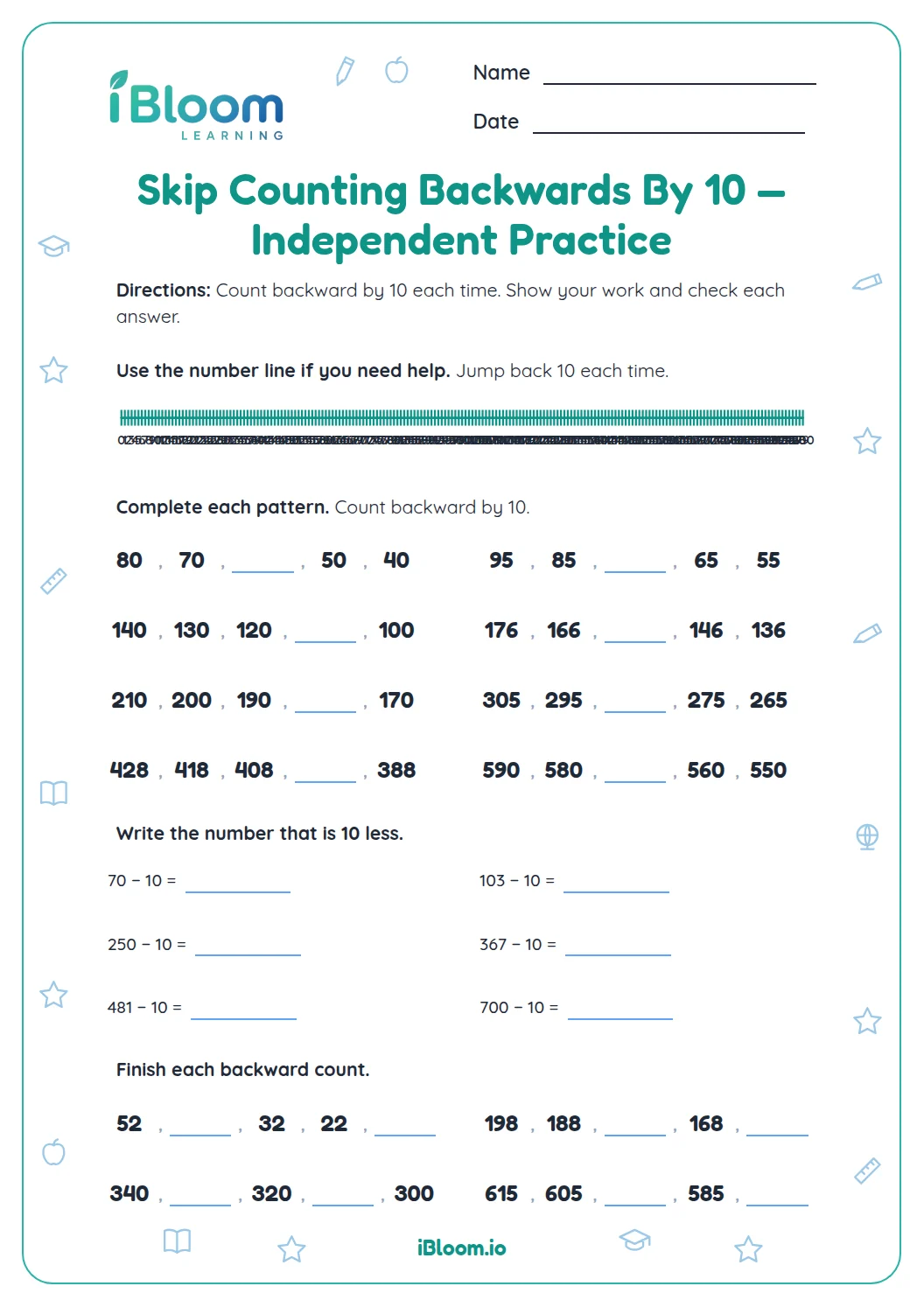
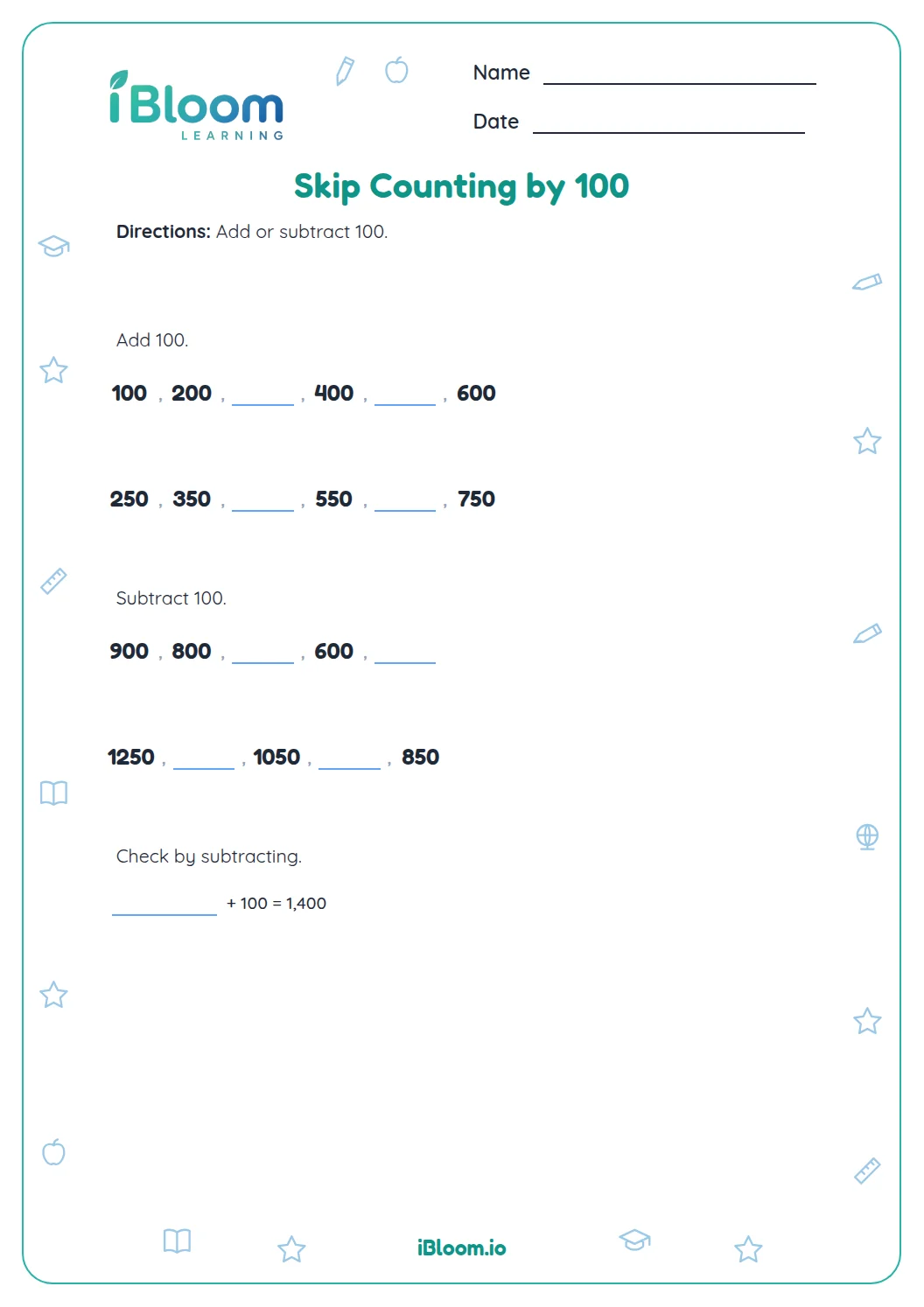
After this page, students can try counting backward by tens or forward by hundreds. The linked worksheets practice those related patterns with a different direction or jump size. Ask the learner to explain how the step changes while keeping the same pattern rule.