


About this worksheet
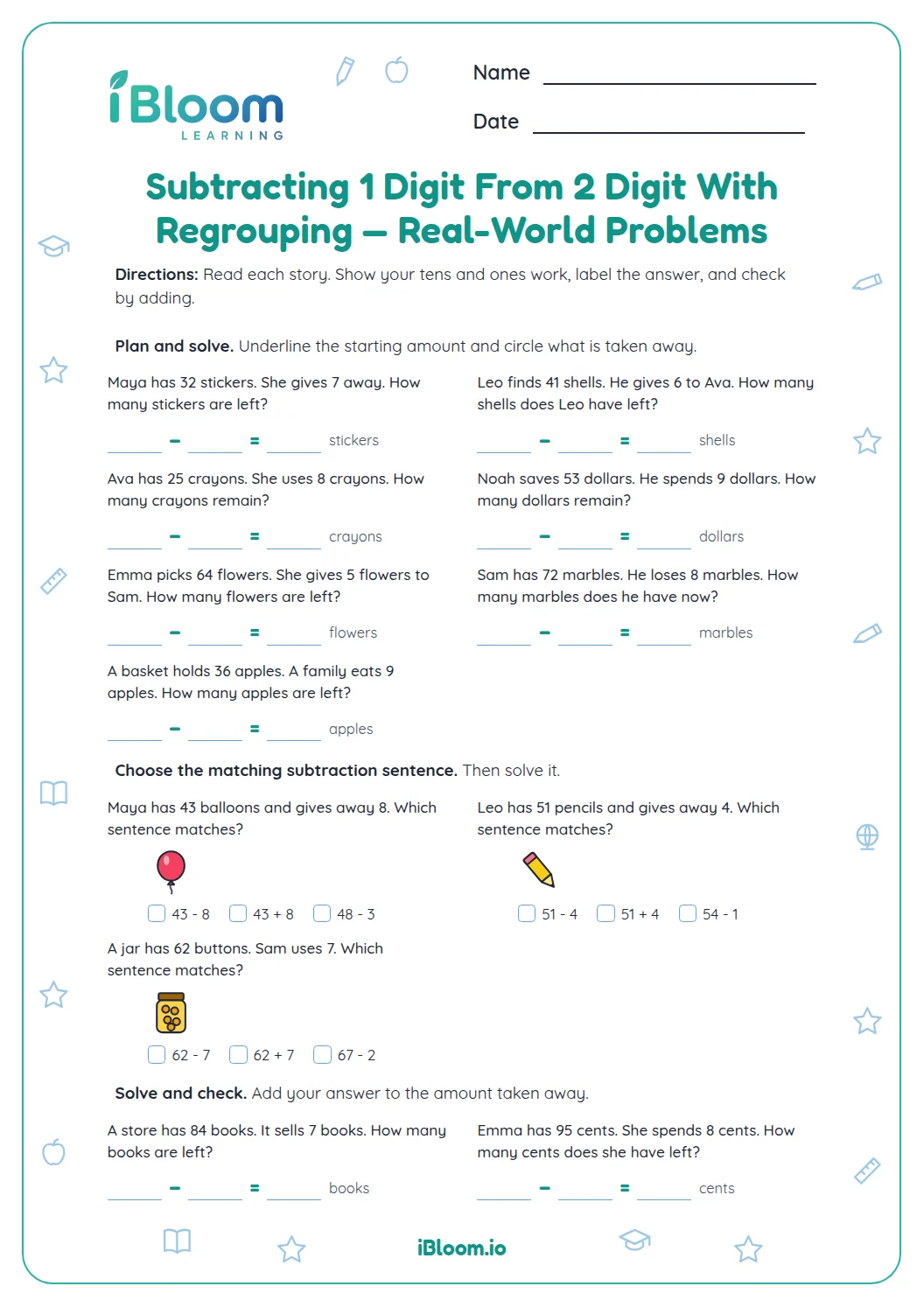
This Grade 2 worksheet uses base-ten blocks and subtraction problems to practice taking a one-digit number from a two-digit number when regrouping is needed. In Part A, learners use a block model; in Parts B and C, they solve subtraction problems and show the regrouping. It supports CCSS 2.NBT.B.5. The 16 questions fill a two-page worksheet, followed by a two-page answer key.
Aligned to 2.NBT.B.5
What does regrouping look like?
A model such as 32 has 3 tens and 2 ones. To subtract 5 ones, trade one ten for 10 ones: 32 becomes 2 tens and 12 ones, and 12 − 5 leaves 7 ones. The answer is 27.
How do the parts build the skill?
Part A pairs six base-ten models with one-digit subtraction. Parts B and C provide ten more problems with working space. Every problem requires regrouping because the ones digit in the starting number is smaller than the number being subtracted.
How can the answer be checked?
After subtracting, add the answer and the number taken away. For 32 − 5 = 27, check that 27 + 5 = 32.
How to subtract with a model
- 1Read the tens and ones in the starting number.
- 2Check whether there are enough ones to subtract.
- 3If not, trade one ten for 10 ones.
- 4Subtract the ones, then combine them with the remaining tens.
- 5Add the answer and subtracted number to check.
Regrouping checks
The mistake
Taking one ten away without adding 10 ones.
The fix
Rename the ten as 10 ones before subtracting.
The mistake
Subtracting the smaller ones digit from the larger one automatically.
The fix
Subtract in the order shown; regroup first when needed.
The mistake
Keeping the original tens after trading.
The fix
Reduce the tens by one when you trade it for 10 ones.
Common Core alignment
Subtract within 100 by regrouping one ten into 10 ones.
On this sheet: Learners subtract within 100; the first six models show a place-value strategy for regrouping.
Show the official wordingHide the official wording
Fluently add and subtract within 100 using strategies based on place value, properties of operations, and/or the relationship between addition and subtraction.
What to practice next
Make more practice
Further reading
Questions parents and teachers ask
Why does a ten become 10 ones?
A ten is made of 10 ones, so it can be traded without changing the number’s value. In 32, trade one of the three tens to make 2 tens and 12 ones. That gives enough ones to subtract 5. The base-ten models on Part A make this trade visible.
How many problems require regrouping?
All 16 problems require regrouping: six use base-ten block models, and ten provide working space for solving. In each starting number, the ones digit is smaller than the one-digit number being subtracted. The answer key follows the two worksheet pages.
What is the answer to 32 minus 5?
32 − 5 = 27. Rename 32 as 2 tens and 12 ones, subtract 5 from 12 to get 7, and keep the 2 tens. The first model on this sheet practices that exact trade, and the answer key gives the result.
How can a learner check a subtraction answer?
Add the difference to the number that was subtracted. For example, 27 + 5 = 32, so 27 is a correct difference for 32 − 5. This inverse check works for each problem on the sheet and is a useful way to review with the answer key.
Does the sheet include a place-value model?
Yes. The first six questions show base-ten blocks for the starting number and ask learners to subtract a one-digit number. The remaining ten questions have workspace for solving. The two parts connect the model to written regrouping practice.