




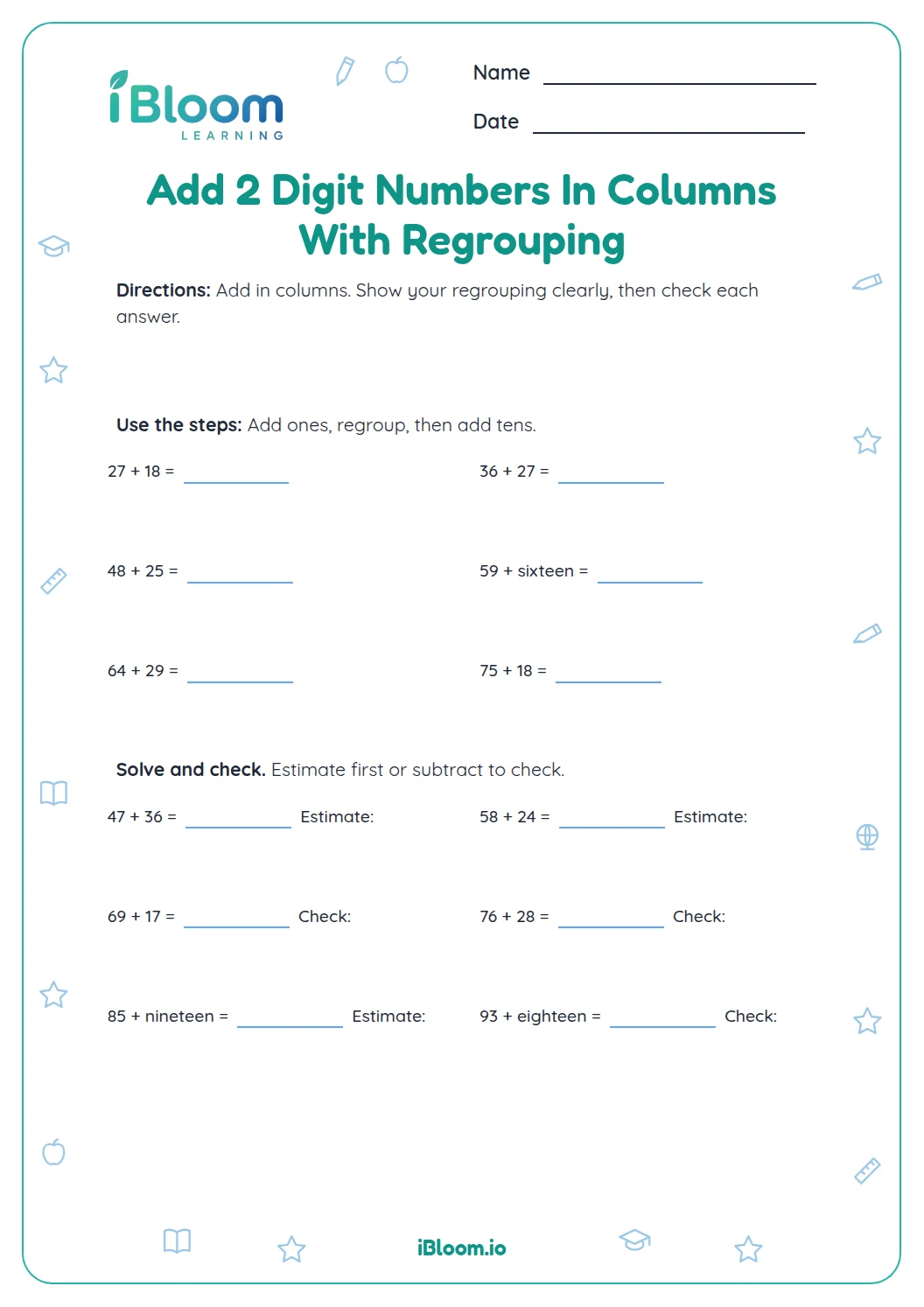

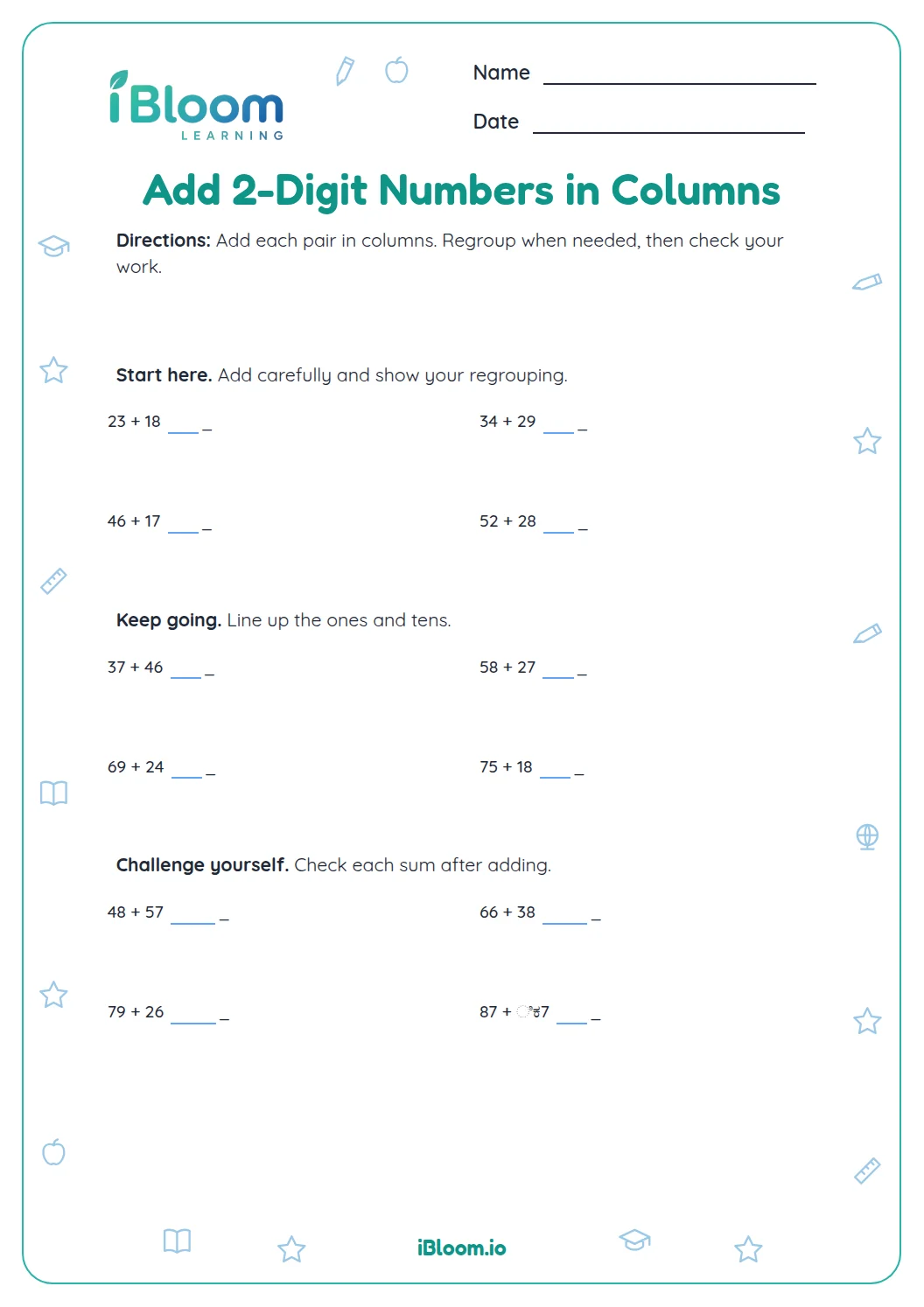
About this worksheet
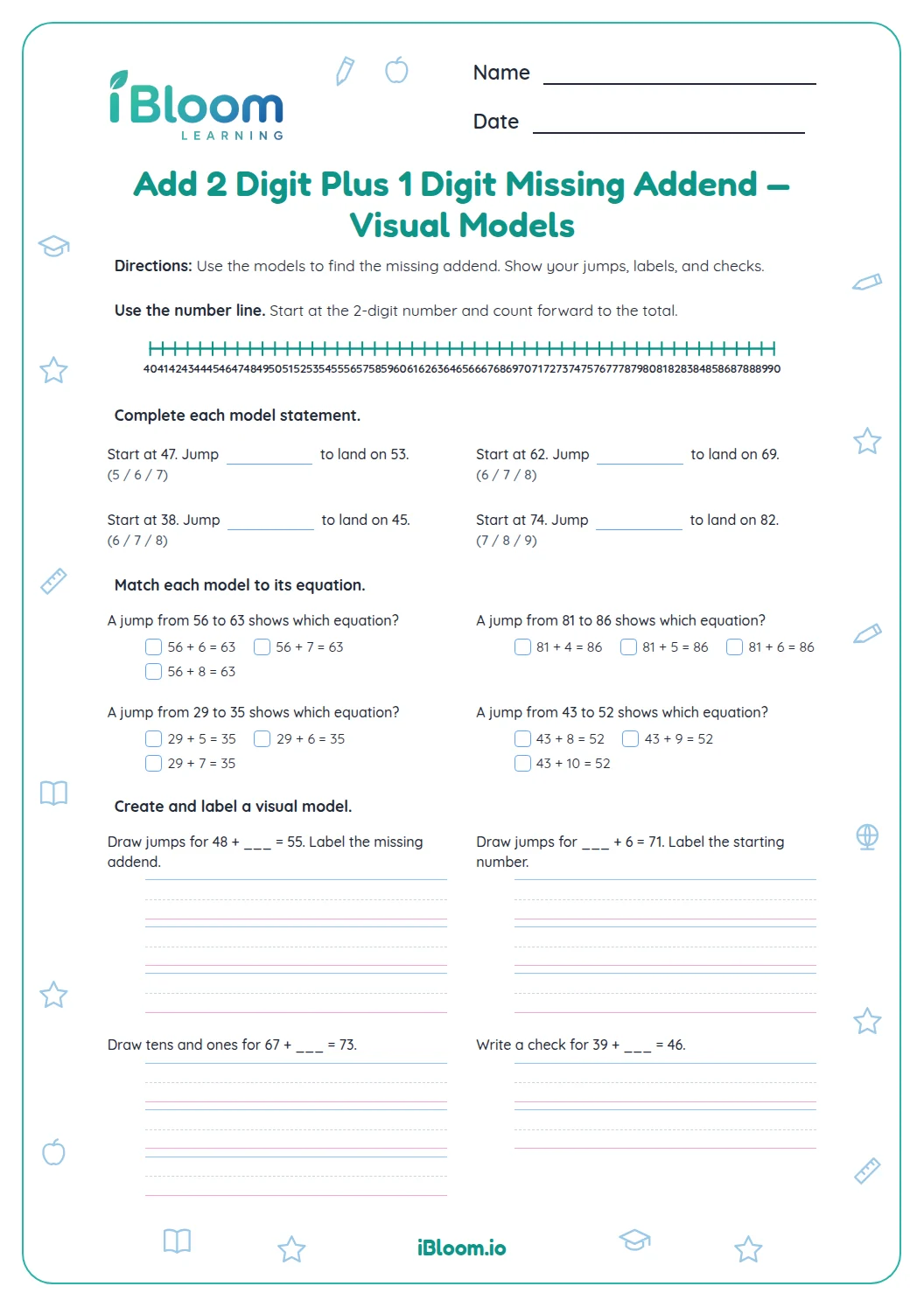
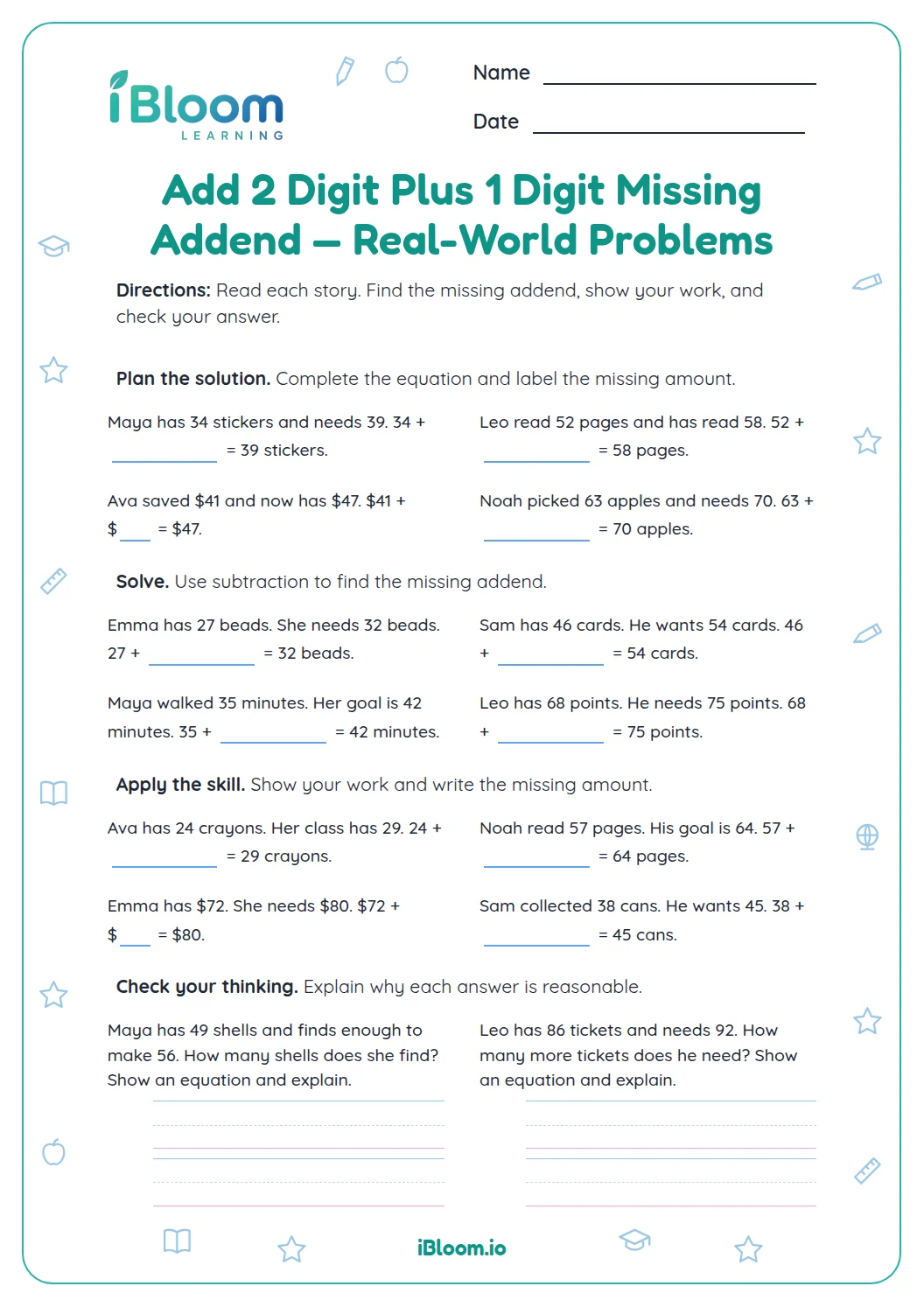
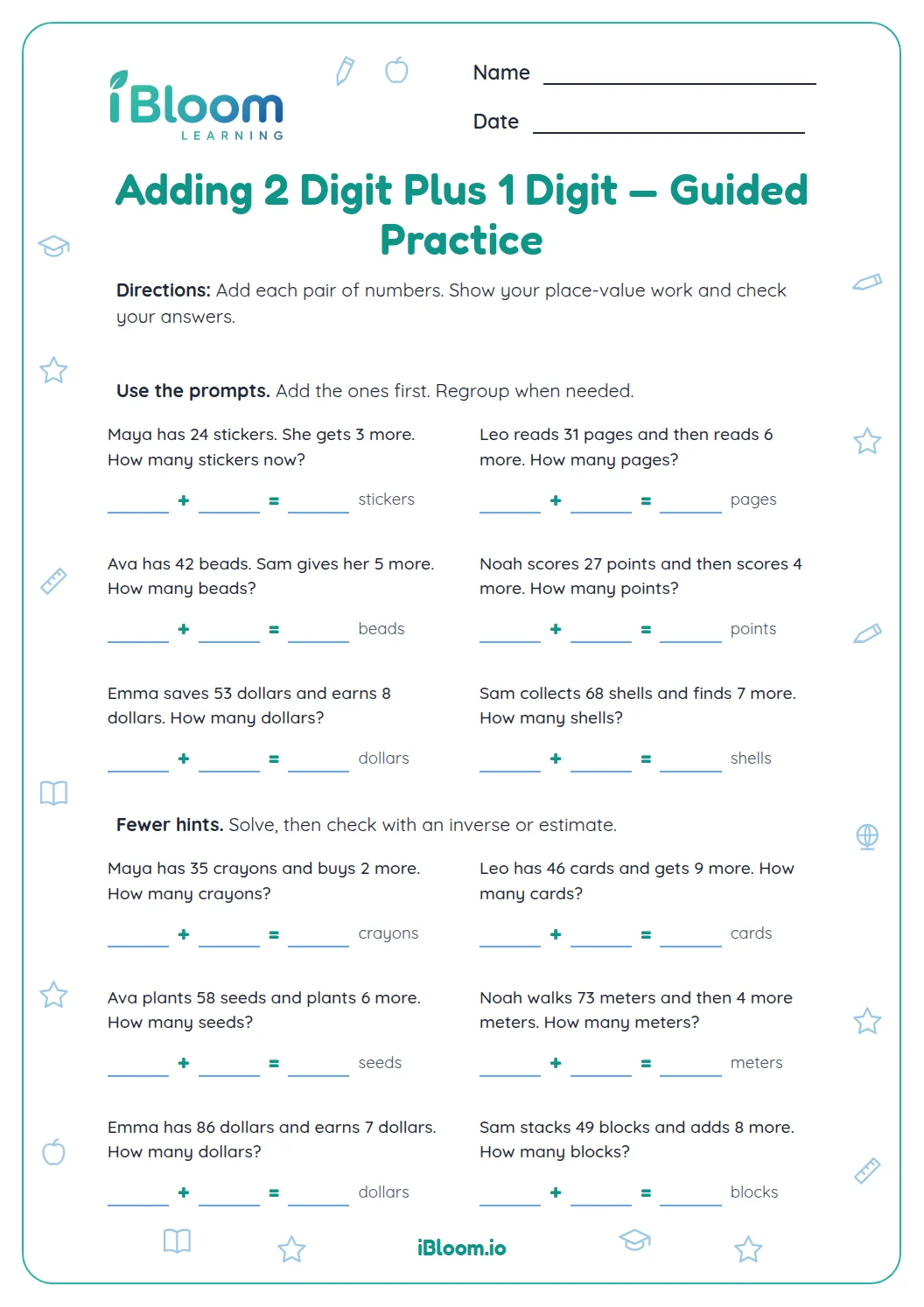
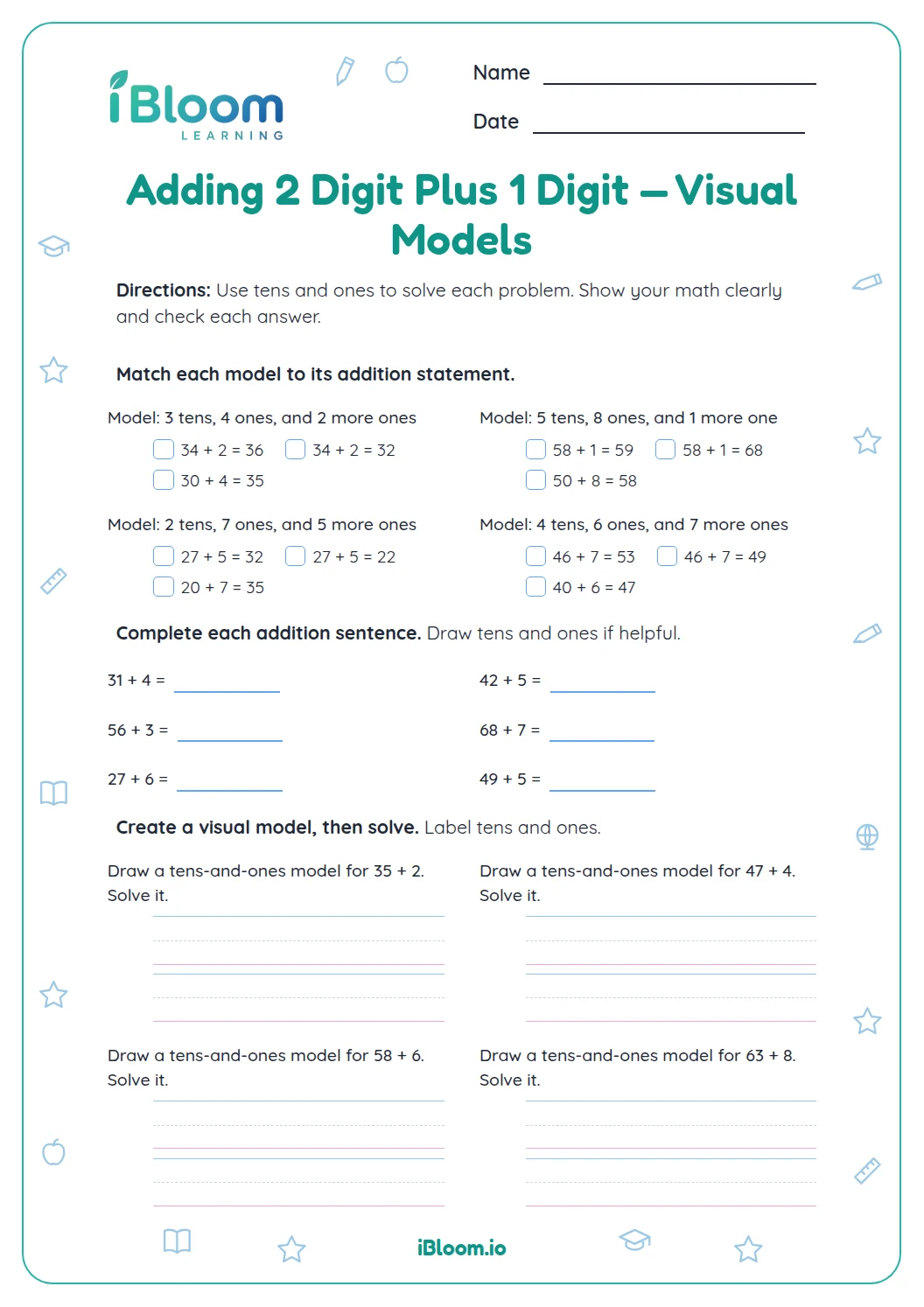
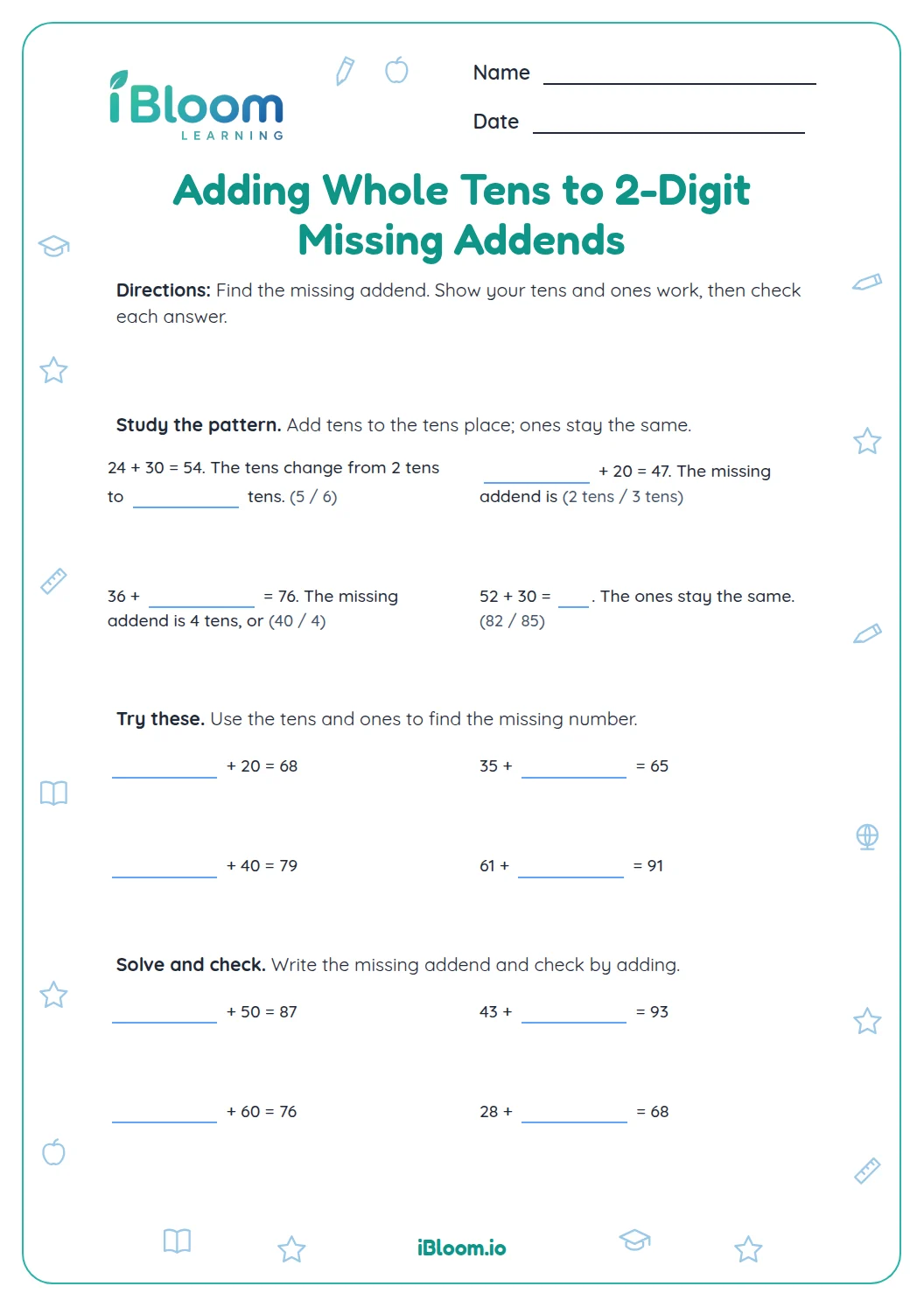
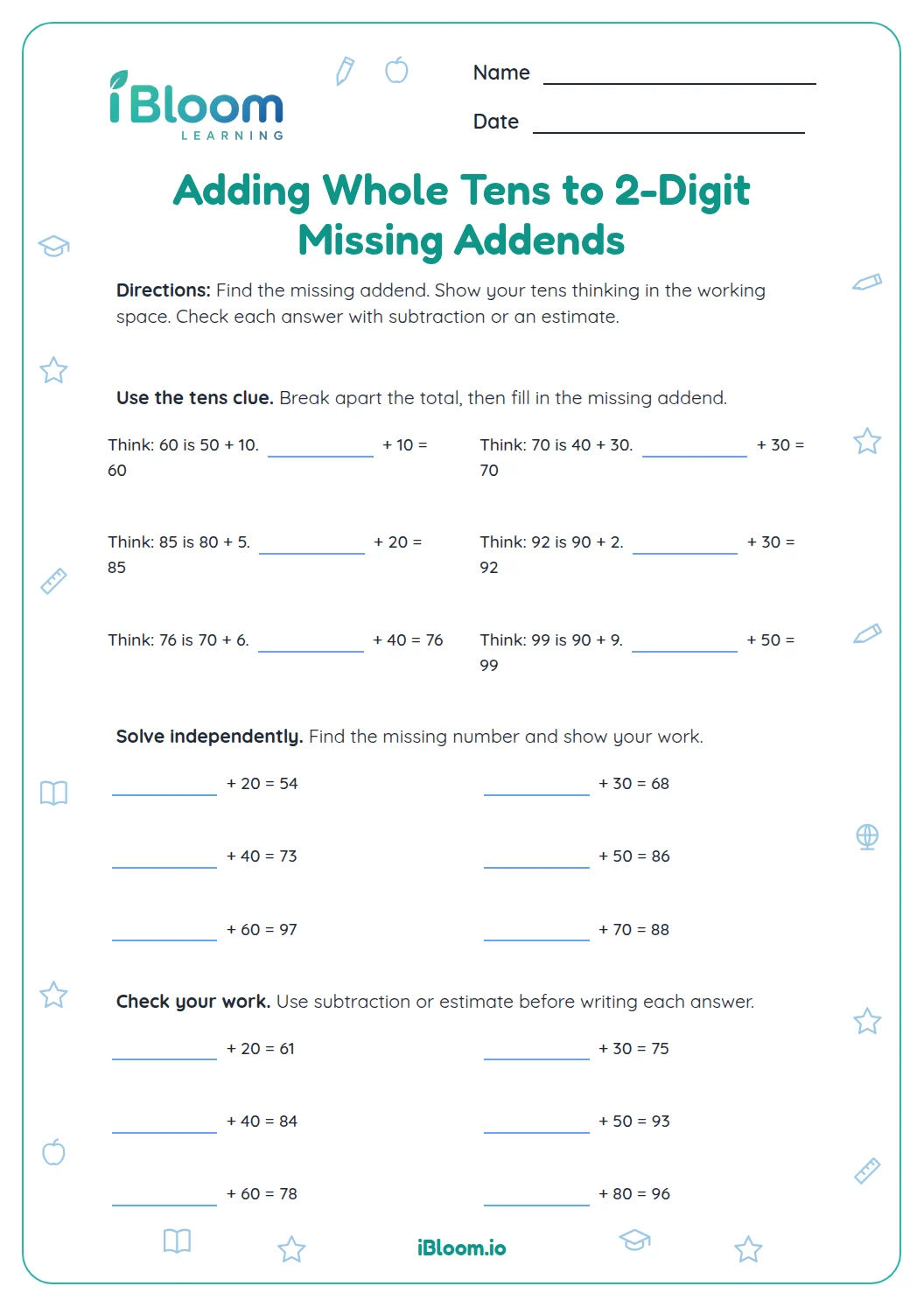
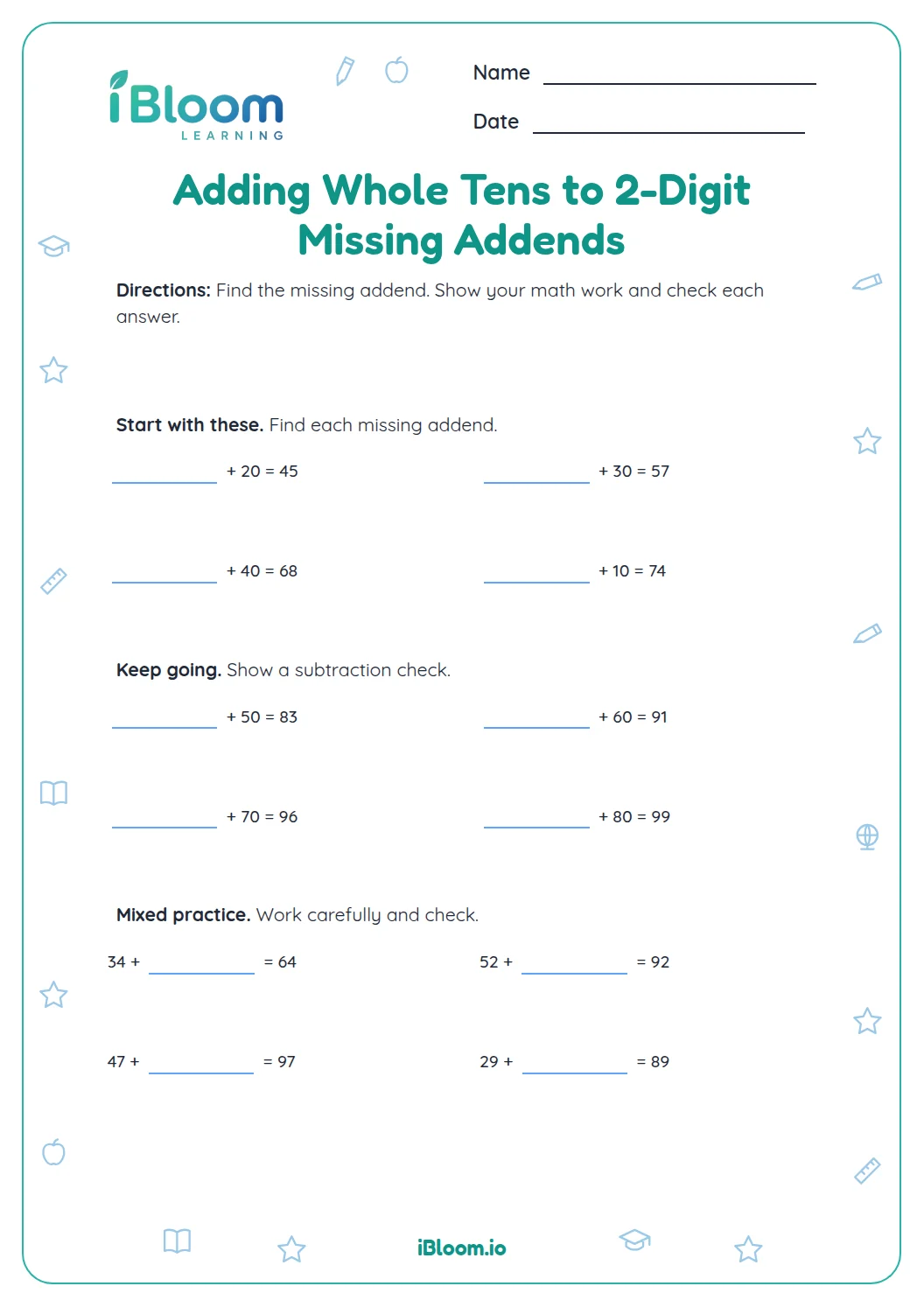
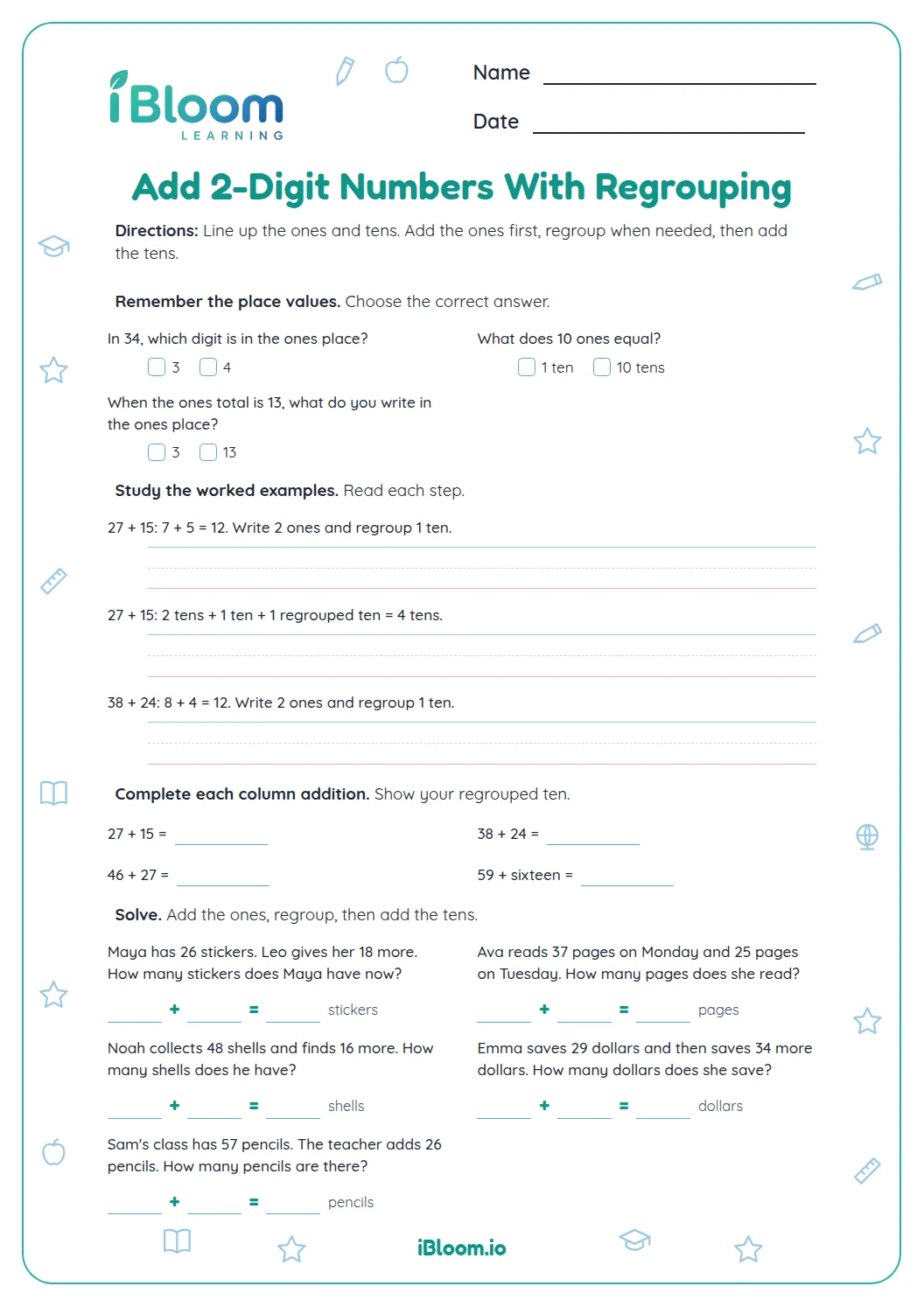
This Grade 3 printable focuses on missing addends in two-digit plus one-digit equations. Children solve number sentences, check choices by substituting an answer, and use addition equations for short everyday situations. The sixteen questions connect to Common Core 2.NBT.B.5 and 2.OA.A.1: use the relationship between addition and subtraction, including unknowns in different positions. The answer key gives each missing value and total.
Aligned to 2.NBT.B.5 and 2.OA.A.1
How do you find a missing addend?
An addition equation tells the total and one part. Find the missing part by counting on from the known addend or subtracting that addend from the total.
Question 1 is 36 + ___ = 42. Count 6 more from 36 to reach 42, so the missing addend is 6. Check: 36 + 6 = 42.
- 136 + ___ = 42
- 242 − 36 = 6
- 336 + 6 = 42
- 4The missing addend is 6.
How does the total help check the answer?
Put the missing number back in the equation. If both addends make the stated total, the answer works. Part B asks children to compare options and catch nearby errors such as 72 + 9 = 80.
How do missing addends appear in a story?
A story may give a starting amount and a goal, or give the added amount and final amount. Write a sentence such as 38 + ___ = 45, then solve for the amount still needed.
How to use this worksheet
- 1Read the equation and point to the total.
- 2Find the difference between the known addend and total.
- 3Check the value by adding both parts.
- 4For Part B, test the choices in the original equation.
- 5For a story, name the starting amount, change and final amount.
- 6Use the key to check each answer and correct the equation if needed.
Common mistakes and quick fixes
The mistake
Subtracting the total from the addend and keeping a negative result.
The fix
Start with the total, then take away the known addend.
The mistake
Choosing a number one away from the missing part.
The fix
Substitute it and check whether the sum reaches the stated total.
The mistake
Treating the story’s final amount as the missing addend.
The fix
Write a sentence with the known amount, blank and total before solving.
Common Core alignment
This worksheet practices the math skills named below through its sequence problems and explanations.
Use addition and subtraction relationships to find a missing addend within 100.
On this sheet: The unknown addends stay within 100 and can be found by subtracting or counting on.
Show the official wordingHide the official wording
Fluently add and subtract within 100 using strategies based on place value, properties of operations, and/or the relationship between addition and subtraction.
Represent missing-addend situations in short problems with an equation.
On this sheet: The final four situations ask for an unknown amount that completes a total.
Show the official wordingHide the official wording
Use addition and subtraction within 100 to solve one- and two-step word problems involving situations of adding to, taking from, putting together, taking apart, and comparing, with unknowns in all positions, e.g., by using drawings and equations with a symbol for the unknown number to represent the problem.
What to practice next
Make more practice
Further reading
Questions parents and teachers ask
How can my child solve 36 + ___ = 42?
Subtract 36 from 42 or count on from 36 to 42. Both methods give 6, and the check is 36 + 6 = 42. Question 1 uses this kind of reasoning before later items move the blank to the first addend or ask children to interpret a situation.
Why is subtraction useful for a missing addend?
Addition and subtraction undo each other. When the total and one addend are known, subtracting the known part reveals the part that is missing. A child can still count on instead, especially when the gap is small, then confirm the result with addition.
What does the worksheet mean by checking an equation?
Replace the blank with the proposed number and add. For example, if a choice says 59 for ___ + 8 = 67, check 59 + 8. This simple substitution catches answers that look close but do not make the stated total.
How should a child approach the bead and ticket questions?
Turn each story into an equation before calculating. The bead problem can be written 38 + ___ = 45, while the ticket problem is 52 + ___ = 60. The missing number is the amount needed to reach the target, not the target itself.
Does the answer key include working?
The key lists the correct missing addends and totals. Encourage a child to show a quick subtraction or count-on path beside the equation, then use addition to verify it. For the story questions, accept an equivalent equation that represents the same starting amount and goal.