





About this worksheet
This free Grade 3 worksheet builds the meaning of adding a one-digit number to a two-digit number. Children begin with base-ten blocks, complete make-ten equations, choose sensible regrouping steps, and solve two short stories. The 14 questions practice place-value strategies within 100 under Common Core 2.NBT.B.5. Sums include both keeping the same tens digit and making a new ten. The separate answer key supports checking the arithmetic and talking through how the ones change.
Aligned to 2.NBT.B.5
What changes when you add a one-digit number?
Add the new ones to the ones already there. The first blocks represent 24: two tens and four ones. Adding three ones gives two tens and seven ones, or 27.
The tens stay the same until the ones make a group of ten. Question 9 asks children to distinguish a sum that crosses a ten from two sums that stay within the same ten.
How does making the next ten help?
In Part B, each set of three equations follows one sum from the first step to the total. The blank changes jobs: first it tells how many ones reach the next ten, then how many remain, then the full sum.
- 128 needs 2 to reach 30.
- 2Split 5 into 2 + 3.
- 328 + 5 = 30 + 3 = 33.
How do the four parts build understanding?
Part A has two block-supported sums. Part B has six linked equations. Part C has two choices about regrouping, including a mistake where someone adds the full 4 again after reaching 60.
Part D applies the method to beads and crayons. Ask children to write the addition sentence in the working space before recording a total with its unit.
How to use this worksheet
- 1Read the rod and cube key in Part A; count the tens first.
- 2Add the new ones without recounting every block from one.
- 3Complete each three-question set in Part B in order.
- 4Ask why the chosen Part C step preserves the original addend.
- 5Solve the two stories, then use the key to check each total.
Mistakes to notice and fix
The mistake
Adding 3 to the tens in 24 + 3 and writing 54.
The fix
Say “three ones,” then combine 4 ones and 3 ones.
The mistake
Reaching 30 from 28 and then adding all 5 again.
The fix
Cross off the 2 already used; only 3 of the 5 remain.
The mistake
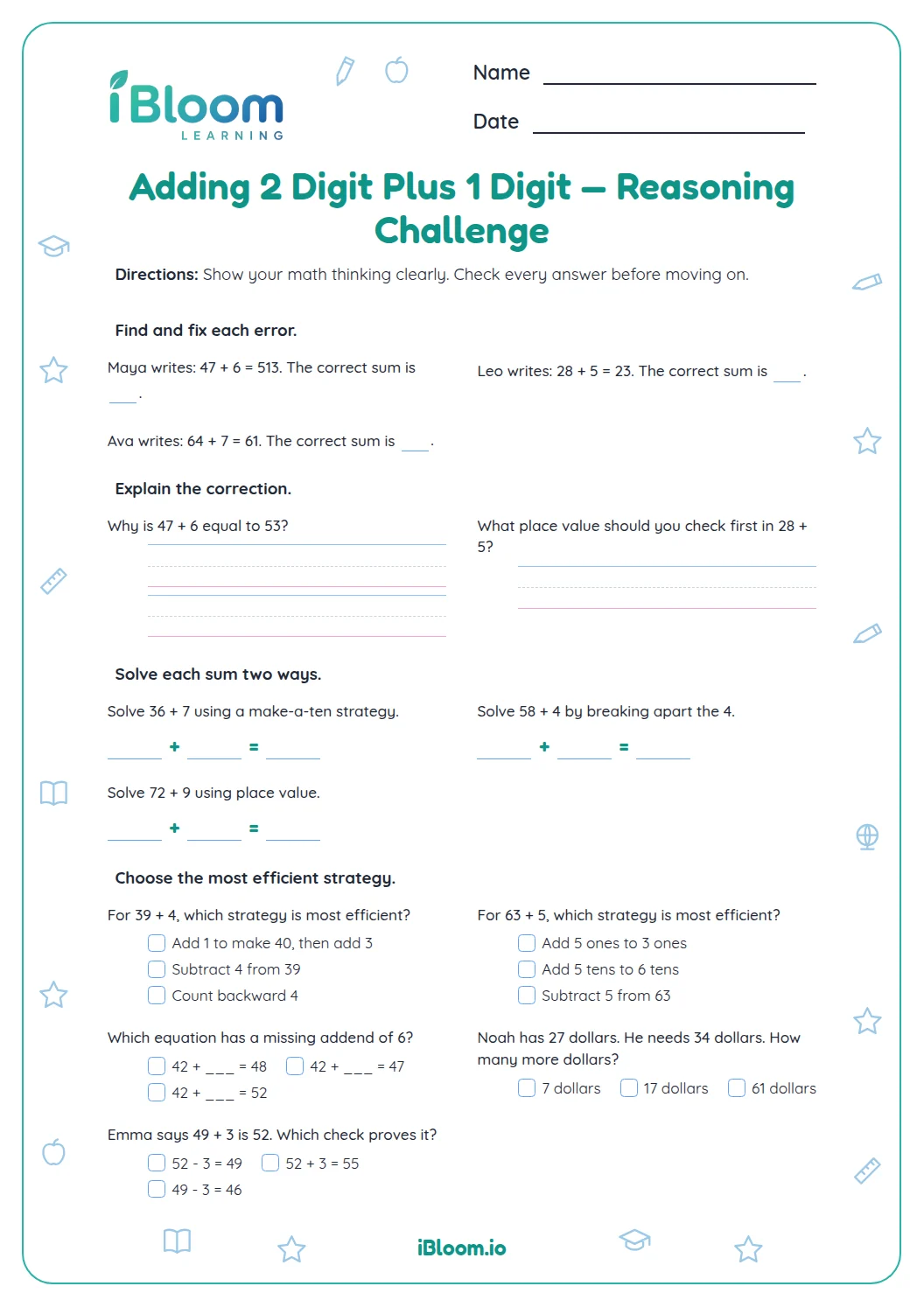
Writing 513 for 50 + 13.
The fix
Exchange ten of the thirteen ones for a ten: 6 tens and 3 ones make 63.
Common Core alignment
Add within 100 by combining ones and making a new ten when needed.
On this sheet: Children use tens and ones, make-ten steps, and addition stories to find sums within 100.
Show the official wordingHide the official wording
Fluently add and subtract within 100 using strategies based on place value, properties of operations, and/or the relationship between addition and subtraction.
What to practice next
Make more practice
Further reading
Questions parents and teachers ask
Does this sheet include regrouping?
Yes, children practice sums that cross a ten as well as sums that stay within one ten. The linked equations for 28 + 5 and 47 + 6 make the exchange visible. Later, 76 + 8 applies that thinking in a crayon story with working space.
What do the blocks in Part A mean?
Each long rod represents ten, and each small cube represents one. The blocks show the starting number before anything is added. Children then add the number of ones named in the prompt. For the first question, two rods and four cubes become 27 after adding three ones.
Why do three questions use the same sum?
The repeated sum separates the steps of making a ten. Children first find how many ones are needed, then identify the unused ones, and finally record the total. With 28 + 5, the answers 2, 3, and 33 describe three different jobs rather than three different sums.
Should children use column addition here?
Children may use column addition to check, but the printed sequence asks them to reason with tens and ones. Invite them to say what a regrouped ten represents. For 47 + 6, reaching 50 and adding three more connects a written method to the value of each digit.
How should I check the two word problems?
Check the number sentence, the total, and the unit. The bead story is 65 + 4 = 69 beads, and the crayon story is 76 + 8 = 84 crayons. If a total is wrong, ask the child to separate the starting tens and ones before trying again.