



About this worksheet
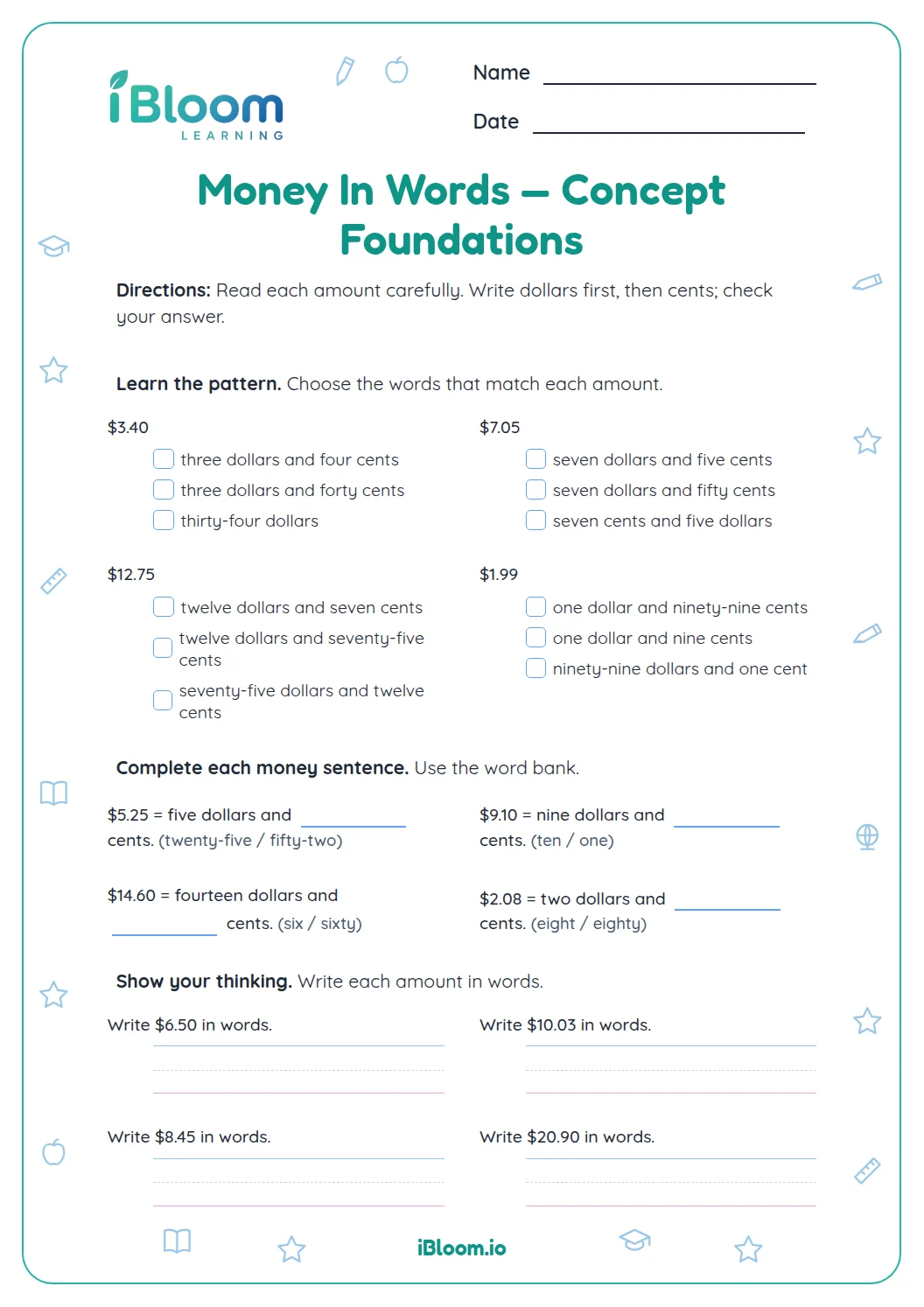
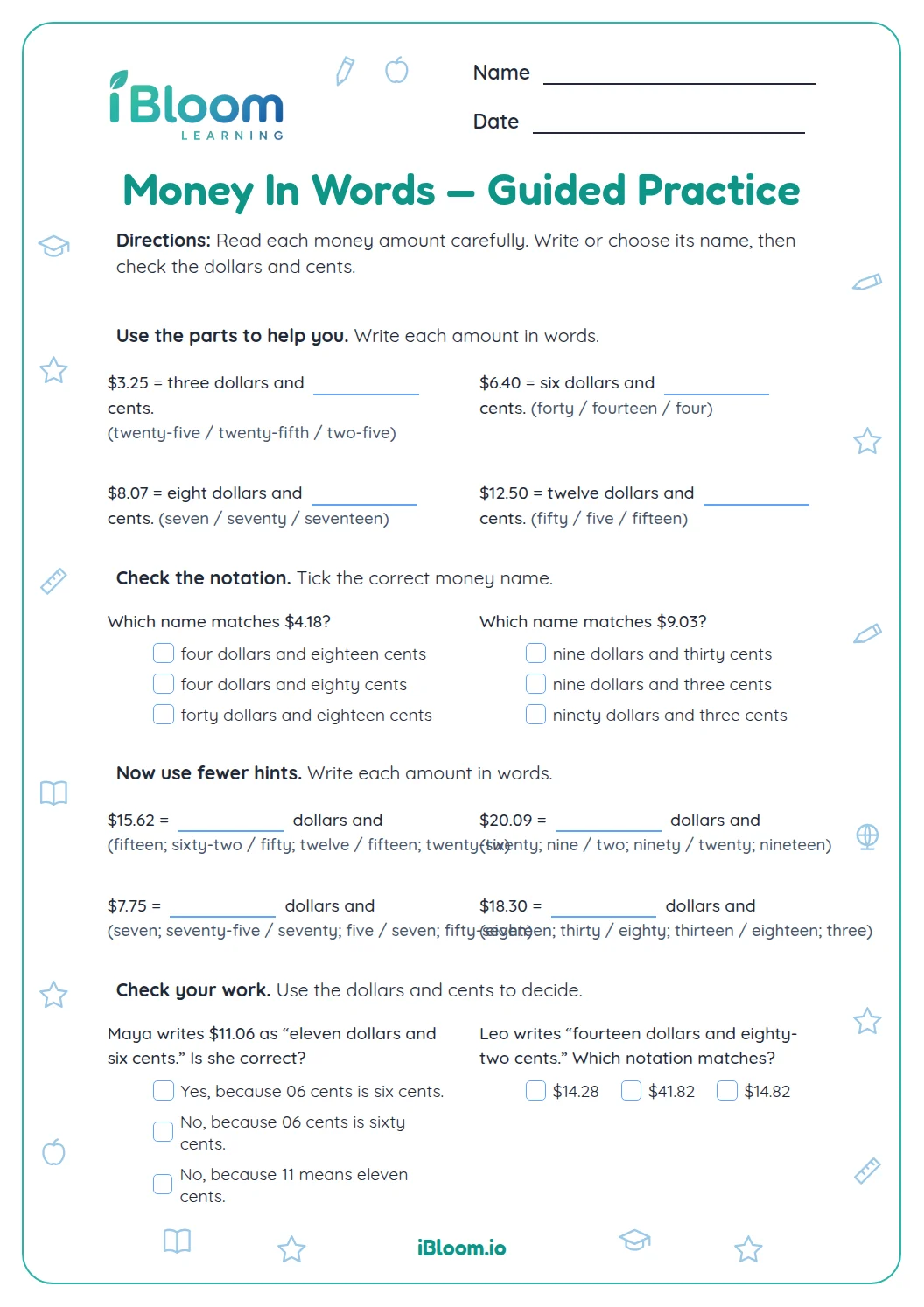
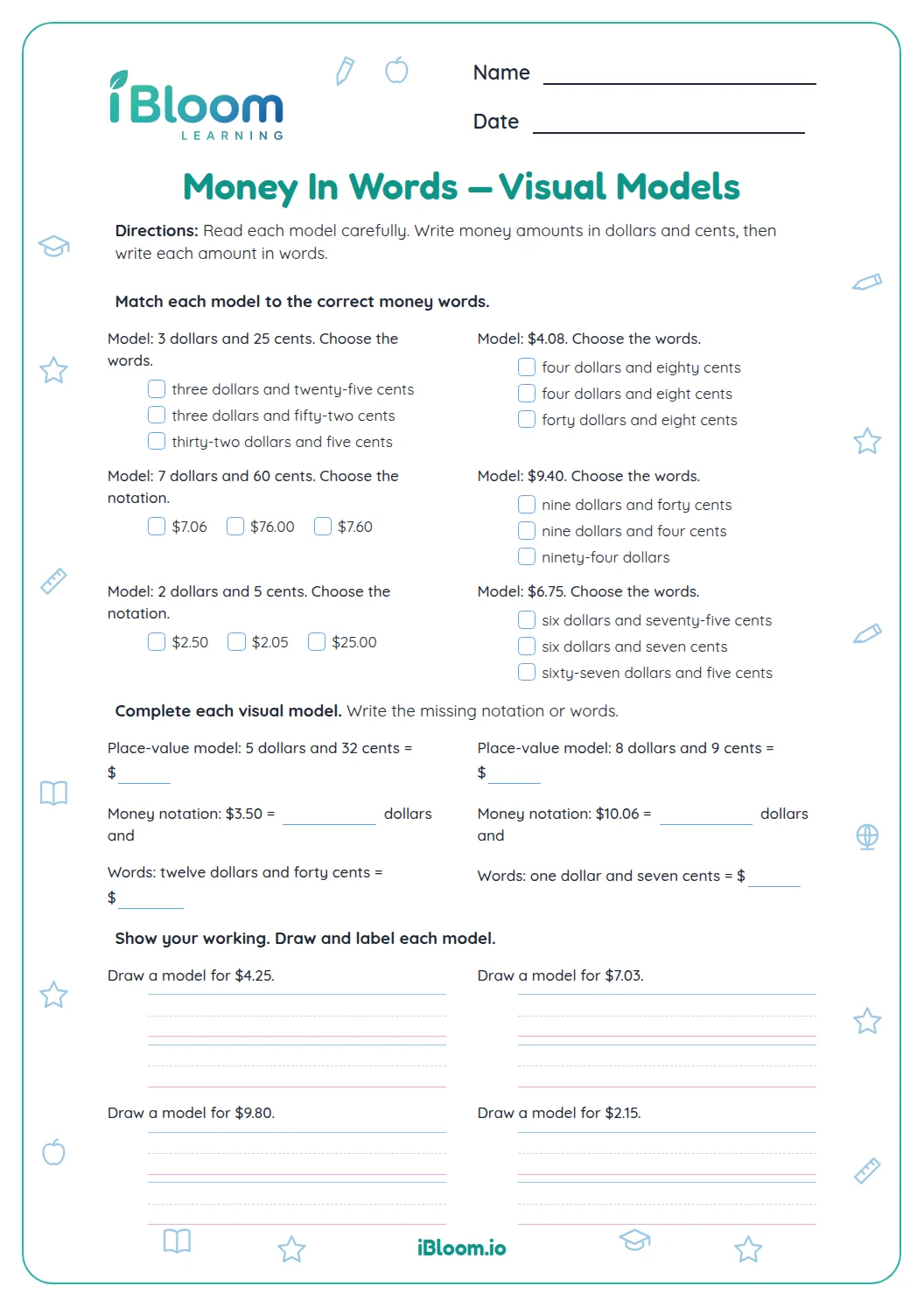
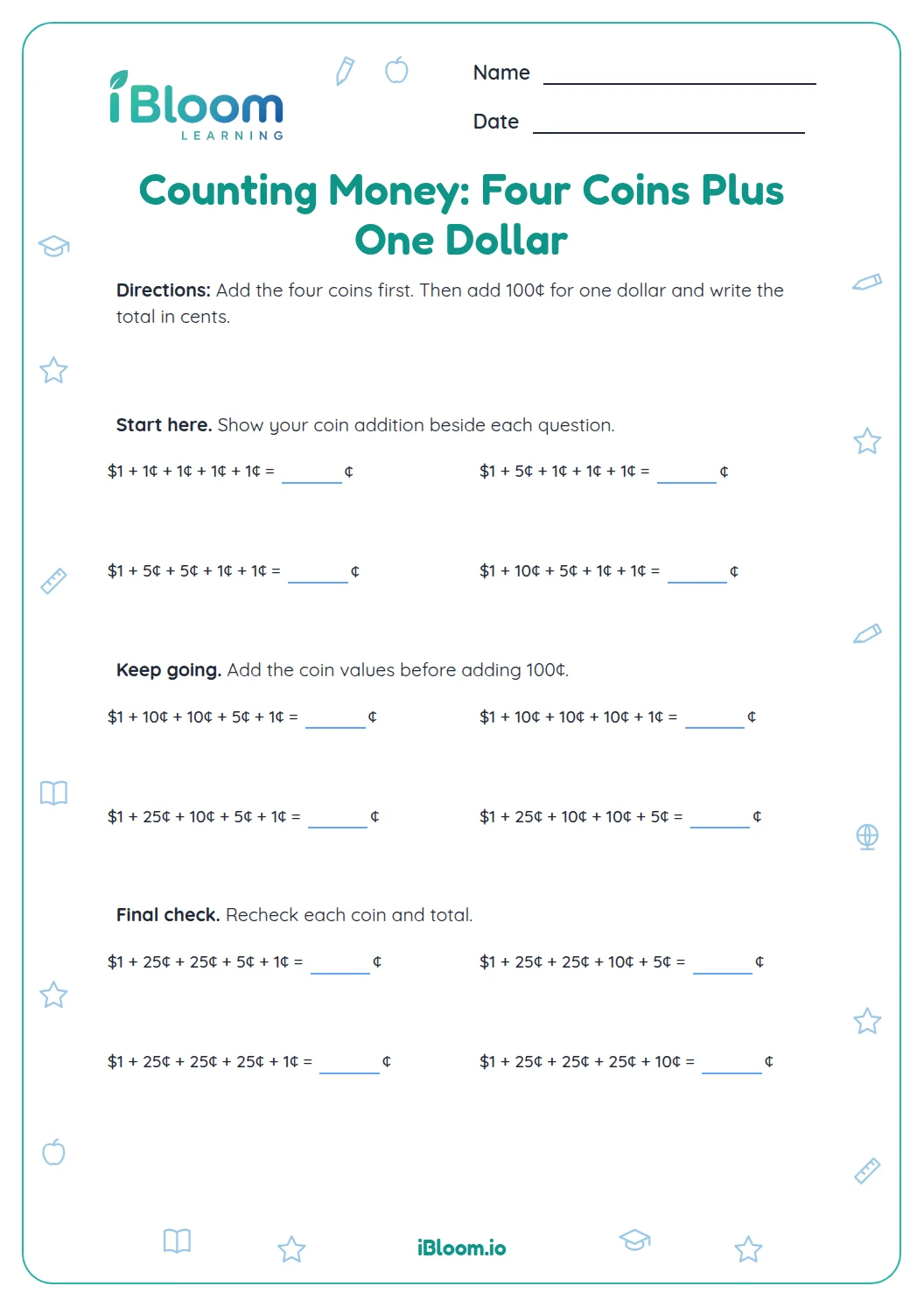
This Grade 3 printable connects money words with written amounts. Part A matches written dollar amounts to notation, Part B writes dollar-and-cent amounts in words, and Part C uses equations for four everyday price situations. The separate answer key shows the answers for all 14 questions.
Aligned to CCSS 2.MD.C.8
How do dollars and cents fit together?
A dollar amount has a dollars part and a cents part. In $6.05, the 6 names six dollars and 05 names five cents. The zero keeps the cents in the correct place.
When writing a dollar amount in words, say the dollars first and then the cents. Use “and” between the dollar and cent amounts, such as three dollars and twenty-five cents.
What should children do in the shopping problems?
Identify whether the story asks for a total, an amount remaining, or change. Add prices for a total and subtract the cost from the amount paid or held when finding what remains. Write an equation and give the result with a dollar sign and two cent digits.
How to use this worksheet
- 1Read the direction at the start of each part before answering.
- 2Work through Part A first, then try the later parts independently.
- 3Use the separate answer key to review each response and talk through any missed item.
Common mistakes and quick fixes
The mistake
Writing $6.5 for six dollars and five cents.
The fix
Use two digits for cents: $6.05.
The mistake
Adding prices when the question asks how much money remains.
The fix
Look for words such as “total,” “remains,” or “change” to choose the operation.
Curriculum alignment
This worksheet practices a foundational skill commonly taught in Grade 3.
Solve word problems involving dollar bills, quarters, dimes, nickels, and pennies, using $ and ¢ symbols.
On this sheet: The worksheet uses dollar notation and price stories as a simple application of money amounts.
Show the official wordingHide the official wording
Solve word problems involving dollar bills, quarters, dimes, nickels, and pennies, using $ and ¢ symbols appropriately.
What to practice next
Make more practice
Further reading
Questions parents and teachers ask
What money skills are practiced on this page?
Children translate written dollar amounts into money notation, write amounts in words, and use prices in short shopping situations. The problems include totals, money remaining, and change, so students must read what each situation asks before choosing an operation.
Why does an amount like $6.05 need a zero?
The two digits after the decimal point show cents. In $6.05, the zero keeps the five in the ones place of cents, so the amount is six dollars and five cents, not six dollars and fifty cents. This place value detail matters when reading, writing, and comparing money amounts.
How should a child find the total cost?
Add the listed prices and write the result with a dollar sign and two digits for cents. For a remaining amount or change, subtract the cost from the money the shopper has or pays. Encourage the child to estimate first, then check whether the answer makes sense.
Are coin conversions part of this worksheet?
No coin conversion is needed. The focus is reading and writing dollar amounts in words and numbers, then applying those amounts to everyday price stories. Children work with the amounts as written, so they can concentrate on notation and the meaning of the story.
What does the money answer key include?
The separate key lists the dollar notation for each word amount, the words for each dollar-and-cent amount, and the result of every shopping problem. For a missed equation, check whether the story asks for a total, remaining money, or change.